Sales Proposal Template: How to Win More Deals With Proven Frameworks
Modern B2B buyers expect professional, data-driven proposals that speak directly to their business challenges.
A well-crafted sales proposal template saves hours of manual work while ensuring consistency across your sales team.
According to Gartner, 61% of B2B buyers now prefer a rep-free buying experience, making self-service proposal documents more critical than ever.
Your proposal template needs to work harder in 2026, combining persuasive storytelling with the data buyers need to make decisions independently.
Whether you're an Account Executive closing enterprise deals or an SDR qualifying opportunities, the right template accelerates your sales funnel and improves win rates.
This guide shows you exactly how to build proposal templates that convert.

Find Quality Leads Faster With Apollo
Tired of slow lead generation killing your pipeline? Apollo delivers qualified prospects with 96% email accuracy and laser-focused targeting. Join 550K+ companies building predictable revenue.
Start Free with Apollo →Key Takeaways
- Sales proposal templates standardize your pitch while allowing personalization for each prospect's unique pain points
- Effective templates include executive summaries, ROI calculations, pricing tables, and clear next steps that drive decision-making
- AI-powered proposal automation integrated with CRM data cuts creation time by 70% while improving accuracy
- Self-service digital proposals address the growing preference for rep-free buying experiences in B2B
- Templates should emphasize measurable business outcomes over product features to align with modern buyer expectations
What Is A Sales Proposal Template?
A sales proposal template is a pre-formatted document framework that sales professionals use to present solutions, pricing, and value propositions to potential customers.
It provides a consistent structure while allowing customization for each prospect's specific business context and requirements.
The template serves as your sales team's standardized starting point, ensuring every proposal includes essential elements like problem statements, solution details, pricing breakdowns, implementation timelines, and success metrics.
For Account Executives managing complex enterprise deals, templates maintain professional consistency while dramatically reducing document creation time.
Modern templates go beyond static PDFs.
They incorporate dynamic pricing calculators, interactive ROI models, and CRM-integrated data that automatically populates prospect information.
Research by McKinsey shows that one in five B2B decision-makers now spend between $500,000 and $5 million on remote or self-service transactions, making digital-first proposal experiences essential.
Why Do Sales Teams Need Proposal Templates?
Sales teams need proposal templates because they eliminate redundant work, ensure brand consistency, and accelerate deal velocity.
Without templates, sales reps waste 15-20 hours per week recreating documents from scratch, leading to inconsistent messaging and slower response times.
Templates solve three critical problems:
- Speed to market: Reps respond to RFPs and inbound requests 3-5x faster with pre-built frameworks
- Quality control: Legal-approved language and consistent value propositions reduce compliance risks
- Onboarding efficiency: New SDRs and AEs ramp faster when they have proven proposal structures to follow
For Sales Leaders managing distributed teams, templates provide visibility into what messaging resonates.
You can A/B test different approaches, track which sections buyers engage with most, and continuously optimize based on win rate data.
Struggling to maintain consistency across your sales org? Centralize your deal management and proposal workflows in Apollo to ensure every rep follows your proven playbook.
What Should Be Included In A Sales Proposal Template?
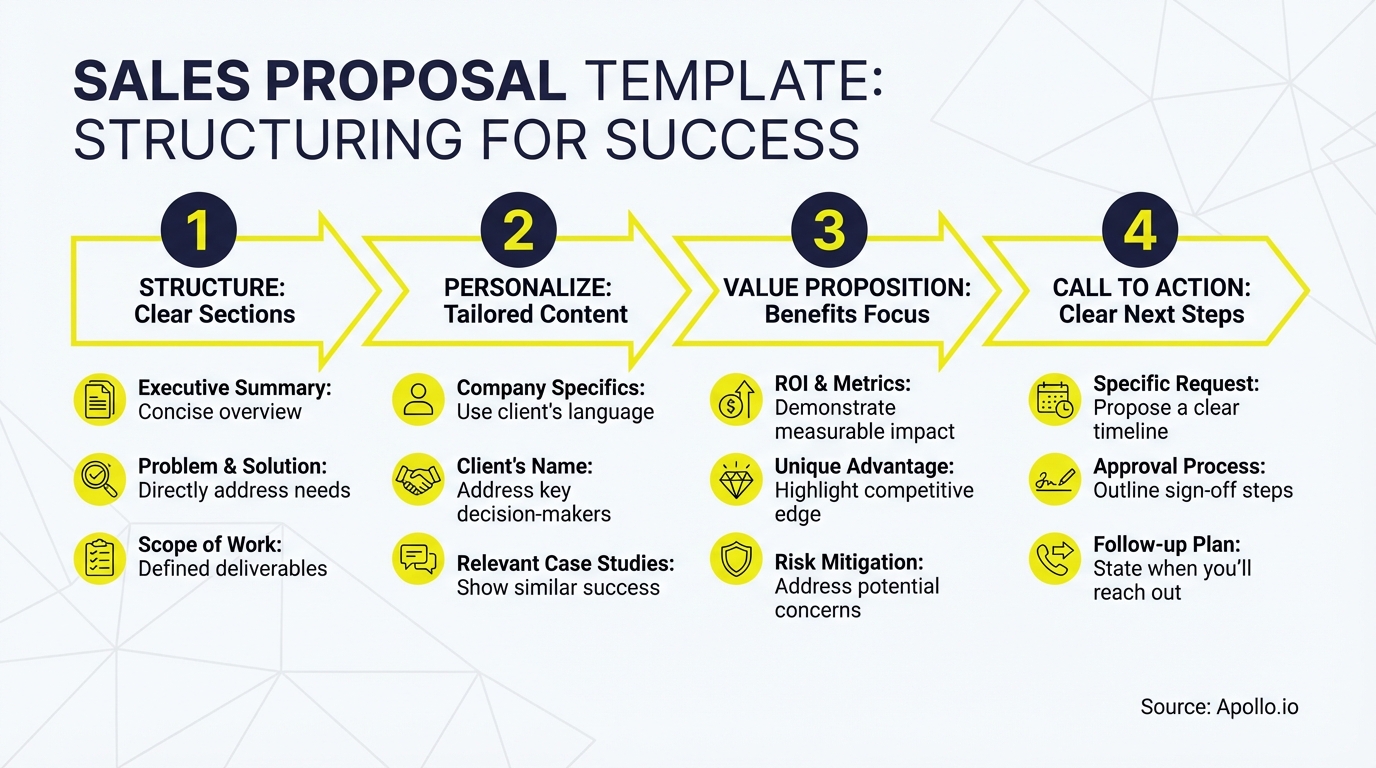
A comprehensive sales proposal template includes eight essential components that guide prospects from problem recognition through purchase decision.
Each section serves a specific purpose in building buyer confidence and addressing objections.
| Section | Purpose | Key Elements |
|---|---|---|
| Executive Summary | Hook decision-makers with business impact | Problem statement, solution overview, ROI snapshot |
| Company Overview | Establish credibility and expertise | Mission, client logos, relevant case studies |
| Problem Analysis | Demonstrate understanding of buyer challenges | Current state assessment, cost of inaction, pain points |
| Proposed Solution | Show how you solve their specific problems | Product/service details, implementation approach, timeline |
| Pricing & Packages | Provide transparent cost breakdown | Tiered options, line items, payment terms |
| ROI & Business Case | Quantify financial impact | Cost savings, revenue uplift, payback period |
| Success Stories | Reduce perceived risk with social proof | Customer testimonials, metrics, industry-specific wins |
| Next Steps & Terms | Create clear path to close | Implementation milestones, contract terms, signature block |
The most effective templates prioritize buyer outcomes over product features.
Instead of listing capabilities, connect each feature to a measurable business result.
For example, rather than "24/7 customer support," write "Reduce system downtime by 40% with around-the-clock technical assistance."
Turn Forecast Guesswork Into Revenue Certainty
Pipeline forecasting a guessing game? Apollo delivers real-time deal visibility and intent signals so you can predict revenue with confidence. Built-In improved win rates 10% with Apollo's scoring.
Start Free with Apollo →How Do Account Executives Personalize Proposal Templates?
Account Executives personalize proposal templates by incorporating prospect-specific research, customizing case studies to match the buyer's industry, and tailoring ROI calculations to reflect their actual business metrics.
Generic proposals fail; personalization drives 35% higher win rates.
Start with discovery call insights. Reference specific challenges the prospect mentioned, quote their exact language around pain points, and align your solution sections to their stated priorities.
If they emphasized "reducing customer churn," lead with retention-focused benefits rather than acquisition features.

Smart AEs layer in three personalization types:
- Company context: Industry benchmarks, competitive landscape, relevant regulatory considerations
- Stakeholder alignment: Different value props for economic buyers vs. technical evaluators
- Proof points: Case studies from similar company sizes, industries, or use cases
Modern sales teams leverage AI-powered tools to automate personalization at scale.
Instead of manually researching each account, platforms pull firmographic data, recent news, and buying signals directly into proposal templates.
This approach combines the efficiency of templates with the impact of bespoke documents.

For enterprise deals involving multiple stakeholders, create role-specific proposal versions.
CFOs need financial justification and risk mitigation.
IT leaders want technical specifications and integration details.
End users care about usability and training support.
Your template should flex to address each persona's unique concerns while maintaining a consistent core message.
Learn how top performers structure their outreach with our sales email templates guide.
How Can Sales Teams Automate Proposal Creation?
Sales teams automate proposal creation by integrating templates with CRM systems, using AI to populate prospect data, and implementing approval workflows that eliminate manual handoffs.
Automation reduces proposal creation time from 8 hours to under 90 minutes.
The automation workflow follows four steps:
- Data integration: Pull contact details, company info, and deal history directly from your CRM into proposal fields
- Content generation: Use AI to draft personalized problem statements and solution descriptions based on discovery notes
- Dynamic pricing: Auto-calculate quotes based on product selections, discount rules, and contract terms
- Approval routing: Trigger manager review for deals above threshold values or non-standard terms
RevOps leaders report 70% time savings when they connect proposal tools to their existing tech stack. Instead of juggling separate systems for data enrichment, document creation, and e-signature, unified platforms handle the entire workflow.
Census, an Apollo customer, noted they "cut costs in half" by consolidating multiple tools into one workspace.
Spending hours copying data between systems? Automate your entire proposal workflow with Apollo's AI-powered platform and reclaim 15+ hours per week for actual selling.
Look for automation platforms that offer version control, analytics tracking, and collaboration features. You need visibility into which proposals get opened, which sections receive the most attention, and where prospects drop off.
This data informs continuous template optimization and helps you identify winning patterns across your sales organization.
What Are Common Sales Proposal Template Mistakes?
Common sales proposal template mistakes include leading with company history instead of buyer problems, using generic value propositions that don't address specific pain points, and burying pricing information that buyers actively seek.
These errors cost you deals before prospects finish reading.
The five most damaging template mistakes:
- Feature dumping: Listing product capabilities without connecting them to business outcomes
- One-size-fits-all messaging: Using identical language for different industries, company sizes, or buyer personas
- Weak ROI justification: Vague claims about "increased efficiency" without hard numbers or timeframes
- Poor visual hierarchy: Dense text blocks that overwhelm readers instead of scannable sections with clear headings
- Unclear next steps: Ending without explicit calls-to-action or defined implementation milestones
Many templates also fail the "so what?" test.
After each benefit statement, ask yourself: "So what does this mean for the buyer's business?" If you can't articulate tangible impact, rewrite the section.
Instead of "Our platform includes advanced analytics," write "Identify your top 20% of customers driving 80% of revenue, then replicate their profile to prioritize high-value prospects."
Another critical mistake: ignoring mobile optimization.
Data from Forrester shows 86% of B2B purchases stall during the buying process, often because stakeholders can't easily review materials on mobile devices.
Ensure your templates render properly on phones and tablets, with responsive tables and appropriately sized fonts.
How Do You Measure Proposal Template Performance?
You measure proposal template performance by tracking open rates, time spent per section, conversion rates from proposal sent to closed-won, and average deal size compared to forecast.
These metrics reveal which templates drive revenue and which need optimization.
Establish baseline KPIs across three categories:
- Engagement metrics: Open rate, pages viewed, return visits, time-on-page by section
- Conversion metrics: Proposal-to-meeting rate, proposal-to-close rate, average sales cycle length
- Revenue metrics: Average deal size, discount frequency, upsell attachment rate
Sales Leaders should run A/B tests on high-impact sections. Try different executive summary approaches, pricing presentation formats, and case study selections.
Track which variations produce higher conversion rates, then standardize winning elements across all templates.
Modern proposal platforms provide heatmaps showing exactly where prospects spend time.
If buyers consistently skip your company overview but linger on ROI calculations, restructure your template to lead with financial impact.
This data-driven approach removes guesswork from template design.
Compare template performance across segments.
What works for SMB deals may not resonate with enterprise buyers.
SDRs qualifying early-stage opportunities need different templates than AEs closing six-figure contracts.
Build separate templates for each use case, then measure which ones deliver the highest win rates and shortest sales cycles.
Discover how leading teams structure their entire sales process in our HubSpot sales playbook breakdown.
Start Closing More Deals With Better Proposals
Sales proposal templates transform from time-consuming documents into revenue-generating assets when you combine structured frameworks with AI-powered personalization and CRM integration.
The most successful sales teams in 2026 use templates that adapt to buyer preferences, automate repetitive tasks, and provide the self-service experience modern B2B buyers demand.
Focus on buyer outcomes over product features, back every claim with quantifiable ROI, and continuously optimize based on engagement data.
Your template should answer the prospect's core question within the first two paragraphs: "Why should we choose you, and what specific results will we achieve?"
Apollo's all-in-one GTM platform helps Account Executives, SDRs, and Sales Leaders consolidate their entire sales workflow into one workspace. From prospect research and outreach automation to deal management and proposal tracking, you get everything you need without juggling multiple tools.
As Cyera's sales team put it: "Having everything in one system was a game changer."
Ready to cut your tech stack and accelerate your sales cycle? Schedule a Demo to see how Apollo's 224M+ verified contacts, AI-powered workflows, and unified platform help sales teams close more deals with less complexity.
Prove Apollo's ROI In Your First 30 Days
Budget approval stuck on unclear metrics? Apollo delivers measurable pipeline impact from day one—track time saved, meetings booked, and revenue generated. Built-In increased win rates 10% and ACV 10% with Apollo's data-driven approach.
Start Free with Apollo →Don't miss these
Sales
Inbound vs Outbound Marketing: Which Strategy Wins?
Sales
What Is a Sales Funnel? The Non-Linear Revenue Framework for 2026
Sales
What Is a Go-to-Market Strategy? The 2026 GTM Playbook
See Apollo in action
We'd love to show how Apollo can help you sell better.
By submitting this form, you will receive information, tips, and promotions from Apollo. To learn more, see our Privacy Statement.
4.7/5 based on 9,690 reviews
