
What Is Sales Productivity? The 2026 Blueprint for Revenue Growth
Sales productivity is the measure of how efficiently your team converts time, effort, and resources into revenue. It is not simply about working more hours. It is about eliminating the friction that keeps reps from selling. According to Mindtickle, sales reps spend a mere 28% of their week actively selling, with administrative tasks consuming nearly half the workweek. That gap between capacity and output is where revenue is lost.
The stakes are high. A 2024 B2B benchmark report found that up to 70% of B2B sales representatives missed their annual quota, meaning only 30% hit their target. Fixing sales productivity is not a nice-to-have. It is a survival imperative.

Get Verified Contacts, Skip the Research
Tired of your reps burning hours hunting down emails that bounce? Apollo delivers 96% accurate contact data so your team spends time selling, not searching. Join 550K+ companies turning research time into revenue.
Start Free with Apollo →Key Takeaways
- Sales reps spend less than a third of their week on actual selling — administrative overhead is the primary productivity killer.
- Quota attainment is at a critical low, with only 30% of B2B reps hitting annual targets in 2024.
- A digital-first buying environment means reps need better tools, data, and content to engage buyers who prefer self-serve channels.
- The fastest path to higher productivity is eliminating tool sprawl and consolidating prospecting, engagement, and analytics into one platform.
- Measuring the right KPIs — not just top-of-funnel volume — is what separates teams that improve from teams that stagnate.
Why Sales Productivity Is at a Breaking Point in 2026
Three forces are converging to make productivity harder than ever. First, B2B buying has gone digital. According to Trinity42, 80% of B2B sales interactions are expected to occur in digital channels. Buyers research, evaluate, and often decide before speaking to a rep. Reps who rely on outdated outreach methods are invisible to these buyers.
Second, deal cycles are lengthening. Data from Databox shows the average time to close a B2B deal was approximately 69 days. Longer cycles mean more touchpoints, more stakeholders, and more opportunities for deals to stall.
Third, tool sprawl is fragmenting rep attention. When reps toggle between a CRM, a data platform, a sequencer, and a dialer, they lose time to context-switching rather than closing.
The solution is consolidation, not addition.
What Are the Core Components of Sales Productivity?
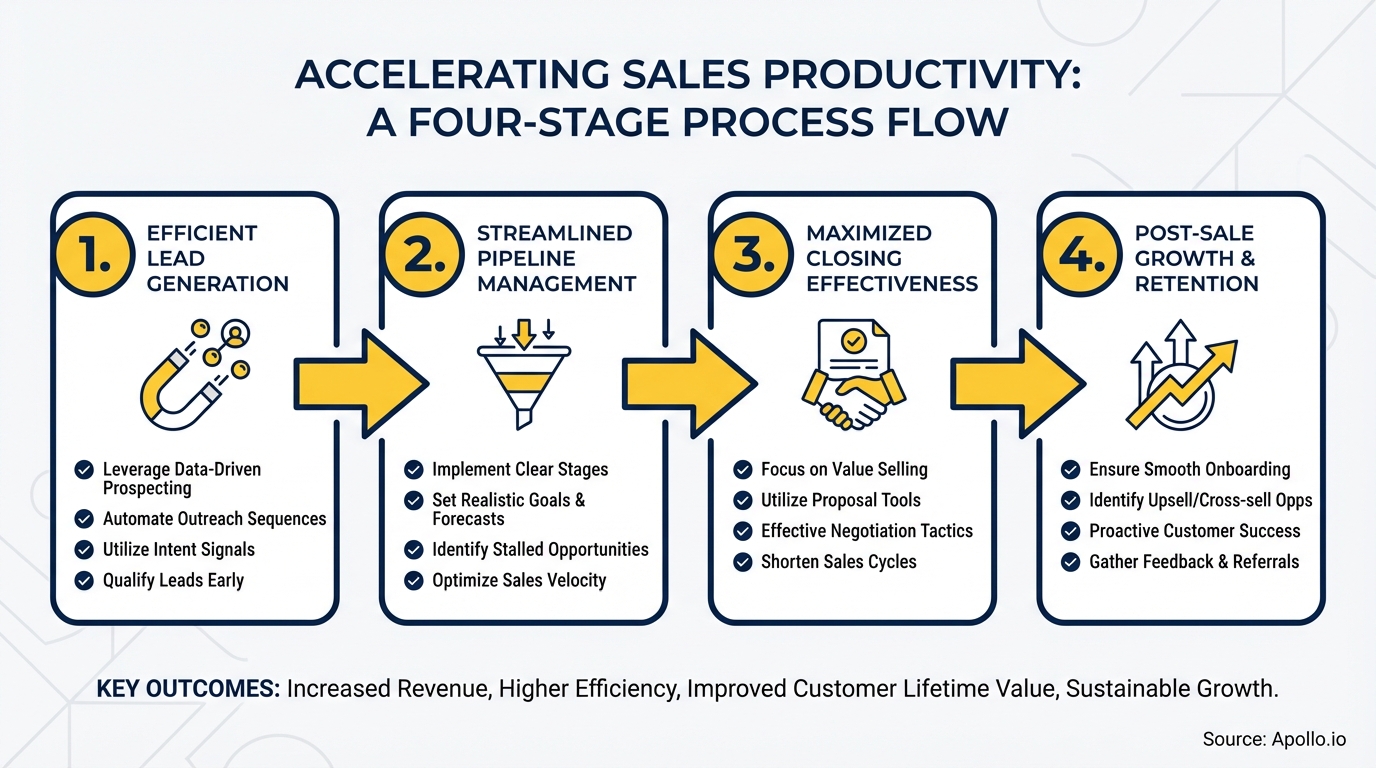
Sales productivity breaks down into four interconnected levers. Improving all four compounds results faster than optimizing any single area.
| Component | What It Covers | Primary Bottleneck |
|---|---|---|
| Time Allocation | Ratio of selling time vs. admin time | Manual data entry, CRM updates, scheduling |
| Pipeline Quality | ICP fit, deal stage accuracy, forecast reliability | Poor prospecting filters, stale contact data |
| Engagement Effectiveness | Open rates, reply rates, connect rates, meeting bookings | Generic messaging, single-channel outreach |
| Deal Velocity | Time from first touch to closed-won | Missing stakeholders, slow follow-up, no deal intelligence |
Understanding which lever is weakest in your org is the starting point. Most teams have a pipeline quality or time allocation problem — not a skills problem.

How Does Technology Consolidation Drive Sales Productivity?
The fastest productivity gains come from reducing how many tools reps must use to complete a single workflow. When prospecting data, outreach sequences, dialers, and pipeline tracking live in separate platforms, reps waste significant time on coordination rather than selling.
"The thing that made me most excited as somebody who's been in sales development a long time was Apollo's integration between sales data and sales engagement and the magic that you can make happen when those two are together on the same platform."
Consolidating your sales tech stack into a unified platform means reps can find a contact, verify their data, build a sequence, and track engagement without switching tabs. That compounding efficiency is what moves the needle on quota attainment. Spending hours on manual prospecting and outreach? Automate your sequences with Apollo and reclaim that selling time.
The right AI sales tools also reduce the administrative load that drains rep capacity. AI-assisted call summaries, automated CRM updates, and smart follow-up suggestions eliminate the work-about-work that keeps reps from selling.
Turn Blind Forecasts Into Clarity
Pipeline forecasting a guessing game? Apollo surfaces real-time deal signals so your team stops flying blind and starts calling shots with confidence. Join 90K paying customers who've made guesswork obsolete.
Schedule a Demo →What Are the Key Sales Productivity Metrics to Track?
Tracking the right sales KPIs is what separates teams that improve from those that guess. Focus on metrics that connect directly to revenue outcomes, not just activity volume.
| Metric | What It Measures | Why It Matters |
|---|---|---|
| Selling Time % | Hours in selling activities vs. total hours | Baseline for identifying admin drag |
| Quota Attainment Rate | % of reps hitting quota | Team-level health signal |
| Pipeline Coverage Ratio | Pipeline value vs. quota | Forecasting accuracy |
| Deal Cycle Length | Days from first touch to close | Identifies process bottlenecks |
| Meeting-to-Opportunity Rate | % of booked meetings that become opps | Measures ICP targeting quality |
| Win Rate by Stage | % of deals advancing at each stage | Pinpoints where deals stall |
Pair these metrics with sales analytics dashboards that update in real time. Static spreadsheets reviewed monthly are too slow to surface the patterns that drive coaching decisions.
The 30/60/90 Day Sales Productivity Improvement Playbook
A structured rollout prevents the two most common failure modes: doing everything at once, and doing nothing systematically. Use this framework to sequence improvements for maximum impact.

Days 1–30: Diagnose and Baseline
- Audit how reps currently spend their time across selling, admin, research, and internal meetings.
- Identify the top three administrative tasks consuming the most hours per week.
- Benchmark current quota attainment, deal cycle length, and pipeline coverage.
- Evaluate tech stack for overlap, gaps, and integration friction.
- Owner: RevOps + Sales Leadership. Output: Productivity baseline scorecard.
Days 31–60: Eliminate Friction
- Consolidate prospecting and engagement into a single platform to eliminate tool-switching.
- Deploy automated CRM data entry and sequence enrollment triggers.
- Build standardized outreach templates that reps can personalize in under two minutes.
- Launch a sales automation workflow for lead routing, follow-up reminders, and stage progression.
- Owner: RevOps + Enablement. Output: Measurable reduction in admin hours per rep per week.
Days 61–90: Optimize and Scale
- Review pipeline data to identify the highest-converting ICP segments and reallocate rep focus.
- Introduce AI-assisted personalization for outreach at scale.
- Run coaching cycles using call recording and conversation intelligence data.
- Establish a weekly productivity review cadence tied to KPI dashboards.
- Owner: Sales Leadership. Output: Improved quota attainment rate and shortened deal cycle.
How Does Revenue Operations Accelerate Sales Productivity?
Revenue Operations functions as the connective tissue between marketing, sales, and customer success. When RevOps aligns data, processes, and tooling across those functions, reps spend less time hunting for information and more time using it. According to Corefactors, organizations with RevOps grow revenue nearly three times faster than non-adopters.
The highest-impact RevOps actions for sales productivity include: building a single source of truth for contact and account data, creating automated pipeline hygiene rules that flag stale deals, and embedding enablement content directly into CRM workflows so reps access it at the moment of need.
"Having Apollo and having everything be in one system was a game changer — for BDRs specifically."
Struggling to keep your pipeline clean and moving? Build and manage your pipeline with Apollo's AI-powered tools and give your RevOps team the data they need to make faster decisions.
What Separates High-Productivity Sales Teams from Average Ones?
The difference is not talent. It is systems. Everstage reports that only 15% of sales teams had more than half their reps achieving at least 80% of their quota. The teams in that 15% share three characteristics: they measure selling time and protect it aggressively, they use verified contact data to eliminate wasted outreach, and they run structured coaching cycles tied to deal-level data rather than gut feel.
High-productivity teams also treat their deal management process as a living system. They review pipeline weekly, update stage criteria based on win/loss patterns, and use conversation intelligence to replicate what top reps do differently on calls.
For teams pursuing larger deals, enterprise sales strategies require additional discipline around multi-stakeholder mapping and executive engagement cadences. The productivity principles are the same; the complexity is higher.
Conclusion: Build a Productivity System, Not a Productivity Initiative
Sales productivity improvement fails when it is treated as a one-time project. The teams that sustain gains treat it as an operating system: continuous measurement, regular coaching, automated workflows, and a unified platform that keeps data and engagement in one place.
The core formula is straightforward. Protect selling time by automating admin.
Improve pipeline quality with verified data and tighter ICP targeting. Accelerate deals with better conversation intelligence and faster follow-up.
Measure what matters and cut what does not.
Apollo brings all of these levers into a single workspace — from prospecting and outreach to call intelligence and pipeline management. Over 90,000 paying customers use Apollo to build more pipeline and close deals faster.
Ready to reclaim your team's selling time? Start a free trial with Apollo and see how a unified go-to-market platform changes what your team can accomplish.
Prove Pipeline ROI From Day One
Budget approval stuck on unclear metrics? Apollo delivers measurable pipeline impact fast — so your team justifies every dollar with confidence. Leadium 3x'd their revenue. Your ROI story starts now.
Start Free with Apollo →Don't miss these
Sales
Inbound vs Outbound Marketing: Which Strategy Wins?
Sales
What Is a Sales Funnel? The Non-Linear Revenue Framework for 2026
Sales
What Is a Go-to-Market Strategy? The 2026 GTM Playbook
See Apollo in action
We'd love to show how Apollo can help you sell better.
By submitting this form, you will receive information, tips, and promotions from Apollo. To learn more, see our Privacy Statement.
4.7/5 based on 9,690 reviews
