Sales Process Steps: A Complete Guide to Closing More Deals
Modern B2B sales requires more than intuition and hustle. In 2026, Gartner confirms that 60% of sales organizations now operate with data-driven processes integrating applications, analytics, and unified workflows. Whether you're an SDR building pipeline or a sales leader scaling your team, understanding the core sales process steps creates consistency, predictability, and revenue growth.

Eliminate 4+ Hours Of Daily Research Work
Finding accurate emails and phone numbers takes forever. Apollo delivers 224M+ verified contacts with 96% email accuracy instantly. Join 550K+ companies who replaced manual research with predictable pipeline.
Start Free with Apollo →Key Takeaways
- Modern sales process steps blend data-driven prospecting with hybrid digital and human touchpoints for maximum conversion
- SDRs and AEs using structured processes with automation book 46% more meetings and close deals 35% faster
- Consolidating tools into one platform cuts costs in half while improving visibility across every process step
- Buyer teams now prefer self-service options, requiring sellers to design processes supporting both rep-led and digital-first journeys
- Implementation roadmaps with 30/60/90-day milestones ensure teams adopt new process steps without disrupting current pipeline
What Are Sales Process Steps?
Sales process steps are the repeatable, measurable stages that move prospects from initial awareness to closed deals. These steps create a framework guiding B2B sales teams through prospecting, qualification, presentation, negotiation, and closing. Unlike ad-hoc selling, structured process steps enable forecasting, coaching, and optimization.
In 2026, effective sales process steps integrate three critical elements: data-driven targeting, hybrid engagement channels, and buyer-centric collaboration. Research by McKinsey shows hybrid selling combining remote, digital, and in-person channels now dominates as the most successful strategy.
Why Do Sales Process Steps Matter for SDRs and AEs?
Structured process steps directly impact quota attainment and deal velocity. SDRs using defined prospecting and qualification steps identify higher-quality leads faster.
AEs following consistent discovery and closing steps shorten sales cycles by eliminating guesswork.

For sales leaders, documented process steps enable accurate forecasting and targeted coaching. RevOps teams gain visibility into conversion rates at each stage, identifying bottlenecks and optimization opportunities.
Founders scaling outbound teams replicate success by codifying what works into repeatable steps.
Struggling to find qualified leads? Search Apollo's 224M+ contacts with 65+ filters to build targeted lists in minutes.
What Are the Core Sales Process Steps in 2026?
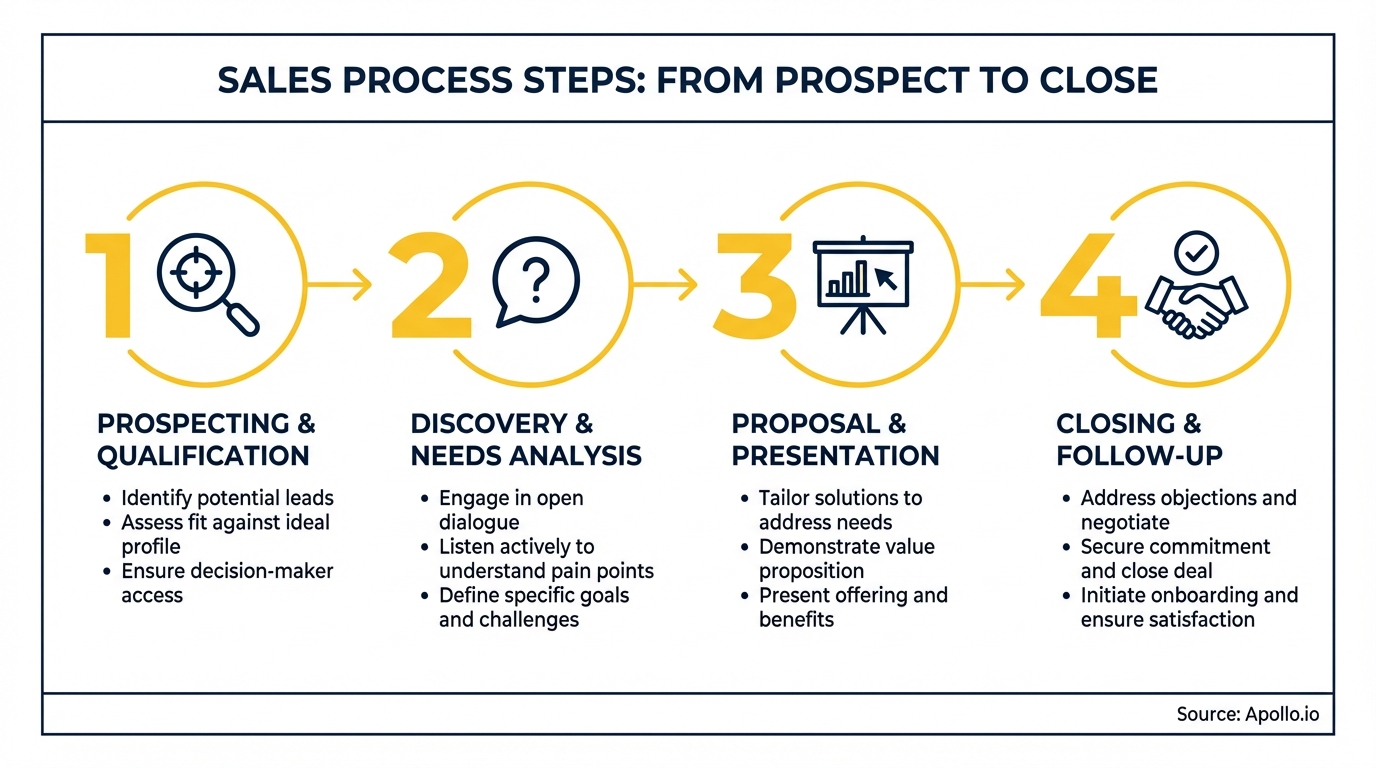
Modern sales process steps adapt traditional frameworks for today's data-driven, hybrid buying environment. Here are the seven core stages:

| Process Step | Primary Activities | Key Metrics | Tools Required |
|---|---|---|---|
| 1. Prospecting & Research | Identify target accounts, gather contact data, enrich with firmographics and technographics | Contacts sourced, list quality score, data accuracy rate | Contact database, enrichment platform, intent signals |
| 2. Initial Outreach | Multi-channel engagement via email, phone, LinkedIn, and video | Response rate, meeting booking rate, channel effectiveness | Sales engagement platform, dialer, email automation |
| 3. Qualification & Discovery | Assess fit using BANT/MEDDIC, uncover pain points, identify stakeholders | Qualification pass rate, discovery call completion, budget confirmed | Call recording, conversation intelligence, CRM |
| 4. Solution Presentation | Deliver tailored demos, share case studies, address technical questions | Demo completion rate, technical validation, champion identified | Presentation software, screen sharing, mutual action plans |
| 5. Proposal & Negotiation | Present pricing, handle objections, negotiate terms, engage procurement | Proposal acceptance rate, discount levels, negotiation cycle time | CPQ software, contract management, e-signature |
| 6. Closing | Finalize agreements, secure signatures, coordinate implementation kickoff | Close rate, average deal size, sales cycle length | Deal management platform, document storage, handoff workflows |
| 7. Post-Sale & Expansion | Onboard customers, track adoption, identify upsell opportunities | Net revenue retention, expansion revenue, customer health score | Customer success platform, usage analytics, renewal tracking |
Each step requires specific data inputs, actions, and success criteria. Top-performing teams document decision criteria and exit requirements for every stage, ensuring consistency across reps.
Turn Forecast Guesswork Into Revenue Certainty
Pipeline forecasting a guessing game? Apollo delivers real-time deal visibility and intent signals that make every forecast reliable. Built-In increased win rates 10% with Apollo's scoring and guidance.
Start Free with Apollo →How Do SDRs Execute Early-Stage Process Steps?
SDRs own the first two process steps (prospecting and initial outreach) and set the foundation for everything downstream. Success requires balancing volume with personalization.
Prospecting best practices for SDRs:
- Build targeted account lists using firmographics (company size, industry, revenue) and technographics (current tech stack)
- Enrich contacts with verified email addresses, direct dial numbers, and job change alerts
- Layer intent signals showing active research or buying behavior
- Prioritize accounts matching your ideal customer profile (ICP)
Outreach execution for SDRs:
- Sequence multi-channel touches: email, phone, LinkedIn, video
- Personalize opening lines using research insights and trigger events
- Test messaging variations and track what drives responses
- Follow up persistently (7-10 touches) without being pushy
SDRs using Apollo report booking 46% more meetings by combining verified contact data with AI-powered message generation and automated follow-up sequences.
How Do Account Executives Manage Mid-Stage Process Steps?
AEs take over at qualification and guide prospects through discovery, presentation, and negotiation. These middle stages determine deal quality and forecast accuracy.
Discovery and qualification tactics:
- Use frameworks like MEDDIC (Metrics, Economic Buyer, Decision Criteria, Decision Process, Identify Pain, Champion) to assess deal viability
- Ask open-ended questions uncovering business impact, not just feature requirements
- Map the full buying committee and understand each stakeholder's priorities
- Confirm budget, timeline, and decision-making authority early
Presentation and proposal best practices:
- Tailor demos to specific pain points discussed in discovery
- Share relevant customer success stories matching their industry and use case
- Create mutual action plans with clear next steps and ownership
- Address technical and procurement concerns proactively
For Account Executives managing complex deals, Apollo's deal management platform provides complete visibility into stakeholder engagement, next actions, and deal health across your entire pipeline.
What Tools Support Modern Sales Process Steps?
In 2026, the average sales team uses 10+ disconnected tools creating data silos and workflow friction. Top performers consolidate their tech stack into unified platforms.
Essential capabilities by process step:
- Prospecting: Contact database (224M+ records), advanced search filters, data enrichment, intent signals
- Outreach: Multi-channel sequences, email deliverability, call recording, activity tracking
- Qualification: Conversation intelligence, call transcription, CRM integration, scoring models
- Presentation: Screen sharing, demo environments, mutual action plans, follow-up automation
- Closing:Pipeline visibility, forecast accuracy, contract management, e-signature
Tool consolidation benefits: Census cut their costs in half by replacing multiple point solutions with a unified platform. Cyera's sales leader noted that "having everything in one system was a game changer" for team adoption and data accuracy. Predictable Revenue reduced the complexity of three separate tools into one workspace.
Modern sales tech stacks prioritize integration, eliminating manual data entry and ensuring every process step flows seamlessly into the next.
How Can Sales Leaders Implement New Process Steps?
Introducing structured process steps requires change management, not just documentation. Sales leaders must balance process discipline with rep autonomy.
30/60/90-day implementation roadmap:
- Days 1-30: Document current state, define ideal process steps, select success metrics, secure leadership buy-in
- Days 31-60: Build enablement materials, train teams on new steps, launch pilot with top performers, gather feedback
- Days 61-90: Roll out to full team, integrate with CRM and tools, establish coaching cadence, track adoption and results
Adoption best practices:
- Start with one or two critical process steps rather than overhauling everything
- Involve top reps in design to increase buy-in and surface practical concerns
- Tie process adherence to compensation and recognition
- Review conversion metrics weekly and adjust based on data
RevOps leaders find that AI-powered automation reduces manual tasks at each process step, allowing reps to focus on high-value activities like discovery and negotiation.
Start Building Your Data-Driven Sales Process
Structured sales process steps transform unpredictable revenue into a repeatable growth engine. By combining verified contact data, hybrid engagement channels, and unified technology, modern sales teams achieve consistent quota attainment and shorter sales cycles.
The shift to data-driven selling is complete. According to Gartner, 80% of B2B sales interactions now occur in digital channels. Sales organizations that document process steps, measure conversion rates, and optimize with AI outpace competitors still relying on intuition.
Whether you're an SDR prospecting for your first meeting or a sales leader scaling to $100M ARR, every stage of your sales process benefits from clean data, intelligent automation, and consolidated workflows. Start by mapping your current process, identifying gaps, and implementing improvements one step at a time.
Ready to transform your sales process? Start free with Apollo and access 224M+ verified contacts, AI-powered engagement tools, and complete pipeline visibility in one unified platform.
Prove Apollo's ROI In Your First 30 Days
Budget approval stuck on unclear metrics? Apollo delivers measurable pipeline impact from day one—quantifiable time savings, win rate lifts, and revenue growth. Built-In increased win rates 10% and ACV 10% with Apollo's scoring.
Start Free with Apollo →Don't miss these
Sales
Inbound vs Outbound Marketing: Which Strategy Wins?
Sales
What Is a Sales Funnel? The Non-Linear Revenue Framework for 2026
Sales
What Is a Go-to-Market Strategy? The 2026 GTM Playbook
See Apollo in action
We'd love to show how Apollo can help you sell better.
By submitting this form, you will receive information, tips, and promotions from Apollo. To learn more, see our Privacy Statement.
4.7/5 based on 9,690 reviews
