Sales Pitch Template: How to Close More Deals With a Proven Framework
Modern B2B buyers expect more than generic slide decks.
A sales pitch template in 2026 is a structured framework that helps SDRs, AEs, and sales leaders deliver consistent, personalized messaging that addresses buyer pain points and accelerates deal cycles. Proven sales pitch techniques show that teams using structured templates close deals faster by eliminating guesswork and ensuring every conversation focuses on buyer value.

Apollo Finds Verified Contacts In Seconds
Tired of spending 4+ hours daily hunting for contact info? Apollo delivers 224M+ verified contacts with 96% email accuracy. Join 550K+ companies who eliminated manual research.
Start Free with Apollo →Key Takeaways
- Sales pitch templates provide repeatable frameworks that help teams deliver consistent, buyer-focused messaging across every conversation
- According to Synthesia, effective sales enablement content is considered important to making a sale by nearly 80% of sales professionals
- Modern templates integrate data-driven personalization, ROI quantification, and stakeholder enablement to address internal buying group alignment
- AI-powered pitch systems in 2026 combine CRM data, governance guardrails, and multi-format outputs (slides, one-pagers, email sequences) from a single source
What Is a Sales Pitch Template?
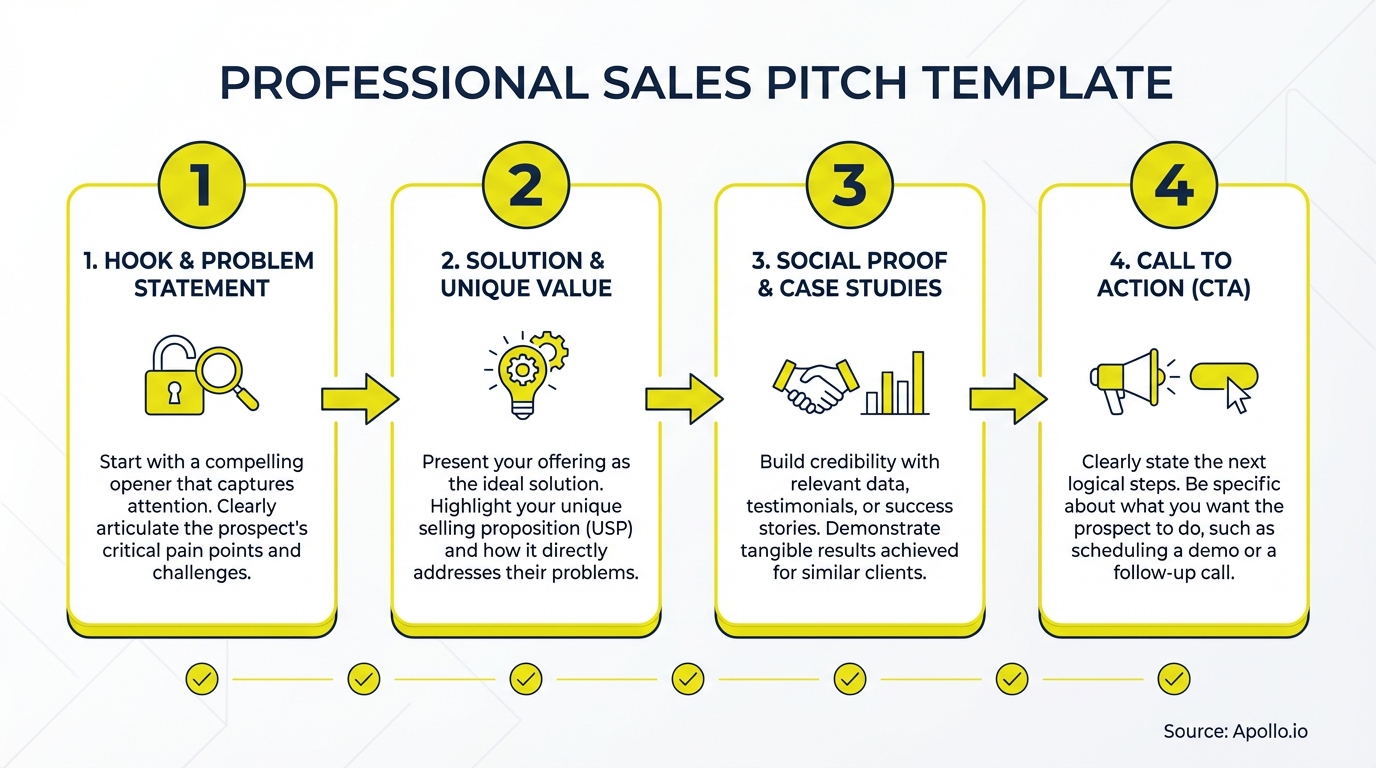
A sales pitch template is a pre-structured framework that guides sales conversations by organizing key messaging elements: problem statement, solution positioning, proof points, and call-to-action.
Unlike static slide decks, modern templates function as systems that pull live data from CRM platforms and adapt to buyer context.
Research from Pangea Global Services shows that 76% of B2B buyers expect personalized attention, making generic outreach ineffective.
Effective templates include:
- Buyer persona mapping: Industry-specific pain points and desired outcomes
- Value proposition framework: Clear differentiation and quantified business impact
- Proof architecture: Case studies, metrics, and customer testimonials
- Stakeholder enablement: Executive summaries and procurement-ready scope documents
Teams using structured sales pitch frameworks report higher win rates because they eliminate messaging inconsistency and ensure every rep delivers value-focused conversations.
Why Do Sales Teams Use Pitch Templates in 2026?
Sales pitch templates solve three critical challenges: inconsistent messaging, inefficient prep time, and poor buyer alignment.
According to CareerTrainer.ai, organizations with a sales enablement strategy achieve a 49% higher win rate on forecasted deals.
For SDRs and BDRs: Templates reduce research time and provide proven messaging that books more meetings.
Instead of building pitches from scratch, reps customize pre-tested frameworks with buyer-specific data.
For Account Executives: Templates ensure discovery calls and demos follow a consistent structure that uncovers pain points, establishes ROI, and addresses objections systematically.
For Sales Leaders: Templates enable coaching at scale.
Managers can review pitch quality, identify messaging gaps, and replicate what top performers do across the entire team. Sales presentation templates also create a single source of truth that aligns with marketing collateral and website positioning.
Struggling to maintain consistent messaging across your team? Automate your sequences and pitch delivery with Apollo's sales engagement platform.
What Are the Core Elements of a High-Converting Sales Pitch Template?
Winning pitch templates in 2026 include seven essential components that address both buyer needs and internal stakeholder alignment.

| Template Component | Purpose | Key Content |
|---|---|---|
| Problem Statement | Establish relevance and urgency | Industry-specific pain points, cost of inaction, buyer research insights |
| Solution Positioning | Differentiate your approach | Unique methodology, feature-to-benefit mapping, competitive advantages |
| Proof Points | Build credibility and trust | Customer case studies, quantified outcomes, third-party validation |
| ROI Framework | Justify investment decision | Cost-benefit analysis, payback period, value realization timeline |
| Implementation Plan | Reduce perceived risk | Onboarding process, support structure, success milestones |
| Stakeholder Enablement | Facilitate internal consensus | Executive brief, technical spec sheet, procurement scope |
| Next Steps | Drive action and momentum | Clear CTA, timeline, mutual action plan |
A study by Infopro Digital Media found that an emotional sales pitch, backed by numbers and incorporating contrast elements, achieved a performance 23% higher than a rational pitch among 500 B2B decision-makers.
Turn Forecast Chaos Into Revenue Certainty
Missing deals because your pipeline data is always outdated? Apollo delivers real-time prospect intelligence and intent signals so you never lose visibility. Built-In increased win rates 10% with Apollo's scoring.
Start Free with Apollo →How Do SDRs and AEs Customize Templates for Different Buyer Personas?
Template customization starts with buyer intelligence.
SDRs use account data to tailor problem statements and proof points to specific industries, company sizes, and pain points.
Modern pitch systems integrate with CRM platforms to auto-populate buyer context, eliminating manual research.

Persona-specific customization includes:
- C-level executives: Focus on strategic outcomes, ROI, and competitive positioning. Keep slides minimal and data-driven.
- Department heads: Emphasize operational efficiency, team productivity, and implementation ease. Include workflow diagrams and success metrics.
- Individual contributors: Highlight daily workflow improvements, time savings, and ease of use. Provide product demos and user testimonials.
Account Executives managing complex deals use multi-channel templates that coordinate email sequences, call scripts, and demo decks.
This ensures consistent messaging across every touchpoint.
RevOps teams building these systems prioritize data accuracy and real-time updates to avoid the messaging inconsistencies that frustrate buyers.
What Role Does AI Play in Modern Sales Pitch Templates?
According to Landbase, AI adoption among sales teams reached 43% in 2026, with 92% of sales teams planning increased AI investment.
AI transforms pitch templates from static documents into dynamic systems that adapt to buyer signals and market intelligence.
AI capabilities in pitch systems:
- Content generation: Auto-create personalized sections based on CRM data, industry trends, and buyer behavior
- Performance optimization: Analyze which messaging variants drive higher conversion rates
- Governance enforcement: Flag prohibited claims, ensure brand compliance, and verify data accuracy
- Multi-format output: Generate slides, one-pagers, email sequences, and call scripts from a single narrative
Sales leaders implementing AI-powered templates establish clear governance policies: what sources the system can cite, what claims require legal review, and how human editors verify output quality.
This prevents the "AI spam" problem where generic, unsubstantiated content damages credibility.
Need better prospect intelligence to power your pitch personalization? Access Apollo's 224M verified business contacts with real-time data enrichment.
How Should Sales Leaders Measure Pitch Template Performance?
Template effectiveness is measured through conversion metrics, sales cycle velocity, and win rate analysis.
Sales Leaders track how different template versions perform across buyer segments and deal stages.
Key performance indicators:
- Meeting-to-opportunity conversion: Percentage of discovery calls that advance to qualified opportunities
- Sales cycle length: Time from first pitch to closed-won (compare templated vs. freestyle approaches)
- Win rate by template version: Which messaging frameworks drive higher close rates
- Stakeholder engagement: How many buying group members engage with pitch materials
Founders and CEOs building outbound motion use deal management platforms to correlate pitch performance with pipeline velocity.
Teams that consolidate pitch delivery, buyer engagement tracking, and deal analytics into one workspace eliminate data silos and accelerate revenue operations.
Ready to Build Your Sales Pitch System?
Sales pitch templates in 2026 are governed, data-driven systems that combine personalization, stakeholder enablement, and AI optimization.
Teams that move beyond static decks to integrated pitch frameworks report higher win rates, shorter sales cycles, and more predictable revenue.
Modern sales organizations consolidate their tech stack by using all-in-one platforms that combine contact intelligence, engagement automation, and deal management. Building a sales tech stack that scales means choosing systems that reduce tool complexity rather than adding more point solutions.
Apollo helps SDRs, AEs, and sales leaders deliver consistent, personalized pitches by providing verified buyer intelligence, automated engagement sequences, and deal tracking in one workspace. "We reduced the complexity of three tools into one," says Collin Stewart of Predictable Revenue.
Try Apollo Free and build pitch systems that convert.
Prove Apollo's ROI In Your First 30 Days
Budget approval stuck on unclear metrics? Apollo tracks every touchpoint from prospect to pipeline so you can show leadership exactly what's working. Built-In increased win rates 10% and ACV 10% with Apollo's scoring.
Start Free with Apollo →Don't miss these
Sales
Inbound vs Outbound Marketing: Which Strategy Wins?
Sales
What Is a Sales Funnel? The Non-Linear Revenue Framework for 2026
Sales
What Is a Go-to-Market Strategy? The 2026 GTM Playbook
See Apollo in action
We'd love to show how Apollo can help you sell better.
By submitting this form, you will receive information, tips, and promotions from Apollo. To learn more, see our Privacy Statement.
4.7/5 based on 9,690 reviews
