Sales Pipeline Stages: A Complete Guide to Building and Managing Your Sales Process
Sales pipeline stages define the structured journey prospects take from initial contact to closed deal. In 2026, successful sales teams combine data-driven stage management with AI automation to move deals forward faster while maintaining the human connection buyers expect. Modern deal management platforms transform how teams track, forecast, and accelerate pipeline velocity across every stage.

Scale Your Team Without The Chaos
Tired of inconsistent processes killing productivity as you grow? Apollo standardizes your entire GTM motion with proven playbooks and automation. Join 550K+ companies scaling smarter.
Start Free with Apollo →Key Takeaways
- Sales pipeline stages map the buyer journey from prospecting to close, with clear entry and exit criteria for each stage
- Data-driven pipeline management increases forecast accuracy by 65% and shortens sales cycles by tracking stage-specific metrics
- AI automation handles research and outreach while human interaction drives trust at decision stages, creating the hybrid selling model buyers prefer
- RevOps teams consolidate pipeline tools into unified platforms, cutting tech costs in half while improving data quality and visibility
- Stage-specific playbooks with AI assistance help SDRs and AEs know exactly what actions drive deals forward at each phase
What Are Sales Pipeline Stages?
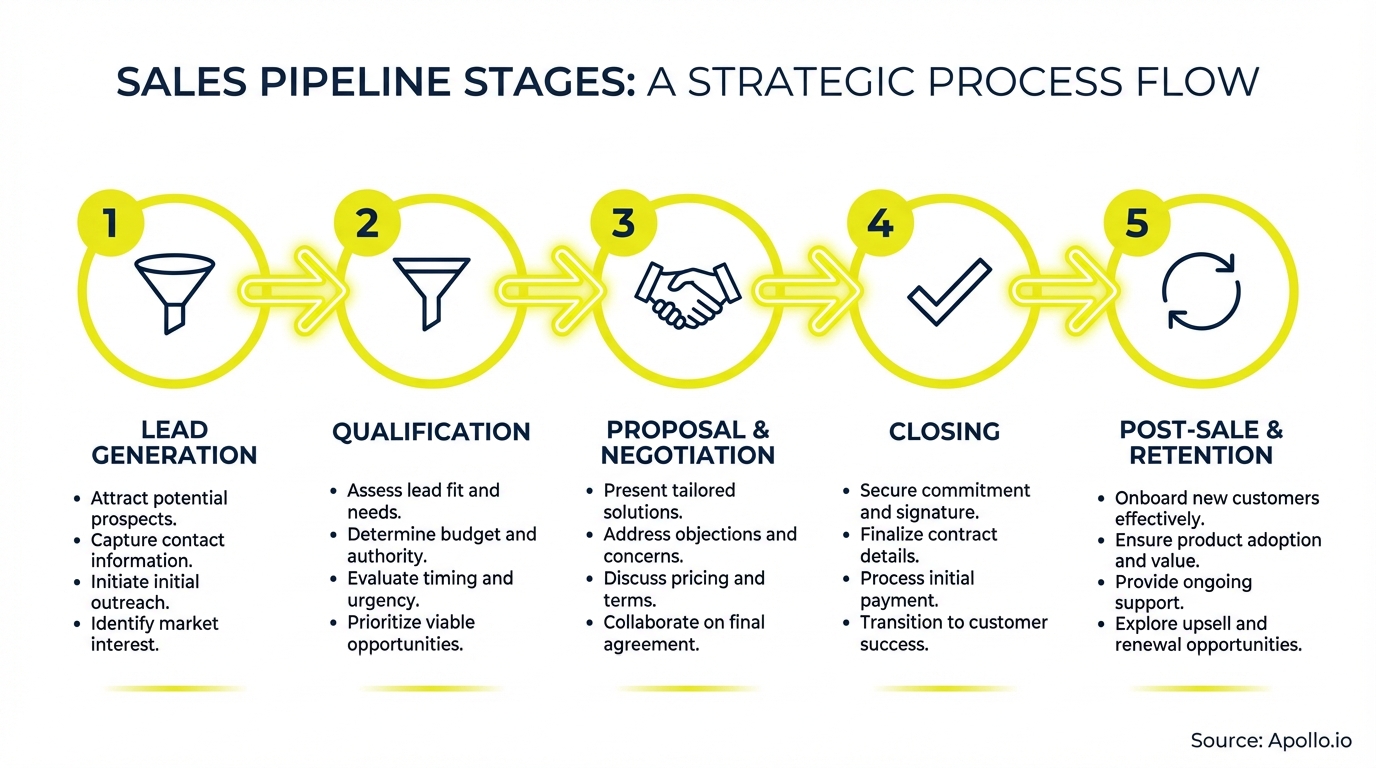
Sales pipeline stages are the sequential steps a prospect moves through from initial awareness to becoming a customer. Each stage represents a specific milestone in the buying journey with defined activities, objectives, and success criteria. According to Gartner, by 2026, 65% of B2B sales organizations will transition from intuition-based to data-driven decision-making, making structured pipeline stages essential for revenue predictability.
Most B2B sales pipelines include six core stages:
- Prospecting: Identifying and researching potential customers who match your ideal customer profile
- Qualification: Determining if prospects have the budget, authority, need, and timeline to buy
- Meeting/Discovery: Conducting initial conversations to understand pain points and requirements
- Proposal: Presenting tailored solutions with pricing and implementation details
- Negotiation: Addressing objections, refining terms, and securing stakeholder alignment
- Closed Won/Lost: Finalizing contracts or documenting why deals didn't convert
The specific stages vary by sales cycle length, deal complexity, and industry. Enterprise sales might add stages for technical validation or executive sign-off, while transactional sales may compress qualification and proposal into one step.
How Do Sales Pipeline Stages Work in 2026?
Pipeline stages work by creating a visual framework that shows where every deal stands and what actions move it forward. Each stage has clear entry criteria (what must happen to enter), exit criteria (what must happen to advance), and stage-specific activities that sales teams execute.
In 2026, pipeline management balances AI automation with human judgment. Research by McKinsey shows hybrid selling combining digital tools and personal engagement is now the dominant B2B sales strategy. SDRs use AI for prospect research and initial outreach, while Account Executives focus on relationship-building and complex negotiations.
| Stage | AI Automation | Human Focus | Key Metric |
|---|---|---|---|
| Prospecting | Contact discovery, enrichment, scoring | Account selection, personalization | Qualified leads generated |
| Qualification | Data gathering, BANT verification | Needs assessment, fit evaluation | Conversion to opportunity |
| Discovery | Meeting scheduling, call summaries | Problem exploration, solution mapping | Discovery calls completed |
| Proposal | Document generation, follow-up sequences | Custom positioning, pricing strategy | Proposal acceptance rate |
| Negotiation | Stakeholder tracking, engagement alerts | Objection handling, executive alignment | Close rate, discount percentage |
Struggling to track deals across stages? Manage your entire pipeline in Apollo with AI-powered deal intelligence and automated stage progression.

How Do SDRs Use Pipeline Stages to Book More Meetings?
SDRs focus on the top two pipeline stages (prospecting and qualification) where their actions directly impact meeting volume and quality. In 2026, top-performing SDRs use AI to handle repetitive research while spending their time on personalized outreach and qualification conversations.
Stage-specific SDR playbooks include:
- Prospecting Stage: Use AI to search 224M+ contacts with 65+ filters, identifying prospects showing buying signals like job changes or funding announcements
- Qualification Stage: Run automated sequences across email, LinkedIn, and phone to engage prospects, then jump into live conversations when they respond
- Meeting Handoff: Provide AEs with enriched contact data, engagement history, and AI-generated call summaries so discovery calls start with context
SDRs using unified platforms report 46% more meetings booked because they eliminate time wasted switching between prospecting tools, engagement platforms, and CRM systems. As one SDR at Predictable Revenue noted, "We reduced the complexity of three tools into one."
Turn Forecast Guesswork Into Revenue Certainty
Pipeline forecasting a guessing game? Apollo delivers real-time deal visibility and AI-powered intent signals so you know exactly where revenue stands. Built-In increased win rates 10% with Apollo's scoring.
Start Free with Apollo →What Pipeline Metrics Should RevOps Teams Track?
RevOps leaders need stage-specific metrics that reveal bottlenecks, forecast accuracy, and conversion patterns. Data-driven pipeline governance transforms gut-feel forecasting into predictable revenue engines.
Critical metrics by stage:
| Metric | What It Measures | Target Benchmark |
|---|---|---|
| Stage Velocity | Average days in each stage | Decrease 15-20% YoY |
| Stage Conversion Rate | % advancing to next stage | 20-30% (varies by stage) |
| Pipeline Coverage | Pipeline value vs quota | 3-4x quota coverage |
| Win Rate by Stage Entry | Close rate based on entry point | Track trends monthly |
| Stage Accuracy | % of deals correctly staged | 90%+ accuracy |
RevOps teams consolidating into single platforms like Apollo gain real-time visibility across all pipeline stages without manual data entry or integration maintenance. Census reported they "cut costs in half" by moving to an integrated GTM platform.
How Does AI Change Sales Pipeline Management?
AI transforms pipeline management by automating data entry, predicting deal outcomes, and recommending next-best actions at each stage. However, buyers still prefer human interaction at critical decision points, creating a hybrid model.
AI applications by pipeline stage:
- Prospecting: AI scores leads based on fit and intent signals, prioritizing accounts most likely to convert
- Qualification: Automated enrichment fills missing contact data and company information without manual research
- Discovery:AI call assistants generate meeting summaries and extract action items, saving AEs 5-7 hours weekly
- Proposal: AI suggests messaging based on similar won deals and automatically follows up on unopened proposals
- Negotiation: Deal intelligence alerts reps when stakeholders engage with content or when deals stall beyond typical stage duration

Despite AI capabilities, Gartner predicts 75% of B2B buyers will prefer sales experiences prioritizing human interaction over AI by 2030. The winning approach uses AI to eliminate busywork so reps focus on relationship-building conversations.
What Are Common Pipeline Stage Mistakes?
Pipeline mismanagement destroys forecast accuracy and hides revenue problems until it's too late to fix them. The most damaging mistakes involve stage definition, data quality, and premature advancement.
Critical mistakes to avoid:
- Vague Stage Criteria: Without clear entry/exit rules, reps stage deals subjectively, making pipeline data unreliable for forecasting
- Too Many Stages: Overly complex pipelines (8+ stages) slow deals down and confuse sales teams about required actions
- Skipping Stages: Jumping prospects from qualification to proposal without discovery creates misalignment and higher close-lost rates
- Stale Deals: Leaving dead deals in pipeline inflates forecasts and masks the need for more prospecting activity
- Inconsistent Data: Manual CRM updates lead to missing information, duplicate records, and inaccurate stage assignments
Sales leaders should audit pipeline health monthly, removing stale opportunities and coaching reps on proper stage progression. Sales analytics platforms surface these issues automatically through anomaly detection and data quality scoring.
Transform Your Sales Pipeline with Unified Intelligence
Sales pipeline stages provide the framework for predictable revenue growth, but only when combined with accurate data, AI automation, and consistent execution. In 2026, winning teams consolidate their tech stack into unified platforms that eliminate data silos and manual busywork.
Modern pipeline management requires three capabilities: verified contact data for prospecting, multi-channel engagement for moving deals forward, and AI-powered insights for forecasting and coaching. Teams using integrated solutions report faster ramp times, higher quota attainment, and better visibility into what's actually driving revenue.
Ready to build a data-driven pipeline that actually converts? Schedule a Demo to see how Apollo's 2M+ users manage pipeline stages, automate outreach, and close deals faster in one unified workspace.
Show Measurable Pipeline ROI In 30 Days
Budget approval stuck on unclear metrics? Apollo delivers trackable pipeline impact with real-time ROI dashboards. Built-In increased win rates 10% and ACV 10% with Apollo's scoring.
Start Free with Apollo →Don't miss these
Sales
Inbound vs Outbound Marketing: Which Strategy Wins?
Sales
What Is a Sales Funnel? The Non-Linear Revenue Framework for 2026
Sales
What Is a Go-to-Market Strategy? The 2026 GTM Playbook
See Apollo in action
We'd love to show how Apollo can help you sell better.
By submitting this form, you will receive information, tips, and promotions from Apollo. To learn more, see our Privacy Statement.
4.7/5 based on 9,690 reviews
