What Is a Sales Personality Test and Does It Predict Quota?
Sales personality tests are back in the spotlight. With AI making resumes easier to optimize, hiring teams are turning to assessments as a differentiator.
But here's the question that matters: do these tests actually predict who will hit quota?
The answer is nuanced. According to Sales Assessment Testing, the use of personality assessments by U.S. companies saw a 30% increase between 2021 and 2022. Yet the predictive power of personality alone is modest. The real value comes from combining personality insights with situational judgment, skill assessments, and observable behaviors.

Apollo Eliminates 4+ Hours Of Daily Research
Tired of spending 4+ hours daily hunting for contact info? Apollo delivers 224M verified contacts with 96% email accuracy. Start building pipeline instead of chasing data.
Start Free with Apollo →Key Takeaways
- Sales personality tests measure traits like conscientiousness, resilience, and adaptability, but their predictive power is modest when used alone
- Combining personality assessments with situational judgment tests (SJTs) and behavioral interviews improves hiring accuracy
- By 2026, 65% of B2B sales organizations are shifting from intuition-based to data-driven hiring decisions
- Ethical implementation requires transparency, bias auditing, and clear communication about assessment limitations
- Modern sales roles increasingly value coachability, data literacy, and AI partnership skills over traditional extroversion
What Sales Personality Tests Actually Measure
A sales personality test evaluates psychological traits and behavioral tendencies that correlate with sales performance. The most effective assessments measure resilience, emotional intelligence, persuasion ability, adaptability, and intrinsic motivation.
Research from University of Dallas Business Review indicates that highly conscientious salespeople exhibit stronger delayed gratification, which positively influences sales performance. But conscientiousness is just one piece of the puzzle.
Understanding a salesperson's core psychological makeup helps leaders identify ideal roles, customize coaching, build cohesive sales teams, and match reps with compatible prospects, according to Substrata.
Common Types of Sales Personality Assessments
| Assessment Type | What It Measures | Best Use Case |
|---|---|---|
| DISC Assessment | Dominance, Influence, Steadiness, Conscientiousness | Team dynamics and communication styles |
| Big Five (OCEAN) | Openness, Conscientiousness, Extraversion, Agreeableness, Neuroticism | Comprehensive personality profiling with research backing |
| Situational Judgment Tests | Decision-making in realistic sales scenarios | Predicting on-the-job behavior and judgment |
| Emotional Intelligence (EQ) | Self-awareness, empathy, social skills | Complex B2B sales and relationship building |
The trend is moving away from single-method assessments. Teams now combine Big Five measures with situational judgment tests and structured interviews to improve predictive validity for complex B2B selling.
"Apollo enriches everything we have: contacts, leads, accounts... And we don't really have to touch it, it just works."
How Sales Personality Tests Connect to Quota Performance
The relationship between personality and sales performance exists, but it's more modest than many vendors claim. A study confirmed a positive and significant effect of personality traits on sales performance (β=0.189, p=0.012), specifically noting a positive relationship between extraversion and agreeableness, according to research published in Dergipark.
What matters more than raw personality traits are trainable competencies. Sellers who effectively partner with AI are 3.7x more likely to meet quota. Tactical flexibility correlates with being 3.4x more likely to hit targets. These are skills that can be developed through structured coaching and training.
The shift in B2B buying behavior makes this even more critical. With 61% of B2B buyers preferring rep-free experiences, modern sellers need different capabilities than the stereotypical extroverted closer.
They need data literacy, consultative skills, and the ability to create consistent messaging across digital channels.
The Data-Driven Hiring Shift
According to BookYourData, by 2026, it's projected that 65% of B2B sales organizations will move from intuition-based to data-driven decision-making, indicating a broader embrace of analytical tools, including personality assessments.
This shift aligns with modern revenue operations practices that demand measurable, repeatable processes. Sales leaders are no longer relying on gut feel when building teams.
See Every Deal Stage In Real Time With Apollo
Pipeline forecasting a guessing game? Apollo gives you live visibility into deal progression and buyer signals. Built-In boosted win rates 10% with real-time pipeline intelligence.
Start Free with Apollo →Implementing Sales Personality Tests the Right Way
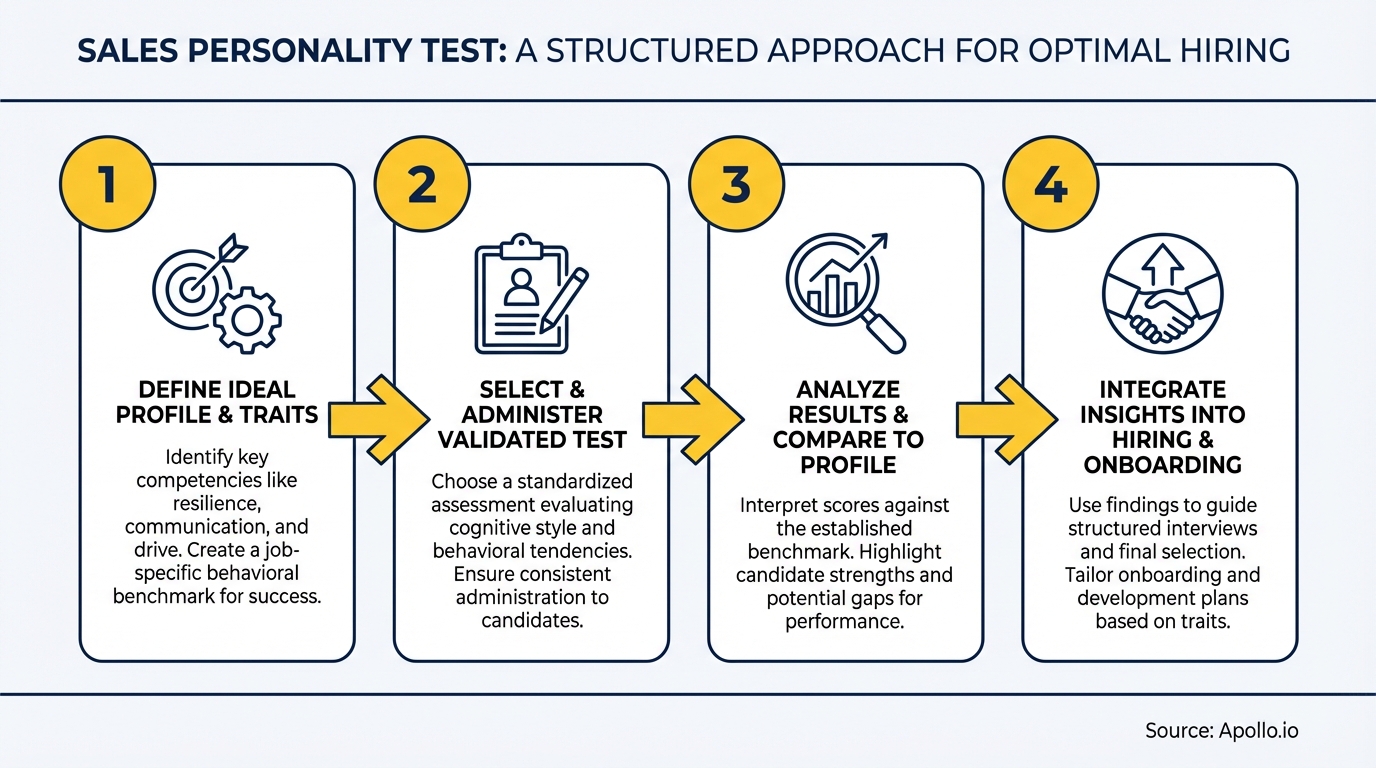
Effective implementation requires more than buying an assessment tool. Here's a framework that works:
Phase 1: Define Success Profiles
Start by analyzing your top performers. What observable behaviors drive their success? Use sales analytics to identify patterns in activity, conversion rates, and deal velocity. Then map those behaviors to assessment constructs.
Phase 2: Select Multi-Signal Assessments
Don't rely on personality alone. Combine Big Five or DISC assessments with situational judgment tests that present realistic sales scenarios. Add structured behavioral interviews that probe for evidence of key competencies.
Phase 3: Establish Ethical Guardrails
Be transparent with candidates about how assessments are used. Document your validation process. If your assessment scoring influences automated hiring decisions, understand that you may fall under NYC's Local Law 144 or similar regulations requiring bias audits.
Need better data to validate your hiring decisions? Apollo's 224M+ verified contacts help you track candidate backgrounds and validate performance claims.
Phase 4: Use Assessments for Development, Not Just Selection
The best ROI comes from using personality insights to customize onboarding and coaching. If an assessment reveals a rep scores low on resilience, pair them with a mentor who excels at handling rejection. If they're high on conscientiousness but low on spontaneity, coach them on adapting their approach mid-conversation.
"Apollo could be a third of the cost if you look at the full price of what we were spending on ZoomInfo, Outreach, Salesforce, and admins to make it all work."
What Modern B2B Sales Roles Actually Require
The profile of a successful B2B seller has changed. Digital-first buying journeys, longer sales cycles, and AI-assisted workflows demand different capabilities than traditional relationship selling.
Stop hiring primarily for extroversion. The new B2B seller profile emphasizes structured thinking, consultative skills, and the ability to orchestrate complex buying committees across multiple channels.
With 73% of buyers actively avoiding suppliers that send irrelevant outreach, precision matters more than volume.
Key competencies for 2026 include:
- AI Partnership: Ability to leverage AI tools for research, personalization, and workflow automation
- Data Literacy: Comfort interpreting analytics, A/B test results, and performance dashboards
- Omnichannel Consistency: Delivering coherent messaging across email, phone, social, and self-serve content
- Consultative Selling: Diagnosing complex problems rather than pitching features
- Adaptability: Adjusting approach based on buyer signals and context
These capabilities can be assessed through situational judgment tests and work samples, then developed through targeted coaching and the right sales tech stack.

Ethical Considerations and Legal Compliance
Sales personality testing isn't just a hiring decision; it's increasingly a legal and compliance consideration. NYC's Local Law 144 requires annual bias audits, public summaries, and notices when automated employment decision tools (AEDTs) are used.
Even if you're not in NYC, these requirements set a practical standard. Document your validation process.
Test for adverse impact across protected groups. Provide candidates with clear information about how assessments influence decisions.
Build in human oversight for final hiring choices.
Most importantly, communicate limitations honestly. Don't oversell predictive power. Personality assessments are one signal among many, not a crystal ball for quota attainment.
How to Measure Assessment Program ROI
Track these metrics to validate your investment:
- Quality of Hire: Compare first-year quota attainment for assessment-based hires vs. traditional hires
- Time to Productivity: How quickly do new reps reach full productivity?
- Retention Rates: Do assessment-based hires stay longer?
- Manager Confidence: Do hiring managers report better role fit?
- Coaching Efficiency: Does personality-informed coaching reduce ramp time?
Set a baseline before implementation, then track quarterly. Adjust your assessment battery based on what actually predicts success in your specific sales environment.

Struggling to track these metrics effectively? Apollo's deal management tools help you monitor rep performance and identify top performer patterns.
Common Mistakes to Avoid
Over-weighting Personality: Don't make personality test results the primary hiring criterion. They're one input among many.
Using Invalid Assessments: Free online quizzes lack validation. Invest in psychometrically sound tools with documented reliability and validity.
Ignoring Context: What works for high-velocity SDR roles differs from enterprise AE positions. Validate assessments for each role separately.
Failing to Train Managers: Managers need coaching on how to interpret results and avoid stereotyping. A DISC profile doesn't define someone's potential.
Not Updating Success Profiles: As your market, product, and go-to-market motion evolve, so should your ideal rep profile. Review annually.
The Future: AI Agents and Hybrid Sales Teams
As AI agents take on more SDR and AE tasks, the definition of "sales personality" is shifting. Leaders increasingly need reps who can design workflows, supervise AI agents, maintain brand voice, and govern risk rather than just display traditional seller temperament.
This doesn't mean personality tests become irrelevant. It means the constructs we measure need to evolve.
Future assessments will likely evaluate a seller's coachability around AI tools, comfort with data-driven decision-making, and ability to orchestrate human-AI collaboration.
The organizations that thrive will be those that use assessments as a development tool, not just a selection filter.
Start Free with Apollo
Sales personality tests work best when combined with comprehensive sales intelligence and the right execution tools. Apollo brings together prospecting, engagement, and analytics in one platform, giving you the data foundation to validate hiring decisions and coach reps effectively.
Ready to build a data-driven sales hiring process? Start free with Apollo and access 224M+ verified contacts, AI-powered engagement tools, and the analytics you need to identify what actually drives quota attainment on your team.
Prove Apollo's ROI In Your First 30 Days
Budget approval stuck on unclear metrics? Apollo tracks every touch to closed revenue, showing exactly what's working. Built-In increased win rates 10% and ACV 10% with measurable pipeline intelligence.
Start Free with Apollo →Don't miss these
Sales
Inbound vs Outbound Marketing: Which Strategy Wins?
Sales
What Is a Sales Funnel? The Non-Linear Revenue Framework for 2026
Sales
What Is a Go-to-Market Strategy? The 2026 GTM Playbook
See Apollo in action
We'd love to show how Apollo can help you sell better.
By submitting this form, you will receive information, tips, and promotions from Apollo. To learn more, see our Privacy Statement.
4.7/5 based on 9,690 reviews
