
Sales Operations Manager Job Description: Roles, Skills, and Salary Guide
Sales operations managers are the architects of revenue efficiency. They transform raw sales data into predictable growth by optimizing processes, managing sales technology stacks, and removing friction from seller workflows. In 2026, this role has evolved beyond analytics into a strategic function that drives measurable productivity gains and competitive advantage through revenue operations excellence.

Stop Manual Research - Apollo Finds Contacts Fast
Tired of spending 4+ hours daily hunting for contact info? Apollo delivers 224M verified contacts with 96% email accuracy. Join 550K+ companies who eliminated manual research.
Start Free with Apollo →Key Takeaways
- Sales operations managers focus on optimizing processes, managing data quality, and enabling sales teams to spend more time selling
- The role now encompasses data governance, tech stack consolidation, and cross-functional collaboration as core competencies
- Modern job descriptions emphasize speed-to-lead workflows, automation orchestration, and revenue-impact metrics over activity tracking
- Organizations with structured revenue operations frameworks see measurably faster growth and higher quota attainment
- Career paths offer competitive compensation with median salaries benchmarked against sales management roles
What Is a Sales Operations Manager?
A Sales Operations Manager is a strategic leader who optimizes the entire sales engine through process design, technology management, and data governance. According to SuperLeap, sales operations managers are responsible for optimizing sales processes, managing sales tools and data, and enabling sales teams to perform efficiently.
The role has expanded significantly in 2026. Beyond traditional CRM administration and reporting, today's Sales Ops Managers own the full revenue infrastructure: routing logic, SLA enforcement, sales analytics frameworks, tool integration architecture, and cross-functional operating cadences. They translate executive revenue goals into actionable workflows, measurable KPIs, and scalable systems that drive predictable growth.
Why Are Sales Operations Managers Critical in 2026?
Sales reps spend only 34% of their week actually selling, with 66% consumed by administrative work, internal meetings, and data entry. This productivity gap makes Sales Operations Managers directly accountable for reclaiming selling time through automation, streamlined processes, and tool consolidation.
Research from Deloitte Digital found that B2B organizations using RevOps were 1.4 times as likely to exceed 2023 revenue goals by 10% or more compared to those not using RevOps. Additionally, FullEnrich reports that companies with RevOps teams grow revenue 3.5 times faster than those without.
The role addresses three critical business challenges:
- Data quality barriers: Poor data quality blocks analytics impact for 44% of sales leaders
- Tool sprawl: Sales orgs using 4-6+ tools create workflow drag and integration complexity
- Speed-to-lead urgency: Buyers contact vendors early in their journey, and first-contact wins 80% of deals
What Are the Core Responsibilities of Sales Operations Managers?
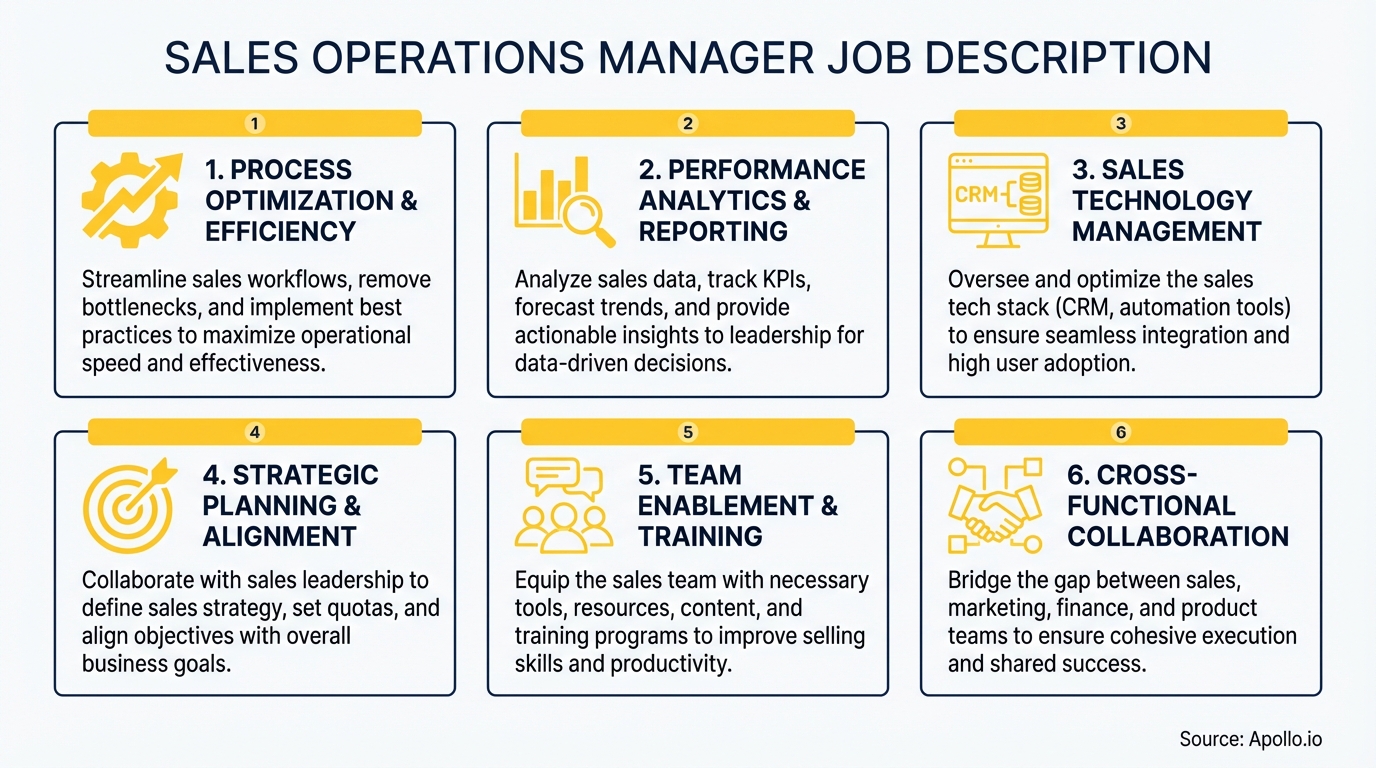
Modern Sales Operations Manager job descriptions map responsibilities to specific KPIs and business outcomes. Here are the primary accountabilities:
| Responsibility Area | Key Activities | Success Metrics |
|---|---|---|
| Process Optimization | Design lead-to-close workflows, define stage criteria, enforce pipeline hygiene standards | Sales cycle length, stage conversion rates, deal slippage reduction |
| Technology Management | Implement CRM, configure automation tools, manage integrations, rationalize tech stack | System adoption rates, integration uptime, cost per tool/seat |
| Data Governance | Establish data quality standards, define source of truth, manage enrichment workflows | Data completeness scores, duplicate rates, field accuracy percentages |
| Analytics & Reporting | Build dashboards, forecast accuracy models, pipeline health reports, performance scorecards | Forecast accuracy, report delivery SLAs, decision latency reduction |
| Enablement Support | Document playbooks, create training materials, run QBRs, onboard new reps | Ramp time to first deal, playbook adoption rates, quota attainment lift |
| Cross-Functional Collaboration | Partner with marketing on lead routing, align with CS on expansion plays, coordinate with finance on comp plans | Lead response times, handoff conversion rates, cross-team satisfaction scores |
Struggling with fragmented data across multiple systems? Consolidate your sales intelligence with Apollo's 224M+ verified contacts and automated enrichment.
Find Buyers Ready To Convert With Apollo
Marketing leads never turn into real opportunities. Apollo's buyer intent signals identify prospects ready to buy right now. Built-In boosted win rates 10% with Apollo scoring.
Start Free with Apollo →How Do Sales Operations Managers Support RevOps Teams?
For RevOps leaders building scalable go-to-market engines, Sales Operations Managers execute the operational infrastructure that connects strategy to execution. They translate revenue operations frameworks into daily workflows, governance artifacts, and measurable outcomes.
Key collaboration points include:
- Unified data architecture: Establishing single source of truth across sales, marketing, and customer success systems
- Lead lifecycle management: Defining routing rules, SLA targets, and escalation paths for inbound and outbound motions
- Technology rationalization: Evaluating ROI of tools, managing vendor relationships, driving stack consolidation initiatives
- Operating rhythm ownership: Running weekly pipeline reviews, monthly forecast calls, and quarterly business reviews
According to The B2B Mix, by 2025, 75% of the world's highest-growth companies will have adopted a RevOps model. Sales Operations Managers serve as the execution layer that makes this model work at scale.
What Skills and Qualifications Do Sales Operations Managers Need?
Modern Sales Operations Manager job descriptions prioritize a blend of technical, analytical, and strategic competencies:

Technical Skills
- CRM platform expertise (Salesforce, HubSpot) including admin-level configuration
- Sales engagement tools and automation platforms
- Data analysis tools (SQL, Excel, Tableau, Looker)
- Integration architecture and API fundamentals
- Workflow automation platforms (Zapier, Workato)
Analytical Capabilities
- Statistical analysis and forecasting methodologies
- Pipeline modeling and conversion rate optimization
- Cohort analysis and win/loss pattern recognition
- ROI calculation and business case development
Strategic Competencies
- Process design and change management
- Cross-functional stakeholder management
- Data governance and privacy compliance
- Vendor evaluation and negotiation
- Operating rhythm facilitation
Typical Qualifications
- Bachelor's degree in Business, Analytics, or related field
- 3-5 years in sales operations, revenue operations, or sales enablement roles
- CRM certification (Salesforce Admin, HubSpot Revenue Operations preferred)
- Experience with deal management systems and sales intelligence platforms
How Do Sales Operations Managers Drive Speed-to-Lead Excellence?
Buyer behavior in 2026 demands operational precision. With buyers making decisions from Day One shortlists and first-contact wins correlating to 80% of closed deals, Sales Operations Managers own the workflows that capture and convert demand at speed.
Critical speed-to-lead responsibilities include:
- Routing automation: Configure lead assignment rules based on territory, product fit, account tier, and rep capacity
- SLA enforcement: Set and monitor response time targets (5-minute for hot leads, 1-hour for warm, 24-hour for nurture)
- Alert orchestration: Trigger real-time notifications via Slack, SMS, or mobile app when high-intent leads enter the system
- Handoff protocols: Define clear ownership transitions between SDRs and AEs with documented criteria and accountability
Losing deals because your team responds too slowly? Build faster go-to-market workflows with Apollo's unified platform and automated routing.
What Is the Career Path and Compensation for Sales Operations Managers?
Sales Operations Manager roles offer competitive compensation aligned with sales leadership tracks. The U.S.
Bureau of Labor Statistics reports median annual pay for Sales Managers at $138,060, with top earners exceeding $239,200. Sales Operations Manager salaries typically range from $85,000 to $140,000 base, with total compensation reaching $110,000 to $180,000 including bonuses.
Career progression typically follows this trajectory:
- Sales Operations Analyst (1-3 years): Report building, data hygiene, basic CRM administration
- Sales Operations Manager (3-7 years): Process design, tool ownership, cross-functional collaboration
- Senior Sales Operations Manager (5-10 years): Strategy development, team leadership, executive stakeholder management
- Director of Sales Operations (7-12 years): Department leadership, budget ownership, multi-product coordination
- VP Revenue Operations (10+ years): Full revenue org oversight, board reporting, strategic planning
The Bureau of Labor Statistics projects 5% growth in sales management roles from 2024-2034, faster than the 3% average for all occupations, with approximately 49,000 openings per year.
How Should Sales Leaders Write Effective Job Descriptions in 2026?
Modern Sales Operations Manager job descriptions emphasize outcomes over activities, systems thinking over tool administration, and strategic impact over tactical execution. Key elements include:
Position Summary
Frame the role as the operational backbone of revenue growth. Example: "The Sales Operations Manager designs and optimizes the sales infrastructure that enables our team to spend more time selling and less time on administrative work."
Core Responsibilities with KPIs
Link each responsibility to measurable outcomes. Instead of "Manage CRM," write "Own CRM data quality, achieving 95%+ field completeness and reducing duplicate records to under 2%."
Technology Stack Ownership
Specify platforms and integration requirements. Example: "Manage our sales technology ecosystem including CRM, sales engagement platform, conversation intelligence, and enrichment tools.
Drive consolidation initiatives to reduce tool sprawl and improve workflow efficiency."
Cross-Functional Collaboration
Define partnership expectations. Example: "Partner with Marketing Operations on lead routing and SLA governance.
Collaborate with Customer Success on expansion play workflows. Coordinate with Finance on territory planning and compensation administration."
Success Metrics
Establish clear 90-day and annual performance indicators tied to revenue outcomes, productivity gains, and system adoption.
Conclusion
Sales Operations Managers have evolved from back-office administrators to strategic architects of revenue efficiency. In 2026, this role demands expertise in data governance, technology consolidation, process optimization, and cross-functional collaboration.
Organizations that invest in strong sales operations infrastructure see measurably faster growth, higher productivity, and more predictable revenue outcomes.
For sales leaders building or refining their operations function, focus job descriptions on outcome-based responsibilities, strategic competencies, and clear KPI ownership. Emphasize the role's impact on seller productivity, data quality, and speed-to-lead excellence.
Position Sales Operations Managers as the operational foundation that transforms sales strategy into scalable, repeatable execution.

Ready to build a revenue operations engine that scales? Get leads now with Apollo's all-in-one platform and consolidate your sales tech stack into one unified workspace.
Prove Apollo's ROI In Your First 30 Days
Budget approval stuck on unclear metrics? Apollo tracks every touchpoint from first contact to closed deal. Customer. io achieved 50% YoY growth with measurable pipeline impact.
Start Free with Apollo →Don't miss these
Sales
Inbound vs Outbound Marketing: Which Strategy Wins?
Sales
What Is a Sales Funnel? The Non-Linear Revenue Framework for 2026
Sales
What Is a Go-to-Market Strategy? The 2026 GTM Playbook
See Apollo in action
We'd love to show how Apollo can help you sell better.
By submitting this form, you will receive information, tips, and promotions from Apollo. To learn more, see our Privacy Statement.
4.7/5 based on 9,690 reviews
