
What Is Sales Operations and How Does It Drive Revenue Growth?
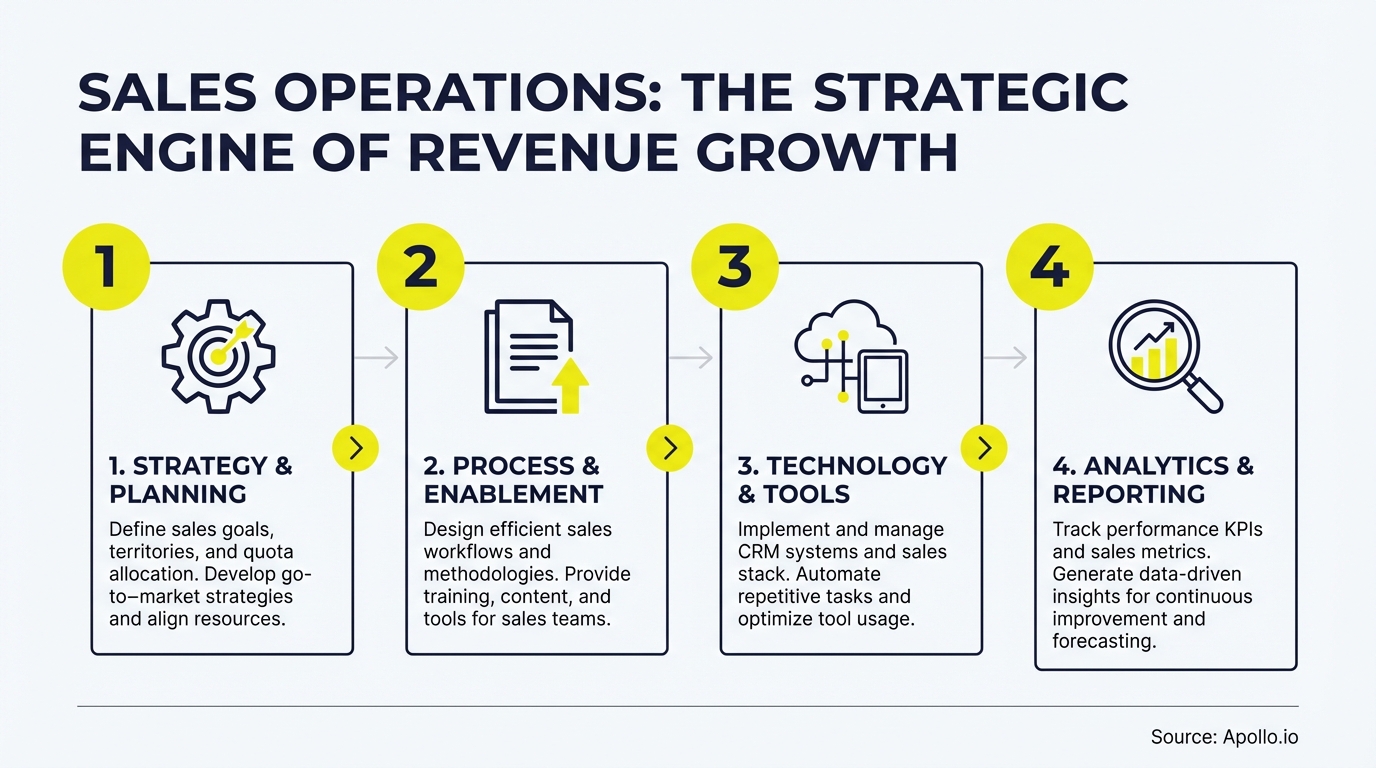
Sales operations is the function responsible for making revenue teams faster, smarter, and more predictable. It covers everything from CRM governance and territory design to pipeline analytics, sales technology, and enablement — the infrastructure that allows sellers to focus on selling.
The stakes are high. According to BookYourData, 73% of sales representatives missed their H2 quotas in 2023, and 69% are still falling short on average in 2024. Sales ops exists precisely to close that gap — by removing friction, improving data quality, and deploying the right technology at the right time.

Research Less, Pipeline More With Apollo
Tired of hours lost verifying contacts before a single outreach goes out? Apollo surfaces accurate, ready-to-contact prospects so your reps sell instead of search. Over 550K companies have already made the switch.
Start Free with Apollo →Key Takeaways
- Sales operations is the backbone of a scalable revenue engine — it owns process, data, technology, and enablement.
- Poor data quality directly undermines forecasting, territory planning, and pipeline analytics.
- AI is reshaping the Sales Ops mandate: agentic workflows are moving from "assist" to "execute," making governance a core competency.
- Quota attainment is a structural problem that Sales Ops can solve through better tooling, role clarity, and process design.
- A unified GTM platform consolidates the tech stack, reduces operational complexity, and gives reps more time to sell.
What Is Sales Operations?
Sales operations (also called Sales Ops) is the team or function that designs, manages, and optimizes the systems and processes that support a sales organization. It is distinct from sales management (which leads people) and revenue operations (which aligns sales, marketing, and customer success under one function).
Sales Ops IS: process design, CRM administration, data governance, territory planning, quota modeling, sales technology management, forecasting, and performance reporting.
Sales Ops IS NOT: closing deals, coaching individual reps, or setting sales strategy. It enables those activities by removing the operational friction that slows them down.
What Are the Core Responsibilities of Sales Operations?
| Responsibility | What It Includes | Why It Matters |
|---|---|---|
| CRM & Data Governance | Field definitions, required fields, enrichment, deduplication, stage exit criteria | Forecasting and routing accuracy depend on clean, trusted data |
| Territory & Quota Design | Capacity models, account segmentation, rep assignment rules, quota-setting methodology | Fair, data-driven territories improve attainment and reduce churn |
| Pipeline Management | Inspection cadences, stage conversion tracking, deal health scoring | Identifies at-risk deals early and improves forecast confidence |
| Sales Technology | Stack selection, integration management, adoption tracking, vendor consolidation | Tool sprawl overwhelms reps and degrades data quality |
| Forecasting | Forecast methodology, SLAs, call accuracy reporting, scenario modeling | Reliable forecasts drive better resource allocation and board confidence |
| Enablement Operations | Content taxonomy, asset distribution, onboarding design, training cadences | Reps find the right content faster in a digital-first buying environment |

Why Data Governance Is the Foundation of Sales Ops
Every Sales Ops output — forecast accuracy, pipeline health, territory fairness — depends on data quality. Yet data trust remains a critical weakness across most organizations.
When reps, managers, and ops teams can't trust what's in the CRM, every downstream decision degrades.
A practical data governance blueprint for Sales Ops includes:
- Field definitions: Standardize what each CRM field means across teams (e.g., "close date" = rep-committed date, not aspirational).
- Required fields by stage: Define the minimum data needed to advance a deal (contact role, use case confirmed, decision criteria captured).
- Enrichment triggers: Auto-enrich new contacts and accounts to reduce manual entry and data decay.
- Validation rules: Prevent bad data from entering the system rather than cleaning it after the fact.
- Health metrics: Track completeness, accuracy, and age of records in a weekly data health dashboard.
Struggling with dirty CRM data? Apollo's data enrichment keeps your contacts and accounts always-fresh, automatically filling gaps and flagging stale records so your pipeline analytics stay reliable.
"Apollo enriches everything we have: contacts, leads, accounts... And we don't really have to touch it, it just works."
Turn Funnel Guesswork Into Closed Deals
Pipeline forecasting a guessing game? Apollo surfaces quality prospects that actually convert, so your funnel stops leaking and your forecast stops lying. Over 550K companies now call their numbers with confidence.
Start Free with Apollo →How AI Is Reshaping Sales Operations in 2026
AI in sales operations is no longer experimental. The shift happening right now is from AI that assists (drafting emails, summarizing calls) to agentic AI that executes: handling lead routing, triggering follow-up sequences, updating CRM records, and flagging pipeline risk without human intervention.
Sales Ops now owns agent governance — defining permissions, QA processes, and exception-handling rules for AI actions inside the CRM.
The business case is clear. According to Nektar.ai, multithreading — forming relationships with multiple stakeholders — increases deal close rates by 16%. AI tools that automatically map buying committees and surface missing contacts make this kind of systematic multithreading scalable for every rep, not just the top performers.
Key AI use cases Sales Ops teams should standardize in 2026:
- Pipeline inspection: AI deal scoring that surfaces at-risk opportunities before the weekly call.
- Forecast assistance: AI-generated forecast summaries with confidence intervals, replacing manual roll-ups.
- Conversation intelligence: Automated call scoring against defined talk tracks and objection-handling criteria.
- Contact enrichment: Real-time enrichment triggered by new record creation, keeping CRM data current.
- Sequence automation: AI-personalized outreach at scale, reducing rep time on manual tasks.
For a deeper look at how AI sales tools are closing more deals, see Apollo's guide to the top platforms and use cases.
The Sales Ops Tech Stack: What to Keep, What to Cut
Tool sprawl is one of the biggest threats to sales productivity. When reps toggle between six or more platforms to complete a single workflow, data quality degrades, adoption drops, and operations spend more time managing integrations than improving processes.
The modern Sales Ops mandate includes active tech stack rationalization.
A well-structured sales tech stack for 2026 covers five core layers:
- CRM: The system of record for accounts, contacts, and pipeline.
- Sales intelligence & prospecting: Verified contact and account data with ICP filtering.
- Sales engagement: Multi-channel sequences (email, phone, social) with automation and A/B testing.
- Conversation intelligence: Call recording, transcription, and coaching insights.
- Analytics & reporting: Pipeline dashboards, forecast accuracy, and rep performance metrics.
The consolidation opportunity is significant. Platforms that unify prospecting, engagement, and analytics in one workspace eliminate the integration overhead and data inconsistency that comes from stitching together separate tools.
"We reduced the complexity of three tools into one. We're getting higher reply rates, open rates are doubled, meetings are up, and speed to booking a meeting is cut in half."
How to Measure Sales Operations Success
Sales Ops teams are accountable for outcomes, not just activities. The right sales KPIs for measuring Sales Ops impact fall into four categories:
| Category | Key Metrics |
|---|---|
| Pipeline Health | Pipeline coverage ratio, stage conversion rates, average deal age by stage, deal velocity |
| Forecast Accuracy | Forecast vs. actual variance (%), commit accuracy by rep and manager, call-to-close ratio |
| Rep Productivity | Activities per rep per day, time-to-first-contact, meetings booked per SDR, quota attainment distribution |
| Data & Process Quality | CRM completeness score, data enrichment coverage, sequence reply rates, tool adoption rate |
Track these metrics in a consistent cadence: pipeline health weekly, forecast accuracy bi-weekly, productivity and data quality monthly. Use QBR packs to present trends over time rather than point-in-time snapshots.
For more on building a sales analytics framework that ties these metrics to revenue outcomes, see Apollo's dedicated guide.

Sales Operations vs. Revenue Operations: What's the Difference?
Sales Ops focuses on the sales team specifically: their processes, tools, data, and performance. Revenue operations is the broader function that aligns Sales, Marketing, and Customer Success under shared data, shared technology, and shared accountability for the full revenue cycle.
In practice, Sales Ops often reports into RevOps at larger organizations. At smaller companies, the same person may own both functions.
The distinction matters for scoping responsibilities and avoiding gaps — particularly in areas like lead routing (who owns the handoff rules?), attribution (which team defines the model?), and technology governance (who approves new tools?).
Building a Sales Operations Playbook: Where to Start
If you're standing up or restructuring a Sales Ops function, prioritize in this order:
- Audit current state: Map existing processes, tools, and data quality gaps before building anything new.
- Define the data model: Agree on CRM field definitions, required fields by stage, and enrichment standards.
- Establish pipeline inspection cadences: Weekly deal reviews with a consistent checklist prevent forecast surprises.
- Rationalize the tech stack: Identify redundant tools and consolidate toward a unified platform where possible.
- Build reporting before optimizing: You can't improve what you can't measure. Get dashboards live before launching new programs.
- Implement AI governance: As AI agents take actions in your CRM, define permission levels, QA workflows, and exception-handling protocols.
Need to build pipeline faster while cleaning up your data foundation? Apollo's AI-powered pipeline builder combines verified contact data, automated sequences, and pipeline analytics in one workspace — so Sales Ops can standardize the entire prospecting-to-pipeline process without managing multiple vendors.
Conclusion: Sales Operations Is the Revenue Engine's Control Room
Sales operations doesn't close deals — it creates the conditions where deals get closed consistently. From data governance to AI agent oversight, the Sales Ops mandate is expanding in 2026, and teams that invest in the right foundations will see it directly in their quota attainment numbers.
According to RevOps Co-op, only 27% of sales reps hit their quota in H1 2023. The gap between top performers and the rest isn't just talent — it's the operational infrastructure supporting them. Sales Ops is how you close that gap at scale.
Apollo gives Sales Ops teams a unified platform for prospecting, engagement, enrichment, and analytics — eliminating the tool sprawl that fragments data and slows down every process you're trying to optimize. Start your free trial today and see what your revenue engine looks like when everything works together.
Prove Pipeline ROI From Day One
ROI pressure killing budget approval for your sales tools? Apollo delivers measurable pipeline impact fast — so you walk into every renewal with proof, not promises. Leadium 3x'd their revenue. You're next.
Start Free with Apollo →Don't miss these
Sales
Inbound vs Outbound Marketing: Which Strategy Wins?
Sales
What Is a Sales Funnel? The Non-Linear Revenue Framework for 2026
Sales
What Is a Go-to-Market Strategy? The 2026 GTM Playbook
See Apollo in action
We'd love to show how Apollo can help you sell better.
By submitting this form, you will receive information, tips, and promotions from Apollo. To learn more, see our Privacy Statement.
4.7/5 based on 9,690 reviews
