
What Is Sales Onboarding? The Architecture-First Guide for 2026
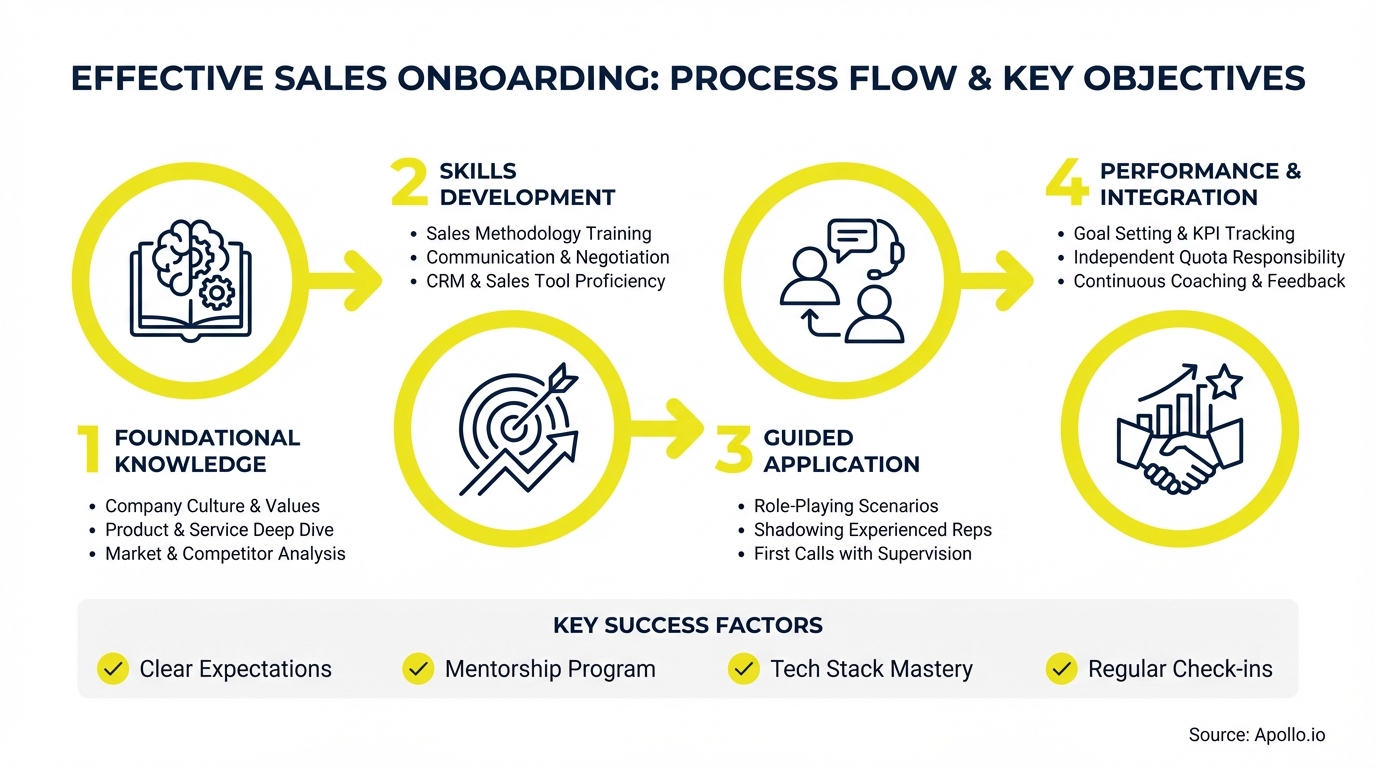
Sales onboarding is the structured process of equipping new sales hires with the knowledge, tools, skills, and context they need to reach full productivity. Done well, it compresses ramp time, increases quota attainment, and reduces early attrition.
Done poorly, it costs you months of lost revenue per rep.
The 2026 reality: the old 30/60/90-day bootcamp model is being replaced by architecture-first, always-on enablement. The question isn't just "what do we train?" — it's "how do we design onboarding to match our segment, our team structure, and our transformation goals?"

More Pipeline, Less Manual Grind
Tired of burning hours on research just to hit a wall with low lead volume? Apollo surfaces verified contacts instantly so your team spends time selling, not searching. Join 550K+ companies building predictable pipeline.
Start Free with Apollo →Key Takeaways
- Structured sales onboarding can reduce ramp time by up to 34%, according to Hyperbound.
- The centralized vs. decentralized onboarding decision materially changes revenue outcomes — choose based on segment, deal complexity, and manager span of control.
- "Everboarding" (continuous, in-flow reinforcement) is replacing one-time bootcamps as the dominant enablement model in 2026.
- Measuring ramp time, time-to-first-sale, and quota attainment at 90 days gives you the instrumentation to prove onboarding ROI.
- AI role-play and automated coaching are closing the manager bandwidth gap at scale.
Why Sales Onboarding Architecture Matters More Than Content
Most teams obsess over onboarding content (slides, playbooks, certifications) and underinvest in onboarding architecture — the structural decisions that determine whether any of that content actually produces results.
According to Forrester, high-performing sales teams take one-third longer to train than non-high-performing teams — suggesting that intentional, thorough onboarding is a feature, not a bug. Meanwhile, flair.hr reports that new hires typically operate at approximately 25% productivity in their first month. The architectural decisions you make directly control how fast that number climbs.
Centralized vs. Decentralized vs. Hybrid: Which Model Fits Your Team?
| Model | Best For | Manager Span | Trade-off |
|---|---|---|---|
| Centralized | High-volume SDR teams, consistent messaging needs | Large (8+ reps) | Faster to deploy, lower personalization |
| Decentralized | Complex enterprise sales, technical products | Small (1–5 reps) | Higher outcomes, requires manager investment |
| Hybrid | Mid-market teams with mixed segments | Medium (5–8 reps) | Balances scale with coaching depth |
Baylor University's Keller Center (March 2024) found that decentralized onboarding programs delivered 23.5% higher sales compared to centralized programs — and that figure rose to 29.6% when managers had smaller spans of control. The implication: if you want performance, shrink manager spans or build decentralized coaching into your architecture.
For teams scaling enterprise sales motions, decentralized onboarding with dedicated manager coaching is worth the investment. For high-volume outbound teams, a hybrid model with centralized curriculum and manager-led deal reviews often hits the right balance.
Time-to-Readiness: Building a Modular Learning Catalog
Time-to-readiness is the interval between hire date and the moment a rep can independently run a qualified discovery call, handle common objections, and manage a pipeline. Compressing it is the primary ROI lever of sales onboarding.
The modern approach breaks onboarding into retrievable, role-specific modules rather than linear, week-by-week courses. Each module should answer a single question a rep will face in the field.
Core Modules by Role
- SDR/BDR: ICP definition, prospecting workflows, cold call scripts, objection handling, sequence structure
- Account Executive: Discovery framework, demo delivery, multi-stakeholder navigation, objection handling, negotiation and close
- RevOps: CRM hygiene, pipeline stage definitions, KPI dashboards, territory and quota logic
Want new reps building pipeline from day one? Apollo's prospecting tools give new hires instant access to 224M+ verified contacts with 65+ filters — so they're practicing real outreach, not hypothetical exercises, from week one.
"The moment we select someone in our database, they're instantly added to a sequence and we can take action right away. We're effective and efficient with our outreach."
Everboarding: Why Onboarding Can't Stop at 90 Days
"Everboarding" is the practice of treating sales readiness as a continuous, ongoing process rather than a one-time event. It's the direct response to a world where products, pricing, positioning, and competitive landscapes change faster than any annual training cycle can accommodate.
The bootcamp model front-loads information that reps can't yet apply. Everboarding embeds reinforcement into the daily workflow — deal reviews, weekly call drills, AI role-plays, and just-in-time content surfaced inside the tools reps already use.
Everboarding Cadence Template
- Daily: AI-assisted call prep and post-call debrief (via AI call assistant)
- Weekly: Manager-led deal review (30 min), one targeted role-play drill
- Monthly: Messaging refresh certification, pipeline health audit
- Quarterly: Full playbook review against updated ICP, competitive positioning update
The 2026 enablement trend is clear: AI role-play and automated coaching are becoming the scalable substitute for manager time. When managers carry large spans of control, they cannot deliver consistent 1:1 coaching to every rep.
Automated scoring and feedback loops close that gap without requiring live sessions for every practice repetition.
"With this kind of AI system, my BDRs can send 10x more personalized emails. Their productivity and growth has skyrocketed."

The Transformation Onboarding Playbook
Sales organizations undergoing transformation — new go-to-market motion, new CRM, new segment coverage, new compensation model — face a compounded onboarding challenge. They're not just ramping new reps; they're re-onboarding existing ones.
Gartner found that only 11% of sales organizations successfully drove commercial outcomes while executing a transformation. The missing ingredient is almost always a change enablement kit embedded into onboarding — not just new process documentation, but explicit adoption milestones and manager coaching on the "why" behind the change.
Change Enablement Onboarding Kit (Checklist)
- New process map with before/after comparison
- Updated ICP and qualification criteria
- Revised talk tracks and messaging aligned to new positioning
- Tool adoption milestones with manager sign-off checkpoints
- KPI baseline and 30/60/90-day target dashboard
- FAQ: "Why are we changing?" document for rep confidence
For teams managing a sales tech stack consolidation, onboarding must include explicit workflow training, not just access provisioning. Reps need to know not just what the tool does, but how it fits their daily motion.
Turn Weak Funnels Into Pipeline Gold
Quota stress keeping you up at night? Apollo surfaces verified, in-market buyers so your team stops chasing dead-end leads and starts closing real opportunities. Join 90K paying customers building predictable pipeline.
Start Free with Apollo →KPI and Measurement Framework for Sales Onboarding
Completion rates are a vanity metric. The KPIs that matter connect onboarding inputs to revenue outputs.
| KPI | Definition | Target Benchmark |
|---|---|---|
| Ramp Time | Days from hire to first closed deal or full pipeline coverage | Reduce vs. prior cohort |
| Time-to-First-Sale | Calendar days from start date to first booked revenue | Track by role and segment |
| Quota Attainment at 90 Days | % of quota achieved in first full quarter | Compare cohort vs. cohort |
| First-Year Retention | % of onboarded reps still active at 12 months | Great onboarding may increase retention by 82% |
| Module Certification Rate | % of reps certified on core competencies within 30 days | Track leading indicator for ramp |
Connecting these metrics to pipeline and revenue outcomes — not just HR completion dashboards — is what separates enablement teams that influence strategy from those that run logistics. Pair this with sales analytics to attribute onboarding cohort performance to pipeline outcomes over time.

Governance: Keeping Onboarding Content Current and Trustworthy
Outdated onboarding content actively harms reps. A new hire who learns stale messaging, deprecated product positioning, or incorrect pricing walks into their first call at a disadvantage.
Governance is the operational system that keeps content accurate, findable, and version-controlled. Without it, onboarding programs decay within months of launch.
Minimum Viable Governance Framework
- Taxonomy: Tag every asset by role, segment, product line, and stage (prospecting / discovery / close)
- Versioning: Date-stamp all assets; archive superseded versions with a clear retirement notice
- Review cadence: Quarterly review for positioning and messaging; monthly for competitive content
- Certification workflows: Require re-certification when core assets change (new product launch, pricing update, ICP shift)
- Content owner accountability: Each asset has a named owner responsible for review and update
The sales enablement platform market is growing rapidly — Grand View Research estimates it at $5.23B in 2024, with a projected 16.3% CAGR through 2030. Budget is following the governance problem. Teams that build operational content management now will have a structural advantage as their competitor's programs decay.
Conclusion: Build for Architecture, Not Just Content
The best sales onboarding programs in 2026 share three traits: they're architecturally designed (centralized vs. decentralized vs. hybrid, matched to segment and manager span), they're continuous (everboarding, not bootcamps), and they're measured against revenue outcomes, not training completion rates.
Start with your onboarding architecture decision. Then build modular content your reps can find and use in the flow of work.
Instrument everything against ramp time, first-sale timing, and 90-day quota attainment. Review and govern your content on a defined cadence.
That's the program that compounds over time.
New reps ramping faster need a prospecting foundation that works from day one. Apollo's sales engagement platform gives your team the sequences, data, and automation to run real outreach from week one — not after a three-month ramp.
Prove Pipeline ROI With Apollo
ROI pressure making tool renewals feel impossible to justify? Apollo delivers measurable pipeline impact from day one — no guesswork. Leadium 3x'd their annual revenue. Start yours free.
Start Free with Apollo →Don't miss these
Sales
Inbound vs Outbound Marketing: Which Strategy Wins?
Sales
What Is a Sales Funnel? The Non-Linear Revenue Framework for 2026
Sales
What Is a Go-to-Market Strategy? The 2026 GTM Playbook
See Apollo in action
We'd love to show how Apollo can help you sell better.
By submitting this form, you will receive information, tips, and promotions from Apollo. To learn more, see our Privacy Statement.
4.7/5 based on 9,690 reviews
