How Do You Run Successful Sales Meetings in 2026?
Sales meetings have never been harder to earn or easier to waste. Gartner research found that 61% of B2B buyers now prefer a rep-free buying experience — meaning when a buyer does agree to meet, the stakes are higher than ever. Every sales meeting must deliver insight the buyer couldn't find on their own.
The playbook has shifted. Discovery calls are no longer early-stage fishing expeditions.
They're late-stage validation events for buyers who already have a shortlist. If your meeting prep, messaging, and follow-through aren't tight, you lose before you ever pitch.
This guide covers exactly what it takes to run sales meetings that move deals forward in 2026.

Research Less, Pipeline More With Apollo
Tired of burning hours verifying contacts that go nowhere? Apollo surfaces accurate, ready-to-engage prospects so your reps spend time selling — not searching. Join 550K+ companies building predictable pipeline.
Start Free with Apollo →Key Takeaways
- B2B buyers prefer self-serve research first — meetings must deliver value unavailable through self-service.
- Messaging inconsistency between your website and sellers is a trust-killer that costs you deals.
- Prep, structure, and post-meeting follow-up are the three levers that separate high-converting meetings from wasted hours.
- AI tools now automate meeting recaps, CRM updates, and follow-up workflows — reducing admin and compressing deal cycles.
- Mutual action plans (MAPs) and stakeholder-specific prep are the highest-leverage assets for complex, multi-buyer deals.
What Are Sales Meetings and Why Do They Matter More Now?
A sales meeting is any structured interaction between a seller and a prospect or customer designed to advance a deal. Types include discovery calls, product demos, negotiation sessions, QBRs, and closing conversations.
Each has a distinct objective and requires different preparation.
The stakes have risen dramatically. According to Zoom, unproductive meetings cost U.S. professionals an estimated $259 billion annually. Meanwhile, Calendly's State of Meetings report found that sales professionals have the most meetings of any role surveyed, with half spending five or more hours in meetings daily. The volume is high. The cost of poor execution is enormous.
| Meeting Type | Primary Objective | Key Output |
|---|---|---|
| Discovery Call | Qualify pain, understand buying process | Confirmed fit or disqualification |
| Product Demo | Connect features to specific buyer problems | Agreed next step, stakeholder buy-in |
| Negotiation / Close | Resolve objections, align on terms | Signed agreement or clear timeline |
| QBR / Business Review | Demonstrate ROI, expand relationship | Renewal commitment or expansion opportunity |
How Do You Prepare for a High-Value Sales Meeting?
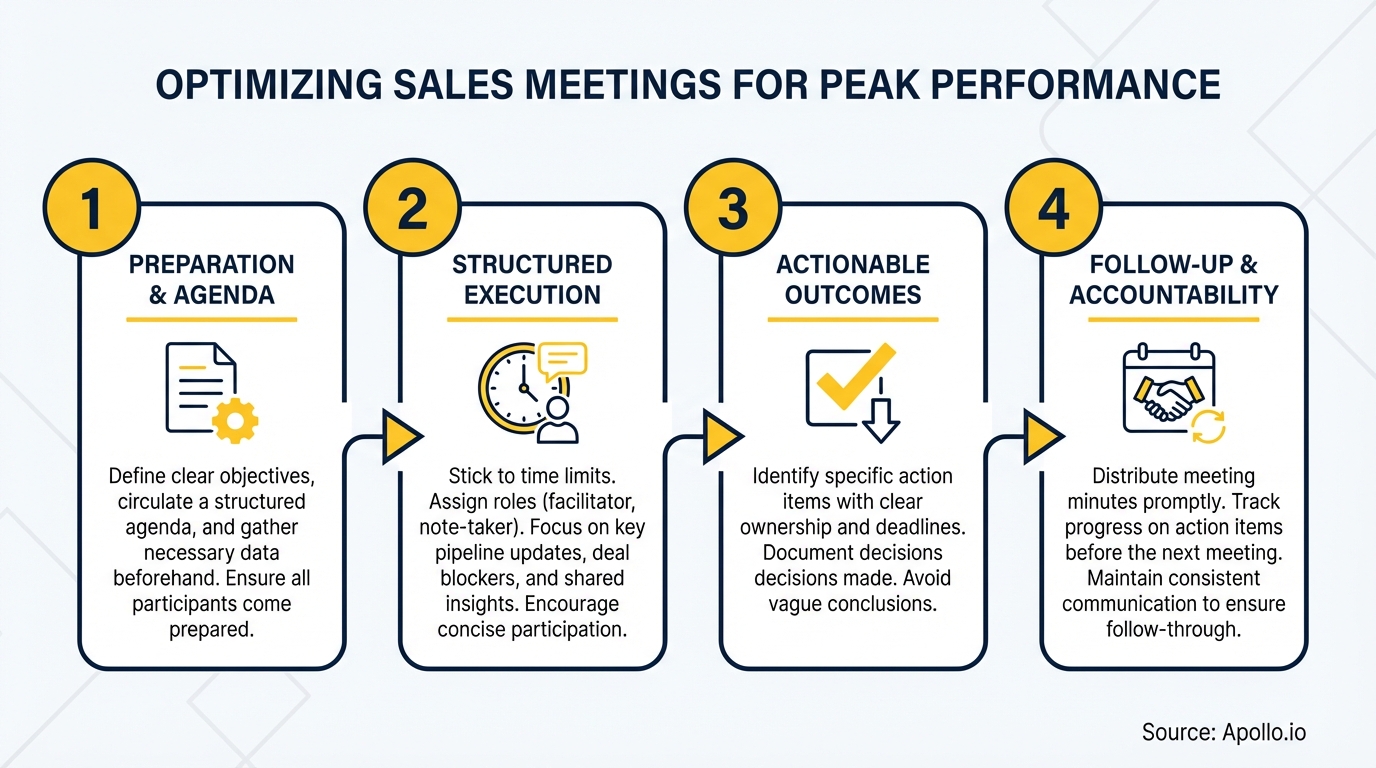
Preparation determines outcome more than any in-meeting tactic. Buyers have already done their research before agreeing to meet — your job is to show up knowing more about their situation than they expected.
Strong prep takes 15–30 minutes and covers four areas.
- Account intelligence: Recent news, funding rounds, leadership changes, and active initiatives at the target company.
- Stakeholder mapping: Who's in the room, their role in the buying decision, and their likely objections.
- Custom agenda: Sent in advance, tied to the buyer's stated goals — not a generic slide deck order.
- Proof points: Relevant case studies, benchmarks, or data specific to the buyer's industry or use case.
Struggling to get meetings booked in the first place? Apollo's prospecting platform gives reps verified contact data, buying signals, and account intelligence to reach the right buyers before competitors do.
"Now we know exactly what we want to say and who we want to say it to. It's just a matter of going into Apollo and making it happen."
Turn Weak Funnels Into Pipeline Gold
Pipeline forecasting a guessing game because marketing leads never convert? Apollo surfaces high-intent prospects already showing buying signals — so your reps work opportunities, not dead ends. Join 90K paying customers building real pipeline.
Start Free with Apollo →What Does a Winning Sales Meeting Structure Look Like?
The best sales meetings follow a tight structure that keeps the buyer engaged and drives toward a clear next step. Improvised meetings rarely close deals.
Here's the framework that works across discovery, demo, and closing conversations.
- Open with alignment (2–3 min): Confirm the agenda, time available, and what success looks like for the buyer by the end of the call.
- Diagnose before prescribing (30–40% of time): Ask layered questions about current state, desired state, and the cost of inaction.
- Connect solution to pain (30–40% of time): Show only what's relevant. Every feature should map to a stated problem.
- Handle objections proactively (10–15% of time): Surface concerns before they become deal-killers. Acknowledge, validate, resolve.
- Confirm the next step (5 min): Get a specific commitment — a date, a stakeholder intro, or a signed agreement. Never end on "I'll follow up."
For high-stakes enterprise deals, read our guide to enterprise sales strategies for closing mega deals to adapt this structure for complex buying committees.

How Do You Handle Last-Minute and Ad Hoc Sales Meetings?
Meeting schedules are increasingly unpredictable. The rise of ad hoc conversations means reps must be ready to run a credible meeting with minimal prep time. A 5-minute prep kit solves this problem.
The 5-Minute Pre-Meeting Checklist:
- Pull the account record: last activity, open opportunities, recent notes.
- Scan the company's recent news (one headline is enough to open strong).
- Confirm who you're meeting and their title — adjust your opener accordingly.
- Identify one specific outcome you want by the end of the call.
- Have one relevant case study or proof point ready to reference.
Teams using structured sales productivity systems build these habits into their daily workflow so ad hoc prep becomes automatic rather than reactive.
What Is a Mutual Action Plan and When Should You Use One?
A mutual action plan (MAP) is a shared document between seller and buyer that outlines every step required to reach a signed agreement, with owners and deadlines on both sides. MAPs are the single most effective tool for managing complex, multi-stakeholder deals.
Use a MAP when: there are three or more decision-makers involved, the sales cycle exceeds 30 days, or procurement/legal review is required. A basic MAP includes:
- Agreed decision date and contract start date.
- Required approvals and who owns each (buyer side and seller side).
- Milestones: security review, legal redline, executive sign-off.
- Communication cadence between meetings.
MAPs reduce deal slippage by giving buyers a shared stake in the timeline. When a buyer co-creates the plan, they're less likely to go dark.
How Does Messaging Consistency Affect Sales Meeting Outcomes?
Trust is fragile in sales. Gartner's research found that 69% of B2B buyers report inconsistencies between what a vendor's website says and what sellers tell them in meetings. That gap destroys credibility at exactly the moment you need it most.
To close the consistency gap, run a simple pre-meeting QA check:
- Do your deck claims match what's published on your website?
- Are pricing estimates within the range your team is quoting?
- Do case study results cited in the meeting match published case studies?
- Are feature capabilities described accurately relative to your current product?
Sales leaders should audit meeting decks quarterly against live website content. A single inconsistency — especially in a competitive evaluation — can hand the deal to a competitor.
"A lot of deals at the enterprise level are driven through outbound. Apollo has been huge in helping us to get our foot in the door with those accounts."
How Do AI Tools Improve Sales Meeting Outcomes?
AI is transforming the before, during, and after of every sales meeting. The shift is from passive note-taking to active workflow automation — and it's compressing follow-up cycles significantly.
| Meeting Phase | AI Capability | Practical Benefit |
|---|---|---|
| Pre-meeting | Auto-generated account briefs, contact enrichment | Faster prep, better personalization |
| During meeting | Real-time transcription, talk-track prompts | Rep stays present, nothing missed |
| Post-meeting | Auto-summary, CRM field updates, follow-up drafts | Admin eliminated, faster follow-up |
Platforms like Apollo's AI call assistant capture conversation intelligence and surface next-step recommendations automatically — so reps spend less time on admin and more time closing. Explore how AI sales tools are reshaping the entire revenue workflow.
What Metrics Should You Track to Measure Sales Meeting Success?
Meetings are only valuable if they move deals forward. Track these metrics to identify what's working and where your process breaks down.
- Meeting-to-opportunity rate: What percentage of first meetings become qualified opportunities?
- Meeting-to-close rate: How many opportunities that include a demo or discovery call result in closed-won revenue?
- No-show rate: High no-shows signal a prospecting or qualification problem upstream.
- Average meetings per deal: Track by deal size to understand cycle complexity and resource allocation.
- Next-step commitment rate: What percentage of meetings end with a confirmed next step on the calendar?
Use sales analytics to connect meeting activity data to pipeline outcomes. Teams that instrument this data make faster coaching decisions and spot conversion drop-offs before they become quarter-ending problems.
Conclusion: Make Every Sales Meeting Count
In 2026, buyers grant fewer meetings and arrive better informed. The teams winning deals are the ones that treat every sales meeting as a high-value event — with structured prep, consistent messaging, a clear agenda, and automated follow-through.
The reps who book more meetings and close more of them share one advantage: they spend less time on admin and more time on the conversations that matter. That starts with having the right data, the right outreach, and the right tools in one place.
Ready to book more meetings and close more deals? Start a free trial with Apollo and see how the all-in-one GTM platform helps teams prospect smarter, engage faster, and turn meetings into revenue.
Apollo Proves ROI Before Budget Review
ROI pressure killing your tool adoption? Apollo delivers measurable pipeline impact fast — so your next budget conversation is a victory lap, not a justification. Leadium 3x'd their revenue. You're next.
Start Free with Apollo →Don't miss these
Sales
Inbound vs Outbound Marketing: Which Strategy Wins?
Sales
What Is a Sales Funnel? The Non-Linear Revenue Framework for 2026
Sales
What Is a Go-to-Market Strategy? The 2026 GTM Playbook
See Apollo in action
We'd love to show how Apollo can help you sell better.
By submitting this form, you will receive information, tips, and promotions from Apollo. To learn more, see our Privacy Statement.
4.7/5 based on 9,690 reviews
