What Sales Meeting Ideas Actually Work in 2026?
Sales meetings are changing faster than most teams realize. By 2025, 80% of B2B sales interactions between suppliers and buyers are projected to occur in digital channels. Yet most meeting strategies still center on the traditional discovery-demo-close format designed for in-person selling. The gap between buyer expectations and seller behavior has never been wider.
Modern buyers don't want more meetings. They want self-serve assets, consistent messaging, and efficient decision-making processes that respect their time.
The best sales meeting ideas for 2026 solve these problems by replacing status updates with decision meetings, leveraging AI to standardize prep and follow-up, and designing agendas around attention constraints rather than seller convenience.

Get Verified Contacts In Seconds With Apollo
Tired of spending 4+ hours daily hunting for contact info? Apollo delivers 224M+ verified contacts with 96% email accuracy. Join 500,000+ companies who eliminated manual research.
Start Free with Apollo →Key Takeaways
- B2B buyers increasingly prefer rep-free experiences, with approximately 75% of B2B buyers preferring a sales experience without direct interaction with sales representatives
- Meeting effectiveness depends on pre-meeting assets (ROI calculators, stakeholder packs, async videos) that buyers can consume independently
- AI-powered meeting prep and recap tools now enable standardized qualification frameworks (MEDDICC, BANT) and reduce post-meeting admin
- Deal stalls affect 91% of B2B purchases due to multi-stakeholder complexity (average 13 decision-makers), requiring internal alignment playbooks
- Agenda engineering for 15-25 minute blocks with async pre-reads combats meeting overload and improves outcome quality
Why Traditional Sales Meeting Formats Are Failing
The traditional sales meeting playbook assumes buyers want seller-led interactions. Research shows the opposite.
B2B buyers report inconsistencies between vendor websites and seller conversations 69% of the time, and 73% actively avoid suppliers who send irrelevant outreach. These friction points turn meetings into obstacles rather than accelerators.
The root cause is structural. Most sales meetings prioritize seller activity (discovery questions, feature demos, objection handling) over buyer outcomes (internal consensus, risk mitigation, procurement alignment).
When buying groups average 13 people and 91% of purchases stall at some point, meeting content must shift from "what we sell" to "how you buy."
"The thing that made me most excited as somebody who's been in sales development a long time was Apollo's integration between sales data and sales engagement and the magic that you can make happen when those two are together on the same platform."
Need better meeting prep data? Apollo's 224M+ verified contacts provide the account intelligence you need before every call.
Meeting-to-Asset Map: Replace Meetings with Self-Serve Resources
The best meeting strategy starts with reducing unnecessary meetings. For each traditional meeting type, create a self-serve asset that buyers can consume independently.
Reserve synchronous time for decision-making, not information transfer.
| Meeting Type | Self-Serve Asset | Sync Meeting Goal | Attendance |
|---|---|---|---|
| Discovery | Diagnostic questionnaire, ROI calculator | Validate findings, prioritize use cases | Champion + 1-2 users |
| Demo | Personalized video walkthrough, sandbox access | Answer technical questions, confirm fit | Technical buyer + users |
| Business Case | ROI model, customer proof points | Align on assumptions, address risks | Economic buyer + finance |
| Procurement Review | Security docs, contract redlines FAQ | Resolve blockers, commit timeline | Procurement + legal |
This approach respects buyer autonomy while ensuring sellers control the narrative. The self-serve asset becomes the "source of truth" that reduces messaging inconsistency. The meeting becomes a decision checkpoint rather than a content delivery mechanism. Learn more about running successful sales meetings with modern best practices.

Agenda Engineering for Attention-Constrained Buyers
Meeting overload is real. Employees are interrupted every 2 minutes on average, and 57% of meetings are ad hoc with no calendar invite.
Traditional 60-minute meetings assume sustained attention that buyers no longer have. Agenda engineering solves this by designing meetings around 15-25 minute decision blocks.
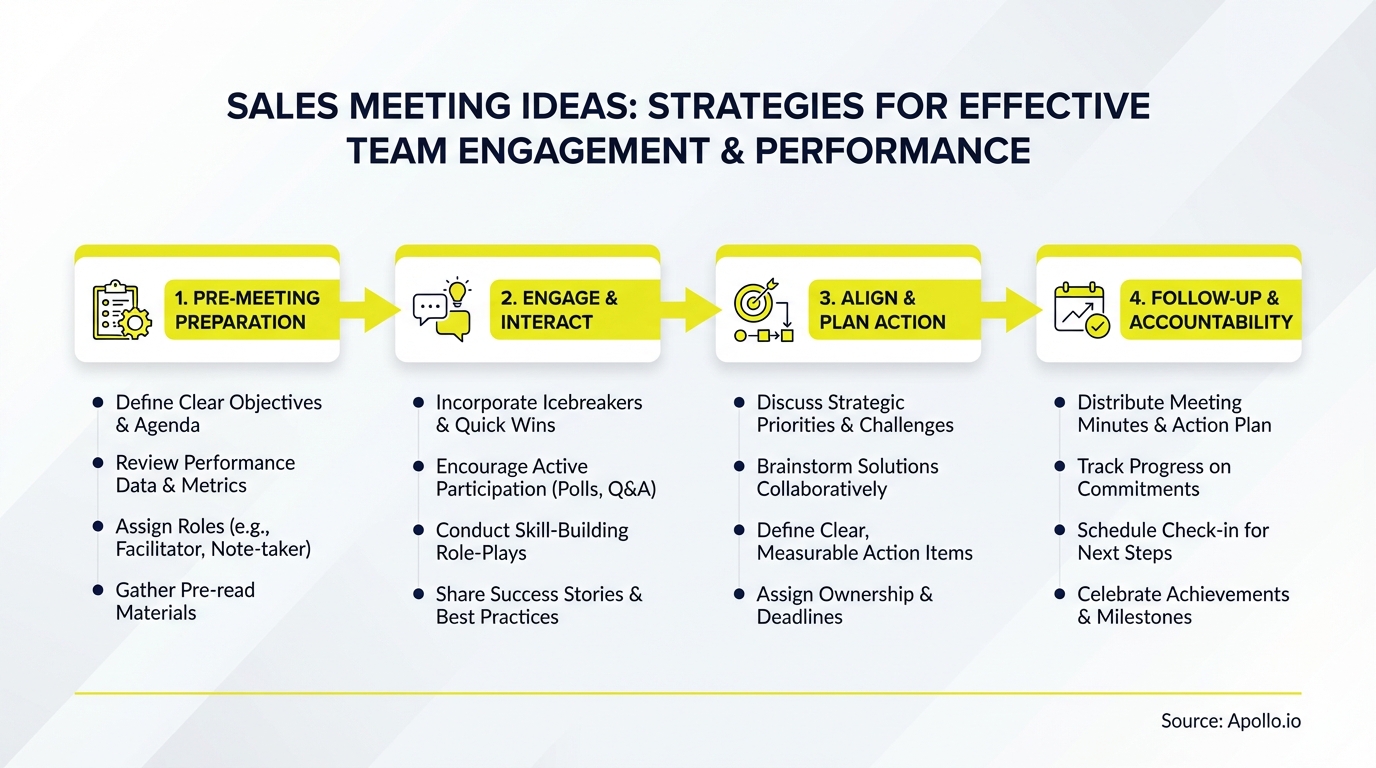
Pre-Meeting (Async):
- Send pre-read 48 hours before meeting (max 2 pages or 5-minute video)
- Include decision framework: "At the end of this meeting, we need to decide X"
- Share stakeholder map showing who owns which decision
During Meeting (15-25 Minutes):
- Minutes 1-5: Confirm pre-read understanding, surface new questions
- Minutes 6-15: Decision-focused discussion (risks, trade-offs, next steps)
- Minutes 16-20: Document decisions, assign owners, set deadlines
- Minutes 21-25: Buffer for overrun or early close
Post-Meeting (Automated):
- AI-generated recap with decisions, actions, and owners (pushed to CRM within 24 hours)
- Mutual action plan update showing progress toward close
- Next meeting pre-read to maintain momentum
This structure forces clarity. If you can't articulate the decision in the pre-read, you're not ready for the meeting. If the meeting runs past 25 minutes, you've included information transfer that belongs in async content. Top sales teams like HubSpot use similar time-boxing to maximize meeting ROI.
Internal Alignment Playbook to Prevent Deal Stalls
91% of B2B purchases stall at some point, often due to internal misalignment rather than external objections. The best meeting ideas for 2026 include internal enablement sessions that help champions navigate their own organization.
These aren't "sales meetings" in the traditional sense but they directly impact close rates.
Champion Enablement Session (30 Minutes):
- Review stakeholder map: who supports, who's neutral, who opposes
- Provide "internal pitch deck" champion can present without you
- Anticipate objections by role (finance, IT, procurement, end users)
- Script: "When your CFO asks about ROI, here's the two-sentence answer..."
Procurement Pre-Brief (15 Minutes):
- Send security/compliance docs before procurement enters process
- Offer direct line to your procurement specialist (not AE)
- Provide contract redlines FAQ addressing common asks
- Timeline commitment: "We'll turn around redlines in 48 hours"
Risk Review with IT/Security (20 Minutes):
- Architecture diagrams, data flow maps, compliance certifications
- Reference customer in same industry who passed security review
- Offer proof-of-concept or sandbox for technical validation
- Clear escalation path for unresolved technical questions
"We reduced the complexity of three tools into one. We're getting higher reply rates, open rates are doubled, meetings are up, and speed to booking a meeting is cut in half."
These internal alignment meetings acknowledge that your champion is selling internally on your behalf. Give them the tools to win those conversations. Track complex deals with Apollo's deal management platform to ensure no stakeholder or milestone falls through the cracks.
See Every Deal In Real Time With Apollo
Pipeline forecasting a guessing game? Apollo delivers real-time visibility across every deal stage so you can predict revenue with confidence. Built-In increased win rates 10% with Apollo's intelligence.
Start Free with Apollo →AI-Powered Meeting Prep and Follow-Up
By 2028, Gartner predicts that 60% of B2B seller work will be done by generative AI technologies, up from less than 5% in 2023. Meeting prep and follow-up are the first workflows being transformed. AI now generates prep briefs, suggested questions, meeting recaps, and CRM updates, shifting "meeting ideas" from brainstorming to governance.
AI Meeting Prep (Daily Digest):
- Summarizes upcoming meetings with context (last interaction, open issues, stakeholder changes)
- Suggests next-best actions based on deal stage and historical win patterns
- Flags risks (long silence, competitor mention, budget concerns) requiring attention
AI Meeting Recap (Automated Post-Meeting):
- Transcribes meeting and extracts key decisions, action items, and risks
- Populates CRM fields (MEDDICC scores, next steps, close date confidence)
- Generates follow-up email draft with agreed-upon actions and owners
- Creates reusable templates for consistent deal qualification across team
Governance Requirements:
- Define what AI can draft vs. what humans must verify (pricing, commitments, legal terms)
- Standardize meeting recap templates to enforce qualification frameworks
- Audit AI-generated content for messaging consistency and claim substantiation
- Train reps on prompt engineering: better inputs create better outputs
Without governance, teams scale bad prep faster. With governance, AI becomes a force multiplier that ensures every meeting advances the deal. Explore how sales automation software can standardize your meeting workflows.
Measuring Meeting Effectiveness Beyond Activity Metrics
Most teams measure meeting volume (calls per day, meetings booked) rather than meeting quality (decisions made, deals advanced). The shift to outcome-based measurement requires new KPIs that tie meetings to pipeline velocity and win rates.
| Old Metric | New Metric | Why It Matters |
|---|---|---|
| Meetings booked | Meetings with decision made | Measures meeting quality, not just volume |
| Demo completion rate | Technical validation completion rate | Tracks buyer progress, not seller activity |
| Follow-up tasks created | Follow-up tasks completed on time | Measures execution, not just intention |
| Call duration | Time to next decision checkpoint | Optimizes for deal velocity, not meeting length |
Track these metrics in your CRM and review weekly. Identify patterns: which meeting types correlate with faster close rates? Which AEs consistently advance deals after meetings? Which pre-meeting assets lead to higher decision rates? Use this data to refine your meeting playbook continuously. Sales analytics platforms make these insights actionable at scale.
Meeting Format by Interaction Mode
Not all meetings should be virtual, and not all buyers want synchronous interaction. McKinsey's B2B Pulse research shows a "rule of thirds" where one-third of buyers prefer in-person, one-third prefer remote, and one-third prefer digital self-serve at any given buying stage.
Match meeting format to buyer preference and deal complexity.
In-Person (High-Stakes Decisions):
- Executive business reviews with C-suite stakeholders
- Multi-stakeholder alignment sessions requiring real-time consensus
- Technical deep-dives with hands-on product validation
- Contract negotiation and final close meetings
Remote Video (Standard Deal Progression):
- Discovery and qualification calls
- Product demonstrations and use case walkthroughs
- Champion check-ins and deal coaching
- Internal team syncs and forecast reviews
Digital Self-Serve (Early Exploration):
- Product tours and interactive demos
- ROI calculators and business case builders
- Customer proof points and case study libraries
- Technical documentation and implementation guides
Ask buyers their preference early. Default to their preferred mode unless deal complexity requires escalation. The goal is buyer convenience, not seller efficiency. For tips on multi-channel engagement beyond meetings, see our guide on social selling strategies.
Common Meeting Mistakes That Kill Deals
Even with modern tools and frameworks, basic execution errors still derail meetings. Avoid these patterns that buyers consistently cite as reasons for disengagement.
Preparation Failures:
- Not researching attendees (roles, priorities, recent company news)
- Skipping the pre-read, forcing information transfer during sync time
- Failing to confirm decision criteria and meeting success outcomes upfront
- Inviting wrong stakeholders or too many people (meeting bloat)
Execution Failures:
- Talking past 25 minutes without a decision or clear next step
- Presenting features buyers didn't ask for ("demo vomit")
- Failing to document decisions and actions in real-time
- Ending without mutual commitment (date, next meeting, deliverable)
Follow-Up Failures:
- Sending recap more than 24 hours after meeting (momentum loss)
- Generic follow-up that doesn't reference specific meeting commitments
- No mutual action plan showing both parties' next steps and deadlines
- Failing to surface new risks or blockers that emerged during meeting
These mistakes are preventable with checklists and templates.
Treat meeting execution as a repeatable process, not an improvised performance. Learn proven techniques for structuring compelling sales conversations.
Getting Started: Your 30-Day Meeting Transformation Plan
Week 1 (Audit): Review last 20 meetings. Which advanced deals? Which were information transfer that could have been async? Identify patterns.
Week 2 (Assets): Build 3 self-serve assets (diagnostic tool, ROI calculator, technical FAQ). Test with 5 prospects before scaling.
Week 3 (Templates): Create standardized pre-read template, meeting agenda template, and AI recap template.
Train team on usage.
Week 4 (Measure): Implement new KPIs (decisions per meeting, time to next checkpoint). Review weekly with team to identify improvements.
Start small with one meeting type (discovery or demo) and one rep. Perfect the process before rolling out team-wide. Change management matters more than the perfect framework.

Conclusion
Sales meeting ideas for 2026 look nothing like traditional discovery-demo-close playbooks. The best meetings are short, decision-focused, and backed by self-serve assets that respect buyer autonomy.
AI standardizes prep and follow-up, reducing admin burden while improving consistency. Internal alignment sessions help champions navigate their organizations, preventing the stalls that derail 91% of purchases.
The shift from activity metrics to outcome metrics forces teams to ask: did this meeting advance the deal? If not, it shouldn't have happened.
This discipline, combined with modern tools and buyer-centric design, transforms meetings from necessary evils into competitive advantages.
Ready to transform your meeting effectiveness? Get Leads Now and start building a pipeline with Apollo's all-in-one sales platform.
Prove Apollo's ROI In Your First 30 Days
Budget approval stuck on unclear metrics? Apollo tracks every touchpoint from first contact to closed deal so you can show leadership exactly what's working. Built-In increased win rates 10% with Apollo's intelligence.
Start Free with Apollo →Don't miss these
Sales
Inbound vs Outbound Marketing: Which Strategy Wins?
Sales
What Is a Sales Funnel? The Non-Linear Revenue Framework for 2026
Sales
What Is a Go-to-Market Strategy? The 2026 GTM Playbook
See Apollo in action
We'd love to show how Apollo can help you sell better.
By submitting this form, you will receive information, tips, and promotions from Apollo. To learn more, see our Privacy Statement.
4.7/5 based on 9,690 reviews
