
What Are Sales Materials? Types, Templates, and Best Practices for 2026
Sales materials are the documents, decks, videos, and digital assets that support every stage of the buyer's journey — from first awareness to signed contract. Done right, they do the selling when your reps aren't in the room. According to TryKondo, 90% of B2B buyers say online content has a moderate to major impact on their purchasing decisions. That means your collateral library is a revenue asset, not an afterthought. Pair strong materials with sharp sales analytics and you have a system that compounds over time.

Research Less, Close More With Apollo
Tired of burning hours verifying contact info that goes nowhere? Apollo delivers 224M contacts with 96% email accuracy so your team spends time selling, not searching. Start building real pipeline today.
Start Free with Apollo →Key Takeaways
- Sales materials cover every format buyers use to evaluate independently — decks, one-pagers, case studies, ROI calculators, and more.
- Modern buying groups average 13 stakeholders, so role-specific assets (IT, Finance, Executive, Procurement) outperform generic decks.
- 65% of B2B content goes unused — the fix is aligning assets to buyer stage and role, not just producing more content.
- Pre-sales materials (problem-framing, why-change decks) influence shortlist formation before a rep ever engages.
- Apollo consolidates prospecting, outreach, and pipeline into one workspace — so your materials always reach the right contacts at the right time.
What Are Sales Materials?
Sales materials are any content assets used to educate, persuade, or move a prospect through the buying process. They span formats from slide decks and one-pagers to interactive ROI calculators and short-form video.
The term is often used interchangeably with "sales collateral" or "sales enablement content."
Sales materials are NOT the same as marketing campaigns. Marketing drives awareness at scale. Sales materials support individual deals — they answer specific objections, justify budget, and build stakeholder consensus. A well-structured sales pitch depends on having the right materials ready at every stage.
What Types of Sales Materials Matter Most in 2026?
Different assets serve different stages. The most effective teams build libraries organized by funnel stage and stakeholder role — not just by format.
| Stage | Asset Type | Primary Audience |
|---|---|---|
| Pre-Sales / Awareness | Category POV, problem-framing deck, why-change one-pager | Champion, Executive Sponsor |
| Evaluation | Product data sheets, comparison sheets, security FAQ, demo video | IT/Security, End-User, Finance |
| Justification | ROI calculator, business case template, reference stories | Finance, Executive Sponsor |
| Procurement / Close | Implementation plan, vendor comparison sheet, procurement pack | Procurement, Legal, IT |
Research from MarketingLTB shows 65% of B2B content goes completely unused. The reason is almost always a mismatch between what was created and what buyers actually need at decision time. Late-stage assets — technical data sheets, interactive tools, procurement packs — are chronically under-produced.
Turn Funnel Guesswork Into Qualified Pipeline
Tired of watching marketing leads stall before they ever reach your pipeline? Apollo surfaces high-fit prospects and buying signals so your team works deals that actually close. 550K+ companies trust Apollo to forecast with confidence.
Start Free with Apollo →How Do SDRs and AEs Use Sales Materials Differently?
SDRs and AEs have distinct needs from the same content library. Understanding that split prevents wasted assets and faster deal velocity.
SDRs use sales materials to open conversations and establish credibility before a meeting is booked. Their go-to assets include:
- Short-form proof snippets (1–2 sentence customer outcomes) for cold email personalization
- Thought leadership one-pagers to attach to follow-up sequences
- Problem-framing decks that make the "why change" case before a discovery call
AEs use materials to build multi-stakeholder consensus and reduce procurement friction. Their critical assets include:
- Role-specific leave-behinds (IT security FAQ, finance ROI summary, executive brief)
- Mutual success plans and implementation timelines
- Competitive comparison sheets for late-stage objection handling
For AEs managing enterprise deals, having a complete multi-stakeholder asset set is the difference between deals stalling in committee and moving to close. Struggling to get materials in front of the right contacts? Automate multi-channel sequences with Apollo's sales engagement platform to deliver the right asset to every stakeholder at the right time.

Why Do Most Sales Materials Fail to Drive Decisions?
Three root causes explain most collateral failures:
- Wrong stage, wrong role. A generic product deck sent to a procurement manager does nothing. Assets must match both the buyer's stage and their specific concerns.
- No pre-sales presence. Forrester reported in 2025 that 92% of buyers have a shortlist before they engage a vendor. If your materials aren't influencing that shortlist formation, you're starting late.
- Sales-marketing misalignment. According to Semrush, 45% of B2B marketers find alignment between sales and marketing teams difficult — which means sales teams often lack assets that match their real deal conversations.
The fix combines role-based asset mapping with a feedback loop between AEs and content creators. AEs flag which assets are actually being shared and which are going unused. RevOps leaders use that data to prioritize production and retire stale content. Learn how to connect content performance to revenue in our guide to sales KPIs to track in 2026.
What Does a Strong Sales Materials System Look Like?
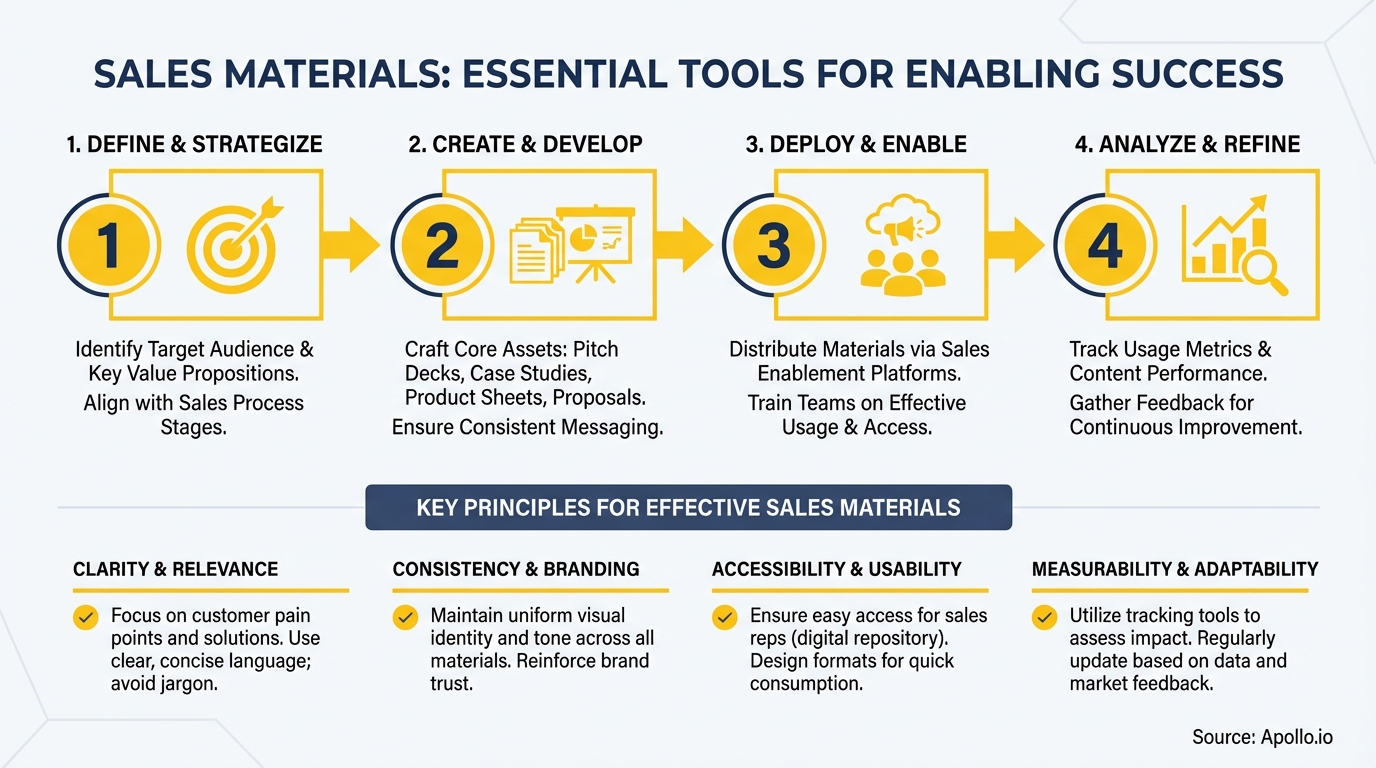
A complete sales materials system has four components working together:
- Asset library organized by role and stage — not just by format. Every asset has a clear owner, audience, and expiry date.
- Interactive decision tools — ROI calculators, integration fit checkers, and readiness assessments that buyers can self-serve. These are especially powerful for rep-free evaluation phases.
- Video kit — modular clips by role (executive overview, security/privacy walkthrough, implementation steps). Taboola reports that 61% of B2B marketers expect increased investment in video — and for good reason, as role-specific demo clips accelerate async evaluation.
- Governance layer — approval workflows for AI-assisted content, version control, and QA checks before any asset becomes customer-facing.
RevOps leaders find that treating the asset library as a living system — with usage data, win/loss tagging, and quarterly audits — dramatically reduces the 65% unused-content problem. Connect your asset strategy to your revenue operations framework to ensure content investment maps directly to pipeline outcomes.
Need to get your materials in front of the right buyers faster? Build and qualify your pipeline with Apollo's AI-powered pipeline builder — so every asset reaches a contact who actually matches your ICP.
How Should Sales and Marketing Teams Align on Sales Materials?
Alignment between sales and marketing is the multiplier that makes or breaks a collateral strategy. Organizations with strong sales and marketing alignment achieve 208% higher marketing revenue than those with poor alignment, according to Brainstorm Club.
Practical alignment steps:
- Run a monthly "content gap" review where AEs share the top 3 objections or questions their deals surfaced that week
- Tag every asset in your library with deal stage, persona, and industry vertical so reps can filter — not browse
- Give marketing access to deal outcome data so they can see which assets correlate with closed-won vs. stalled deals
- Assign a content DRI (directly responsible individual) for each product area or persona
This feedback loop also feeds your sales tech stack — when your CRM tracks which assets were shared in winning deals, you build a repeatable playbook instead of guessing what works.
How to Build a Sales Materials Library That Actually Gets Used
Start with an audit, not production. Map what you have against the stage-and-role matrix above.
Most teams discover they over-index on awareness content and have almost nothing for procurement and late-stage justification.
Build in this order:
- Champion pack — one-pager, ROI summary, and talking points your buyer's internal champion can share without you in the room
- Procurement-ready pack — security FAQ, implementation timeline, vendor comparison sheet, standard contract terms summary
- Interactive ROI calculator — self-serve, shareable, and tied to your buyer's specific metrics
- Role-specific video clips — 90-second maximum, one stakeholder concern per clip
- Pre-sales problem-framing content — category POV, why-change narrative, industry benchmarks
Once built, your sales productivity compounds. Reps stop recreating assets from scratch on every deal and spend their time on high-value conversations instead.

Start Closing More Deals with the Right Sales Materials
Sales materials are not a design project — they are a revenue system. The teams winning in 2026 treat their asset library the same way they treat their pipeline: with clear ownership, regular audits, and performance data driving every decision.
Map your assets to buyer stage and stakeholder role. Build the interactive and late-stage content your competitors are skipping.
Align sales and marketing around deal feedback, not just campaign metrics. And make sure every asset reaches the right contact at the right moment in the buying journey.
Apollo gives SDRs, AEs, and RevOps teams a unified platform to find the right buyers, engage them across channels, and track which touchpoints move deals forward. Start a free trial with Apollo and put your best sales materials in front of the buyers who are ready to act.
Prove Pipeline ROI With Apollo
ROI pressure killing your next budget approval? Apollo delivers measurable pipeline impact your leadership can't ignore. Leadium 3x'd annual revenue — see what Apollo can justify for your team.
Schedule a Demo →Don't miss these
Sales
Inbound vs Outbound Marketing: Which Strategy Wins?
Sales
What Is a Sales Funnel? The Non-Linear Revenue Framework for 2026
Sales
What Is a Go-to-Market Strategy? The 2026 GTM Playbook
See Apollo in action
We'd love to show how Apollo can help you sell better.
By submitting this form, you will receive information, tips, and promotions from Apollo. To learn more, see our Privacy Statement.
4.7/5 based on 9,690 reviews
