Sales Manager Interview Questions That Reveal Top Performers
Hiring the right sales manager can boost team performance by up to 6×, yet most interviews fail to identify candidates who actually deliver results. With sales cycles lengthening and teams overwhelmed by technology, sales leaders need a structured framework that tests coaching systems, transformation leadership, and the ability to simplify workflows. Traditional sales interview questions fall short because they focus on rehearsed stories rather than measurable competencies.
This guide provides an evidence-based interview framework grounded in 2026 research, with questions that reveal real management capability through practical scenarios, metrics, and role-specific demonstrations.

Apollo Finds Verified Contacts In Seconds
Tired of spending 4+ hours daily hunting for contact info? Apollo delivers 224M+ verified contacts with 96% email accuracy. Join 550K+ companies who eliminated manual research.
Start Free with Apollo →Key Takeaways
- Test coaching systems with specific cadence templates, rubrics, and leading indicators
- Evaluate transformation leadership through case prompts that measure adoption and commercial results
- Screen for tool rationalization skills by asking candidates to quantify how they reduce team workload
- Use structured scorecards with pass/fail signals and evidence requests to eliminate bias
- Incorporate role-plays and pipeline reviews that candidates can't prepare with AI tools
What Are Sales Manager Interview Questions and Why Do They Matter?
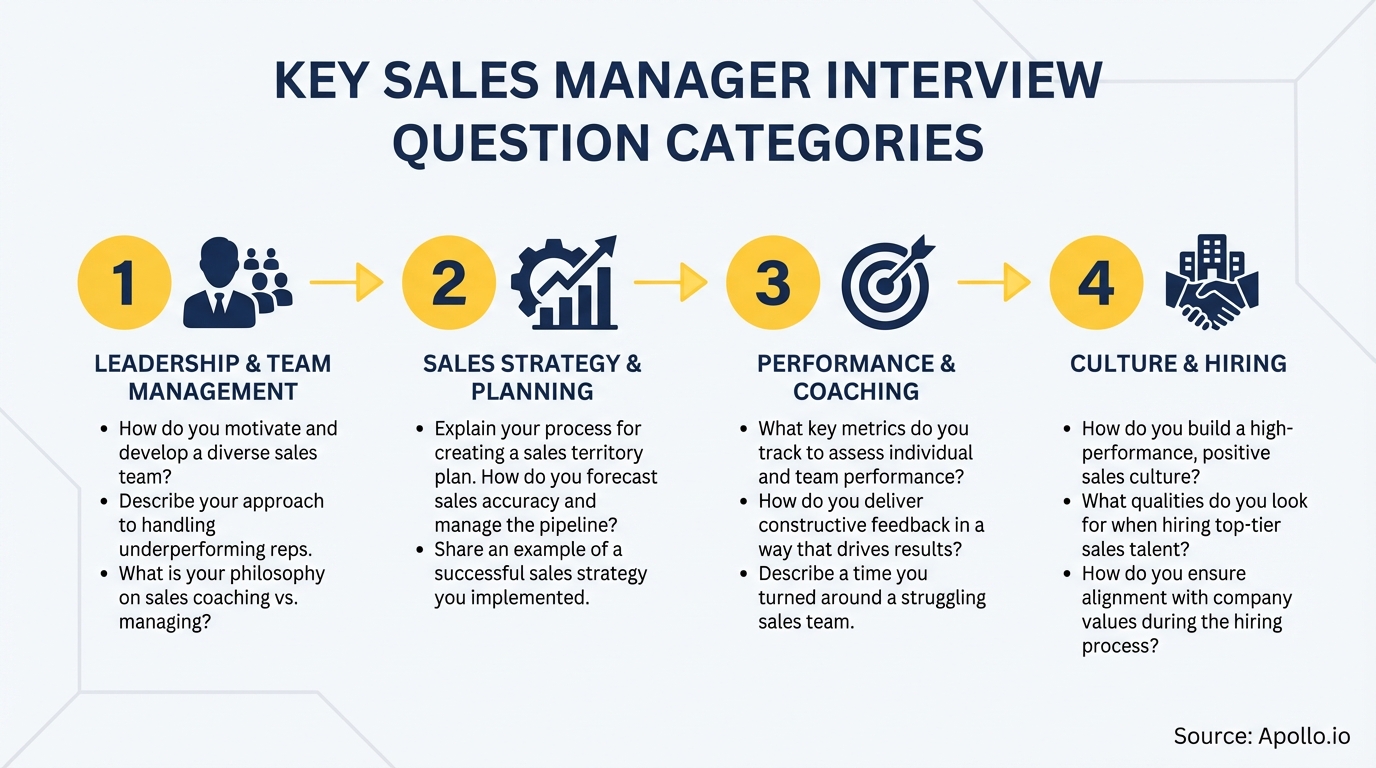
Sales manager interview questions are structured prompts designed to assess a candidate's ability to coach teams, drive revenue, and lead through organizational change. According to High5Test, employers are looking for sales managers who can articulate their sales skills, understand sales processes, customer service, handle objections, and build customer relationships.
Effective questions go beyond generic leadership scenarios. They test specific competencies like pipeline hygiene, CRM discipline, forecasting accuracy, and the ability to simplify seller roles. Research from Sales Xceleration shows organizations that invested in thorough sales team assessments were better positioned to identify top performers and uncover development needs, which helped reduce mis-hires.
In 2026, interview questions must also account for AI-assisted candidates. Teams are shifting toward live problem-solving, role-plays, and "show your work" demonstrations that reveal true competence rather than polished, rehearsed answers.
How Do Sales Leaders Screen for Coaching Capability?
Coaching is the primary value driver for sales managers, yet only 55% of CSOs say their frontline managers consistently meet performance expectations. Your interview must test whether candidates have a repeatable coaching operating system with measurable impact.
Core Coaching Questions:
- Walk me through your weekly coaching cadence. What specific activities happen on which days?
- Describe your deal review framework. What questions do you ask and in what sequence?
- How do you measure coaching effectiveness? What leading indicators do you track?
- Show me a 1:1 coaching template you've used. What sections does it include and why?
- Tell me about a rep you coached from underperformance to quota attainment. What was your 90-day plan?
Evidence Requests: Ask candidates to share actual coaching artifacts like 1:1 notes, deal review templates, or performance improvement plans. Strong candidates will have documentation showing systematic approaches, not just anecdotes.
For RevOps leaders evaluating sales manager candidates, look for answers that include CRM usage patterns, conversion metrics at each pipeline stage, and how they use data to prioritize coaching focus areas.
What Questions Test Transformation Leadership?
Sales organizations experienced an average of 4 transformations over the past 2 years, but only 11% drove commercial success while executing change. Your interview must assess whether candidates can lead adoption while maintaining revenue performance.
Transformation Leadership Questions:
- Describe a major process or tool change you led. How did you drive adoption while hitting quarterly targets?
- What metrics did you track to measure transformation success beyond completion rates?
- How do you handle resistance from top performers during organizational changes?
- Walk me through your communication cadence during a transformation. Who got what information and when?
- Tell me about a transformation that failed. What would you do differently?
Case Prompt Example: Present a scenario where the company is rolling out new sales engagement software while the team is at 85% of quarterly goal with 3 weeks remaining. Ask: What's your week-by-week plan to maintain forecast while ensuring 80%+ adoption by quarter end?
Strong candidates will outline specific tradeoffs, identify which activities to pause, and describe how they'd segment the team based on adoption readiness and pipeline risk.
How Do You Evaluate Tool Rationalization and Workflow Simplification?
With 70% of sellers overwhelmed by the number of technologies required for their work, sales managers must simplify rather than add complexity. According to The Sales Blog, interview questions should address how candidates would handle underperforming salespeople, describe an average day, share quarterly planning cadences, and discuss past goal achievements and win rates.
Simplification Questions:
- Describe a time you reduced your team's tool count or simplified their workflow. What was the impact?
- If you inherited a team using 8 different sales tools, how would you audit and rationalize the stack?
- How do you measure whether a tool is actually improving productivity versus adding busy work?
- What's your philosophy on tool adoption: mandated compliance or opt-in based on value?
- Walk me through how you'd evaluate whether to consolidate three separate tools into one platform.
Looking to consolidate your sales tech stack? Apollo unifies prospecting, engagement, and intelligence in one workspace, helping sales leaders cut costs and simplify workflows for their teams.
Evidence Request: Ask candidates to quantify tool reduction outcomes. Strong answers include: "We cut from 5 tools to 2, saving $47K annually and reducing onboarding time from 3 weeks to 5 days."
What Questions Reveal Pipeline Management and Forecasting Rigor?
Sales managers must demonstrate operational excellence through pipeline hygiene, accurate forecasting, and data-driven decision-making. With B2B sales cycles lengthening and win rates typically ranging from 15-25% across all pipeline stages, precision matters.
Pipeline and Forecasting Questions:

- Walk me through your weekly pipeline inspection process. What do you look for in each deal?
- How do you define pipeline stages? What exit criteria must be met before a deal advances?
- Describe your forecasting methodology. How do you weight deals and calculate commit vs. best case?
- Tell me about a quarter where your forecast accuracy was off by more than 10%. What happened?
- How do you use sales analytics to identify leading indicators of deal risk?
Live Exercise: Present a sample pipeline report with 15 deals at various stages. Ask the candidate to identify the 3 highest-risk deals and explain their reasoning. Strong candidates will reference deal age, engagement patterns, multi-threading, and competitive dynamics.
For sales leaders managing distributed teams, ask: "How do you maintain pipeline visibility and forecasting accuracy when reps work remotely?" Look for answers that include CRM hygiene standards, regular deal reviews, and early warning systems.
How Do Sales Managers Develop Account Executives and SDRs?
Sales managers must tailor their approach to different roles. SDRs need help with messaging, qualification, and meeting conversion.
Account Executives require support with discovery, multi-threading, and closing strategies.
Role-Specific Development Questions:
- How would you coach an SDR struggling to book meetings despite high activity volume?
- Describe your approach to developing an AE who excels at discovery but struggles to close.
- What's your onboarding plan for a new rep? Break down the first 30, 60, and 90 days.
- How do you identify which skills to prioritize when coaching multiple team members?
- Walk me through how you'd train a team on a new sales pitch approach or messaging framework.
Struggling to give your team accurate contact data for outreach? Apollo provides 224M+ verified business contacts with 96% email accuracy, helping sales managers ensure their reps spend time selling instead of data hunting.
Behavioral Prompt: "Your top AE just lost 3 deals in a row to the same competitor. Walk me through your coaching conversation." Strong candidates will focus on pattern identification, competitive intelligence gaps, and specific skill development rather than generic motivation.
Turn Forecast Guesswork Into Revenue Certainty
Struggling with unreliable pipeline visibility? Apollo delivers real-time deal intelligence and verified contacts so you can forecast with confidence. Built-In boosted win rates 10% with Apollo's scoring.
Start Free with Apollo →What Are Red Flags to Watch for in Sales Manager Interviews?
Certain responses signal candidates who won't succeed in the role. Watch for these warning signs during your interview process:
| Red Flag | Why It Matters | Better Response |
|---|---|---|
| Generic answers without metrics | Cannot measure or improve performance | Specific numbers, percentages, timeframes |
| Blaming reps for underperformance | Lacks coaching accountability | Describes systematic development plans |
| No CRM or data discipline | Cannot forecast or manage pipeline | Detailed inspection and hygiene standards |
| Adding tools without removing any | Creates complexity and overwhelm | Rationalization examples with outcomes |
| Only talks about personal selling | Has not made manager transition | Focus on coaching others to success |
Additional red flags include inability to describe their coaching cadence, lack of transformation experience, or no examples of developing underperformers into quota-achievers.
How Should You Structure the Sales Manager Interview Process?
A complete sales manager interview process includes multiple evaluation methods beyond traditional Q&A. Structure your process across 4-5 stages:
Stage 1: Phone Screen (30 min)
- Verify basic qualifications, team size managed, quota attainment history
- Ask 2-3 behavioral questions about coaching and transformation
- Assess communication clarity and executive presence
Stage 2: Structured Interview (60 min)
- Use consistent scorecard with 12-15 core questions
- Request specific evidence and artifacts for each answer
- Probe for metrics, timelines, and quantified outcomes
Stage 3: Role-Play Assessment (45 min)
- Conduct a mock 1:1 coaching session with underperforming rep scenario
- Run a pipeline review with sample deals requiring risk assessment
- Present a tool consolidation decision requiring tradeoff analysis
Stage 4: Executive Interview (45 min)

- Focus on strategic thinking, culture fit, and leadership philosophy
- Discuss compensation expectations and career goals
- Allow candidate to interview the leadership team
Sales leaders should also review actual work samples like territory plans, QBRs, coaching documentation, and transformation project plans. This approach helps reduce mis-hires and ensures candidates can execute, not just interview well.
Conclusion
Hiring exceptional sales managers requires moving beyond generic interview questions to structured assessments that test coaching systems, transformation leadership, and operational rigor. By focusing on evidence-based evaluation with specific metrics, role-plays, and work samples, you'll identify candidates who actually drive team performance rather than those who simply interview well.
The best sales manager interviews reveal whether candidates can simplify complex workflows, lead through change while maintaining revenue, and build repeatable coaching systems that develop reps at scale. Use the framework and questions in this guide to build an interview process that predicts real management success.
Ready to give your sales team the tools they need to succeed? Start your free Apollo trial and discover how 90K+ paying customers consolidate their sales tech stack into one unified platform for prospecting, engagement, and intelligence.
Prove Apollo's ROI In Your First 30 Days
Budget approval stuck on unclear metrics? Apollo delivers measurable pipeline impact from day one—track time saved, meetings booked, and deals closed. Built-In increased win rates 10% and ACV 10% with Apollo's scoring.
Start Free with Apollo →Don't miss these
Sales
Inbound vs Outbound Marketing: Which Strategy Wins?
Sales
What Is a Sales Funnel? The Non-Linear Revenue Framework for 2026
Sales
What Is a Go-to-Market Strategy? The 2026 GTM Playbook
See Apollo in action
We'd love to show how Apollo can help you sell better.
By submitting this form, you will receive information, tips, and promotions from Apollo. To learn more, see our Privacy Statement.
4.7/5 based on 9,690 reviews
