
Sales Management System: Definition, Benefits, and Implementation Guide
Sales teams in 2026 face a critical challenge: buyers now use up to 10 different channels during their purchase journey, and Gartner predicts that 65% of B2B organizations must shift from intuition-based to data-driven decision-making. A sales management system unifies these fragmented touchpoints into one platform, giving teams the visibility and automation they need to close deals faster. For RevOps leaders and sales managers, the right system eliminates tool sprawl and transforms scattered data into actionable pipeline intelligence.

Scale Quality Leads Without Scaling Headcount
Generating qualified leads at scale shouldn't require doubling your team. Apollo's AI finds your exact ICP with 96% email accuracy while your reps focus on closing. Join 550K+ companies building predictable pipeline.
Start Free with Apollo →Key Takeaways
- A sales management system combines CRM, analytics, and workflow automation in one platform to eliminate tool sprawl and reduce costs
- Modern systems support hybrid selling across 10+ channels, including digital self-serve paths that now account for over 50% of large B2B deals
- Data-driven architecture with real-time enrichment helps SDRs and AEs make smarter decisions and shorten sales cycles by 35%+
- Unified platforms like Apollo replace 3-5 separate tools, cutting tech costs in half while improving team productivity
What Is a Sales Management System?
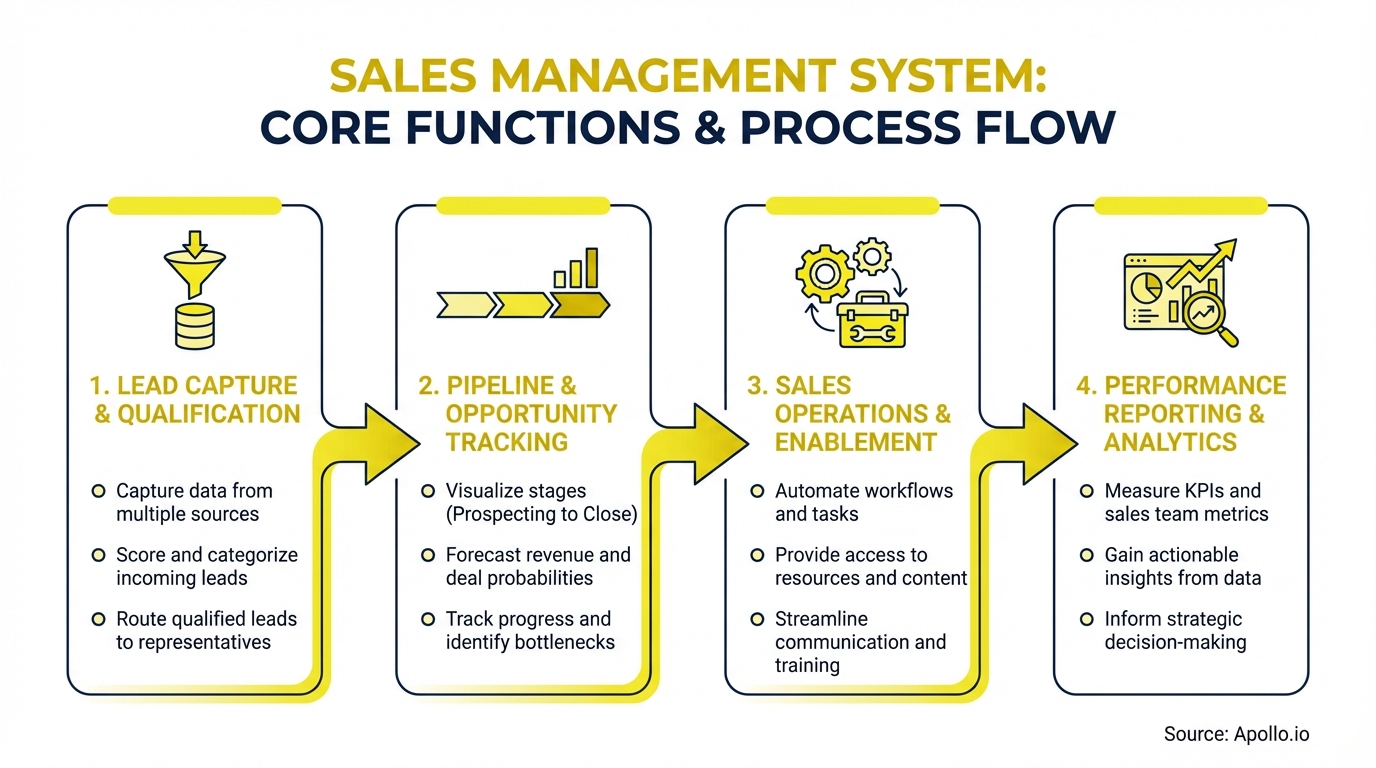
A sales management system is a unified platform that combines contact data, pipeline tracking, engagement tools, and analytics to manage the entire sales process from prospecting to close. Unlike standalone CRM systems, modern sales management systems integrate prospecting, outreach automation, meeting scheduling, and deal management in one workspace.
This eliminates the need for SDRs and AEs to switch between multiple tools, reducing friction and increasing velocity.
The core components include a verified contact database, multi-channel engagement sequencing, conversation intelligence, pipeline visualization, and forecasting analytics. Sales performance management becomes significantly easier when all data flows through a single system rather than scattered across disconnected tools.
Why Do Sales Teams Need a Data-Driven Sales Management System in 2026?
The buying journey has fundamentally changed. Research by McKinsey shows that hybrid selling is now the dominant strategy, with buyers engaging across digital, self-serve, and human-assisted channels simultaneously. Sales leaders can no longer rely on gut instinct when buyers expect personalized experiences across every touchpoint.

According to Gartner, 60% of B2B organizations have already transitioned to data-driven selling by integrating processes, applications, data, and analytics into unified systems. Teams using fragmented tools waste 3-4 hours daily on manual data entry, context switching, and reconciling information across platforms. A unified sales management system eliminates this friction while providing the real-time intelligence needed to compete.
How Does a Sales Management System Architecture Work?
Modern sales management system architecture consists of four core layers that work together seamlessly:
| Architecture Layer | Purpose | Key Components |
|---|---|---|
| Data Foundation | Centralized contact and company intelligence | 224M+ verified contacts, 30M+ companies, real-time enrichment, waterfall verification |
| Engagement Engine | Multi-channel outreach automation | Email sequences, calling, LinkedIn, SMS, meeting scheduling |
| Intelligence Layer | AI-powered insights and recommendations | Conversation intelligence, scoring, forecasting, next-best-action guidance |
| Workflow Automation | Process orchestration and handoffs | Lead routing, task triggers, stage progression, team notifications |
The system ingests signals from all channels, enriches contact records automatically, and surfaces actionable insights to reps at the moment of engagement. Deal management functionality sits at the center, providing visibility into pipeline health and forecasting accuracy.
What Integration Strategy Works Best?
Successful implementations prioritize native integrations with existing CRM systems (Salesforce, HubSpot) while consolidating point solutions into the core platform. Instead of maintaining 5-7 separate tools for prospecting, enrichment, sequencing, calling, and analytics, teams reduce to 1-2 integrated systems.
Apollo customers like Census report cutting costs in half by eliminating redundant subscriptions while improving data quality.
How Do Sales Leaders Build Multi-Channel Engagement Strategies?
Effective multi-channel strategies map each stage of the buyer journey to specific channel combinations. SDRs prospecting cold accounts might use LinkedIn research, email sequences, and phone calls.
AEs nurturing warm opportunities combine demo scheduling, personalized video, and executive engagement.
The key is orchestration. A sales management system automates channel selection based on prospect behavior, engagement history, and conversion data. If email open rates drop below 15%, the system automatically shifts to LinkedIn or phone outreach. Struggling to coordinate outreach across your team? Automate multi-channel sequences with Apollo's engagement platform.
| Sales Stage | Channel Mix | Success Metric |
|---|---|---|
| Cold Outbound (SDR) | Email (60%), Phone (30%), LinkedIn (10%) | 12-15% response rate |
| Warm Lead Nurture (AE) | Email (40%), Phone (40%), Demo/Meeting (20%) | 35-40% meeting conversion |
| Opportunity Acceleration | Phone (50%), Email (30%), In-Person (20%) | 60%+ close rate |
| Enterprise Deals | Executive engagement (40%), Product demos (30%), Business case (30%) | $500K+ ACV |
How Do SDRs and AEs Use Sales Management Systems Differently?
SDRs rely on sales management systems for top-of-funnel activities: building targeted prospect lists, launching automated sequences, and booking qualified meetings. They need speed and volume.
The system must surface high-intent accounts instantly, provide pre-researched talking points, and automate follow-up cadences. SDRs using Apollo report 46% more meetings booked thanks to AI-powered research agents that eliminate manual prospecting work.
Account Executives use the same system differently. They focus on deal progression, stakeholder mapping, and opportunity management. AEs need visibility into buying committee dynamics, conversation history across all touchpoints, and predictive close probability. AI sales tools help AEs prioritize which deals to focus on and what actions will move opportunities forward fastest.
What About Sales Leaders and RevOps Teams?
Sales leaders use the analytics layer to forecast revenue, identify coaching opportunities, and optimize team performance. They track metrics like pipeline velocity, win rates by segment, and rep productivity.
RevOps teams focus on system health: data quality scores, integration uptime, workflow efficiency, and tech stack ROI. Having everything in one system means RevOps maintains one integration instead of seven, dramatically reducing operational overhead.
Turn Forecast Chaos Into Revenue Certainty
Pipeline forecasting a guessing game? Apollo tracks real-time deal stages and signals so you forecast with confidence. Built-In improved win rates 10% using Apollo's intelligence.
Start Free with Apollo →What ROI Can Teams Expect from Consolidating Their Tech Stack?
Tool consolidation delivers measurable financial and productivity benefits. Teams typically replace 3-5 separate tools (prospecting database, email automation, dialer, enrichment, analytics) with one unified platform.
The average cost savings runs 40-60% compared to maintaining multiple subscriptions.
| Cost Category | Before Consolidation | After Consolidation | Savings |
|---|---|---|---|
| Software Subscriptions (10 reps) | $8,000/month | $4,000/month | 50% |
| Integration Maintenance | 8 hours/week | 2 hours/week | 75% |
| Training Time (new hires) | 2 weeks | 3 days | 70% |
| Rep Context Switching | 90 minutes/day | 15 minutes/day | 83% |
Beyond cost savings, productivity gains compound quickly. Reps spend 3-4 fewer hours per week on administrative tasks and tool navigation.
That time converts directly to more prospect conversations and closed deals. Predictable Revenue reduced the complexity of three tools into one with Apollo, while Cyera reported that having everything in one system was a game changer for their team velocity.

Tired of juggling multiple tools and losing deals in the cracks? Unify your pipeline with Apollo's all-in-one deal management system.
How Should Teams Implement a Sales Management System?
Successful implementations follow a phased approach rather than attempting a big-bang migration. Start with one team or use case, prove ROI, then expand.
Phase 1 (Weeks 1-2): Foundation - Migrate contact data, configure CRM integration, set up user permissions.
Import existing sequences and templates.
Train 2-3 power users who will become internal champions.
Phase 2 (Weeks 3-4): Pilot Team - Roll out to 5-10 reps. Focus on core workflows: prospecting, sequencing, calling, meeting scheduling.
Gather feedback daily and adjust configurations. Track adoption metrics and early performance indicators.
Phase 3 (Weeks 5-6): Optimization - Build custom workflows and automation rules based on team feedback. Integrate conversation intelligence and analytics.
Create dashboards for managers and RevOps. Document best practices and playbooks.
Phase 4 (Weeks 7-8): Full Rollout - Expand to entire sales organization. Conduct training sessions by team role (SDR, AE, Manager).
Establish weekly office hours for questions. Sunset redundant tools systematically to avoid overlap.
Change management matters as much as technical implementation. Sales leaders should communicate the "why" behind consolidation: faster ramp times, better data quality, more time selling. Celebrate early wins publicly and tie adoption metrics to team goals. Sales development teams that follow structured implementation see 80%+ adoption within 30 days.
Start Building Your Unified Sales Management System
The shift to data-driven, multi-channel selling requires a unified platform that eliminates tool sprawl while providing the intelligence teams need to win. Sales management systems in 2026 combine prospecting, engagement, intelligence, and pipeline management in one workspace, cutting costs while improving performance.
For SDRs, that means faster prospecting and more meetings booked. For AEs, it's shorter sales cycles and higher win rates. For sales leaders and RevOps, it's complete visibility and predictable revenue without the overhead of managing seven different tools. Apollo provides everything revenue teams need in one platform: 224M+ verified contacts, multi-channel engagement, AI-powered insights, and complete B2B sales infrastructure.
Ready to consolidate your tech stack and accelerate revenue? Try Apollo Free and see how unified sales management transforms your team's performance.
Prove Apollo's ROI In Your First 30 Days
Budget approval stuck on unclear metrics? Apollo tracks every touchpoint from prospect to closed deal so you justify spend with real pipeline impact. Built-In increased win rates 10% and ACV 10% using Apollo's intelligence.
Start Free with Apollo →Don't miss these
Sales
Inbound vs Outbound Marketing: Which Strategy Wins?
Sales
What Is a Sales Funnel? The Non-Linear Revenue Framework for 2026
Sales
What Is a Go-to-Market Strategy? The 2026 GTM Playbook
See Apollo in action
We'd love to show how Apollo can help you sell better.
By submitting this form, you will receive information, tips, and promotions from Apollo. To learn more, see our Privacy Statement.
4.7/5 based on 9,690 reviews
