
What Is a Sales Kickoff? Strategy, Planning, and ROI Framework
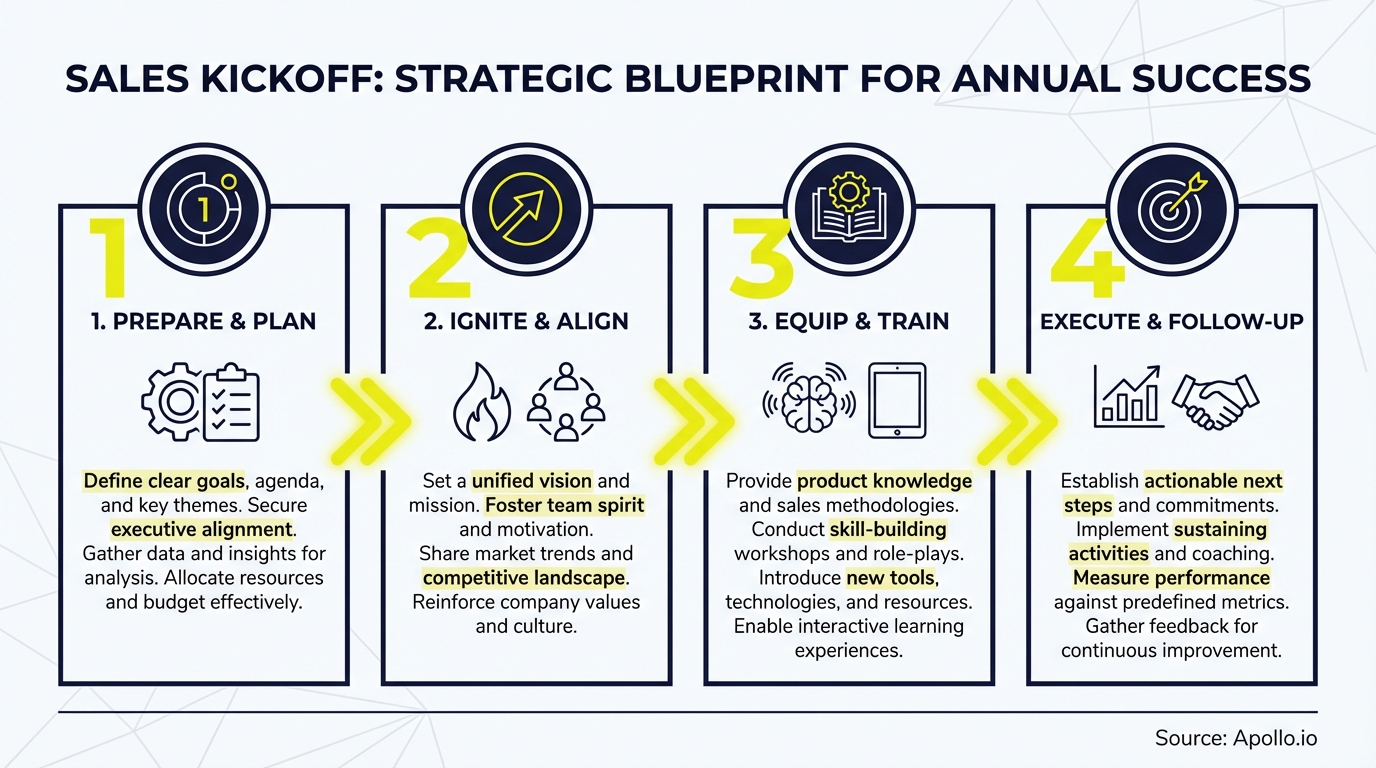
A sales kickoff (SKO) is an annual or semi-annual event where revenue teams align on strategy, build skills, and launch into a new selling period with shared goals and momentum. Done right, it's the highest-leverage investment a sales leader makes all year.
Done wrong, it's an expensive pep rally that fades within weeks.
The stakes are rising. Buyers have changed fundamentally: Gartner found 61% of B2B buyers now prefer a rep-free buying experience, and 73% actively avoid suppliers who send irrelevant outreach. Your SKO must prepare reps for a world where buyers already know your product before picking up the phone.

Research Less, Close More With Apollo
Tired of your reps burning hours verifying contact info instead of selling? Apollo surfaces accurate, ready-to-reach prospects instantly. Join 550K+ companies turning research time into revenue.
Start Free with Apollo →Key Takeaways
- A sales kickoff aligns strategy, skills, and culture at the start of a new revenue period.
- Modern SKOs must equip reps with persona-segmented messaging, not one-size-fits-all talk tracks.
- Post-SKO reinforcement (30/60/90 days) is what separates behavior change from conference-room inspiration.
- Measurement is non-negotiable: tie every SKO asset to a small set of pipeline and productivity metrics.
- AI is moving from keynote topic to operational agenda item at leading SKOs in 2026.
What Is a Sales Kickoff and Why Does It Matter?
A sales kickoff is a structured event — typically 2 to 4 days — where sales, marketing, customer success, and increasingly technical presales align on the go-to-market strategy for the period ahead. It covers new product messaging, competitive positioning, skill development, and cultural reinforcement.
The format is shifting. According to Allego, 59% of meeting professionals prefer in-person gatherings for events like sales kickoffs, reflecting a strong return to face-to-face SKOs after years of virtual experimentation. Simultaneously, Mereo notes the growing trend of rebranding SKOs as "Revenue Kickoffs" — with Chief Revenue Officers overseeing the full customer lifecycle, not just sellers. Marketing, CS, and solutions engineers now routinely share the SKO agenda.
The business case is clear: a well-executed SKO compresses ramp time, drives message consistency, and creates the cultural alignment that sustains pipeline through Q1 and beyond. Tracking the right sales KPIs before and after your SKO is the fastest way to prove that impact.
What Makes a Modern SKO Effective?
The most common SKO failure is over-investing in inspiration and under-investing in execution. Research from RAIN Group and Alchemist found that only a portion of SKOs result in sustained adoption of new behaviors, and only one in five organizations with highly effective SKO events report lasting change.
The highest-performing SKOs share four design principles:
- Persona-segmented messaging: Build talk tracks and content blocks organized by buyer role, industry, and use case — not a single script for every rep.
- Messaging governance: Synchronize SKO content with website language and product positioning. Gartner reports 69% of B2B buyers encounter inconsistencies between what sellers say and what the company website says — a trust-killer that SKO content can fix.
- Digital-first content packs: Equip reps with self-serve proof points, ROI tools, and product narratives that buyers can explore without a seller present.
- Built-in measurement: Map every SKO asset to a small set of outcome metrics. Enablement teams that measure well protect and grow their budgets — organizations that increased event budgets in 2024 were most likely to attribute growth to better data and analytics, according to BizBash/Stova's 2024 white paper.
"Now we know exactly what we want to say and who we want to say it to. It's just a matter of going into Apollo and making it happen."
How Do You Plan a Sales Kickoff? The 90-Day Timeline
Effective SKO planning starts 90 days out, not 30. Here is a practical timeline:
| Phase | Timing | Key Actions |
|---|---|---|
| Strategy | 90–60 days before | Define 3–5 SKO objectives; audit last year's metrics; align with CRO on themes |
| Content Build | 60–30 days before | Build persona-segmented messaging; sync with website; create digital content packs |
| Logistics | 45–15 days before | Confirm venue/virtual platform; finalize agenda; assign session owners |
| Pre-SKO Prep | 2 weeks before | Send pre-work; distribute competitive battle cards; set rep expectations |
| Event Execution | SKO days | Run sessions; certify reps; capture feedback; record all content |
| Reinforcement | 30/60/90 days after | Manager coaching check-ins; practice prompts; pipeline review against SKO plays |
Need to build pipeline fast after your SKO? Apollo's AI-powered sales pipeline builder helps reps find and qualify the right accounts immediately after kickoff — no lag between strategy and execution.

What Should a Sales Kickoff Agenda Include?
A strong SKO agenda balances three elements: alignment (where are we going?), enablement (how do we get there?), and activation (practice and certification). Avoid packing too many sessions. The best SKOs leave significant working time for reps to practice, ask questions, and apply new messaging.
Core agenda components:
- Executive vision: Company direction, annual targets, and the "why" behind the strategy
- Market and competitive update: What has changed; how to handle objections — see the guide to handling sales objections in 2026
- New product/feature messaging: Persona-specific talk tracks with live demos
- AI and tool workflows: In 2026, leading SKOs dedicate sessions to standardizing AI usage across the team — not just showcasing tools, but certifying reps on actual workflows
- Role-based breakouts: SDRs, AEs, and CS teams have different skill gaps; separate tracks respect that
- Certification and practice: Role-play with recorded feedback; pitch competitions
- Pipeline and territory reviews: Connect strategy to actual accounts reps will work in Q1
"A lot of deals at the enterprise level are driven through outbound. Apollo has been huge in helping us to get our foot in the door with those accounts."
For teams building outbound motions post-SKO, Apollo's sales engagement platform lets reps launch persona-specific sequences immediately, putting SKO messaging into market without manual setup delays.
Turn Funnel Gaps Into Predictable Pipeline
Tired of watching marketing leads stall before they ever reach your pipeline? Apollo surfaces high-intent prospects and keeps your funnel moving with verified contacts. Top revenue teams use Apollo to forecast with confidence.
Schedule a Demo →How Do You Measure Sales Kickoff ROI?
Most SKO measurement stops at attendance and satisfaction scores. That's insufficient.
Tie your SKO directly to a small set of leading and lagging indicators that reflect behavior change in the field.
| Metric Category | Specific KPI | Measurement Window |
|---|---|---|
| Adoption | % of reps using new plays/sequences within 30 days | 30 days post-SKO |
| Ramp Velocity | Days to first qualified meeting for new hires | 60 days post-SKO |
| Certification | % of reps certified on new messaging | During and 2 weeks post-SKO |
| Pipeline Influence | New pipeline created in Q1 vs. prior year | 90 days post-SKO |
| Conversion | First-meeting-to-next-step conversion rate | 60–90 days post-SKO |
Good sales analytics make this measurable. If your CRM and engagement platform aren't instrumented to track these metrics, build that infrastructure before the SKO — not after.
What Is the 30/60/90-Day Post-SKO Reinforcement Plan?
The SKO event is the launch, not the finish line. Without structured reinforcement, most new behaviors fade within weeks. A 30/60/90-day reinforcement plan keeps SKO momentum alive:
- Days 1–30: Weekly manager check-ins against SKO plays; practice pitch certifications for anyone who didn't complete them; deploy new sequences in market
- Days 31–60: Review first-meeting conversion data; identify reps who haven't adopted new messaging; run targeted coaching sessions; share early wins to reinforce confidence
- Days 61–90: Measure pipeline influence; run a mid-quarter enablement session to address gaps surfaced in field; adjust messaging based on objection patterns
Reinforcement is especially critical for reducing seller ramp time. Teams that treat SKO as a system launch — with ongoing coaching, content workflows, and deal collaboration — consistently outperform those that treat it as a one-time event. Pairing reinforcement with strong sales productivity practices is what moves the needle on time-to-quota for new hires.
How Is AI Changing Sales Kickoffs in 2026?
AI has moved from keynote inspiration to operational agenda item. Leading SKOs in 2026 now include dedicated sessions on AI workflow standardization: which agents reps use, how to prompt them effectively, and how AI-assisted outreach fits into certified plays.
This isn't about showcasing tools — it's about certifying teams on an AI operating model.
The underlying business case is strong. According to Spekit, revenue teams using AI are growing nearly 30% faster than those that aren't. SKOs that build AI literacy into their certification tracks give reps a compounding advantage throughout the year.
For teams building their sales tech stack, SKO is the ideal moment to consolidate tools and train reps on a unified workflow — rather than managing disconnected point solutions that create friction and inconsistency in the field.
"With this kind of AI system, my BDRs can send 10x more personalized emails. Their productivity and growth has skyrocketed."
Common Sales Kickoff Mistakes to Avoid
- One-size-fits-all messaging: Generic talk tracks don't survive contact with real buyers. Build persona and industry-specific blocks.
- No measurement plan: If you can't measure behavior change, you can't defend budget or improve next year.
- Skipping post-SKO reinforcement: The event without follow-through produces inspiration, not results.
- Misaligned web and sales messaging: 69% of buyers notice when what sellers say contradicts the company website. Audit and harmonize before SKO.
- Overloading the agenda: Too many sessions leave no time for practice. Cut sessions; add working time.
- Ignoring cross-functional GTM partners: CS, marketing, and solutions engineers need the same narrative as sellers. Include them or risk inconsistent messaging in market.
Conclusion: Turn Your SKO into a Revenue System
A sales kickoff is only as valuable as the execution it produces. The teams winning in 2026 treat SKO as the launch of a year-long revenue system — with persona-segmented messaging, governance that keeps content synchronized with the market, and a 30/60/90-day reinforcement plan that turns conference-room alignment into field-level results.
Measure what matters. Reinforce relentlessly. And give your reps the tools to execute from day one.
Ready to put your SKO strategy into action? Start a Trial with Apollo — the unified go-to-market platform that connects prospecting, engagement, and pipeline in one workspace so your team can execute SKO plays immediately.
Prove Pipeline ROI Before Next Quarter
Budget approval stuck on unclear metrics? Apollo delivers measurable pipeline impact your leadership can see — fast. Leadium 3x'd their annual revenue after switching. Start your free trial today.
Start Your Free Trial →Don't miss these
Sales
Inbound vs Outbound Marketing: Which Strategy Wins?
Sales
What Is a Sales Funnel? The Non-Linear Revenue Framework for 2026
Sales
What Is a Go-to-Market Strategy? The 2026 GTM Playbook
See Apollo in action
We'd love to show how Apollo can help you sell better.
By submitting this form, you will receive information, tips, and promotions from Apollo. To learn more, see our Privacy Statement.
4.7/5 based on 9,690 reviews
