What Is a Sales Interview? Preparation Guide and Best Practices for 2026
A sales interview is both a job evaluation and a live demonstration of your selling ability. Hiring managers aren't just assessing your resume — they're watching how you prospect, handle objections, and close in real time.
With quota pressure at historic highs, companies are raising the bar for every hire.
This guide gives you a modern preparation framework: what interviewers actually evaluate, which questions to expect, how to handle role-plays, and how AI tools can sharpen your readiness before you walk in the door.

Let Apollo Find Your Leads Instantly
Tired of your reps burning hours on manual research instead of closing deals? Apollo surfaces verified contacts instantly, so your team spends time selling — not searching. Join 550K+ companies building pipeline faster.
Start Free with Apollo →Key Takeaways
- Sales interviews are performance auditions — prepare stories, metrics, and a mock pitch, not just answers.
- Modern interviewers evaluate multi-stakeholder awareness, pipeline discipline, and AI fluency alongside classic competencies.
- According to Everstage, 69% of sales reps missed quota in H1 2024 — hiring teams are scrutinizing process and mindset more than ever.
- Role-plays, mock pitches, and discovery calls are now standard at most companies, not optional extras.
- Following up strategically after the interview is itself a sales skill — and interviewers notice.
What Is a Sales Interview?
A sales interview is a structured evaluation process employers use to assess whether a candidate can sell — not just whether they have sales experience. It typically combines behavioral questions, situational scenarios, role-play exercises, and competency assessments.
What makes sales interviews distinct from other job interviews is the expectation that you'll demonstrate skills live. Your ability to ask discovery questions, handle objections, and close the conversation is being evaluated throughout, not only during designated role-play segments.
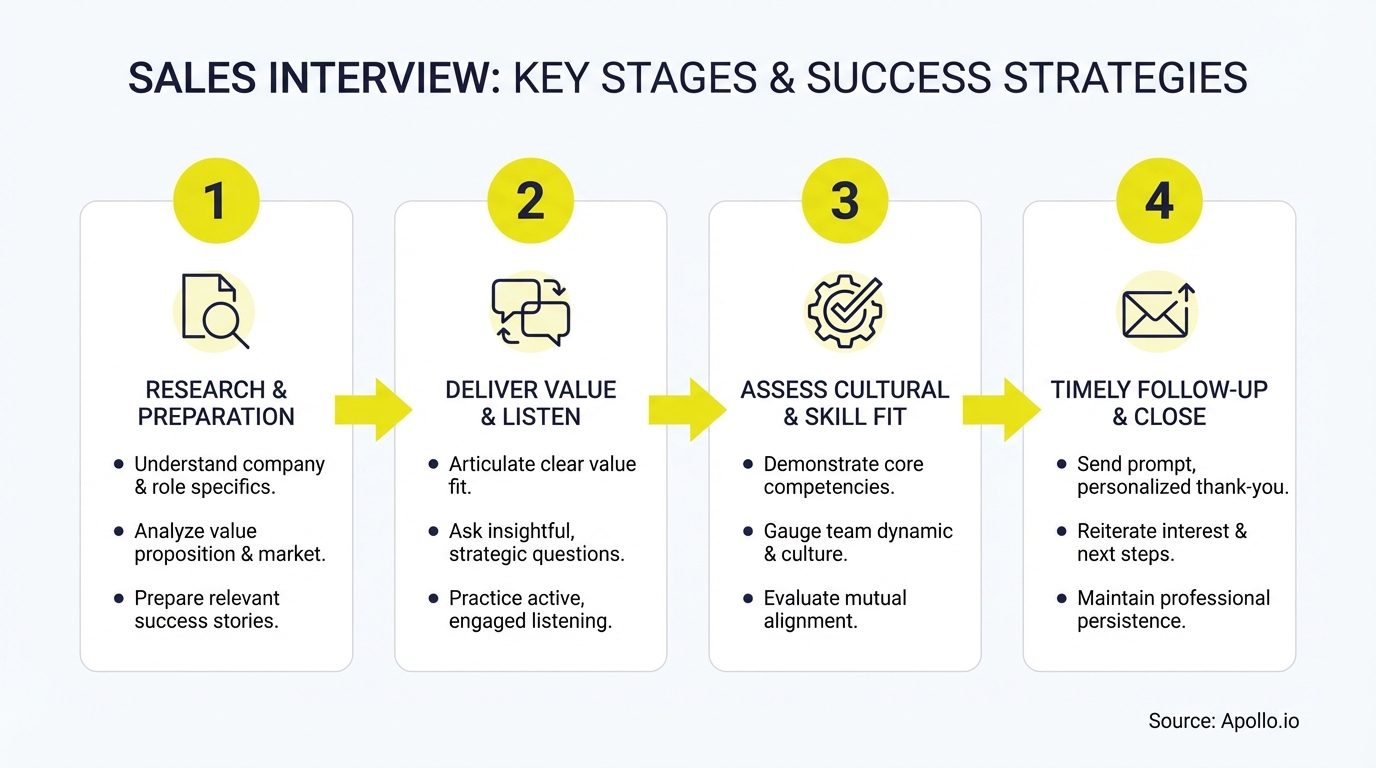
What Are the Key Stages of a Sales Interview Process?
| Stage | Format | What's Being Evaluated |
|---|---|---|
| Phone Screen | 30-min recruiter call | Communication clarity, motivation, baseline experience |
| Hiring Manager Interview | 45-60 min behavioral | Pipeline approach, metrics ownership, cultural fit |
| Panel or Loop | Multi-person interviews | Cross-functional alignment, stakeholder navigation |
| Role-Play or Mock Pitch | Live scenario exercise | Discovery skills, objection handling, closing instinct |
| Final / Executive Round | Strategic conversation | Business acumen, vision, long-term fit |
For deeper preparation on specific question types, see What Are Tough Sales Interview Questions and How Should You Answer Them? and What Are the Best Sales Interview Questions for 2026?
What Questions Are Asked in Sales Interviews?
Sales interview questions fall into four categories. Prepare at least two strong examples for each type.
Behavioral Questions
These follow the STAR format (Situation, Task, Action, Result). Common examples:
- "Tell me about a deal you lost and what you learned."
- "Describe a time you exceeded quota — what drove it?"
- "Walk me through how you've managed a complex, multi-stakeholder sale."
According to Gradient Works, the average number of stakeholders involved in a B2B purchase decision reached 11 in 2022. Interviewers want to know you can navigate group dynamics, not just one buyer.
Situational Questions
Hypothetical scenarios testing judgment:
- "You're 60% to quota with two weeks left in the quarter. What do you do?"
- "A prospect ghosts you after a strong demo. How do you re-engage?"
- "Your champion just left the company. What's your next move?"
Pipeline and Metrics Questions
- "What was your average deal size and sales cycle length?"
- "How did you prioritize your pipeline when you had too many open opportunities?"
- "What CRM hygiene practices did you maintain?"
Product and Industry Questions
- "How would you position our product against [competitor]?"
- "Who is our ideal customer profile and how would you find them?"
- "What trends are shaping this market right now?"
Struggling to articulate how you'd build pipeline from scratch? See how Apollo's AI-powered pipeline builder helps reps identify and prioritize their best accounts — understanding tools like this demonstrates the modern sales fluency interviewers want to see.

What Role-Play Scenarios Should You Expect?
Role-plays are now standard in most sales hiring processes. They reveal instincts that behavioral answers can't. The three most common formats:
Discovery Call Role-Play
You play the rep; the interviewer plays a prospect. Your job: ask great questions, identify pain, and qualify.
Don't pitch too early. The best candidates spend 70% of the time asking questions and listening.
Key moves: Open with context, use open-ended questions, reflect back what you hear, and earn the right to present.
Objection Handling Role-Play
Common setups include: "It's too expensive," "We're happy with our current vendor," or "I need to think about it." Don't argue. Acknowledge, explore the root concern, then reframe.
Framework: Feel / Felt / Found works well under pressure. Practicing proven pitch techniques beforehand will sharpen your instincts for live scenarios.
Mock Pitch or Demo
You're asked to present the company's product (or a product you've sold) to a simulated buying group. Prepare a tight, three-part structure: current state problem, future state vision, why now.
Keep it under 10 minutes and leave room for questions.
Turn Funnel Guesswork Into Closed Deals
Tired of marketing leads that never convert and forecasts you can't trust? Apollo surfaces quality pipeline at every stage so your team always knows what's real. 90K paying customers stopped guessing.
Start Free with Apollo →How Should You Prepare for a Sales Interview?
Strong preparation separates candidates who talk about selling from those who demonstrate it.
Research the Company's Sales Motion
- Identify whether they run inbound, outbound, or a hybrid motion
- Read their case studies to understand customer pain points and proof points
- Review their pricing, ICP, and competitive positioning publicly available
- Know their tech stack — CRM, engagement tools, data providers
Prepare Your Metrics Story
Every answer needs a number attached. Prepare your: quota attainment percentage, average deal size, win rate, average sales cycle, and ramp time at previous roles.
Interviewers distrust vague answers like "I consistently performed well."
For context on what strong performance benchmarks look like, How Does Sales Analytics Drive Revenue Growth? is a useful reference for understanding the metrics that matter most.
Build Your STAR Story Bank
Prepare 6-8 specific stories covering: biggest win, toughest loss, pipeline management challenge, multi-stakeholder deal, competitive displacement, and a time you used data or technology to improve performance. Each story should be under 2 minutes when spoken aloud.
Practice With AI Tools
Use AI tools to simulate interview questions, generate objections, and stress-test your answers. Record yourself and review for filler words, pace, and confidence.
The reps who use AI fluently in their preparation signal to hiring managers they'll use it on the job.
"With this kind of AI system, my BDRs can send 10x more personalized emails. Their productivity and growth has skyrocketed."
What Do Interviewers Actually Evaluate?
Modern sales hiring evaluates six core competencies. Understanding these helps you frame every answer strategically.
| Competency | What Interviewers Look For | How to Demonstrate It |
|---|---|---|
| Pipeline Discipline | Methodical qualification, CRM hygiene | Reference specific pipeline metrics and stages |
| Discovery Skills | Question quality, listening, problem framing | Ask great questions during the role-play itself |
| Objection Handling | Composure, reframing, persistence | Acknowledge before countering — never argue |
| Multi-Stakeholder Navigation | Champion building, consensus creation | Tell a story about a complex, multi-buyer deal |
| Coachability | Response to feedback, growth mindset | Show how you've changed approach based on input |
| Tech and AI Fluency | CRM proficiency, AI tool usage, data literacy | Name specific tools and how you used them to improve results |
Understanding how top-performing reps structure their sales process — including their use of automation and AI — can help you answer technology questions with specificity. Which AI Sales Tools Actually Close More Deals? gives you vocabulary and context for these conversations.
Want to show interviewers you understand modern outbound from the inside? Explore Apollo's sales engagement platform to understand how high-performing teams run multi-channel sequences at scale.
"The moment we select someone in our database, they're instantly added to a sequence and we can take action right away. We're effective and efficient with our outreach."
What Mistakes Eliminate Candidates?
These errors are the most common reasons strong-on-paper candidates don't get offers:
- Pitching without discovering: Jumping to features before understanding the interviewer's (or mock prospect's) pain kills your credibility immediately.
- Vague metrics: "I was one of the top performers" without supporting numbers reads as avoidance.
- No questions for the interviewer: A salesperson who doesn't ask questions in a sales interview signals weak discovery instincts.
- Badmouthing previous employers: It raises red flags about cultural fit and professionalism.
- Failing to follow up: A tailored thank-you note that references a specific moment from the interview is itself a closing move.
How Should You Follow Up After a Sales Interview?
Your follow-up is a final sales touch. Send a personalized email within 24 hours.
Reference something specific from the conversation, restate your fit for the role, and include one piece of value (a relevant article, a case study you mentioned, a resource you promised).
If you don't hear back within the timeline discussed, one professional follow-up is appropriate. Treat it like a re-engage sequence: brief, specific, and value-forward.

The Bottom Line: Prepare Like You're Selling
A sales interview rewards the same skills that win deals: preparation, curiosity, listening, and follow-through. The candidates who succeed treat the interview itself as their first sale — researching the buyer (the company), understanding their pain (the role requirements), and presenting a clear case for why the investment in you pays off.
Use the frameworks in this guide to structure your preparation, build your story bank, and sharpen your role-play instincts. The reps who land the best roles don't just answer questions — they run a great sales process from first contact to final close.
Ready to build the pipeline skills that impress in any sales interview? Start Your Free Trial with Apollo and see how 550K+ companies run modern outbound from one unified platform.
