Sales Funnels: How to Build a Revenue Engine That Converts
Modern B2B buyers have fundamentally changed how they purchase. According to Gartner, 61% now prefer a rep-free buying experience. Yet organizations offering both self-service and rep-led interactions are 3.9 times more likely to exceed profit expectations. The answer? Hybrid sales funnels that blend data-driven automation with strategic human touchpoints.

Apollo Eliminates 4+ Hours Of Daily Research
Tired of spending hours hunting for contact info? Apollo delivers 224M verified contacts with 96% email accuracy instantly. Join 550K+ companies who replaced manual prospecting with predictable pipeline.
Start Free with Apollo →Key Takeaways
- Hybrid sales funnels combining self-service and rep-led interactions drive 3.9x higher profit growth than single-channel approaches
- Third-party validation influences B2B buyers 1.4 times more than direct supplier content at every funnel stage
- Data-driven funnel design replaces guesswork with measurable metrics, conversion rates, and predictable pipeline velocity
- Marketing and sales alignment on funnel governance creates consistent buyer experiences across all touchpoints
- Modern sales funnels consolidate prospecting, engagement, and pipeline management into unified platforms
What Is a Sales Funnel in 2026?
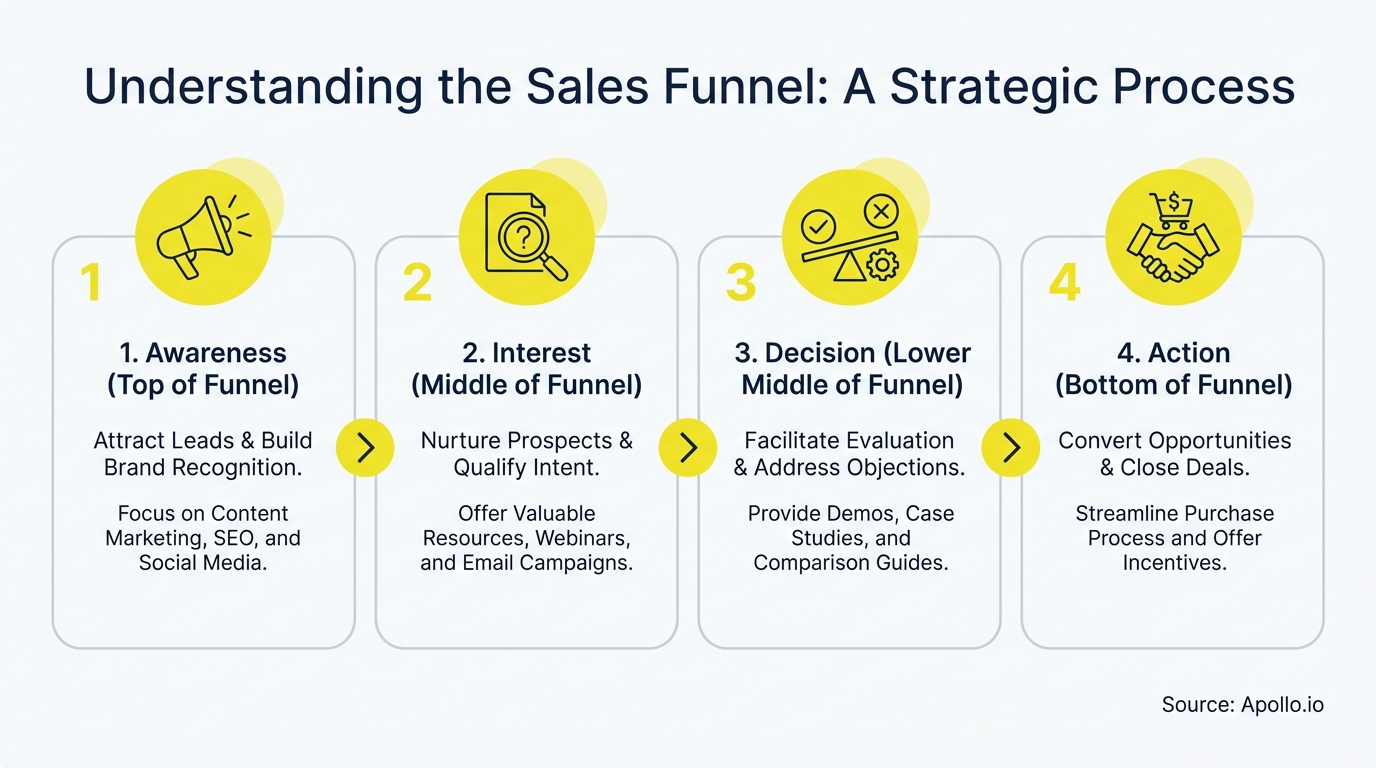
A sales funnel is a structured framework that maps the buyer journey from initial awareness to closed deal. It visualizes how prospects move through stages while identifying where they drop off or convert.
Modern sales funnels differ from traditional models in three critical ways. First, they support hybrid buying paths where prospects switch between self-service research and sales conversations. Second, they integrate third-party validation at each stage. Third, they rely on real-time data rather than intuition.
The typical funnel stages include:
- Awareness: Prospect identifies a problem or opportunity
- Interest: Prospect researches solutions and evaluates options
- Consideration: Prospect compares specific vendors and features
- Decision: Prospect selects a solution and negotiates terms
- Retention: Customer expands usage and renews contracts
Why Do Sales Funnels Matter for Revenue Teams?
Sales funnels transform unpredictable revenue into a measurable, scalable system. They reveal exactly where prospects stall, which activities drive conversions, and how to forecast accurately.
Gartner predicts that 65% of B2B sales organizations will transition from intuition-based to data-driven decision-making by 2026. Funnels provide the framework for this shift. They enable RevOps teams to track conversion rates at each stage, identify bottlenecks, and allocate resources strategically.

For sales leaders, funnels answer critical questions:

- How many prospects do we need at the top to hit quota?
- Which stages have the lowest conversion rates?
- What activities correlate with closed deals?
- How long does our average sales cycle take?
SDRs and BDRs use funnel data to prioritize high-intent prospects. Account Executives leverage stage-specific insights to tailor conversations.
Founders gain visibility into the entire revenue engine.
How Do Hybrid Sales Funnels Work?
Hybrid funnels blend self-service digital experiences with strategic rep involvement. Prospects can research independently while accessing sales help exactly when they need it.
The model addresses a fundamental tension in B2B buying. Research by Gartner shows buyers value third-party interactions 1.4 times more than digital supplier content. Yet they still need sales expertise for complex decisions.
Implementation requires three components:
| Component | Self-Service Elements | Rep-Led Elements |
|---|---|---|
| Top of Funnel | Interactive ROI calculators, comparison tools, third-party reviews | SDR outreach to engaged prospects, personalized demo invitations |
| Mid Funnel | Product tours, documentation, customer case studies | Discovery calls, technical demos, custom proof of concepts |
| Bottom Funnel | Pricing transparency, contract templates, implementation guides | Negotiation, legal review, executive alignment |
Struggling to track prospects across channels? Apollo's deal management platform unifies self-service signals and rep activities in one workspace.
Turn Forecast Chaos Into Revenue Certainty
Pipeline forecasting a guessing game? Apollo's real-time deal intelligence gives you accurate visibility across every stage. Built-In increased win rates 10% with Apollo's scoring and signals.
Start Free with Apollo →How Do Sales Leaders Build Data-Driven Funnels?
Data-driven funnels replace assumptions with measurable metrics at every stage. Sales leaders define conversion benchmarks, track performance in real time, and iterate based on results.
Start by establishing baseline metrics for your current funnel:
- Stage conversion rates: Percentage moving from one stage to the next
- Velocity: Average days spent in each stage
- Win rate: Percentage of opportunities that close
- Average deal size: Revenue per closed opportunity
RevOps teams then identify the highest-impact optimization opportunities. If awareness-to-interest conversion is 40% but interest-to-consideration drops to 15%, focus there first.
If average deal size is declining, examine whether qualification criteria need adjustment.
Modern sales analytics platforms surface these insights automatically. They track individual rep performance, campaign effectiveness, and funnel health across territories.
For Account Executives managing complex deals, data reveals which activities correlate with wins. Does sending case studies in the consideration stage increase close rates?
Do prospects who attend webinars convert faster? Test hypotheses systematically.
How Do SDRs Optimize Top-of-Funnel Prospecting?
SDRs drive funnel performance by filling the top with qualified prospects who match ideal customer profiles. The challenge is doing this efficiently without burning hours on manual research.
Top-performing SDRs use a three-step approach:
- Define precision targeting criteria: Company size, industry, technologies used, hiring signals, funding events
- Build multi-channel sequences: Email, LinkedIn, phone calls coordinated over 7-10 touchpoints
- Personalize at scale: Reference specific triggers like job changes, product launches, or competitor mentions
The bottleneck is typically data quality and research time. SDRs waste 40% of their day finding contact information and researching accounts.
Spending hours on prospect research? Apollo's 224M+ verified contacts with 65+ filters let SDRs build targeted lists in minutes, not hours.
What Role Does Third-Party Validation Play?
Third-party validation from analysts, review sites, and independent experts builds trust faster than any supplier content. Buyers actively seek objective perspectives before engaging with sales.
Integrate validation at each funnel stage:
- Awareness: Industry analyst reports, market research, trend studies
- Interest: G2 reviews, Gartner Peer Insights, customer testimonials
- Consideration: Third-party comparison guides, ROI case studies, implementation partners
- Decision: Reference calls, analyst briefings, security audits
Marketing teams should create a validation content library that sales can deploy contextually. When a prospect asks about security, share the SOC 2 report and customer testimonials.
When they question ROI, provide analyst-validated case studies.
The most effective B2B sales organizations don't just reference third-party content. They actively cultivate relationships with analysts, invest in review platforms, and showcase customer voices throughout the funnel.
How Do You Align Marketing and Sales on Funnel Governance?
Funnel governance establishes shared definitions, handoff criteria, and accountability between marketing and sales. Without it, leads fall through cracks and teams blame each other for missed targets.
According to Gartner research, marketing and sales collaborate on only three out of 15 commercial activities. This misalignment costs revenue.
Create formal agreements covering:
| Element | Marketing Owns | Sales Owns |
|---|---|---|
| Lead Definition | MQL criteria and scoring model | SQL acceptance standards |
| Response Time | Speed to route qualified leads | SLA to contact within 1 hour |
| Nurture Strategy | Content and campaigns for unqualified leads | Feedback on lead quality and readiness |
| Data Hygiene | CRM field requirements and automation | Updating contact info and deal stages |
Schedule weekly funnel review meetings where both teams examine conversion rates, lead quality scores, and win rates by source. When marketing sees which campaigns generate closed revenue, they optimize accordingly.
When sales provides timely feedback, marketing adjusts targeting.
Turn Your Sales Funnel into a Revenue Engine
Sales funnels have evolved from static diagrams into dynamic systems that blend human expertise with data intelligence. The organizations winning in 2026 build hybrid models that respect buyer preferences while maintaining strategic sales involvement.
Success requires three commitments. First, transition from intuition to data-driven decisions across every funnel stage.
Second, embed third-party validation throughout the buyer journey. Third, align marketing and sales on shared definitions, metrics, and accountability.
Apollo consolidates the entire funnel into one platform. Our customers report reducing complexity from three tools to one unified workspace.
Census cut their costs in half. Cyera found having everything in one system was a game changer.
Ready to build a data-driven sales funnel that scales? Schedule a demo with Apollo and see how 2M+ users are closing more deals with less tech stack complexity.
Prove Apollo's ROI In Your First 30 Days
Budget approval stuck on unclear metrics? Apollo delivers measurable wins fast: 46% more meetings, 10% higher win rates, 3x revenue growth. Built-In and Leadium justified spend in weeks, not quarters.
Start Free with Apollo →Don't miss these
Sales
Inbound vs Outbound Marketing: Which Strategy Wins?
Sales
What Is a Sales Funnel? The Non-Linear Revenue Framework for 2026
Sales
What Is a Go-to-Market Strategy? The 2026 GTM Playbook
See Apollo in action
We'd love to show how Apollo can help you sell better.
By submitting this form, you will receive information, tips, and promotions from Apollo. To learn more, see our Privacy Statement.
4.7/5 based on 9,690 reviews
