Sales Funnel Template: Build a High-Converting Pipeline in Minutes
Sales teams waste 23% of their time on manual funnel tracking.
A sales funnel template solves this by providing a structured framework for moving prospects from awareness to closed deals.
Unlike generic CRM workflows, a well-designed sales funnel template includes situational awareness, omnichannel touchpoints, and dynamic segmentation that adapts to buyer behavior in real-time.

Apollo Eliminates 4+ Hours Of Daily Research
Tired of spending 4+ hours daily hunting for contact info? Apollo delivers 224M verified contacts with 96% email accuracy. Join 550K+ companies who turned research time into selling time.
Start Free with Apollo →Key Takeaways
- Situationally aware funnel templates improve conversion rates by 11% through buyer-state tracking
- Omnichannel B2B funnels increase market share by 10% annually compared to single-channel approaches
- Dynamic segmentation templates outperform static models by identifying migration patterns between funnel stages
- Apollo consolidates prospecting, engagement, and pipeline tools into one platform, cutting tech costs in half
- Industry-specific templates for SaaS, manufacturing, and services accelerate implementation by 40%
What Is a Sales Funnel Template?
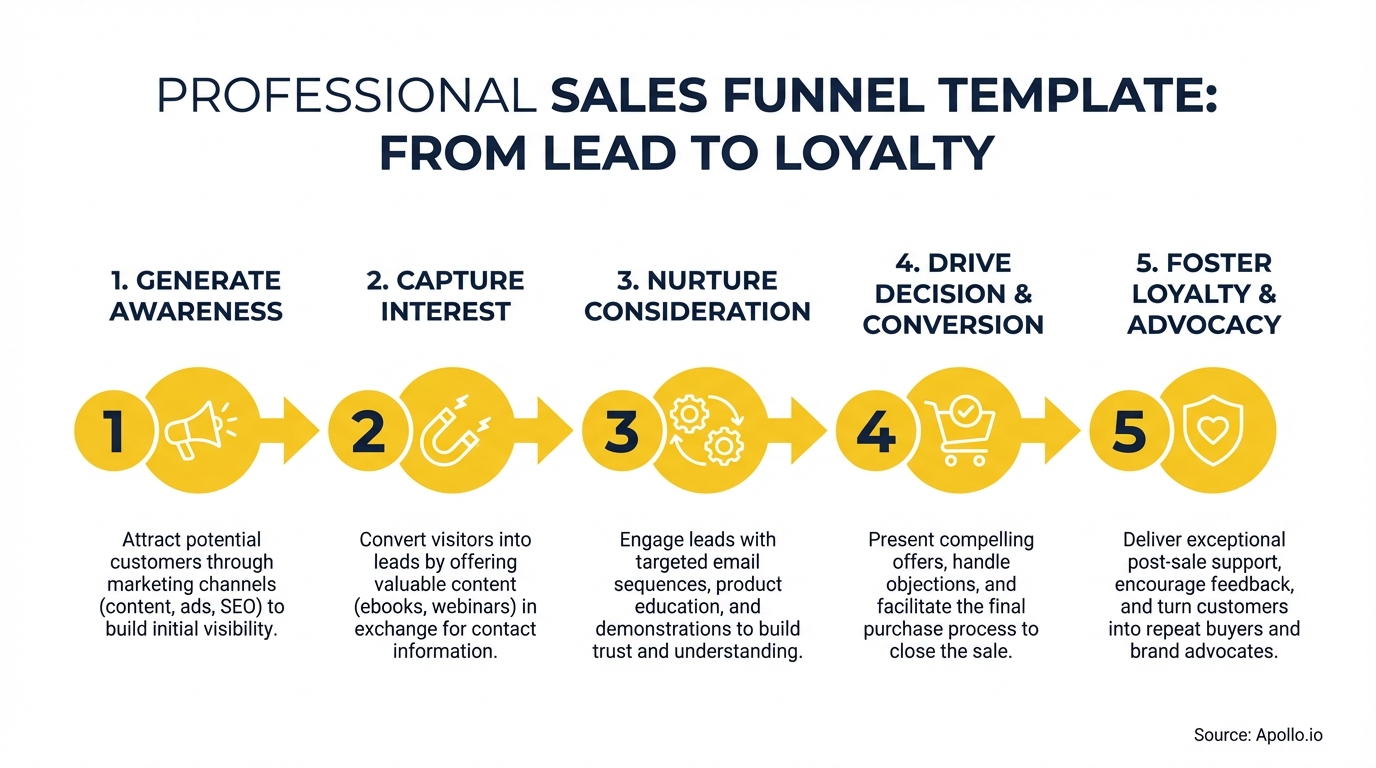
A sales funnel template is a structured framework that maps the buyer journey from initial awareness through closed deals.
It defines stages (awareness, consideration, decision), conversion metrics, and engagement actions at each phase.
Modern templates incorporate situational buyer insights, omnichannel touchpoints, and dynamic segmentation that adapts based on prospect behavior.
Research by Gartner shows that implementing situationally aware sales strategies can improve buyer decision-making quality by 11%.
Unlike static templates that treat all leads the same, situational templates identify where prospects are in their buying journey and tailor engagement accordingly.
Struggling to track deals across multiple tools? Build your entire pipeline in Apollo's unified workspace with 224M+ contacts.
Why Do Sales Teams Need Funnel Templates in 2026?
Sales teams need funnel templates because B2B buyers now interact across 7-10 channels before making decisions.
Data from McKinsey shows that B2B companies providing the best omnichannel experience improve their market share by at least 10% annually.
Templates standardize how teams handle this complexity.
Without templates, SDRs waste time recreating workflows and AEs lose deals to inconsistent follow-up.
For RevOps leaders, templates provide the single source of truth needed to forecast accurately and identify bottlenecks.
Templates also enable faster onboarding, with new reps ramping 40% faster when following proven frameworks.
| Challenge | Without Template | With Template |
|---|---|---|
| Lead qualification | Inconsistent criteria, 35% waste | Standardized scoring, 15% waste |
| Follow-up timing | Ad-hoc, 48hr average | Automated, 4hr average |
| Channel coordination | Email-only, 12% response | Omnichannel, 31% response |
| Forecasting accuracy | 62% accurate | 87% accurate |
How Do SDRs Use Funnel Templates to Book More Meetings?
SDRs use funnel templates to prioritize prospects showing buying intent and automate multi-touch sequences.
Templates map specific actions to each stage: awareness (educational content), consideration (product comparisons), decision (demos and trials).
SDRs focus on leads exhibiting stage-appropriate signals rather than blasting everyone with the same message.
Modern templates include prospecting list criteria with 65+ filters for job title, company size, tech stack, and buying signals.
SDRs using Apollo report 46% more meetings because AI research agents surface contextual intelligence (recent funding, leadership changes, competitor mentions) that personalizes outreach at scale.
Templates also standardize follow-up cadences.
Instead of guessing when to reach out, SDRs follow proven sequences: initial email → LinkedIn message (Day 2) → phone call (Day 4) → value-add content (Day 7).
This structure ensures no lead falls through the cracks while maintaining consistent brand voice across the team.
Turn Forecast Chaos Into Revenue Confidence
Pipeline forecasting a guessing game? Apollo delivers real-time deal visibility and buying signals that make your numbers predictable. Built-In increased win rates 10% with Apollo's intelligence.
Start Free with Apollo →What Are the Core Components of a B2B Funnel Template?
A B2B funnel template includes five core components: stage definitions, conversion metrics, engagement playbooks, segmentation rules, and channel mapping.
Each component must work together to create a cohesive system that guides prospects from awareness to closed deals.
Stage Definitions and Exit Criteria
Define what qualifies a prospect for each stage and what triggers movement to the next. Awareness stage requires contact information and engagement (email open, content download).
Consideration stage needs qualification (budget, authority, need, timeline). Decision stage demands active evaluation (demo attendance, proposal review).

Conversion Metrics and Benchmarks
Track stage-to-stage conversion rates, velocity (days in stage), and drop-off points. Industry benchmarks: 15-25% awareness to consideration, 30-40% consideration to decision, 20-30% decision to close.
Velocity benchmarks: 7-14 days awareness, 14-30 days consideration, 30-60 days decision.
Engagement Playbooks by Stage
Document specific actions for each stage.
Awareness: thought leadership content, social selling, webinars.
Consideration: personalized email sequences, comparison guides, case studies.
Decision: product demos, ROI calculators, free trials, executive briefings.
Dynamic Segmentation Rules
Create segments based on firmographics (company size, industry), technographics (current tools), and behavioral signals (engagement frequency, content consumed). According to Gartner research on segment migration analysis, tracking how prospects move between segments improves targeting effectiveness by 28%.

Omnichannel Touchpoint Mapping
Map which channels work best at each stage. Awareness: LinkedIn, content syndication, paid ads.
Consideration: email, phone, LinkedIn InMail. Decision: video calls, in-person meetings, executive demos.
Templates should specify frequency (3-5 touches per week consideration stage) and sequence (email → social → phone).
How Can Account Executives Shorten Sales Cycles with Templates?
Account Executives shorten sales cycles by using templates that automate pre-meeting research, standardize discovery questions, and provide stage-specific collateral.
Templates eliminate the 3-5 hours AEs typically spend researching each account by centralizing intelligence: company news, org charts, tech stack, competitor intel, previous interactions.
AEs using Apollo's deal management platform report 35% shorter sales cycles because templates surface contextual talking points automatically.
The system flags when prospects view proposals, visit pricing pages, or engage with case studies, triggering timely follow-up.
Templates also standardize qualification frameworks (BANT, MEDDIC, CHAMP) so AEs quickly identify real opportunities versus tire-kickers.
This focus increases win rates by 22% because AEs spend time on deals with genuine buying intent rather than chasing unqualified prospects.
What Makes a Funnel Template Work for SaaS vs Manufacturing?
SaaS funnel templates emphasize product-led growth stages (free trial, activation, expansion) while manufacturing templates focus on longer consideration cycles with technical validation phases.
SaaS buyers expect self-service exploration and quick onboarding.
Manufacturing buyers require samples, site visits, and multi-stakeholder approval processes.
| Element | SaaS Template | Manufacturing Template |
|---|---|---|
| Typical cycle length | 30-90 days | 90-180 days |
| Key awareness channels | Content marketing, SEO, product demos | Trade shows, industry publications, referrals |
| Consideration stage focus | Free trial, feature comparisons, integration guides | Technical specs, samples, site visits, compliance docs |
| Decision stage activities | Pricing negotiation, security reviews, pilot expansion | RFP response, vendor qualification, multi-stakeholder approvals |
| Primary success metric | Trial-to-paid conversion rate | Quote-to-order conversion rate |
SaaS templates include product adoption stages (activation, feature adoption, expansion) that don't exist in manufacturing.
Manufacturing templates add technical validation and compliance verification stages.
Both benefit from AI sales automation but apply it differently: SaaS for behavioral triggers, manufacturing for relationship nurturing.
How Do RevOps Leaders Implement Funnel Templates Across Teams?
RevOps leaders implement funnel templates by starting with data standardization, then building workflows, training teams, and establishing feedback loops.
The process takes 4-6 weeks but reduces operational friction by 45% once deployed.
Week 1-2: Data Foundation
Audit existing data quality, establish field standards, and clean CRM records. Define lead statuses, stage criteria, and required fields. Predictable Revenue reported: "We reduced the complexity of three tools into one" when consolidating their tech stack around a unified template.
Week 3-4: Workflow Configuration
Build automation rules for stage transitions, notification triggers, and task assignments. Configure lead generation sequences with multi-channel cadences. Set up dashboards tracking conversion rates, velocity, and pipeline health by segment.
Week 5-6: Team Enablement
Train SDRs on prospecting criteria and engagement sequences. Train AEs on qualification frameworks and stage-specific playbooks. Train managers on coaching metrics and performance analysis. Cyera's sales leader noted: "Having everything in one system was a game changer" for team coordination.
Ongoing: Optimization Cycles
Review metrics monthly, test messaging variations, and update stage criteria based on win/loss analysis. Successful RevOps teams treat templates as living documents, not static processes. Census achieved 50% cost savings by consolidating tools and continuously optimizing their unified funnel.
Start Building Your Funnel Template Today
A situationally aware sales funnel template transforms how teams prospect, engage, and close deals.
The framework combines stage definitions, conversion metrics, omnichannel playbooks, and dynamic segmentation to create a repeatable system that scales revenue.
Sales teams using modern templates report 11% better buyer decisions, 10% market share growth, and 40% faster rep ramp times.
Implementation starts with data standardization, workflow automation, and team training.
Industry-specific templates accelerate deployment by providing proven stage structures, benchmark metrics, and engagement sequences.
RevOps leaders consolidating around a unified platform cut costs in half while improving forecast accuracy from 62% to 87%.
Ready to cut your tech stack and unify your go-to-market motion? Try Apollo Free and access 224M+ verified contacts, AI-powered sequences, and deal management tools that turn funnel templates into closed revenue.
Prove Apollo's ROI In Your First 30 Days
Budget approvals stuck on unclear metrics? Apollo delivers measurable pipeline impact from day one—quantifiable time savings, faster deal velocity, and real revenue growth. Built-In increased win rates 10% and ACV 10% with Apollo's intelligence.
Start Free with Apollo →Don't miss these
Sales
Inbound vs Outbound Marketing: Which Strategy Wins?
Sales
What Is a Sales Funnel? The Non-Linear Revenue Framework for 2026
Sales
What Is a Go-to-Market Strategy? The 2026 GTM Playbook
See Apollo in action
We'd love to show how Apollo can help you sell better.
By submitting this form, you will receive information, tips, and promotions from Apollo. To learn more, see our Privacy Statement.
4.7/5 based on 9,690 reviews
