Sales Funnel Stages: A Complete Guide for Revenue Teams
In 2026, understanding sales funnel stages is no longer optional for revenue teams. With Gartner research showing 61% of B2B buyers prefer a rep-free buying experience, your funnel must work across ten interaction channels while maintaining message consistency. This comprehensive guide reveals how modern teams use AI-powered platforms to manage every stage, from initial awareness to closed deals, without juggling multiple tools.

Skip The Research - Apollo Finds Contacts Fast
Tired of spending 4+ hours daily hunting for contact info? Apollo delivers 224M verified contacts with 96% email accuracy. Join 550K+ companies closing deals faster.
Start Free with Apollo →Key Takeaways
- Sales funnel stages map the buyer journey from awareness through decision, with each stage requiring specific engagement tactics and content
- Modern B2B buyers use 10+ channels during their journey, making omnichannel orchestration essential for consistent messaging and conversion
- AI automation handles 19% of B2B sales processes in 2026, enabling SDRs and AEs to focus on high-value conversations instead of manual tasks
- Tool consolidation reduces tech stack complexity by 60-70%, with unified platforms replacing separate prospecting, engagement, and analytics tools
- Self-service content at each funnel stage addresses the 61% of buyers who prefer researching independently before engaging sales reps
What Are Sales Funnel Stages?
Sales funnel stages are the sequential steps prospects move through from first awareness to final purchase decision. Each stage represents a narrowing group of qualified buyers progressing toward conversion.
The funnel visualizes how many leads enter at the top (awareness) versus how many close as customers at the bottom (decision).
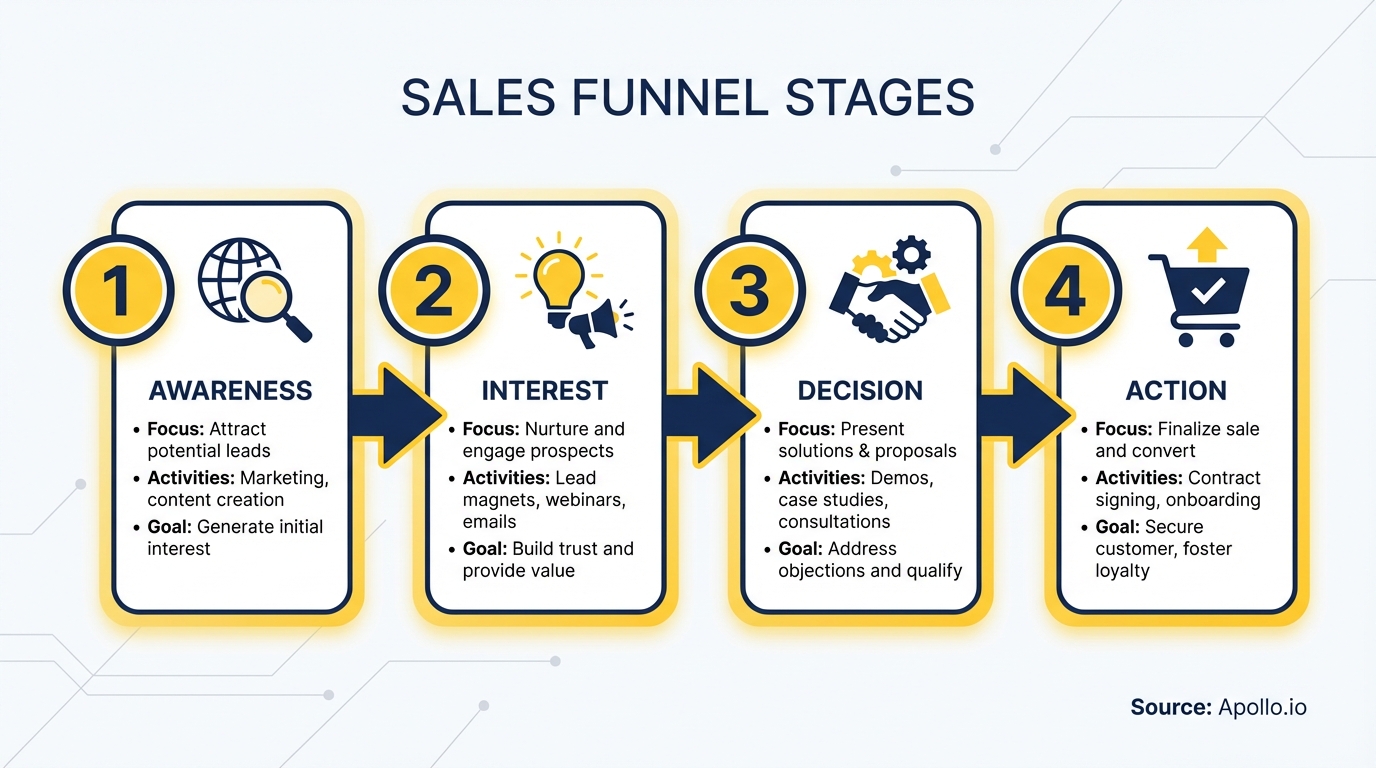
The traditional funnel includes four core stages: Awareness, Interest, Decision, and Action. Modern B2B funnels often expand these into six or more stages to reflect complex buying committees and extended sales cycles. Understanding these stages helps SDRs prioritize outreach, AEs forecast accurately, and RevOps teams optimize conversion rates between each phase.
Why Do Sales Funnel Stages Matter in 2026?
Sales funnel stages provide the framework for targeting the right message to the right buyer at the right time. According to McKinsey research, B2B customers now use an average of ten interaction channels during their buying journey, up from five in 2016. Without stage-specific engagement strategies, your messaging becomes generic and ineffective across these touchpoints.

Each funnel stage reveals buyer intent and readiness. For example, prospects researching blog content (awareness stage) need educational resources, while those requesting demos (decision stage) need ROI calculators and case studies.
Sales Leaders tracking stage progression can identify bottlenecks, coach reps on specific conversion tactics, and allocate budget to the highest-impact activities.
Struggling to track prospects across multiple channels? Manage your entire pipeline in Apollo's unified workspace.
What Are the Six Core Sales Funnel Stages?
The six core sales funnel stages are: Awareness, Interest, Consideration, Intent, Evaluation, and Purchase. Each stage corresponds to a specific buyer mindset and requires tailored content, messaging, and sales actions.
| Stage | Buyer Mindset | Sales Action | Key Metrics |
|---|---|---|---|
| Awareness | Problem recognition | Educational content, social selling | Website visits, content downloads |
| Interest | Solution research | Nurture campaigns, webinars | Email opens, event registrations |
| Consideration | Vendor comparison | Product demos, case studies | Demo requests, pricing page views |
| Intent | Shortlist creation | Personalized proposals, ROI analysis | Proposal opens, stakeholder meetings |
| Evaluation | Final decision-making | Contract negotiation, executive alignment | Contract reviews, legal discussions |
| Purchase | Commitment ready | Close deal, onboarding kickoff | Signed contracts, activation rate |
For SDRs, focus intensifies at Awareness and Interest stages where outbound prospecting and social selling tactics generate qualified leads. Account Executives own Consideration through Purchase, leveraging proven pitch techniques and deal management discipline to advance opportunities.
Turn Unreliable Forecasts Into Revenue Clarity
Pipeline forecasting feel like guesswork? Apollo delivers real-time deal visibility and quality lead flow that makes your numbers predictable. Built-In boosted win rates 10% with Apollo's scoring.
Start Free with Apollo →How Do SDRs and AEs Optimize Each Funnel Stage?
SDRs optimize top-of-funnel stages (Awareness and Interest) through targeted prospecting and qualification. They use lead generation frameworks to identify accounts showing buyer signals, then execute multi-channel sequences combining cold email, LinkedIn outreach, and phone calls. The goal is booking qualified meetings, not pushing unready prospects to AEs.
Account Executives optimize middle and bottom stages (Consideration through Purchase) by aligning value propositions to specific buyer pain points discovered during discovery. They leverage enterprise sales methodologies for complex deals, provide customized ROI analysis during Intent stage, and orchestrate buying committee alignment during Evaluation. RevOps teams support both roles by maintaining clean data, tracking conversion metrics between stages, and identifying drop-off points.
Tired of switching between prospecting, engagement, and analytics tools? Apollo consolidates your entire tech stack into one AI-powered workspace.
What Content Works Best at Each Funnel Stage?
Content effectiveness depends on matching format and depth to buyer readiness at each stage.
Awareness stage content educates on problems, not products: blog posts, industry reports, and social media insights work best.
Interest stage content introduces your solution category through comparison guides, webinars, and nurture email sequences that build credibility without hard selling.

Consideration and Intent stages require proof: case studies showing ROI, product demos tailored to use cases, and interactive tools like savings calculators. Evaluation stage content removes final objections through security documentation, implementation timelines, and executive briefings.
For Founders and Sales Leaders, this content strategy must maintain consistency across all ten buyer interaction channels to avoid the 69% messaging disconnect identified in Gartner research.
How Does AI Improve Funnel Stage Management in 2026?
AI improves funnel management through predictive lead scoring, automated stage progression, and intelligent content recommendations. With 19% of B2B sales forces already implementing generative AI use cases, platforms now analyze buyer behavior across channels to determine optimal next actions.
For example, AI identifies when a prospect moves from Interest to Consideration based on content consumption patterns, then triggers personalized outreach.
Sales teams using AI-powered platforms report 46% more meetings booked and 35% increases in conversion rates. AI handles repetitive tasks like data entry, email personalization, and meeting summaries, allowing SDRs and AEs to focus on strategic conversations. RevOps teams gain real-time visibility into funnel health, with AI flagging deals at risk of stalling and recommending intervention tactics based on historical win patterns.
Start Optimizing Your Sales Funnel Stages Today
Mastering sales funnel stages in 2026 requires omnichannel orchestration, stage-specific content, and AI-powered automation. The teams winning deals are those who consolidate their tech stack, maintain message consistency across ten buyer touchpoints, and empower self-service research for the 61% of buyers who prefer rep-free experiences.
As one customer noted, "We reduced the complexity of three tools into one" with a unified platform approach.
Start by auditing your current funnel: identify conversion rates between each stage, map content to buyer needs at each phase, and eliminate tools creating data silos. For SDRs struggling with prospecting efficiency, focus on top-of-funnel automation. For AEs managing complex deals, prioritize middle-funnel intelligence and deal management discipline. RevOps leaders should implement full-funnel analytics to identify optimization opportunities and prove revenue impact.
Ready to transform your sales funnel with AI-powered automation and 224M+ verified contacts in one platform? Start a Trial and see how Apollo helps teams cut their tech stack, increase pipeline visibility, and close more deals across every funnel stage.
Prove Apollo's ROI In Your First 30 Days
Budget approval stuck on unclear metrics? Apollo delivers measurable pipeline impact from day one—track time saved, meetings booked, and revenue generated. Built-In increased win rates 10% and ACV 10% with Apollo's scoring.
Start Free with Apollo →Don't miss these
Sales
Inbound vs Outbound Marketing: Which Strategy Wins?
Sales
What Is a Sales Funnel? The Non-Linear Revenue Framework for 2026
Sales
What Is a Go-to-Market Strategy? The 2026 GTM Playbook
See Apollo in action
We'd love to show how Apollo can help you sell better.
By submitting this form, you will receive information, tips, and promotions from Apollo. To learn more, see our Privacy Statement.
4.7/5 based on 9,690 reviews
