Sales Funnel Examples That Actually Convert in 2026
Sales funnels are no longer just marketing theory. In 2026, they are operational blueprints that integrate AI, hybrid selling, and omnichannel touchpoints to drive predictable revenue. Whether you're an SDR prospecting your first 100 accounts or a RevOps leader optimizing conversion rates across ten channels, understanding real-world sales funnel examples helps you build systems that convert.

Apollo Finds Verified Contacts In Seconds
Tired of spending 4+ hours daily hunting for contact info? Apollo delivers 224M+ contacts with 96% email accuracy. Join 550K+ companies who stopped manual research.
Start Free with Apollo →Key Takeaways
- Modern sales funnels blend digital, hybrid, and AI-driven touchpoints across 10+ channels to match how buyers research and purchase in 2026.
- SaaS, enterprise, and e-commerce funnels each require distinct strategies for lead qualification, nurture sequences, and handoff protocols between inside and field teams.
- AI tools now automate lead scoring, next-best-action recommendations, and personalized messaging at scale, reducing manual work for SDRs and AEs by 35-46%.
- Successful funnels measure stage-specific conversion rates, velocity, and attribution across channels to identify bottlenecks and optimize ROI.
- Tool consolidation into unified platforms cuts costs and improves data quality, with leading teams replacing 3-5 separate systems with all-in-one GTM solutions.
What Are Sales Funnel Examples?
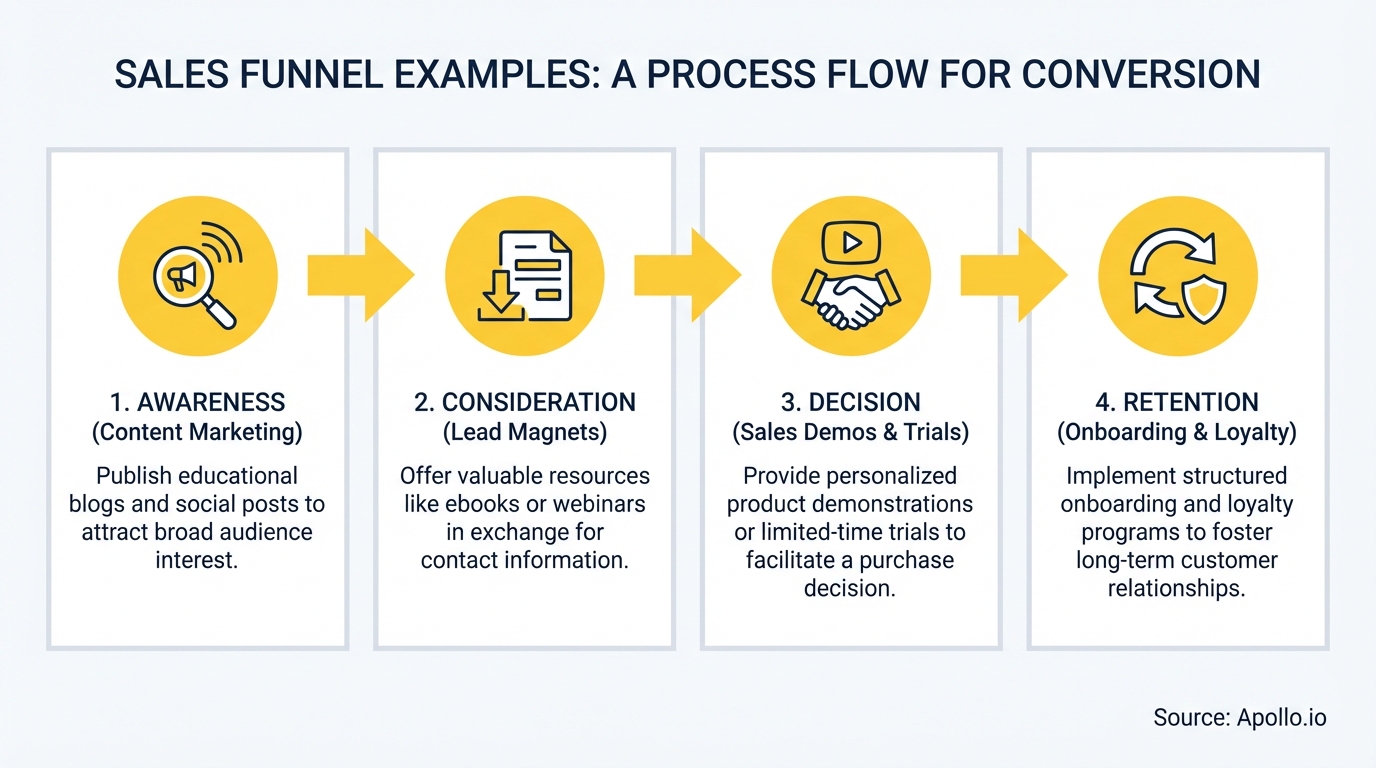
Sales funnel examples are real-world blueprints showing how companies move prospects from initial awareness to closed deals. They map specific tactics, channels, and handoffs at each funnel stage: awareness, interest, consideration, decision, and retention. A SaaS sales funnel differs dramatically from an enterprise or e-commerce funnel in cycle length, touchpoint mix, and team involvement.
According to McKinsey research, B2B buyers now use an average of ten channels during their purchasing journey, with 42% utilizing more than 11 different touchpoints. This means your funnel must orchestrate email, social selling, webinars, product demos, and field sales seamlessly.
How Do SaaS Companies Structure Their Sales Funnels?
SaaS funnels prioritize product-led growth and self-service at the top, transitioning to human touchpoints for qualified leads. The typical structure includes content marketing (blog posts, webinars), free trials or freemium tiers, automated email sequences, product tours, sales-assisted demos, and expansion revenue motions.
Key metrics for SaaS funnels:
- Trial-to-paid conversion: 10-25% industry benchmark
- Time to first value: Under 5 minutes for PLG models
- MQL-to-SQL conversion: 20-30% for well-qualified leads
- Sales cycle: 30-90 days for mid-market, 6-12 months for enterprise
Struggling to qualify leads at scale? Search Apollo's 224M+ contacts with 65+ filters to build targeted prospect lists in minutes.
What Does an Enterprise B2B Sales Funnel Look Like?
Enterprise funnels involve multiple decision-makers, longer cycles (6-18 months), and coordinated efforts between SDRs, AEs, and field sales. Research from McKinsey shows that hybrid selling has become the dominant B2B strategy, with companies adopting this model experiencing up to a 50% increase in revenue.
Enterprise funnel stages and ownership:
| Stage | Owner | Key Activities | Success Metrics |
|---|---|---|---|
| Awareness | Marketing | ABM campaigns, executive content, events | Account engagement score |
| Qualification | SDR/BDR | Discovery calls, pain validation, stakeholder mapping | Meeting book rate (15-20%) |
| Evaluation | AE | Product demos, ROI analysis, proof of concept | Demo-to-proposal rate (40-50%) |
| Decision | AE + Field Sales | Executive sponsorship, contract negotiation, legal review | Proposal-to-close rate (30-40%) |
| Expansion | Customer Success + AE | Upsells, cross-sells, renewals | Net revenue retention (110-130%) |
For enterprise sales teams, clear handoff protocols and SLA-style metrics between inside and field sales prevent deals from stalling. Leading teams define when SDRs pass qualified accounts to AEs (typically after 2-3 positive discovery interactions with decision-maker engagement).
Turn Forecast Guesswork Into Revenue Certainty
Pipeline forecasting a guessing game? Apollo's real-time deal tracking gives you accurate visibility across every stage. Built-In increased win rates 10% with Apollo's scoring and signals.
Start Free with Apollo →How Do SDRs and AEs Optimize Funnel Conversion Rates?
SDRs focus on top-of-funnel activities: prospecting, outreach, and booking qualified meetings. AEs own mid-to-bottom funnel stages: running discovery, delivering demos, and closing deals.
Both roles benefit from AI-powered tools that automate research, personalize messaging, and surface next-best actions.
SDR optimization tactics:
- Use multi-channel cadences mixing email, LinkedIn, and phone (7-12 touchpoints)
- Personalize outreach with trigger events (funding, hiring, technology changes)
- A/B test subject lines and messaging angles weekly
- Track reply rates (target 8-15%) and meeting book rates (target 15-25%)
AE optimization tactics:

- Conduct thorough discovery using frameworks like MEDDIC or BANT
- Deliver value-focused demos tailored to prospect pain points
- Build multi-threaded relationships with 3-5 stakeholders per account
- Use deal management systems to track stage progression and identify at-risk deals
Spending hours on manual outreach and follow-up? Automate your sequences with Apollo's multi-channel engagement platform.
What Role Does AI Play in Modern Sales Funnels?
AI transforms funnels from static processes into adaptive systems that optimize in real time. Data from Gartner indicates 92% of businesses are considering investing in AI-powered software in 2026 to enhance operations and gain a competitive edge.
AI applications across funnel stages:
- Lead scoring: Predict conversion likelihood based on firmographic, behavioral, and intent data
- Personalization: Generate tailored email copy, subject lines, and call scripts
- Next-best-action: Recommend optimal outreach timing, channel, and message for each prospect
- Conversation intelligence: Analyze call recordings to surface objections, buying signals, and coaching opportunities
- Forecasting: Project pipeline coverage and revenue outcomes with 85-95% accuracy
Teams using AI sales tools report 35-46% increases in meeting bookings and deal velocity. The key is integrating AI into your existing workflow rather than treating it as a separate system.
How Do You Measure and Optimize Funnel Performance?
Effective funnel measurement requires stage-specific metrics, attribution modeling, and regular analysis of conversion rates and velocity. RevOps leaders should establish dashboards tracking both leading indicators (activity volume, engagement rates) and lagging indicators (revenue, win rates).
Critical funnel metrics by stage:
- Top of funnel: Lead volume, source mix, cost per lead, MQL rate
- Middle of funnel: SQL conversion, meeting show rate, demo completion, opportunity creation
- Bottom of funnel: Proposal acceptance, close rate, average deal size, sales cycle length
- Post-sale: Onboarding completion, time to value, expansion rate, churn rate
Optimization follows a test-and-learn approach. Run experiments on messaging, outreach sequences, demo formats, and pricing structures. Measure impact on conversion rates and iterate weekly. For example, testing email subject lines can lift open rates by 20-30%.

Why Should Sales Teams Consolidate Their Tech Stack?
Most sales teams use 5-8 separate tools for prospecting, engagement, data enrichment, call recording, and pipeline management. This fragmentation creates data silos, integration headaches, and higher costs.
Unified platforms that combine these capabilities improve data quality, reduce context switching, and lower total cost of ownership.
Benefits of tool consolidation:
- Cost savings: Replace 3-5 tools with one platform (typically 40-60% reduction)
- Data quality: Single source of truth eliminates sync errors and duplicate records
- Productivity: Reps work in one interface instead of toggling between multiple tools
- Faster ramp: New hires learn one system instead of five
Customer proof points show the impact. Predictable Revenue reported: "We reduced the complexity of three tools into one." Census shared: "We cut our costs in half." Cyera noted: "Having everything in one system was a game changer."
Start Building Your High-Converting Sales Funnel
Sales funnel examples from SaaS, enterprise, and e-commerce companies reveal common patterns: multi-channel touchpoints, AI-powered personalization, clear handoff protocols, and unified data systems. The funnels that win in 2026 combine digital efficiency with human expertise, automate repetitive tasks while preserving relationship-building, and measure performance rigorously to optimize every stage.
For SDRs prospecting accounts, AEs running discovery, or RevOps leaders tracking pipeline health, the right tools make the difference between hitting quota and falling short. Modern teams are consolidating their tech stack into platforms that handle prospecting, engagement, data enrichment, and pipeline management in one workspace.
Ready to build a funnel that converts? Schedule a Demo to see how Apollo's all-in-one platform helps 550K+ companies streamline their sales process, reduce tool sprawl, and accelerate revenue growth.
Prove Apollo's ROI In Your First 30 Days
Budget approval stuck on unclear metrics? Apollo tracks every touchpoint from prospect to close, showing exactly what's working. Built-In increased win rates 10% and ACV 10% with Apollo's scoring and signals.
Start Free with Apollo →Don't miss these
Sales
Inbound vs Outbound Marketing: Which Strategy Wins?
Sales
What Is a Sales Funnel? The Non-Linear Revenue Framework for 2026
Sales
What Is a Go-to-Market Strategy? The 2026 GTM Playbook
See Apollo in action
We'd love to show how Apollo can help you sell better.
By submitting this form, you will receive information, tips, and promotions from Apollo. To learn more, see our Privacy Statement.
4.7/5 based on 9,690 reviews
