Sales Forecasting Software: How to Predict Revenue With AI-Powered Accuracy
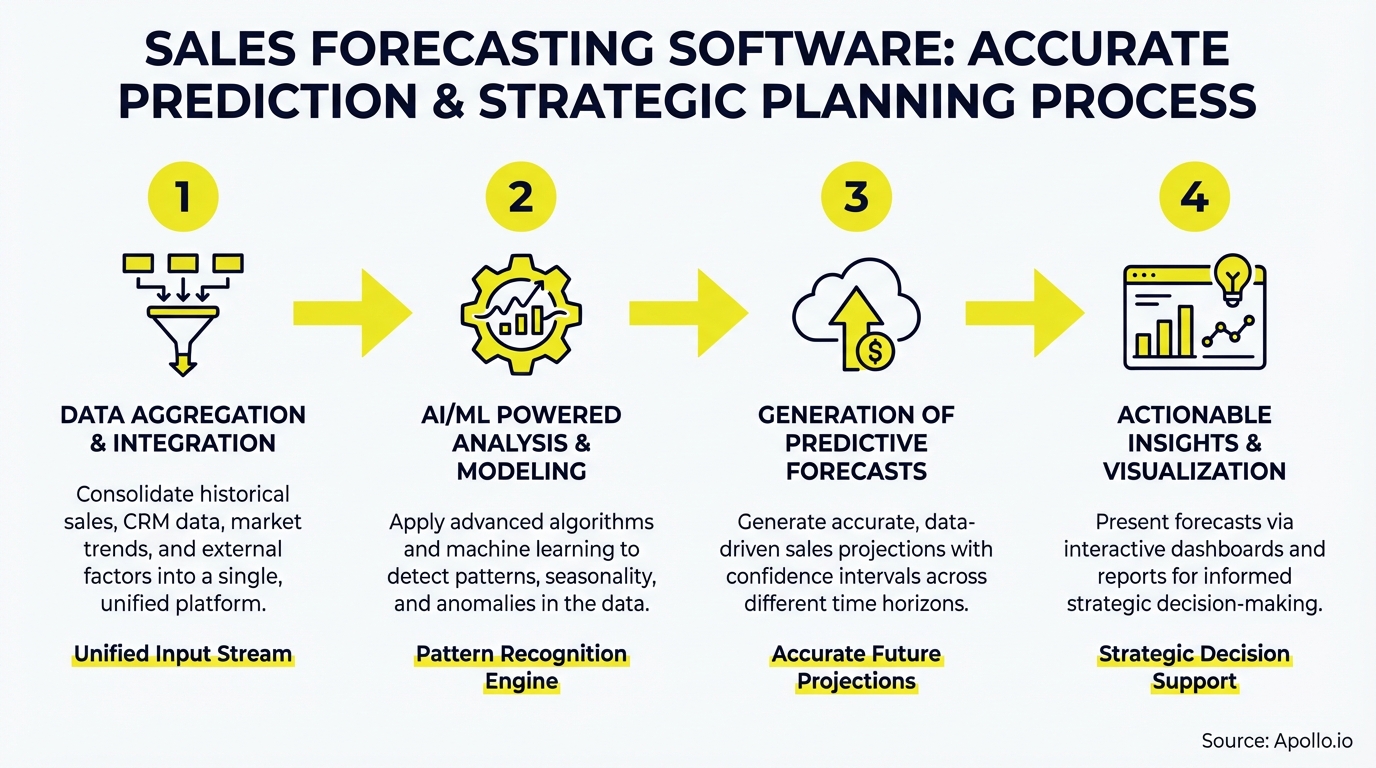
Sales forecasting software in 2026 combines AI with human expertise to predict revenue with unprecedented accuracy. Modern platforms integrate real-time pipeline data, historical trends, and market signals to help sales leaders make confident decisions about hiring, budgeting, and growth strategies.

Apollo Cuts Research Time From Hours To Seconds
Tired of spending 4+ hours daily hunting for contact info? Apollo delivers 224M verified contacts instantly so your reps can focus on closing. Join 550K+ companies who stopped manual prospecting.
Start Free with Apollo →Key Takeaways
- AI-hybrid forecasting combines machine learning with sales rep input to achieve 85%+ accuracy rates in 2026
- Modern sales forecasting software integrates directly with CRM systems to eliminate manual data entry and spreadsheet errors
- Industry-specific implementation playbooks reduce deployment time from 6 months to 8-12 weeks with measurable ROI
- Data governance frameworks ensure forecast reliability by maintaining clean, standardized pipeline data across teams
- Sales leaders using AI-enhanced forecasting report 35% better quota attainment and 40% faster deal cycle predictions
What Is Sales Forecasting Software?
Sales forecasting software predicts future revenue by analyzing pipeline data, historical performance, and deal progression patterns. These platforms automate what used to require hours of spreadsheet work, giving sales leaders real-time visibility into projected outcomes.
Modern systems pull data directly from your CRM, eliminating manual updates. They track deal stages, win rates, and sales velocity to generate forecasts at the rep, team, and company level. According to Gartner, the CRM sales software market reached $28.7 billion in 2025, with a projected CAGR of 12.8% through 2029, driven largely by AI integration.
The best platforms combine quantitative metrics with qualitative signals. They factor in rep confidence levels, buying committee engagement, and competitive dynamics alongside hard numbers.
This hybrid approach delivers accuracy rates that pure algorithm-based systems cannot match.
Why Do Sales Leaders Need Forecasting Software in 2026?
Sales leaders need forecasting software because revenue predictability directly impacts every business decision from hiring to product development. Inaccurate forecasts create cash flow problems, missed targets, and executive team distrust.
The complexity of B2B sales cycles has increased dramatically. Research by Business Solution shows that by 2025, 75% of B2B sales organizations use a combination of AI and traditional sales solutions. Multi-threaded deals, longer evaluation periods, and economic uncertainty make manual forecasting unreliable.

Key benefits for sales leaders include:
- Resource allocation: Know when to hire, ramp, or reallocate territories based on projected pipeline gaps
- Board confidence: Present data-backed projections that executives can trust for strategic planning
- Early warning system: Identify slipped deals and at-risk revenue 30-60 days before quarter end
- Quota setting: Build realistic targets based on historical attainment and market conditions
Struggling with inaccurate pipeline visibility? Track every deal stage and forecast with confidence using Apollo's real-time deal management.
How Does AI-Hybrid Forecasting Work?
AI-hybrid forecasting combines machine learning algorithms with human judgment to predict outcomes more accurately than either approach alone. The system analyzes thousands of deal variables while incorporating rep insights about customer readiness and competitive position.
The framework includes five core components:
| Component | Function | Impact |
|---|---|---|
| Data Layer | Aggregates CRM, email, call, and meeting data | Eliminates manual entry, ensures completeness |
| AI Engine | Identifies patterns in historical win/loss data | Predicts close probability with 80-90% accuracy |
| Rep Input | Captures qualitative signals and deal context | Adjusts AI predictions based on ground truth |
| Governance | Standardizes deal stages and qualification criteria | Creates consistent, comparable forecasts |
| Reporting | Visualizes trends, risks, and opportunities | Enables proactive pipeline management |
The AI analyzes deal velocity, engagement scores, and buying signals to calculate close probability. Reps then validate or adjust these predictions based on conversations and relationship strength.
This collaboration produces forecasts that are both data-driven and contextually aware.
See Every Deal Stage In Real Time With Apollo
Pipeline forecasting a guessing game? Apollo tracks deal progression automatically across your entire team. Built-In boosted win rates 10% with real-time visibility.
Start Free with Apollo →How Do Account Executives Use Forecasting Software Daily?
Account Executives use forecasting software to prioritize deals, identify risks, and communicate pipeline health to leadership. The platform becomes their command center for managing quota attainment throughout the quarter.
Daily workflows include:
- Morning pipeline review: Check updated close probabilities and identify deals requiring immediate attention
- Deal risk assessment: Review stalled opportunities flagged by the system based on activity drop-offs
- Forecast submissions: Update commit, best-case, and worst-case scenarios with one-click adjustments
- Coaching sessions: Share forecast data with managers to discuss strategy and get support on complex deals
AEs managing enterprise deals particularly benefit from multi-quarter visibility. They can track long-cycle opportunities across fiscal periods without losing context. Modern platforms integrate engagement data to show which stakeholders are active and which need re-engagement.

Spending hours updating spreadsheets instead of selling? Automate your forecast updates and focus on closing with Apollo's AI-powered workflows.
What Are the Key Metrics for Forecast Accuracy?
Forecast accuracy metrics measure how closely predicted revenue matches actual closed business. Sales leaders track these KPIs to improve forecasting discipline and hold teams accountable for pipeline management.
Essential metrics include:
| Metric | Calculation | Target Benchmark |
|---|---|---|
| Forecast Accuracy | (Actual Revenue / Forecasted Revenue) × 100 | 90-95% at quarter end |
| Commit Attainment | Percentage of commit category that closes | 95%+ (high-confidence deals) |
| Pipeline Coverage | Total Pipeline Value / Quota | 3-4x for healthy coverage |
| Slipped Deal Rate | Deals pushed to next period / Total Forecast | Less than 15% |
| Win Rate by Stage | Closed Won / Opportunities at Each Stage | Varies by sales cycle |
RevOps leaders use these metrics to identify coaching opportunities. Low commit attainment suggests reps overestimate deal strength. High slip rates indicate qualification problems or unrealistic timelines. Advanced analytics platforms track these trends automatically and alert managers to deteriorating accuracy.
How Should Sales Leaders Implement Forecasting Software?
Sales leaders should implement forecasting software in phases, starting with data hygiene and governance before rolling out AI features. Rushing deployment without clean data guarantees inaccurate predictions and team frustration.
Proven implementation roadmap:
Phase 1 (Weeks 1-4): Foundation
- Audit CRM data quality and standardize deal stages across teams
- Define forecast categories (commit, best case, pipeline) with clear criteria
- Document qualification requirements for each pipeline stage
- Establish weekly forecast submission and review cadence
Phase 2 (Weeks 5-8): Integration
- Connect forecasting software to CRM, email, and communication platforms
- Configure AI models using 12+ months of historical deal data
- Train pilot group of 5-10 reps on daily workflows and best practices
- Set baseline accuracy metrics to measure improvement
Phase 3 (Weeks 9-12): Optimization
- Roll out to full sales organization with dedicated onboarding sessions
- Refine AI predictions based on actual outcomes and rep feedback
- Build custom dashboards for different leadership levels (VP, Director, Manager)
- Integrate forecasting into your existing sales tech stack for seamless workflows
Founders and sales leaders report that phased rollouts reduce resistance and ensure adoption. Census, an Apollo customer, noted they "cut costs in half" by consolidating multiple tools into one unified platform.
What Should Buyers Evaluate When Selecting Software?
Buyers should evaluate forecasting software based on data integration capabilities, AI accuracy, and ease of use for frontline reps. The best technology fails if reps won't use it daily.
Critical evaluation criteria:
| Category | Key Questions |
|---|---|
| Integration | Does it connect natively to our CRM? Can it pull engagement data from email and calls? |
| AI Capabilities | How does it calculate close probability? Can we see the factors driving predictions? |
| User Experience | How many clicks to submit a forecast? Is the mobile experience functional? |
| Customization | Can we define our own deal stages and forecast categories? Does it support multiple sales motions? |
| Reporting | What dashboards come standard? Can we build custom views for different roles? |
| Support | What does onboarding look like? Is there a dedicated CSM for implementation? |
Request proof of accuracy metrics from vendors. Ask for customer references in your industry with similar sales cycles. Review third-party ratings and user reviews to validate vendor claims.
Consider total cost of ownership beyond licensing fees. Factor in integration costs, training time, and ongoing data maintenance.
Platforms that consolidate multiple functions deliver better ROI than point solutions requiring separate tools.
Ready to Transform Your Sales Forecasting?
Sales forecasting software has evolved from simple spreadsheet replacements to sophisticated AI platforms that predict revenue with remarkable accuracy. The combination of machine learning and human expertise creates forecasts that sales leaders can confidently present to boards and use for strategic decisions.
Success requires more than just technology. You need clean data, standardized processes, and team buy-in at every level.
Start with a strong governance framework, choose software that integrates seamlessly with your existing systems, and measure improvement with clear accuracy metrics.
Apollo provides an all-in-one platform that eliminates the complexity of managing separate tools for prospecting, engagement, and pipeline management. Cyera, an Apollo customer, reported that "having everything in one system was a game changer" for their sales operations.
With 224M+ verified business contacts, native CRM integration, and AI-powered deal insights, Apollo helps teams forecast accurately while reducing tech stack costs.
Show Budget Impact In Your First 30 Days
Budget approval stuck on unclear metrics? Apollo tracks every touchpoint from first contact to closed deal. Built-In increased win rates 10% and ACV 10% with measurable pipeline visibility.
Start Free with Apollo →Don't miss these
Sales
Inbound vs Outbound Marketing: Which Strategy Wins?
Sales
What Is a Sales Funnel? The Non-Linear Revenue Framework for 2026
Sales
What Is a Go-to-Market Strategy? The 2026 GTM Playbook
See Apollo in action
We'd love to show how Apollo can help you sell better.
By submitting this form, you will receive information, tips, and promotions from Apollo. To learn more, see our Privacy Statement.
4.7/5 based on 9,690 reviews
