
Sales Forecasting Methods: Proven Strategies for Accurate Revenue Predictions
Sales forecasting in 2026 requires balancing AI efficiency with human expertise. According to Gartner, 75% of B2B buyers will prefer sales experiences prioritizing human interaction over AI by 2030. Yet Forrester reports that more than half of large B2B transactions (US$1 million+) are already processed through digital self-serve channels. This creates a forecasting paradox: how do you predict revenue across both rep-led and self-service buying paths? Modern sales performance management demands a hybrid approach that captures both channels.

Apollo Eliminates 4+ Hours Of Daily Research
Tired of spending 4+ hours daily hunting for contact info? Apollo delivers 224M verified contacts with 96% email accuracy instantly. Join 550K+ companies who replaced manual research with predictable pipeline.
Start Free with Apollo →Key Takeaways
- Hybrid AI-human forecasting combines automated analysis with rep judgment for 30-40% better accuracy
- Channel-specific methods improve predictions across rep-led deals and self-service transactions
- Deal size determines forecasting approach: qualitative methods for enterprise, quantitative for SMB
- Real-time pipeline data prevents forecast drift and enables proactive adjustments
- RevOps teams using unified platforms reduce forecast errors by consolidating data sources
What Are Sales Forecasting Methods?
Sales forecasting methods are systematic approaches to predicting future revenue based on historical data, pipeline analysis, and market trends. These methods range from simple opportunity-stage calculations to sophisticated AI models analyzing hundreds of variables.
The goal is providing Sales Leaders with actionable revenue predictions that inform hiring, budgeting, and go-to-market strategy.
In 2026, effective forecasting requires addressing both traditional rep-led sales and emerging self-service channels. Research by McKinsey shows buyers' comfort with remote and self-service spending has increased dramatically, especially for orders worth $500,000 or more. Your forecasting method must capture both paths to revenue.
Why Do Sales Leaders Need Multiple Forecasting Methods?
No single forecasting method fits every deal type, channel, or sales cycle. Account Executives closing enterprise deals require qualitative assessments of buyer committees and competitive dynamics.
Meanwhile, SDRs feeding high-velocity pipelines need quantitative models tracking conversion rates across thousands of touches.
Deal size also dictates method selection. Enterprise deals above $100K demand opportunity-stage forecasting with rep input on champion strength and budget approval. SMB deals under $25K perform better with historical trend analysis and velocity-based models. Sales Leaders managing diverse pipelines need a forecasting framework that prescribes which method to apply when.
What Are the Most Effective Sales Forecasting Methods in 2026?
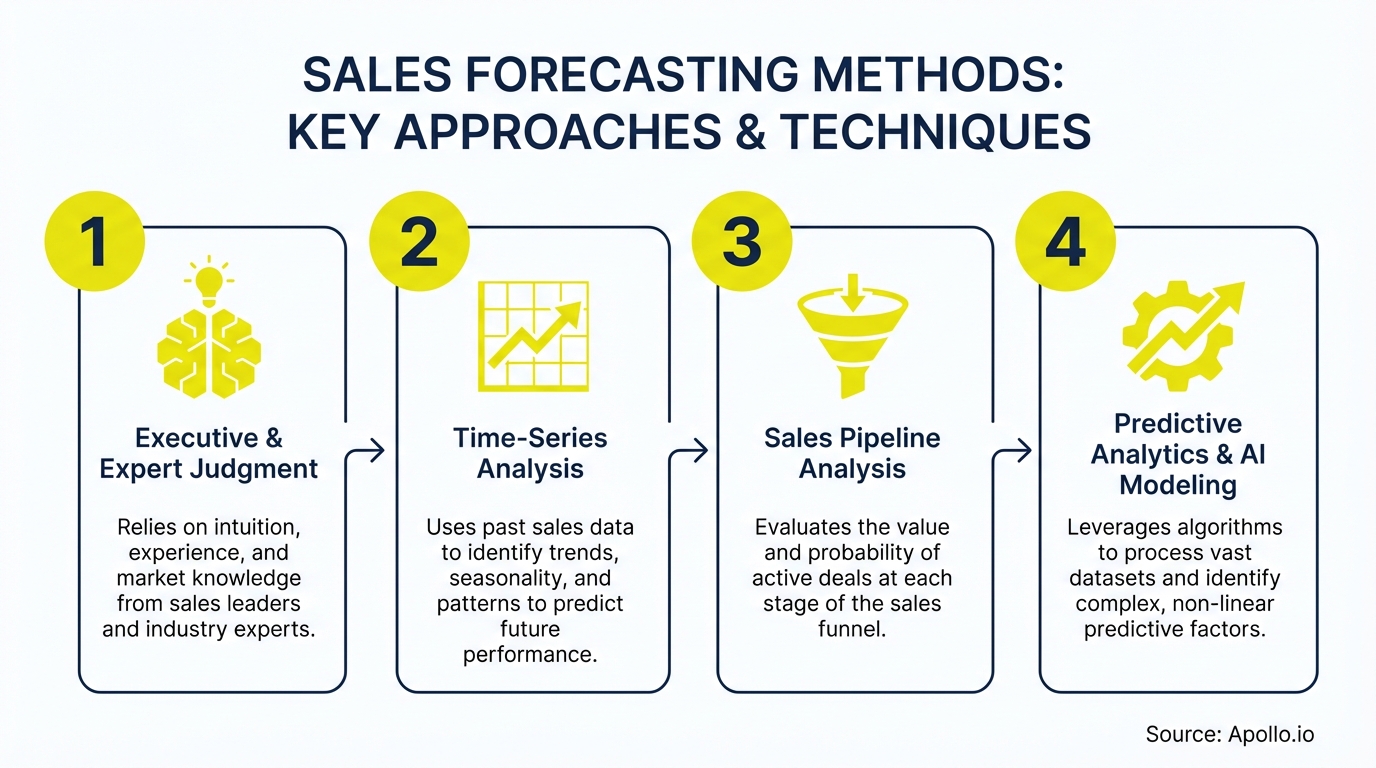
The five core forecasting methods each serve specific scenarios and deal profiles. Here's when to use each approach:
| Method | Best For | Accuracy Range | Data Requirements |
|---|---|---|---|
| Opportunity Stage | Enterprise deals, complex sales | 70-85% | Pipeline stages, historical close rates |
| Historical Trending | Seasonal businesses, established products | 75-90% | 24+ months revenue data |
| Length of Sales Cycle | Predictable buying processes | 65-80% | Deal creation dates, average cycle time |
| AI-Assisted Prediction | High-volume pipelines, digital channels | 80-95% | Clean CRM data, engagement signals |
| Hybrid Judgment | Multi-channel revenue streams | 85-95% | All above + rep assessments |
Struggling with inconsistent pipeline data? Track every deal stage with Apollo's unified pipeline management.
How Do Sales Leaders Build a Hybrid Forecasting Framework?
A hybrid forecasting framework combines AI analysis with human judgment across five implementation steps. Start by segmenting your pipeline into rep-led and self-service channels, then apply appropriate methods to each segment.
What Are the Five Steps to Implement Hybrid Forecasting?
- Channel Segmentation: Separate rep-led deals (requiring human touch) from self-service transactions (automated buying). Data from Gartner indicates 72% of B2B buyers complete transactions via sales rep-led channels, while 28% prefer digital-led channels.
- Deal Size Thresholds: Set dollar thresholds determining forecasting method. Deals above $100K get opportunity-stage + rep input. Deals under $25K use AI velocity models. Mid-market deals ($25K-$100K) blend both approaches.
- AI Model Training: Feed historical win/loss data, engagement patterns, and buyer signals into predictive models. RevOps teams report 30-40% accuracy improvements when models incorporate both CRM data and digital engagement signals.
- Rep Judgment Integration: Build templates for Account Executives to assess deal health beyond stage percentages. Factors include champion access, budget confirmation, decision timeline, and competitive positioning.
- Continuous Calibration: Compare forecast to actual results weekly. Adjust AI model weights and rep assessment criteria based on variance analysis. Top-performing sales tech stacks enable real-time forecast updates as pipeline changes.
Turn Forecast Chaos Into Revenue Certainty
Pipeline forecasting a guessing game? Apollo delivers real-time deal visibility and quality lead scoring that makes your numbers predictable. Built-In increased win rates 10% with Apollo's intelligence.
Start Free with Apollo →How Can RevOps Teams Improve Forecast Accuracy?
RevOps leaders improve forecast accuracy by eliminating data fragmentation across prospecting, engagement, and pipeline tools. When contact data, email sequences, call logs, and deal stages live in separate systems, forecasts rely on incomplete information.
Consolidating into a single platform provides the clean, real-time data AI models require.
Census reported cutting costs in half by moving to an all-in-one GTM platform. Cyera noted that having everything in one system was a game changer for forecast visibility.
Predictable Revenue reduced the complexity of three tools into one, improving data consistency across their forecasting process. For RevOps teams, tool consolidation directly translates to forecast reliability.
Can't get clean pipeline data across your tech stack? Unify prospecting, engagement, and forecasting in Apollo's all-in-one platform.
What Metrics Should Sales Leaders Track for Forecast Performance?
Track four core metrics to measure and improve forecasting accuracy over time:

| Metric | Calculation | Target |
|---|---|---|
| Forecast Accuracy | (Actual Revenue / Forecasted Revenue) × 100 | 90-95% |
| Pipeline Coverage | Total Pipeline Value / Quota | 3-4x for new business |
| Forecast Variance | |Forecasted - Actual| / Forecasted | <10% |
| Commit vs. Actual | Committed Deals Closed / Total Committed | 85-90% |
Sales Leaders at companies using AI sales tools report 35% increases in forecast accuracy by tracking these metrics weekly. The key is connecting metrics to specific pipeline actions, not just reporting variance after the quarter ends.
How Do Different Industries Approach Sales Forecasting?
Industry-specific factors require tailored forecasting approaches. Software companies with subscription models emphasize expansion revenue and churn risk.
Manufacturing businesses with long production cycles weight delivery timelines heavily. Professional services firms forecast based on utilization rates and contract renewals.
SaaS companies typically blend opportunity-stage forecasting for new business with cohort analysis for expansion and renewal revenue. Manufacturing firms use length-of-sales-cycle methods adjusted for production capacity constraints. Service businesses apply historical trending with seasonal adjustments for industry-specific buying patterns. Regardless of industry, the trend toward enterprise sales solutions that unify data across revenue streams improves cross-functional forecast visibility.

Start Forecasting with Confidence in 2026
Sales forecasting methods in 2026 require balancing AI automation with human expertise across both rep-led and self-service channels. The most accurate forecasts come from hybrid frameworks that apply the right method to each deal type, backed by clean pipeline data from unified GTM platforms.
Sales Leaders who consolidate their tech stack see immediate forecast improvements. When prospecting data, engagement tracking, and pipeline management live in one workspace, AI models access complete information while reps maintain visibility into every deal.
The result is forecast accuracy that actually drives confident business decisions.
Ready to improve your forecast accuracy? Start your free Apollo trial and unify your GTM data for better predictions.
Prove Apollo's ROI In Your First 30 Days
Budget approval stuck on unclear metrics? Apollo tracks every dollar—time saved, pipeline created, deals closed. Built-In increased win rates 10% and ACV 10% with measurable impact.
Start Free with Apollo →Don't miss these
Sales
Inbound vs Outbound Marketing: Which Strategy Wins?
Sales
What Is a Sales Funnel? The Non-Linear Revenue Framework for 2026
Sales
What Is a Go-to-Market Strategy? The 2026 GTM Playbook
See Apollo in action
We'd love to show how Apollo can help you sell better.
By submitting this form, you will receive information, tips, and promotions from Apollo. To learn more, see our Privacy Statement.
4.7/5 based on 9,690 reviews
