
Sales Forecast Template: Build Accurate Revenue Projections for Your Team
Sales leaders managing B2B teams in 2026 face unprecedented pressure to predict revenue accurately while adapting to rapid market shifts.
A sales forecast template provides the structured framework to transform scattered pipeline data into actionable revenue projections that align sales, finance, and executive teams.
According to McKinsey, 85% of B2B organizations now expect digital interactions to be the primary mode of engagement, making real-time forecasting essential.
The right template connects your CRM data, forecasting methodology, and business strategy into one executable plan that RevOps teams can trust.

Apollo Eliminates 4+ Hours Of Daily Research
Tired of spending 4+ hours daily hunting for contact info? Apollo delivers 224M verified contacts with 96% email accuracy instantly. Join 550K+ companies who replaced manual research with automated prospecting.
Start Free with Apollo →Key Takeaways
- AI-driven sales forecast templates improve prediction accuracy by 15% compared to traditional spreadsheet methods
- Executive-ready templates align revenue projections directly to business strategy and board-level objectives
- Modern forecasting integrates real-time CRM data to eliminate manual updates and reduce forecast errors
- Scenario planning features help sales leaders adapt forecasts instantly when market conditions shift
- Integrated forecasting platforms consolidate multiple tools, cutting costs while improving accuracy
What Is a Sales Forecast Template?
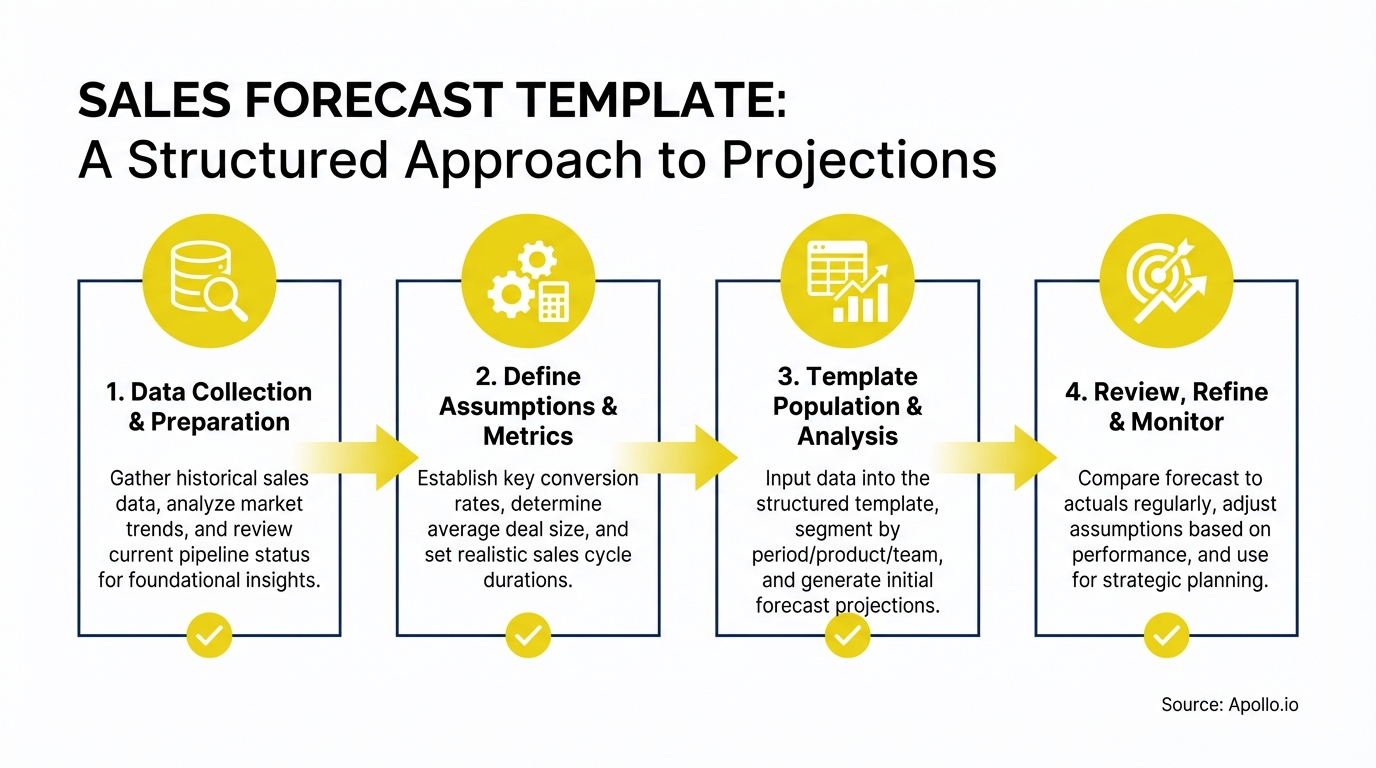
A sales forecast template is a structured framework that predicts future revenue by analyzing historical sales data, current pipeline metrics, and market trends.
It standardizes how sales teams calculate expected revenue across different time periods, typically monthly, quarterly, or annually.
Modern templates go beyond static spreadsheets.
They integrate directly with CRM systems to pull real-time deal data, apply weighted probability models, and generate executive-ready dashboards.
Research by the Journal of Forecasting shows that implementing machine learning workflows in forecasting improves prediction accuracy by 15% compared to traditional methods.
The best templates include scenario planning capabilities, allowing RevOps leaders to model best-case, worst-case, and most-likely outcomes.
This adaptability is critical in 2026, where sales performance management requires constant recalibration based on market volatility.
Why Do Sales Leaders Need Forecast Templates in 2026?
Sales leaders need forecast templates because manual forecasting in spreadsheets creates inconsistent methodologies across teams, leading to revenue surprises that damage credibility with CFOs and boards.
Templates standardize the forecasting process, ensuring every rep applies the same probability weightings and stage definitions.
The shift to digital-first selling has accelerated forecast complexity.
Account Executives managing remote deals across multiple channels need templates that capture engagement signals beyond traditional pipeline stages.
For Sales Leaders overseeing distributed teams, templates provide visibility into forecast health without constant status meetings.
Template-driven forecasting also reduces the time RevOps teams spend consolidating data.
Instead of chasing reps for updates, automated templates pull live data from your CRM, apply your chosen methodology, and generate board-ready reports.
This efficiency matters when building a sales tech stack focused on tool consolidation rather than adding more software.
How Do Sales Forecast Templates Improve Revenue Accuracy?
Sales forecast templates improve accuracy by eliminating subjective guesswork and replacing it with data-driven probability models.
Instead of reps estimating deal closure likelihood based on gut feel, templates apply consistent stage-based weightings derived from historical win rates.
| Pipeline Stage | Traditional Weighting | AI-Optimized Weighting | Accuracy Improvement |
|---|---|---|---|
| Qualification | 10% | 8% | +12% |
| Demo Completed | 30% | 35% | +18% |
| Proposal Sent | 50% | 58% | +15% |
| Negotiation | 75% | 72% | +9% |
| Verbal Commit | 90% | 88% | +6% |
Modern templates integrate external signals that static spreadsheets miss.
When prospects engage with pricing pages, attend webinars, or download case studies, AI-enhanced templates adjust deal probabilities automatically.
This real-time recalibration prevents the forecast inflation that occurs when reps manually update spreadsheets.
For founders building outbound motions, accurate forecasting directly impacts fundraising conversations and hiring decisions.
Templates that connect pipeline metrics to sales funnel conversion rates help CEOs make data-backed growth investments rather than optimistic guesses.
Turn Forecast Guesswork Into Revenue Certainty
Pipeline forecasting a guessing game? Apollo's real-time pipeline visibility shows exactly where every deal stands—no more unreliable forecasts. Built-In increased win rates 10% with Apollo's scoring and guidance.
Start Free with Apollo →What Should a Sales Forecast Template Include?
An effective sales forecast template must include five core components: pipeline snapshot, weighted revenue calculations, time-series projections, scenario modeling, and variance analysis.
These elements work together to give sales leaders both current state visibility and forward-looking predictions.
Pipeline Snapshot: Real-time view of all open opportunities with deal size, stage, close date, and assigned owner. This section pulls directly from your CRM to eliminate manual data entry.
Weighted Revenue Calculations: Applies probability percentages to each deal based on stage, creating a realistic expected revenue figure.
Advanced templates use historical win rates specific to your sales cycle rather than generic industry benchmarks.
Time-Series Projections: Breaks down expected revenue by week, month, and quarter. This granularity helps SDRs and BDRs understand how current prospecting activity translates to future pipeline coverage.
Scenario Modeling: Includes best-case (90th percentile), most-likely (50th percentile), and worst-case (10th percentile) outcomes. RevOps teams use these scenarios to stress-test hiring plans and quota assignments.
Variance Analysis: Compares forecasted revenue against actual results, identifying patterns in forecast accuracy. This feedback loop improves future predictions and highlights which reps consistently over or underestimate their pipeline.
Templates should also integrate with deal management platforms to automatically track stage progression and flag deals at risk of slipping.
Manual tracking creates forecast lag that reduces decision-making speed.
How Do RevOps Teams Implement Forecast Templates?
RevOps teams implement forecast templates through a three-phase approach: data foundation, template configuration, and adoption enforcement.
The process typically spans 60-90 days for mid-market companies with established CRM systems.
Phase 1: Data Foundation (Weeks 1-3)
- Audit CRM data quality and close data gaps (missing deal sizes, unclear stages, inconsistent close dates)
- Standardize pipeline stage definitions across all sales teams
- Calculate historical win rates by stage using at least 6 months of closed deal data
- Establish data governance rules to maintain forecast integrity going forward
Phase 2: Template Configuration (Weeks 4-6)
- Select template architecture (native CRM forecasting vs. integrated platform vs. BI tool)
- Configure weighted probability models using your historical win rates
- Build scenario planning logic for best/worst/likely cases
- Create automated dashboards for sales leaders and executives
- Set up variance tracking to measure forecast accuracy over time
Phase 3: Adoption Enforcement (Weeks 7-12)

- Train reps on template usage and forecast submission cadence (typically weekly)
- Establish forecast review rituals (Monday pipeline reviews, Friday forecast locks)
- Implement forecast accuracy as a performance metric alongside quota attainment
- Continuously refine probability weightings based on variance analysis
Struggling to maintain clean pipeline data across your team? Apollo's data enrichment automatically updates contact and company information so your forecasts reflect accurate deal sizes and buyer profiles.

How Do AEs Use Templates to Close Deals Faster?
Account Executives use forecast templates to identify which deals need immediate attention and which can move through the natural sales cycle.
Templates that highlight deal velocity changes flag opportunities slipping off track before they're lost.
AEs managing enterprise accounts benefit from templates that track multiple stakeholders per deal.
When templates integrate with conversation intelligence platforms, they surface which champions are engaged and which decision-makers need re-engagement.
This visibility shortens sales cycles by preventing deals from stalling in late stages.
Templates also help AEs manage their time allocation.
By viewing weighted pipeline against quota, reps can identify coverage gaps early and prioritize prospecting before the quarter ends.
For Account Executives juggling 20+ opportunities, this prioritization prevents the common mistake of chasing low-probability deals while neglecting high-value prospects.
Modern templates connect forecast data to sales email templates and outreach sequences, helping AEs personalize follow-up based on deal stage and engagement history.
This integration transforms forecasting from a reporting exercise into an active selling tool.
What Are the Best Forecast Templates for Different Business Models?
The optimal forecast template varies based on your sales motion, deal complexity, and sales cycle length.
SaaS companies with monthly recurring revenue need different templates than transactional B2B businesses with one-time purchases.
| Business Model | Template Type | Key Metrics | Forecast Horizon |
|---|---|---|---|
| Transactional B2B | Velocity-based | Deal count, avg deal size, win rate | 30-60 days |
| Mid-Market SaaS | Stage-weighted | ARR, pipeline coverage, sales cycle | 90-120 days |
| Enterprise Sales | Opportunity-based | TCV, close probability, champion strength | 180-270 days |
| Usage-Based | Expansion-focused | NRR, expansion pipeline, churn risk | 90-180 days |
| Channel/Partner | Multi-source | Partner pipeline, co-sell deals, attribution | 60-120 days |
Transactional models benefit from velocity-based templates that focus on deal count and average contract value.
These templates prioritize speed metrics like days in stage and conversion rates between stages.
Enterprise sales teams need opportunity-based templates that track individual mega-deals with granular detail.
These templates include fields for economic buyer engagement, technical validation status, and competitive positioning.
For Sales Development teams building pipeline, templates should connect prospecting activity to future revenue.
SDRs using prospecting lists need visibility into how many qualified meetings convert to pipeline dollars three months later.
Start Forecasting with Confidence in 2026
Sales forecast templates transform revenue prediction from guesswork into science.
By standardizing methodologies, integrating real-time data, and enabling scenario planning, templates give sales leaders the confidence to make strategic decisions about hiring, quota setting, and market expansion.
The most effective templates don't exist in isolation.
They connect pipeline data, engagement signals, and historical performance into one unified view that serves SDRs chasing quota, AEs closing deals, and executives planning company growth.
As B2B buying continues its digital shift, forecasting accuracy becomes the competitive advantage that separates predictable revenue engines from reactive sales organizations.
RevOps teams implementing templates in 2026 should prioritize platforms that consolidate multiple tools rather than adding more software to already complex tech stacks.
Companies that centralize forecasting, pipeline management, and sales engagement report significant cost savings alongside accuracy improvements.
Ready to build forecasts that actually predict your revenue? Get Leads Now with Apollo's all-in-one platform that connects prospecting, engagement, and pipeline management in one workspace.
Cut your tech stack while improving forecast accuracy.
Prove Apollo's ROI In Your First 30 Days
Budget approval stuck on unclear metrics? Apollo tracks every touchpoint from first contact to closed deal—quantify exactly how many hours saved and pipeline dollars generated. Built-In increased win rates 10% and ACV 10% with Apollo's scoring.
Start Free with Apollo →Don't miss these
Sales
Inbound vs Outbound Marketing: Which Strategy Wins?
Sales
What Is a Sales Funnel? The Non-Linear Revenue Framework for 2026
Sales
What Is a Go-to-Market Strategy? The 2026 GTM Playbook
See Apollo in action
We'd love to show how Apollo can help you sell better.
By submitting this form, you will receive information, tips, and promotions from Apollo. To learn more, see our Privacy Statement.
4.7/5 based on 9,690 reviews
