
Sales Forecast Definition: What It Is, How to Measure It, and Why Most Teams Get It Wrong
A sales forecast is a structured estimate of future revenue over a defined period, built from pipeline data, historical performance, and market conditions. It is not a wish list or a gut-feel number. The sales forecast definition has expanded: modern forecasts are auditable data products that capture who submitted what, when, with which category, and how that changed over time. For sales performance management to work, the forecast must be the single source of revenue truth across sales, finance, and operations.
The problem? Most teams are not close. According to Challenger Inc., only 20% of sales organizations achieved forecasts within 5% of projections, while 43% missed their goal by 10% or more. That gap is not a math problem. It is a data quality, governance, and definition problem.

Apollo Turns Hours of Research Into Seconds
Tired of your reps burning the day on manual research instead of selling? Apollo surfaces verified contacts instantly, so your team spends time closing — not digging. 550K+ companies already made the switch.
Start Free with Apollo →Key Takeaways
- A sales forecast is a structured revenue estimate built from pipeline data, historical trends, and market inputs — not rep intuition.
- Most forecasts fail because of poor data quality and undefined category criteria, not because of bad math.
- Forecast accuracy is a measurable KPI: track MAPE, forecast bias, and variance by category and cohort.
- AI is now standard in forecasting workflows, but AI only improves accuracy when category definitions and CRM hygiene are enforced first.
- Sales and finance alignment — with shared cadence, RACI, and SLAs — is a prerequisite for reliable forecasting.
What Is a Sales Forecast? (Full Definition)
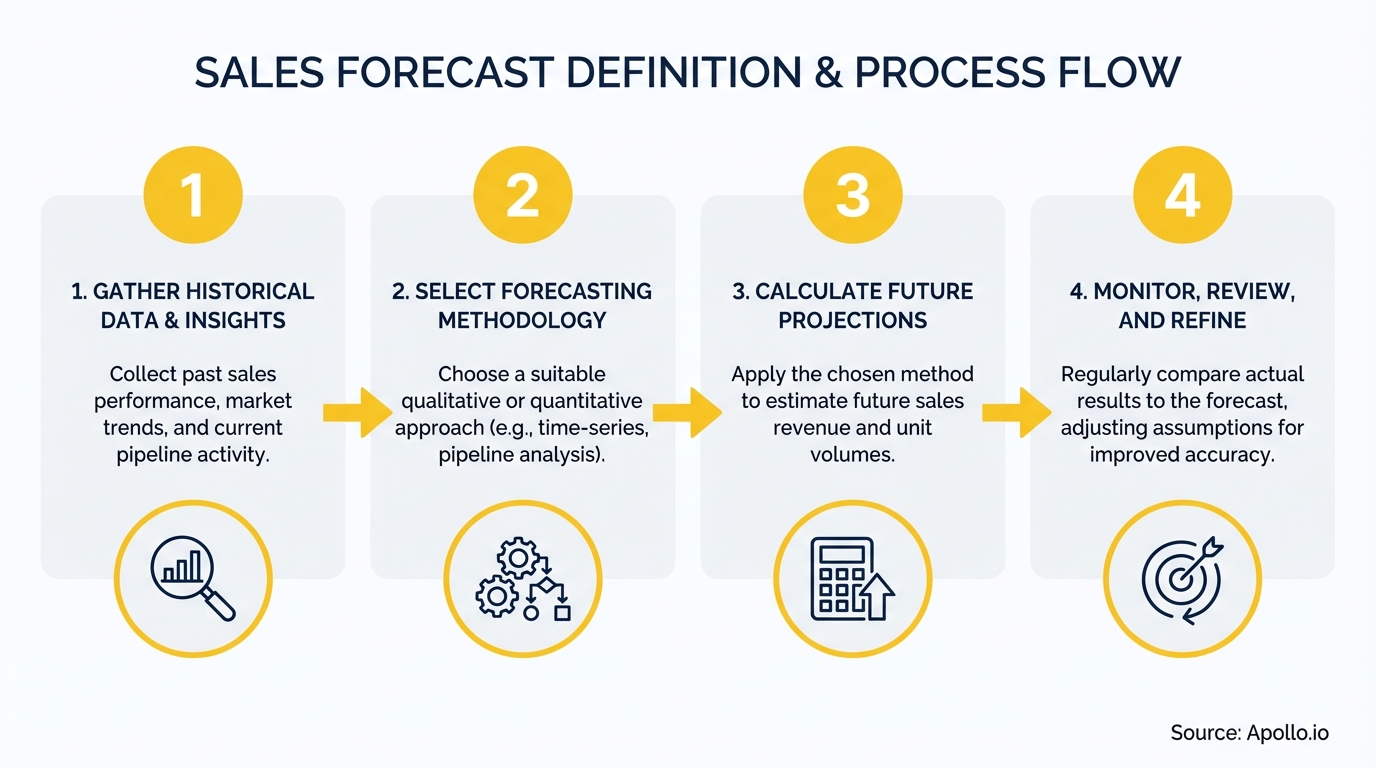
A sales forecast is a time-bound projection of expected revenue, derived from quantifiable inputs and reviewed against actuals on a defined cadence. As noted by Forecastio, it is integral for strategic planning, resource allocation, and achieving predictable growth across sales, marketing, and revenue operations.
A complete forecast includes four input categories:
- Pipeline data: open opportunities by stage, close date, and deal value
- Historical performance: win rates, average sales cycle, seasonal patterns
- Market factors: industry trends, competitive pressure, macroeconomic signals
- Forecast categories: Commit, Best Case, Pipeline — each with defined probability ranges and evidence criteria
A forecast is not a pipeline report. Pipeline shows what exists. A forecast applies probability weights and judgment to project what will close. It is also not an annual plan — plans set targets, forecasts estimate reality against those targets.
What Are Forecast Accuracy Benchmarks?
Forecast accuracy is measured by how close your predicted revenue lands to actual revenue. The primary metric is MAPE (Mean Absolute Percentage Error): lower is better, with sub-10% considered strong for most B2B teams.
Secondary metrics include forecast bias (systematic over- or under-prediction) and variance by category.
| Accuracy Range | What It Signals | Priority Action |
|---|---|---|
| Within 5% | Top-tier; strong data and process | Maintain governance cadence |
| 6–10% | Solid; room for CRM hygiene improvement | Audit stage exit criteria |
| 11–20% | Common; definition and data gaps | Redefine forecast categories |
| 20%+ | Structural problem; process or trust breakdown | Full governance reset |
According to Xactly, 97% of sales and finance leaders agree that better data would significantly improve the accuracy of their forecasts. That consensus makes data quality the highest-leverage fix available.
Need cleaner pipeline data feeding your forecasts? Build a verified pipeline with Apollo's AI-powered pipeline builder and give your forecast a trustworthy foundation.
Turn Forecast Guesswork Into Confidence
Pipeline forecasting a guessing game every quarter? Apollo surfaces verified, in-market buyers so your funnel fills with leads that actually convert. Join 550K+ companies building pipeline they can predict.
Schedule a Demo →Why Does Data Quality Determine Forecast Quality?
A forecast is only as accurate as the data inputs behind it. Inconsistent close dates, missing deal amounts, and vague stage definitions corrupt the model before any math runs.
This is not an edge case — it is the norm.
Five data quality gates every RevOps team should enforce:
- Close date discipline: No open opportunity without a verified, rep-owned close date
- Amount completeness: All deals must carry a dollar value before entering forecast categories
- Stage exit criteria: Each stage requires documented evidence (signed NDA, demo completed, budget confirmed)
- CRM field standardization: Enforce consistent picklist values across territories and segments
- Lineage tracking: Log who changed what and when — forecasts are auditable records, not snapshots
Persistent data quality issues are a top obstacle for B2B organizations in connecting with buyers and achieving goals, according to Forrester. For RevOps leaders, enforcing these gates is not admin overhead — it is forecast infrastructure. Explore how sales analytics can surface data quality gaps before they distort your forecast.
How Does AI Change the Sales Forecast Definition?
AI does not replace the forecast process. It adds a third signal to the triangulation: model output (AI baseline) + stage-based math (pipeline conversion) + rep commit (qualitative judgment).
The result is a hybrid forecast that is more defensible and faster to produce.
What AI changes in practice:
- Inputs: AI ingests engagement signals, email sentiment, and deal velocity — not just CRM fields
- Versioning: AI models create a timestamped forecast audit trail automatically
- Explainability: AI-generated forecasts need human-readable rationale for exec review (not just a number)
- Governance: Teams need rules for when to override AI output and how to document overrides
Gartner reports that only 45% of sales leaders are confident in the accuracy of their forecasts, per Forecastio. AI improves confidence only when category definitions and CRM hygiene are enforced first. AI amplifies the signal — it also amplifies the noise. For more on implementing AI in your sales workflow, see which AI sales tools actually close more deals.
Is your pipeline data ready for AI-assisted forecasting? Enrich your contact and account data with Apollo's verified database to give your AI model clean inputs.

How Do RevOps Leaders Align Sales and Finance on Forecasting?
Forecast alignment breaks down when sales and finance operate on different definitions of the same categories. A rep's "Commit" and a CFO's "Commit" must mean the same thing, backed by the same evidence standards.
A practical alignment framework:
| Element | Sales Responsibility | Finance Responsibility |
|---|---|---|
| Category definitions | Submit with evidence criteria | Validate against historical win rates |
| Cadence | Weekly rep-level updates | Monthly roll-up and variance review |
| RACI owner | RevOps owns CRM data quality | FP&A owns scenario modeling |
| SLA | Forecast locked by Thursday EOD | Variance report by Monday AM |
RevOps leaders who establish this cadence and shared glossary reduce forecast revision cycles and build executive trust in the number. For a broader view of how RevOps functions support revenue predictability, see how sales operations function within organizations. Pair this with deal management software that surfaces deal-level signals in real time.

What Is a Sales Forecast vs. a Sales Plan?
These terms are often used interchangeably and should not be. The distinction matters for governance and accountability.
- Sales plan: Sets targets — what revenue the business needs to achieve based on strategy and growth goals
- Sales forecast: Estimates reality — what revenue the pipeline will actually deliver given current conditions
- Forecast vs. plan variance: The gap between the two is the most important signal in any revenue review
For teams building or refining their approach, best practices for forecasting accuracy covers tested methods beyond definitions. The forecast-to-plan gap, tracked over time, also drives coaching conversations for Sales Leaders and AEs reviewing deal-level performance.
Conclusion: A Better Sales Forecast Definition Starts With Better Data
The modern sales forecast definition is no longer a single number produced in a weekly meeting. It is a governed, auditable data product built from clean pipeline inputs, defined category criteria, cross-functional alignment, and increasingly, AI-assisted triangulation.
Teams that treat forecasting as a system — not a guess — consistently outperform those that do not.
The foundation of that system is data quality. Clean contacts, verified accounts, and accurate pipeline signals are prerequisites, not nice-to-haves.
Apollo gives SDRs, AEs, RevOps leaders, and Sales Leaders a unified platform to build verified pipeline, enrich data, and track deals in one workspace — so your forecast starts with a number you can defend.
Start Prospecting with Apollo and give your sales forecast a foundation it deserves.
Prove Pipeline ROI With Apollo
ROI pressure making budget approvals impossible? Apollo delivers measurable pipeline impact your leadership can see — fast. Leadium 3x'd their annual revenue. Start yours today.
Start Free with Apollo →Don't miss these
Sales
Inbound vs Outbound Marketing: Which Strategy Wins?
Sales
What Is a Sales Funnel? The Non-Linear Revenue Framework for 2026
Sales
What Is a Go-to-Market Strategy? The 2026 GTM Playbook
See Apollo in action
We'd love to show how Apollo can help you sell better.
By submitting this form, you will receive information, tips, and promotions from Apollo. To learn more, see our Privacy Statement.
4.7/5 based on 9,690 reviews
