
Sales Force Management: Definition, Strategies, and Best Practices for 2026
Sales force management in 2026 is fundamentally different from what it was five years ago. B2B buyers now expect seamless omnichannel experiences, and Gartner predicts that 65% of B2B sales organizations will transition from intuition-based to data-driven decision-making by 2026. For Sales Leaders, RevOps teams, and Account Executives, this shift requires a complete rethinking of how you build, coach, and scale your sales organization.

Apollo Eliminates 4+ Hours Of Daily Research
Tired of spending 4+ hours daily hunting for contact info? Apollo delivers 224M verified contacts with 96% email accuracy instantly. Join 550K+ companies who stopped manual research and started closing deals.
Start Free with Apollo →Key Takeaways
- Modern sales force management integrates data-driven workflows, omnichannel engagement, and AI automation to replace outdated intuition-based approaches
- 74% of B2B buyer teams experience unhealthy conflict during decisions, making conflict resolution a critical management skill for closing high-quality deals
- Consolidating your tech stack into unified platforms reduces costs by 50% while improving team adoption and data consistency across your sales org
- Hybrid sales roles now dominate, with 85% of organizations prioritizing reps who can sell effectively across virtual and in-person channels
- Sales Leaders who implement structured data governance, AI integration frameworks, and rep-specific coaching see 35-46% increases in bookings and meetings
What Is Sales Force Management in 2026?
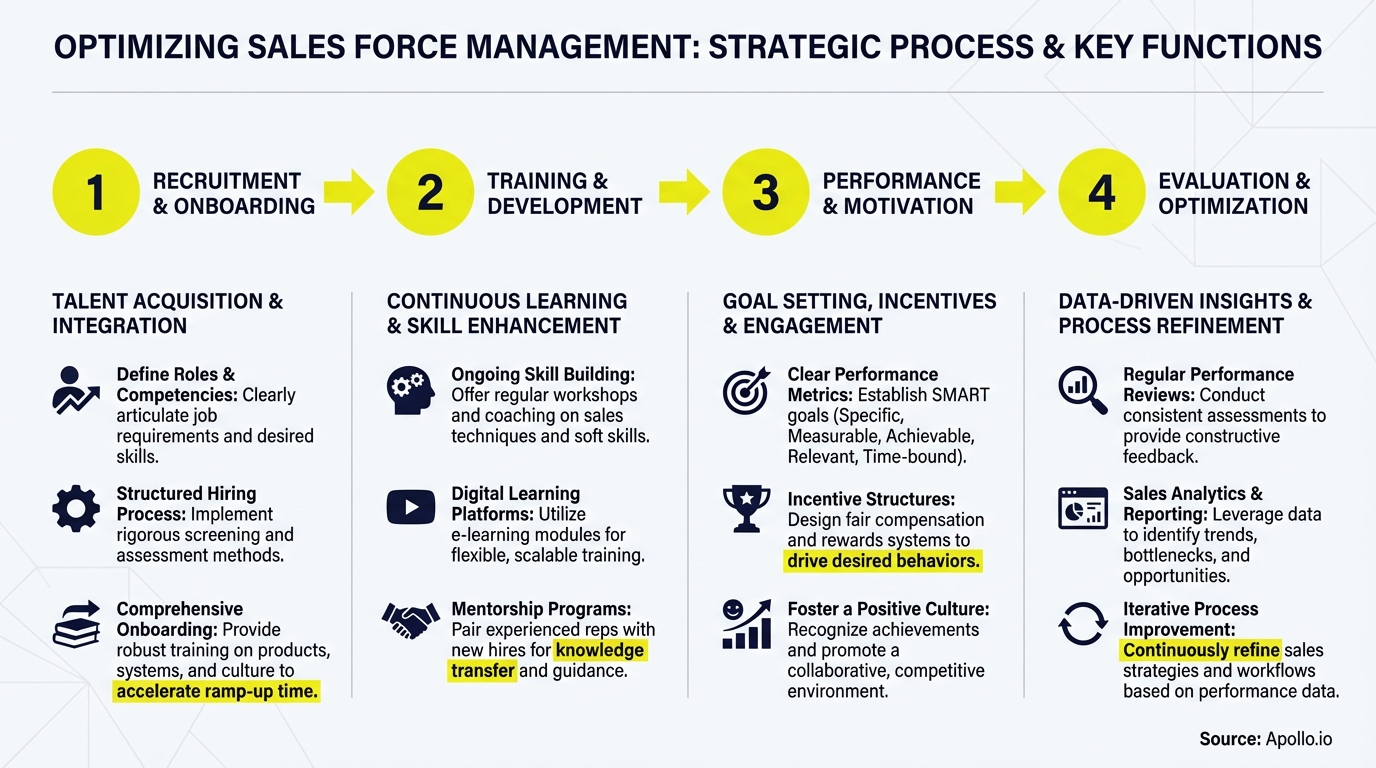
Sales force management is the strategic coordination of people, processes, technology, and data to maximize revenue outcomes. It encompasses recruiting, training, coaching, territory design, quota setting, performance tracking, and technology enablement across your entire sales organization.
In 2026, effective sales force management requires balancing three competing realities: Research by Gartner shows 61% of B2B buyers prefer rep-free buying experiences, yet 75% will prefer human interaction over AI by 2030. Sales Leaders must design organizations that deliver both digital self-service and high-touch human engagement simultaneously.
Modern sales force management integrates sales performance management frameworks with AI-powered automation, replacing gut-feel decisions with predictive analytics. RevOps teams now serve as the central nervous system, unifying CRM data, conversation intelligence, and pipeline metrics into single sources of truth.
Why Do Sales Leaders Struggle with Sales Force Management?
Sales Leaders face unprecedented complexity managing hybrid teams, fragmented tech stacks, and rapidly changing buyer expectations. Only 23% of B2B sales reps feel equally effective selling virtually as in person, creating coaching challenges for managers trying to scale best practices across distributed teams.
Common pain points include:
- Data silos across 5-8 disconnected sales tools preventing unified reporting
- Inconsistent rep performance with top performers closing 3-5x more than average reps
- Lack of visibility into which activities actually drive pipeline and revenue
- High rep turnover (35% annual average) due to inadequate onboarding and coaching
- Misalignment between marketing, sales, and customer success on ICP and messaging
For Founders and CEOs building sales orgs from scratch, the challenge is even steeper. Without established playbooks, they waste months testing tools, territories, and compensation structures that don't scale. Struggling to manage pipeline visibility across multiple tools? Unify your sales process with Apollo's deal management platform and eliminate data silos.
How Do Sales Leaders Build Data-Driven Sales Organizations?
Data-driven sales force management replaces intuition with measurable inputs, activities, and outcomes. Sales Leaders implement structured frameworks that connect leading indicators (activities) to lagging indicators (revenue) with statistical confidence.
Four-step implementation framework:
- Define your revenue formula: Calculate how many opportunities, meetings, and activities each rep needs to hit quota based on historical conversion rates and deal velocity
- Instrument every touchpoint: Capture data from emails, calls, meetings, and CRM updates in a unified system that tracks rep activity against benchmarks
- Build predictive models: Use 12+ months of historical data to identify which activities, messaging, and prospect characteristics correlate with closed-won deals
- Create feedback loops: Schedule weekly pipeline reviews where managers coach reps on activity gaps, deal progression blockers, and messaging improvements based on data
RevOps leaders implementing this framework report 40-60% improvements in forecast accuracy within two quarters. The key is consolidating your tech stack so data flows automatically between prospecting, engagement, meetings, and CRM systems without manual entry or integration maintenance.
What Tools Do SDRs and AEs Need for Sales Force Management?
SDRs and Account Executives need unified platforms that eliminate context-switching between 5-8 separate tools. The average sales rep wastes 2.5 hours daily navigating between prospecting databases, email sequencers, dialers, meeting schedulers, and CRM systems.
| Sales Function | Traditional Approach (5+ Tools) | Consolidated Platform Approach |
|---|---|---|
| Prospecting | ZoomInfo + LinkedIn Sales Nav ($300/user/mo) | Single database with 224M+ contacts |
| Outreach | Outreach.io + SalesLoft ($150/user/mo) | Built-in multi-channel sequences |
| Meetings | Calendly + Chili Piper ($50/user/mo) | Integrated scheduling with routing |
| Intelligence | Gong + Chorus.ai ($200/user/mo) | AI call assistant with deal insights |
| Pipeline | Salesforce + Clari ($180/user/mo) | Native deal management and forecasting |
Sales Leaders at companies like Predictable Revenue report: "We reduced the complexity of three tools into one." This consolidation cuts costs by 50% while improving data quality, rep adoption, and manager visibility. For teams evaluating their sales tech stack architecture, the goal is finding platforms that handle prospecting, engagement, meetings, and pipeline in one workspace.
Tired of paying for 5+ disconnected sales tools? Consolidate your tech stack with Apollo's all-in-one platform and cut costs in half.
Turn Forecast Chaos Into Revenue Certainty
Pipeline forecasting a guessing game? Apollo's real-time deal intelligence and scoring gives you crystal-clear visibility into every opportunity. Built-In increased win rates 10% with Apollo's signals.
Start Free with Apollo →How Do Sales Leaders Coach Hybrid Sales Teams Effectively?
Coaching hybrid sales teams requires structured frameworks that work across virtual and in-person interactions. Sales Leaders must observe rep performance through conversation intelligence, activity metrics, and deal progression data rather than relying on office-based observation.
Effective coaching framework for 2026:
- Weekly 1:1 reviews (30 min): Review activity metrics, pipeline health, and 2-3 recorded calls with specific feedback on discovery questions, objection handling, and closing techniques
- Monthly skill workshops (60 min): Team-wide sessions on common challenges identified through conversation intelligence analysis, with role-playing and peer feedback
- Quarterly territory planning (90 min): Data-driven account prioritization based on propensity-to-buy scores, historical win rates, and strategic account fit
- Real-time nudges: Automated alerts when reps fall below activity thresholds, deals stall, or high-value prospects go cold
For Account Executives managing complex enterprise deals, managers should focus coaching on multi-threading strategies, executive engagement, and competitive positioning. SDRs need coaching on personalization quality, response handling, and meeting-to-opportunity conversion rates. The HubSpot sales playbook demonstrates how world-class organizations structure coaching around role-specific competencies.
What Metrics Should Sales Leaders Track for Sales Force Management?
Sales Leaders in 2026 track three metric categories: activity metrics (leading indicators), pipeline metrics (progression indicators), and outcome metrics (lagging indicators). The mistake most managers make is focusing exclusively on outcomes without diagnosing the activity and pipeline health driving those results.
Essential metrics by role:
For SDRs and BDRs:
- Activities per day: emails sent, calls made, LinkedIn messages, personalization quality scores
- Response rates: email open/reply rates, call connect rates, meeting acceptance rates
- Meeting outcomes: show rates, meeting-to-opportunity conversion, pipeline generated
For Account Executives:
- Pipeline coverage: 3-5x quota coverage in each stage, weighted by win probability
- Deal velocity: days in each stage, time-to-close trends, stalled deal identification
- Win rates: overall win rate, win rate by source, competitive win rates, discount levels
For Sales Leaders and RevOps:
- Forecast accuracy: variance between committed forecast and actual closed business
- Rep productivity: ramp time to quota, percent of reps at quota, top vs. bottom performer gaps
- Customer acquisition cost: fully-loaded CAC including salaries, tools, marketing spend
Organizations using sales analytics platforms to track these metrics report 25-40% faster identification of performance issues and coaching opportunities. The key is building dashboards that surface anomalies automatically rather than requiring manual analysis.
How Should Sales Leaders Prepare for AI-Driven Sales Force Management?
AI is transforming sales force management through three applications: rep augmentation (AI assistants handling research and admin), manager augmentation (AI surfacing coaching opportunities), and strategic augmentation (AI predicting deal outcomes and resource allocation).

Practical AI implementation roadmap:
- Phase 1 (Months 1-3): Implement AI for administrative tasks like call summarization, email drafting, and CRM data entry to save reps 5-10 hours weekly
- Phase 2 (Months 4-6): Deploy conversation intelligence to analyze calls, identify coaching opportunities, and surface winning messaging patterns across your team
- Phase 3 (Months 7-9): Add predictive scoring to prioritize accounts, forecast deal outcomes, and optimize territory assignments based on propensity data
- Phase 4 (Months 10-12): Integrate AI-powered workflow automation to trigger next-best-actions, route leads intelligently, and personalize outreach at scale
Sales Leaders should focus AI adoption on augmenting human judgment, not replacing it. Organizations using AI sales tools strategically report 46% more meetings booked and 35% increases in closed deals. The key is choosing platforms that embed AI naturally into existing workflows rather than requiring separate AI tools that create new data silos.

Conclusion: Building a Modern Sales Force Management System
Sales force management in 2026 requires Sales Leaders to balance data-driven decision-making, omnichannel buyer experiences, hybrid team structures, and AI augmentation simultaneously. The organizations winning are those who consolidate fragmented tech stacks, implement structured coaching frameworks, and use predictive analytics to identify performance gaps before they impact revenue.
For RevOps leaders, the priority is building unified data architectures that eliminate silos between prospecting, engagement, pipeline, and forecasting systems. For Sales Leaders, the focus is translating data insights into actionable coaching that improves rep performance week-over-week.
For Founders and CEOs, the imperative is choosing platforms that scale with your team without requiring massive integration and maintenance overhead.
The companies achieving 40-60% year-over-year growth share one commonality: they've moved beyond managing sales as an art form to engineering it as a science. They measure what matters, coach to data, and continuously optimize their sales systems based on what actually drives pipeline and revenue.
Ready to build a data-driven sales organization? Start Free with Apollo and access 224M+ verified contacts, AI-powered automation, and unified pipeline management in one platform. Join 550K+ companies who have consolidated their sales tech stack and reduced costs by 50% while accelerating revenue growth.
Prove Apollo's ROI In Your First 30 Days
Budget approval stuck on unclear metrics? Apollo tracks every dollar—from prospect to close. Built-In increased win rates 10% and ACV 10% with measurable pipeline impact leaders can justify.
Start Free with Apollo →Don't miss these
Sales
Inbound vs Outbound Marketing: Which Strategy Wins?
Sales
What Is a Sales Funnel? The Non-Linear Revenue Framework for 2026
Sales
What Is a Go-to-Market Strategy? The 2026 GTM Playbook
See Apollo in action
We'd love to show how Apollo can help you sell better.
By submitting this form, you will receive information, tips, and promotions from Apollo. To learn more, see our Privacy Statement.
4.7/5 based on 9,690 reviews
