
Sales Engineers: How Technical Experts Drive B2B Revenue Growth
Sales engineers bridge the gap between technical complexity and customer needs in B2B sales. They translate product capabilities into business outcomes, design custom solutions, and prove value through demos and proof-of-concepts. As buying committees demand deeper technical validation before committing, sales engineers have become essential revenue drivers, not just support staff. Modern sales analytics now track SE contribution to pipeline velocity, deal size, and win rates.

Apollo Eliminates 4+ Hours Of Daily Research
Tired of spending 4+ hours daily hunting for contact info? Apollo delivers 224M verified contacts with 96% email accuracy instantly. Join 550K+ companies who stopped manual research and started closing deals.
Start Free with Apollo →Key Takeaways
- Sales engineers earn competitive compensation, with the average ranging from $102,000 to $281,000 depending on experience and market
- Research shows 70% of B2B deals require presales support, making SEs critical to revenue outcomes
- The role has evolved from technical demos to strategic advisory, requiring business acumen alongside technical expertise
- Modern sales engineers use data enrichment and automation platforms to scale personalized technical discovery
- Demo readiness and risk reduction content directly address buyer needs and minimize post-purchase regret
What Are Sales Engineers?
Sales engineers are technical sales professionals who demonstrate product value, design solutions, and validate fit for complex B2B purchases. They work alongside account executives to handle technical discovery, architecture discussions, competitive differentiation, and proof-of-concept execution.
According to Oakstone, presales professionals are crucial in B2B SaaS, bridging the gap between product capabilities and customer needs by providing technical credibility, tailoring solutions, and ensuring customers purchase the appropriate solution for their business. This consultative approach separates transactional selling from strategic partnership.
Research from Consensus indicates that 70% of sales deals require presales support, highlighting its role as a core driver of deal success across the entire buyer journey. The modern SE owns technical validation from first demo through implementation handoff.
Why Are Sales Engineers Critical in 2026?
The B2B buying process has fundamentally shifted toward self-education and risk aversion. Buyers research independently, compare alternatives, and demand quantified ROI before engaging sales teams.
Sales engineers address this new reality by delivering technical proof points that accelerate decisions.

School of Sales Engineering reports that the B2B sales cycle has become more technical and complex over the last two decades, elevating the prominence of Sales Engineers who have evolved from "demo monkeys" to strategic advisors. Today's SEs influence product roadmaps, create reusable enablement assets, and coach AEs on technical positioning.
Struggling to equip your sales engineers with verified prospect intelligence? Access Apollo's 224M+ business contacts with technical firmographics and buying signals.
What Does a Sales Engineer Actually Do?
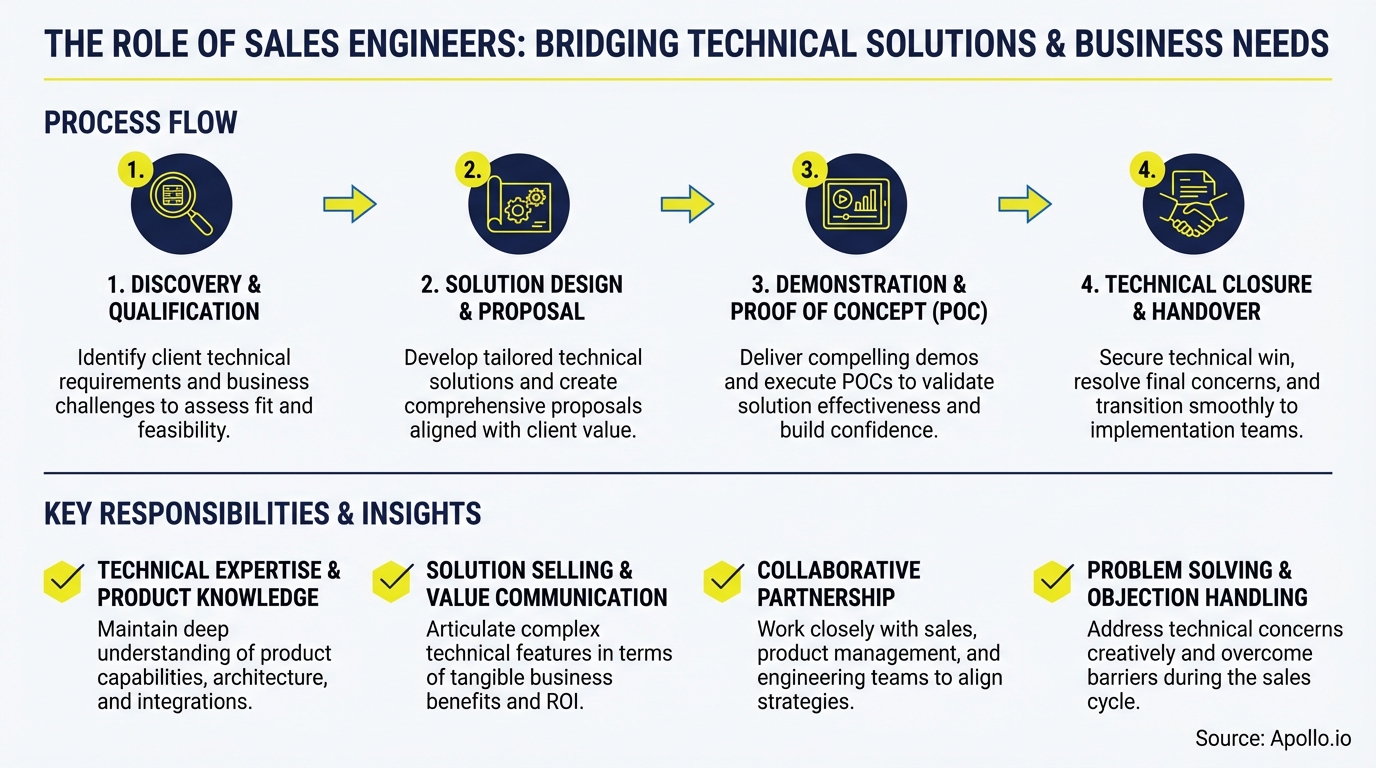
Sales engineers perform discovery, solution design, demos, POCs, RFP responses, and competitive analysis. Their day-to-day varies by deal stage but centers on proving technical fit and de-risking buyer decisions.
Core responsibilities include:
- Technical Discovery: Understanding current architecture, integration requirements, security constraints, and success metrics
- Solution Design: Mapping product capabilities to business problems with architecture diagrams and implementation plans
- Demo Delivery: Customized product walkthroughs focused on buyer-specific use cases and outcomes
- Proof-of-Concept Management: Scoping, executing, and measuring pilot deployments that validate ROI claims
- Competitive Positioning: Technical differentiation against alternatives using feature matrices and benchmarks
- Enablement Creation: Building demo libraries, objection handling guides, and reference architectures for team reuse
For Account Executives managing high-ticket enterprise deals, partnering effectively with sales engineers accelerates technical validation and shortens sales cycles. Clear handoffs and shared success criteria prevent duplicated effort.
How Do Sales Engineers Drive Revenue Growth?
Sales engineers increase win rates, expand deal sizes, and reduce sales cycle length through technical credibility and solution customization. Their involvement correlates directly with deal velocity and customer lifetime value.
Revenue impact mechanisms:
- Higher Win Rates: Technical validation removes buyer uncertainty and differentiates against competitors
- Larger Deal Sizes: Solution scoping uncovers additional use cases and expansion opportunities
- Faster Cycles: Proactive objection handling and risk mitigation prevent late-stage stalls
- Better Retention: Accurate scoping and realistic expectations reduce implementation failures and churn
- Upsell Enablement: Deep product knowledge identifies cross-sell and upgrade paths post-sale
Sales Leaders building scalable sales tech stacks should instrument SE activity tracking to measure contribution to pipeline, influenced revenue, and customer success outcomes. Visibility into SE capacity utilization prevents bottlenecks.
Find Ready Buyers Before Forecasts Fall Short
Pipeline forecasting a guessing game? Apollo reveals which prospects are actually in-market with real-time buying signals. Built-In boosted win rates 10% using Apollo's scoring.
Start Free with Apollo →What Compensation Do Sales Engineers Earn?
Sales engineer compensation reflects their technical expertise and revenue impact. According to Better Career, the average compensation for a sales engineer in the US ranges from $102,000 to $281,000, including base salary and additional pay.
As reported by Comparably, 92% of sales engineers report receiving an annual bonus. Variable compensation typically ties to quota attainment, deal influence metrics, or team revenue targets. Senior SEs and presales managers command higher total compensation, with leadership roles exceeding $200k.

Compensation components:
- Base Salary: Fixed component reflecting experience, market, and company stage
- Variable/Commission: Tied to influenced pipeline, quota attainment, or team performance
- Equity: Common at startups and high-growth companies for senior IC and leadership roles
- Benefits: Health coverage, 401k matching, professional development budgets
How Do Sales Engineers Use Technology to Scale?
Modern sales engineers leverage automation, data enrichment, and conversation intelligence platforms to handle more deals without sacrificing quality. Technology eliminates repetitive tasks and surfaces insights that inform technical positioning.
Spending hours researching prospects before discovery calls? Search Apollo's database with 65+ technical and business filters to pre-qualify accounts.
Essential SE tech stack components:
- Data Enrichment: Automated contact and company intelligence to inform discovery and solution design
- Demo Automation: Reusable demo environments and self-serve product tours that reduce live demo load
- Call Intelligence: AI-powered transcription and insight extraction from technical discovery calls
- Content Libraries: Centralized repositories for demo scripts, objection handling, and reference architectures
- Collaboration Tools: Shared workspaces for AE-SE alignment on deal strategy and next steps
RevOps leaders implementing revenue operations frameworks should measure SE tool adoption and productivity gains to justify tech investments and identify workflow bottlenecks.
What Skills Do Successful Sales Engineers Develop?
Top-performing sales engineers combine deep technical knowledge with business acumen, communication skills, and customer empathy. The role demands continuous learning as products evolve and buyer expectations shift.
Critical competencies:
- Technical Depth: Product architecture, integration patterns, security models, and competitive landscape
- Business Acumen: ROI calculation, value mapping, and economic buyer priorities
- Communication: Translating technical concepts for non-technical audiences and executives
- Discovery: Asking diagnostic questions that surface hidden requirements and decision criteria
- Demo Craft: Story-driven presentations that connect features to outcomes
- Project Management: Coordinating POCs, tracking milestones, and managing stakeholder expectations
Sales engineers who master proven sales pitch techniques and adapt them for technical audiences create more memorable demos and accelerate buyer consensus.
Conclusion: Sales Engineers as Strategic Revenue Partners
Sales engineers have evolved from technical support roles to strategic revenue drivers who own solution validation, risk mitigation, and customer success alignment. As B2B buying committees demand deeper technical proof and quantified outcomes, the SE function becomes indispensable to competitive differentiation.
Organizations that invest in SE enablement, provide modern tooling, and measure technical influence on revenue outcomes will outpace competitors still treating presales as a cost center. The future belongs to teams that scale SE expertise through reusable content, automation, and cross-functional collaboration.
Ready to equip your sales engineers with the intelligence and automation they need to scale? Start free with Apollo to consolidate prospecting, enrichment, and engagement in one platform.
Show Budget Impact Before Renewal Talks
Budget approval stuck on unclear metrics? Apollo tracks pipeline impact from first touch—quantifiable time savings, win rates, and deal velocity. Built-In increased win rates 10% and ACV 10% using Apollo's scoring.
Start Free with Apollo →Don't miss these
Sales
Inbound vs Outbound Marketing: Which Strategy Wins?
Sales
What Is a Sales Funnel? The Non-Linear Revenue Framework for 2026
Sales
What Is a Go-to-Market Strategy? The 2026 GTM Playbook
See Apollo in action
We'd love to show how Apollo can help you sell better.
By submitting this form, you will receive information, tips, and promotions from Apollo. To learn more, see our Privacy Statement.
4.7/5 based on 9,690 reviews
