What Is Sales Engineer Training? Frameworks, Skills, and ROI in 2026
Sales engineer training is the structured process of developing the technical, discovery, and communication skills that presales professionals need to win complex deals. As AI handles more routine product Q&A, the role of the sales engineer (SE) is shifting decisively toward business value discovery, executive storytelling, and trusted advisor behaviors. Understanding how much a sales engineer makes is only the starting point — building a repeatable enablement system is what drives long-term revenue impact.
The business case is clear. According to Hyperbound, for every dollar spent on sales training, companies are seeing $4.53 in return. Yet most SE training programs focus on product knowledge while ignoring the qualification gaps and demo inefficiencies that actually cost deals.

Apollo Turns Research Into Revenue
Tired of burning hours hunting down contact info that's already outdated? Apollo delivers verified contacts instantly so your team sells instead of searches. Join 550K+ companies building pipeline faster.
Start Free with Apollo →Key Takeaways
- Effective sales engineer training goes beyond product knowledge — discovery discipline and demo standardization are the highest-leverage skills to develop.
- Companies with strong sales enablement see 15% higher win rates, making structured SE training a direct pipeline investment.
- Role-based, tiered curricula (new, mid-level, principal SE) outperform one-size-fits-all programs by matching content to experience level.
- AI role-play and simulation are replacing slideware onboarding as the core skill-building loop in 2026.
- Measuring SE training impact through deal-linked metrics (win rate, cycle time, demo-to-close rate) is now a leadership expectation, not a nice-to-have.
What Does Sales Engineer Training Actually Cover?
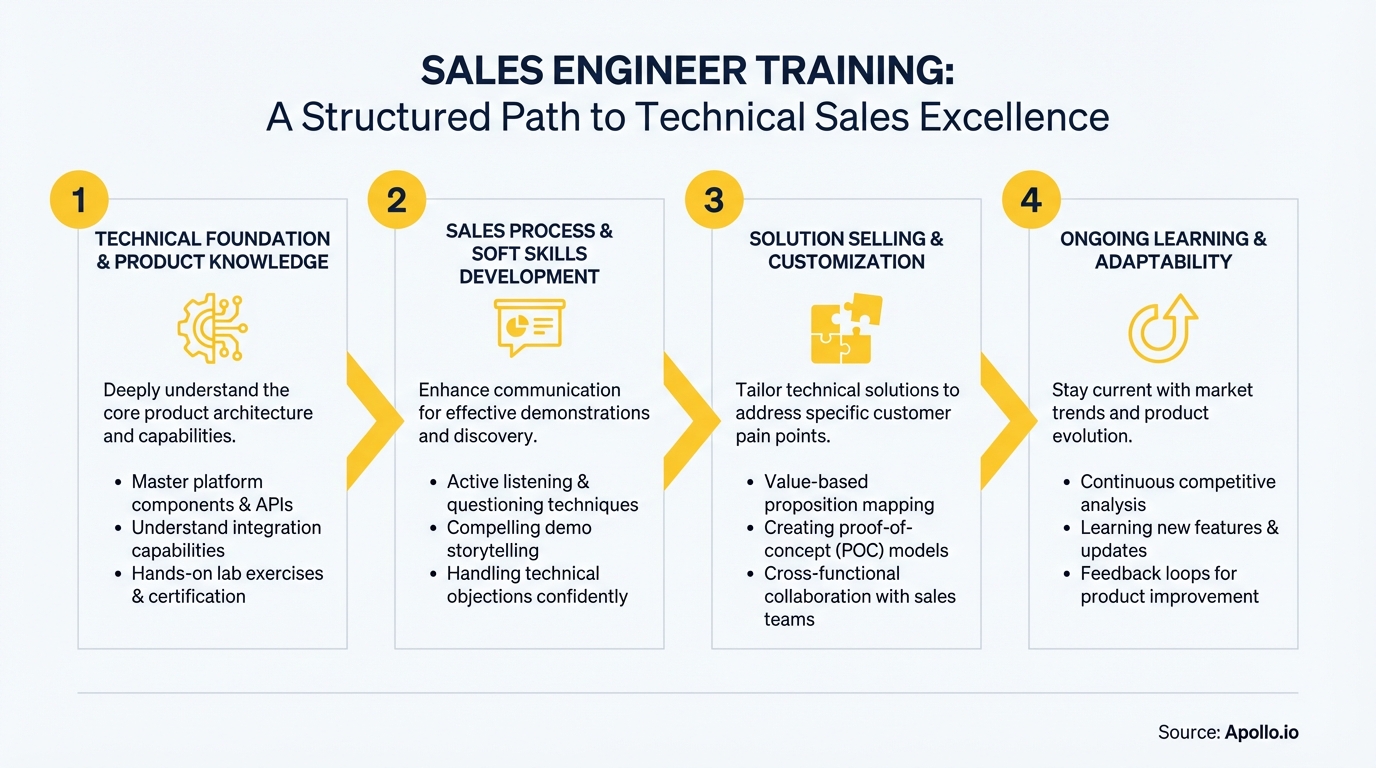
Sales engineer training is not product certification. It is a multi-track curriculum that builds four distinct competency areas: technical credibility, discovery and qualification, demo execution, and business value communication.
The best programs treat these as separate skill sets with separate development paths.
| Competency Area | Core Skills | Common Training Format |
|---|---|---|
| Technical Credibility | Architecture knowledge, integrations, security Q&A | Certification, lab environments |
| Discovery and Qualification | Needs analysis, MEDDIC/MEDDPICC, qualification gates | Role-play, call review, playbooks |
| Demo Execution | Storytelling, environment reuse, objection handling | Demo scripts, simulation, peer review |
| Business Value Communication | ROI framing, executive storytelling, trusted advisor positioning | Coaching, case studies, live deal reviews |
As noted by The Harris Consulting Group, the most effective training programs emphasize meaningful business impact conversations over just product features — a shift that directly maps to higher win rates in technical sales cycles.
Why Do Most SE Training Programs Fail?
Most programs fail because they misdiagnose the problem. Presales inefficiency is rarely a product knowledge gap.
Research consistently shows the real bottlenecks are unqualified demos, wasted demo environment prep time, and inconsistent discovery. Training content that only addresses product knowledge leaves the core problems untouched.
Three structural failure modes stand out:
- One-size-fits-all content: A new SE joining from a technical background needs different training than a principal SE moving into an enterprise territory. Undifferentiated programs waste both groups' time.
- No measurement framework: Training delivered without deal-linked metrics (demo-to-close rate, time-to-first-demo, qualification accuracy) cannot prove ROI to leadership.
- Ignoring change management: New tools, processes, and role redesigns create friction that training content must address directly — not assume away.
Struggling to give your SE team consistent pre-meeting intelligence on prospects? Search Apollo's 224M+ contacts with 65+ filters to build account context before every demo.

How Should Sales Engineer Training Be Structured by Role Level?
Effective sales engineer training uses a tiered curriculum aligned to experience level. Each tier has distinct learning objectives and delivery formats.
| SE Level | Training Focus | Key Milestones |
|---|---|---|
| New SE (0–12 months) | Product depth, discovery fundamentals, demo scripting | First solo demo, qualification certification |
| Mid-Level SE (1–3 years) | Enterprise discovery, competitive positioning, POC management | Lead a strategic deal, mentor a new SE |
| Principal / Staff SE (3+ years) | Executive storytelling, deal strategy, enablement content creation | Own a vertical playbook, deliver internal training |
This approach directly addresses one of the top SE enablement challenges identified in 2025 research: adapting training to different experience levels. For Account Executives working alongside SE teams, this tiered structure also clarifies when to involve which SE profile in a deal cycle, reducing wasted senior SE time on unqualified opportunities. You can explore what great sales onboarding looks like for technical roles to build the foundation for this progression.
Turn Funnel Gaps Into Predictable Pipeline
Pipeline forecasting a guessing game because quality leads never make it to opportunity? Apollo surfaces in-market buyers at the right moment so your funnel fills with deals that actually close. Join 550K+ companies that stopped guessing.
Schedule a Demo →What Skills Are Sales Engineers Prioritizing in 2026?
The SE skill mix is shifting. As AI handles routine product Q&A and content retrieval, training programs are moving up the value chain toward skills that AI cannot easily replicate.
Sales leaders building SE teams should plan curricula around this shift now.
- Business value discovery: Translating technical capabilities into financial outcomes for specific buyer personas
- Executive storytelling: Structuring demos and presentations for C-suite audiences, not just technical evaluators
- AI workflow design: Understanding when to delegate tasks to AI agents, how to verify outputs, and how to maintain buyer trust
- Asynchronous technical education: Creating self-serve evaluation assets (architecture explainers, security FAQs, interactive demos) that support rep-light buying journeys
- Qualification discipline: Applying structured gates to prevent unqualified demos from consuming SE capacity
For SEs working on enterprise deals and mega accounts, executive storytelling and business value framing are now table-stakes skills, not advanced competencies.
How Do You Measure Sales Engineer Training ROI?
Measurement is the component most SE training programs skip entirely. Without deal-linked metrics, training becomes a cost center rather than a revenue investment. According to PremierNX, companies with strong sales enablement see 15% higher win rates — a benchmark that gives SE leaders a concrete target to tie training investment to.
Build your measurement framework around four metric categories:
- Activity quality: Qualification rate, demo-to-opportunity conversion, unqualified demo percentage
- Efficiency: Time spent on demo environment prep, time-to-first-demo, SE-to-AE ratio by deal size
- Deal outcomes: Win rate by SE, technical win rate, average deal cycle length
- Enablement adoption: Playbook usage rate, reusable asset utilization, content findability scores
RevOps leaders find that connecting these metrics to CRM data creates a clear feedback loop: training investments that move win rates and shorten cycles get renewed; those that don't get redesigned. Pair your measurement work with sales analytics to surface the deal patterns that training should address next. Need better pipeline visibility to track SE impact? Get complete pipeline visibility with Apollo's deal management and connect training outcomes directly to revenue data.
How Do Sales Leaders Build a Scalable SE Training System?
A scalable SE training system has four components: a content library, a delivery mechanism, a governance model, and a measurement layer. Without governance and taxonomy, even well-designed training assets become unfindable and unused within six months.
Content library essentials:
- Discovery question banks by industry and persona
- Qualification gate checklists (opportunity-stage specific)
- Reusable demo scripts and environment setup guides
- Security and architecture evaluation templates for buyer self-service
- Competitive positioning playbooks
Governance essentials:
- Tag all assets by deal stage, SE level, product area, and industry
- Assign content owners with quarterly review cadences
- Track asset usage and retire content that isn't being accessed
Sales leaders who want a proven model for high-performance SE programs can study the approach outlined in John Barrows' blueprint for high-performance sales training and adapt the principles to technical presales contexts. Building the right sales tech stack to support content delivery and tracking is equally critical for scale.

Start Building a Better SE Training Program in 2026
Sales engineer training done well is one of the highest-ROI investments a sales organization can make. The shift is clear: move from product-only certification toward a full enablement system that covers discovery discipline, demo standardization, business value communication, and buyer self-service assets.
The organizations winning in 2026 are those that treat SE training as a continuous, measurable system — not a one-time onboarding event. They build tiered curricula, govern their content libraries, and tie every training initiative back to deal outcomes. As a foundation, understanding what sales productivity looks like for technical teams helps leaders set the right benchmarks.
Apollo gives sales teams the unified platform to prospect smarter, engage faster, and close more deals without juggling multiple tools. "Having everything in one system was a game changer" — Cyera. Ready to equip your SE team with better pipeline intelligence and engagement tools? Schedule a Demo and see how Apollo consolidates your sales tech stack.
Prove Pipeline ROI From Day One
ROI pressure killing your next tool renewal? Apollo delivers measurable pipeline impact fast — Leadium 3x'd their annual revenue after switching. Start your free trial and show leadership results, not promises.
Start Free with Apollo →Don't miss these
Sales
Inbound vs Outbound Marketing: Which Strategy Wins?
Sales
What Is a Sales Funnel? The Non-Linear Revenue Framework for 2026
Sales
What Is a Go-to-Market Strategy? The 2026 GTM Playbook
See Apollo in action
We'd love to show how Apollo can help you sell better.
By submitting this form, you will receive information, tips, and promotions from Apollo. To learn more, see our Privacy Statement.
4.7/5 based on 9,690 reviews
