
Sales Development Manager Salary: 2026 Compensation Guide and Benchmarks
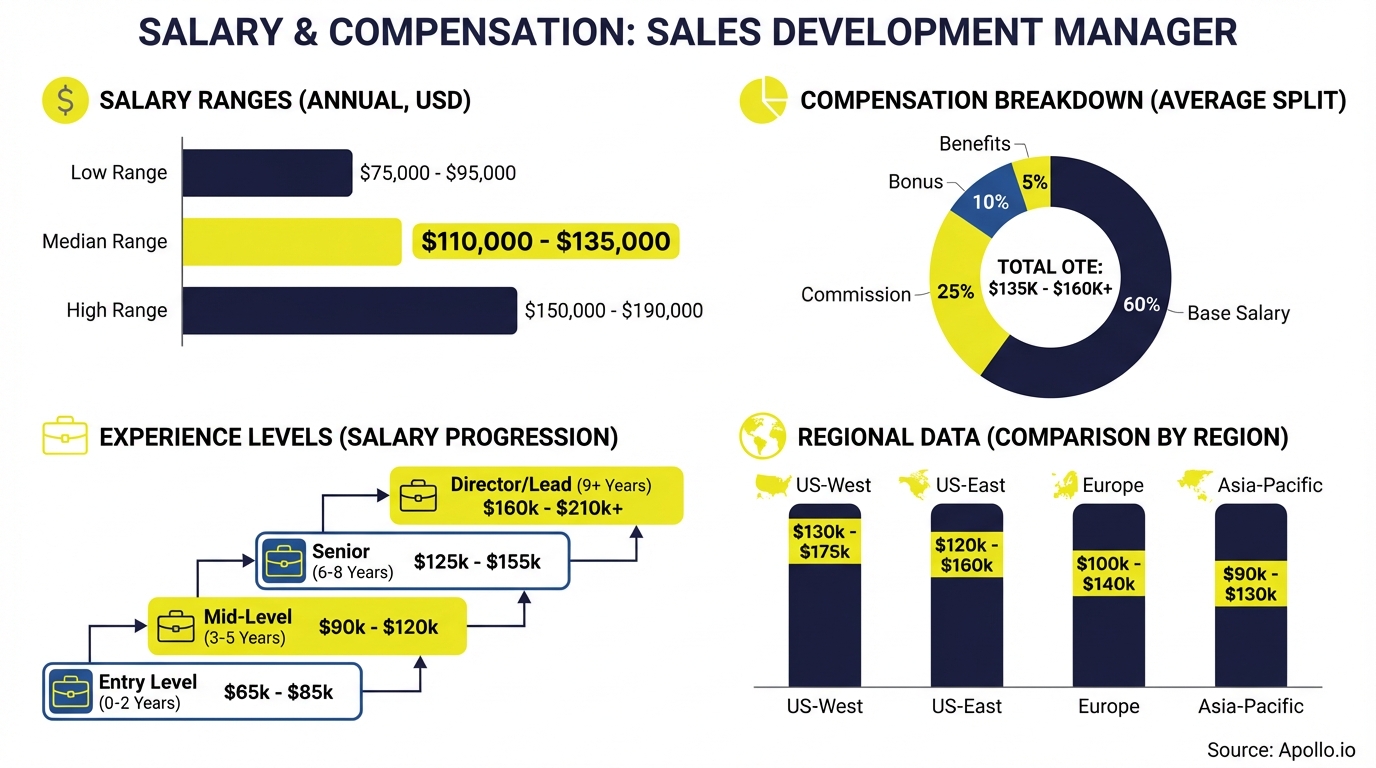
Sales Development Managers (SDMs) play a crucial role in driving pipeline growth and coaching high-performing SDR teams. Understanding compensation benchmarks helps you negotiate effectively and plan your career trajectory. In 2026, SDM salaries vary significantly by region, industry, and skill set, with total compensation packages ranging from $95,000 to over $180,000.

Reclaim 4+ Hours Daily From Manual Research
Tired of reps spending half their day hunting for contact info? Apollo delivers 224M verified contacts with 96% email accuracy instantly. Top teams close 3x more deals.
Start Free with Apollo →Key Takeaways
- Sales Development Manager base salaries range from $75,000 to $120,000, with on-target earnings (OTE) reaching $150,000-$180,000 in tech hubs
- Regional variations matter: SDMs in San Francisco earn 35-40% more than those in mid-tier markets like Austin or Denver
- Skills like MEDDPICC certification, AI sales automation expertise, and multi-channel orchestration command 15-25% salary premiums
- Industry matters: SaaS and fintech SDMs earn 20-30% more than those in traditional B2B sectors
- Career progression from SDR to SDM typically takes 3-5 years and delivers 60-80% total compensation growth
What Is a Sales Development Manager?
A Sales Development Manager is a sales leader who oversees teams of SDRs and BDRs, focusing on pipeline generation, team coaching, and process optimization. They bridge the gap between individual contributor roles and senior sales leadership. SDMs are accountable for meeting quality, conversion rates, and strategic sales development initiatives that feed the broader revenue engine.
The role requires balancing hands-on coaching with strategic planning. SDMs analyze performance metrics, refine outbound sequences, and ensure their teams hit monthly pipeline targets.
They collaborate closely with Account Executives, RevOps, and marketing to align messaging and optimize handoff processes.
What Is the Average Sales Development Manager Salary in 2026?
According to APMP's U.S. Compensation Report, Business Development Managers and Directors reported a median base salary of $156,000 and total compensation of $182,033 in 2023, reflecting steady year-over-year growth. For Sales Development Managers specifically, 2026 compensation typically breaks down as follows:
| Experience Level | Base Salary | Variable/Commission | Total OTE |
|---|---|---|---|
| Entry-Level SDM (1-2 years) | $75,000-$90,000 | $20,000-$30,000 | $95,000-$120,000 |
| Mid-Level SDM (3-5 years) | $95,000-$115,000 | $30,000-$45,000 | $125,000-$160,000 |
| Senior SDM (5+ years) | $110,000-$130,000 | $40,000-$60,000 | $150,000-$190,000 |
Data from Coursera shows that senior sales representatives in 2023 earned an average total compensation of $192,918, including $89,092 in base salary and $103,826 in additional pay. SDMs typically fall within this range or slightly higher, depending on team size and quota responsibility.
How Do Regional Markets Impact SDM Salaries?
Geography drives significant salary variation. Tech hubs command premium compensation due to cost of living and fierce talent competition. Here's how major markets compare:
| Metro Area | Base Salary Range | Total OTE Range | Premium vs. National Avg |
|---|---|---|---|
| San Francisco Bay Area | $115,000-$145,000 | $165,000-$210,000 | +35-40% |
| New York City | $110,000-$135,000 | $155,000-$195,000 | +30-35% |
| Seattle/Boston | $100,000-$125,000 | $140,000-$180,000 | +20-25% |
| Austin/Denver/Chicago | $90,000-$115,000 | $125,000-$160,000 | +10-15% |
| Remote/Secondary Markets | $75,000-$100,000 | $105,000-$140,000 | National baseline |
Remote SDM roles have grown 40% since 2022, allowing companies in expensive markets to access talent at lower compensation levels while still offering competitive packages relative to candidates' local costs.
Which Skills and Certifications Increase SDM Compensation?
Specific competencies command measurable salary premiums. SDMs who invest in targeted skill development see 15-25% higher total compensation than peers with baseline capabilities.
High-Value Skills for SDMs:
- MEDDPICC/MEDDIC Certification: +15-20% premium. Demonstrates mastery of enterprise qualification frameworks.
- AI Sales Automation Expertise: +18-25% premium. Proficiency with AI-powered GTM systems and workflow automation.
- Multi-Channel Orchestration: +12-18% premium. Ability to coordinate email, phone, LinkedIn, and video outreach at scale.
- Advanced Sales Analytics: +10-15% premium. Skills in Salesforce reporting, BI tools, and predictive modeling.
- Team Coaching Frameworks: +10-12% premium. Certifications in leadership development and performance coaching.
Struggling to equip your SDR team with modern prospecting tools? Give your team access to Apollo's 224M+ verified contacts with 65+ filters to accelerate pipeline generation without blowing your budget.
Turn Forecast Guesswork Into Revenue Certainty
Struggling with unreliable pipeline forecasts? Apollo gives you real-time deal visibility and buyer intent signals that make revenue planning predictable. Built-In increased win rates 10% with Apollo's scoring.
Start Free with Apollo →How Does Industry Affect Sales Development Manager Pay?
Industry selection significantly impacts earning potential. SaaS, fintech, and cybersecurity sectors pay 20-35% above traditional B2B industries due to higher deal values and aggressive growth targets.

| Industry | Average Base Salary | Average Total OTE | Growth Outlook |
|---|---|---|---|
| SaaS/Cloud Software | $105,000-$130,000 | $150,000-$190,000 | Strong (8-12% YoY) |
| Fintech/Financial Services | $100,000-$125,000 | $145,000-$180,000 | Strong (7-10% YoY) |
| Cybersecurity | $98,000-$122,000 | $140,000-$175,000 | Very Strong (10-15% YoY) |
| Healthcare Tech | $92,000-$115,000 | $130,000-$165,000 | Moderate (5-8% YoY) |
| Manufacturing/Industrial | $80,000-$100,000 | $110,000-$140,000 | Stable (3-5% YoY) |
Research by Coursera found that sales professionals in pharmaceutical and biotechnology industries reported an average base salary of $100,243 in 2025, demonstrating the premium these specialized sectors command.
How Do SDMs Progress from SDR to Leadership Roles?
The typical career path from SDR to Sales Development Manager takes 3-5 years and delivers substantial compensation growth. Understanding this progression helps you set realistic salary expectations and career milestones.
Typical Career Progression:
- SDR (0-2 years): $45,000-$55,000 base, $70,000-$90,000 OTE. Focus on mastering outbound prospecting and hitting activity metrics. Data from Coursera shows SDRs with 0-1 year of experience earned an average base of $51,043.
- Senior SDR (2-3 years): $55,000-$70,000 base, $85,000-$110,000 OTE. Develop coaching skills and mentor junior reps.
- Team Lead/SDM (3-5 years): $75,000-$95,000 base, $110,000-$140,000 OTE. Manage 5-8 SDRs and own team quota.
- Senior SDM (5-7 years): $95,000-$120,000 base, $140,000-$180,000 OTE. Lead 10-15 reps across multiple segments or regions.
- Director of Sales Development (7+ years): $120,000-$160,000 base, $180,000-$250,000+ OTE. Oversee entire SDR organization and strategy.
For Sales Leaders managing growing SDR teams, Apollo's deal management platform provides complete visibility into pipeline health and team performance, consolidating tools that would otherwise cost 3x more separately.
What Should SDMs Know About Salary Negotiation?
Effective negotiation requires understanding total compensation components and market benchmarks. SDMs should evaluate base salary, variable compensation structure, equity (if applicable), and benefits when assessing offers.
Negotiation Leverage Points:
- Team Performance Metrics: Document pipeline generated, conversion rates, and team quota attainment from previous roles.
- Specialized Skills: Highlight certifications in MEDDPICC, experience with modern sales tech stacks, or AI automation proficiency.
- Market Data: Reference industry reports and compensation surveys specific to your region and industry.
- Total Package: Negotiate signing bonuses, accelerators, and promotion timelines in addition to base salary.
- Tool Budgets: Request dedicated budgets for sales enablement platforms that consolidate prospecting, engagement, and analytics.
Companies increasingly value SDMs who can reduce tech stack complexity. Emphasize your ability to drive results with consolidated platforms rather than managing 5+ disconnected tools.
Transform Your SDM Career With the Right Tools
Sales Development Managers who understand compensation benchmarks and invest in high-value skills position themselves for accelerated career growth. In 2026, SDM salaries range from $95,000 to $190,000+ depending on location, industry, experience, and specialized capabilities like AI automation and enterprise qualification frameworks.
The best-compensated SDMs focus on outcomes, not activities. They leverage modern platforms to give their teams unfair advantages in prospecting, engagement, and pipeline generation.
By consolidating tools and investing in skill development, you maximize both team performance and your earning potential.

Ready to lead a high-performing sales development team? Try Apollo Free and discover how 550,000+ companies are cutting their tech stack costs while accelerating pipeline growth.
Prove Apollo's Value In Your First Week
Budget approval stuck on unclear metrics? Apollo tracks every touchpoint from prospect to pipeline—quantifying time saved, meetings booked, and revenue impact. Built-In increased win rates 10% and ACV 10% with Apollo's scoring.
Start Free with Apollo →Don't miss these
Sales
Inbound vs Outbound Marketing: Which Strategy Wins?
Sales
What Is a Sales Funnel? The Non-Linear Revenue Framework for 2026
Sales
What Is a Go-to-Market Strategy? The 2026 GTM Playbook
See Apollo in action
We'd love to show how Apollo can help you sell better.
By submitting this form, you will receive information, tips, and promotions from Apollo. To learn more, see our Privacy Statement.
4.7/5 based on 9,690 reviews
