
What Is Sales Development and How Does It Drive Revenue in 2026?
Sales development is the specialized function of identifying, engaging, and qualifying prospects before they enter the core sales cycle. It bridges marketing and sales, turning raw leads into qualified opportunities through systematic outreach, research, and conversation.
In 2026, sales development teams are the engine of predictable pipeline growth.
The discipline has evolved dramatically. According to Gartner, 80% of B2B sales interactions now occur in digital channels. This shift demands new playbooks that blend AI automation, multi-channel engagement, and human insight.

Scale Quality Leads Without Adding Headcount
Struggling with slow lead generation that caps your growth? Apollo's AI finds and qualifies your ideal buyers automatically. Join 550K+ companies scaling pipeline without scaling teams.
Start Free with Apollo →Key Takeaways
- Sales development is a distinct function focused on prospecting, outreach, and qualification before deals enter the sales pipeline
- Modern teams use AI-guided selling and hybrid models to engage buyers across 10+ channels
- Top-performing teams consolidate their tech stack to cut costs and improve efficiency
- Data quality and cross-functional alignment are the biggest challenges facing sales development leaders in 2026
- Neurodivergent talent recruitment is emerging as a competitive advantage for forward-thinking teams
How Does Sales Development Work in Practice?
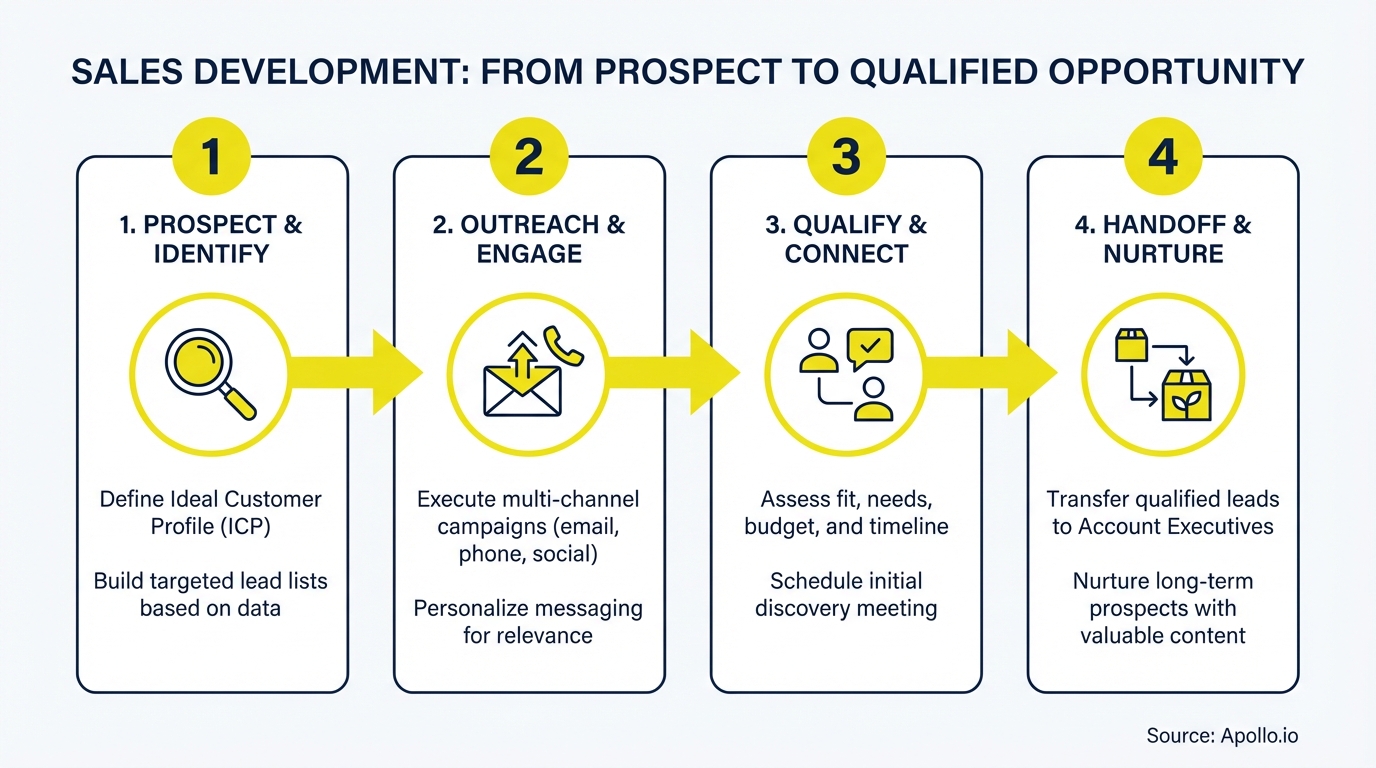
Sales development operates at the intersection of marketing and sales. Sales Development Representatives (SDRs) focus on outbound prospecting, while Business Development Representatives (BDRs) often handle inbound lead qualification. Both roles share a common goal: book qualified meetings for account executives.
The process follows a clear framework:
| Stage | Activities | Key Outcomes |
|---|---|---|
| Prospecting | Database search, account research, list building | Qualified target list |
| Outreach | Email, phone, social engagement across channels | Prospect response and engagement |
| Qualification | Discovery questions, needs assessment, fit analysis | Qualified opportunity |
| Handoff | Meeting scheduling, context transfer to AE | Booked meeting |
Research by McKinsey shows B2B buyers now use up to 10 channels during their purchasing journey. Successful sales development teams orchestrate touchpoints across email, phone, social platforms, and digital channels to meet buyers where they are.
"We reduced the complexity of three tools into one. We're getting higher reply rates, open rates are doubled, meetings are up, and speed to booking a meeting is cut in half."
What Are the Core Sales Development Models?
Teams structure sales development in four primary ways, each with distinct advantages:
Centralized Model
A single SDR team supports all account executives. This model maximizes efficiency and consistency but can create handoff friction.
Best for companies with standardized sales processes and clear ICP definitions.
Distributed Model
SDRs are embedded within specific account executive teams or territories. This improves alignment and context transfer but may duplicate efforts.
Ideal for complex sales cycles requiring deep product knowledge.
Pod-Based Model
Small, cross-functional units (SDR + AE + CSM) own specific accounts or verticals end-to-end. This model drives accountability and collaboration.
Works well for account-based strategies and enterprise segments.
Marketing-Aligned Model
SDRs focus exclusively on inbound lead qualification and nurturing. Marketing owns lead generation; SDRs convert interest into opportunities.
Common in product-led growth companies with high inbound volume.
Struggling to find qualified leads? Search Apollo's 224M+ contacts with 65+ filters to build targeted prospect lists in minutes, not hours.
How Is AI Transforming Sales Development?
According to Gartner, 75% of B2B sales organizations now augment traditional playbooks with AI-guided selling solutions. This shift is redefining what's possible in sales development.
AI sales tools now handle research, personalization, and prioritization tasks that previously consumed hours of SDR time. Teams using AI report measurable improvements in meeting rates and pipeline quality.
"With this kind of AI system, my BDRs can send 10x more personalized emails. Their productivity and growth has skyrocketed."
Key AI applications in sales development include:
- Account research automation: AI pulls company news, tech stack data, and hiring signals to inform outreach strategy
- Message personalization: Generate contextually relevant email copy based on prospect data and engagement history
- Lead scoring and prioritization: Predictive models identify accounts most likely to convert, focusing SDR effort where it matters
- Conversation intelligence: Call analysis surfaces successful talk tracks and coaching opportunities
Spending hours on manual outreach? Automate your sequences with Apollo's AI-powered platform and focus on high-value conversations instead of repetitive tasks.
Turn Forecast Chaos Into Revenue Confidence
Pipeline forecasting a guessing game? Apollo tracks real-time deal stages and buyer signals so your revenue predictions actually hold up. Built-In boosted win rates 10% with Apollo's scoring.
Start Free with Apollo →What Metrics Actually Matter for Sales Development?
Elite sales development teams track metrics across three categories: activity, conversion, and pipeline impact. SDR sales metrics must balance volume with quality.
| Category | Key Metrics | Why It Matters |
|---|---|---|
| Activity | Calls made, emails sent, social touches | Measures effort and consistency |
| Conversion | Connect rate, response rate, meeting set rate | Indicates message effectiveness |
| Pipeline Impact | Qualified opportunities, pipeline created, win rate | Ties SDR work to revenue |
The most important metric is opportunities created that convert to closed-won deals. This connects sales development directly to revenue and prevents gaming of vanity metrics like activity volume.
What Are the Biggest Challenges Facing Sales Development Teams?
Data Quality and Accessibility
Bad data kills productivity. Teams waste hours verifying contact information, researching outdated accounts, and chasing dead-end leads. Data enrichment platforms solve this by providing verified, up-to-date contact information at scale.

Cross-Functional Alignment
Sales and marketing misalignment remains a top challenge. When lead definitions, qualification criteria, and handoff processes aren't clear, opportunities fall through the cracks.
Successful teams establish shared definitions, regular sync meetings, and transparent reporting.
Tech Stack Complexity
The average sales development team uses separate tools for prospecting, enrichment, engagement, and analytics. This fragmentation increases costs and training time. Consolidating your tech stack into an all-in-one platform cuts complexity and improves efficiency.
Talent Retention
SDR roles have high turnover due to repetitive tasks and unclear career paths. Forward-thinking companies are addressing this by automating busywork with AI, providing clear promotion timelines, and increasingly recruiting neurodivergent talent who often excel at pattern recognition and systematic processes.
How Should You Build Your Sales Development Strategy?
Start with these foundational steps:
Define your ideal customer profile (ICP) with precision. Document firmographics, technographics, and behavioral signals that indicate purchase intent.
Share this across sales and marketing to ensure alignment.
Choose the right team structure for your go-to-market motion. Centralized works for transactional sales; pod-based excels in account-based models.
Match structure to your sales cycle and deal complexity.
Implement a unified platform that connects data, engagement, and analytics. Tool consolidation reduces training time, improves data consistency, and cuts costs.
Teams report significant improvements when moving from fragmented stacks to all-in-one solutions.
Establish clear qualification criteria and handoff processes.
Document what makes an opportunity qualified, create handoff templates with required context, and hold regular calibration sessions between SDRs and AEs.
Invest in continuous coaching and development. Review call recordings, share successful talk tracks, and provide regular feedback. Companies that prioritize enablement see higher performance and lower turnover.
Take Action: Modernize Your Sales Development Approach
Sales development in 2026 demands AI-powered tools, hybrid engagement models, and unified platforms that eliminate tech stack complexity. Teams that adapt will generate more pipeline with less effort.
Those that cling to outdated playbooks will struggle to compete.
Focus on three priorities: consolidate your tech stack to cut costs and improve efficiency, implement AI tools that automate research and personalization, and establish clear processes that align sales and marketing around shared definitions and goals.

The teams winning today combine human insight with AI automation, meet buyers across multiple channels, and measure what actually matters: qualified pipeline that converts to revenue.
Ready to transform your sales development results? Start prospecting with Apollo and access 224M+ verified contacts, AI-powered research, and automated multi-channel engagement in one unified platform.
Prove Apollo's ROI In Your First 30 Days
Budget approval stuck on unclear metrics? Apollo tracks every touchpoint from first contact to closed deal—quantifying exactly how much pipeline and revenue you're generating. Built-In increased win rates 10% and ACV 10% with Apollo's scoring.
Start Free with Apollo →Don't miss these
Sales
Inbound vs Outbound Marketing: Which Strategy Wins?
Sales
What Is a Sales Funnel? The Non-Linear Revenue Framework for 2026
Sales
What Is a Go-to-Market Strategy? The 2026 GTM Playbook
See Apollo in action
We'd love to show how Apollo can help you sell better.
By submitting this form, you will receive information, tips, and promotions from Apollo. To learn more, see our Privacy Statement.
4.7/5 based on 9,690 reviews
