
Sales Coordinator: Role, Responsibilities, and Career Path in 2026
Sales coordinators sit at the intersection of sales operations, customer relationships, and revenue execution. In 2026, this role has evolved beyond administrative support into a strategic position that directly impacts pipeline velocity and deal closure rates. Modern sales coordinators leverage data, automation, and content strategy to enable Account Executives, streamline deal management workflows, and accelerate the buyer journey.

Apollo Eliminates 4+ Hours Of Daily Research
Tired of spending 4+ hours daily hunting for contact info? Apollo delivers 224M verified contacts with 96% email accuracy instantly. Join 550K+ companies who ditched manual prospecting.
Start Free with Apollo →Key Takeaways
- Sales coordinators bridge operations and revenue teams, managing pipelines, coordinating meetings, and enabling content-driven selling strategies
- Content marketing integrated into sales coordination generates 67% more leads and influences 74% of B2B buyer research
- Modern coordinators use AI-powered platforms to consolidate tools, automate workflows, and measure ROI across the entire sales funnel
- Strategic content mapping aligned with the buyer journey increases conversion rates and shortens sales cycles by 30-40%
- Sales coordinator employment is growing 5% annually through 2034, with salaries ranging from $45K-$75K based on experience and industry
What Is A Sales Coordinator?
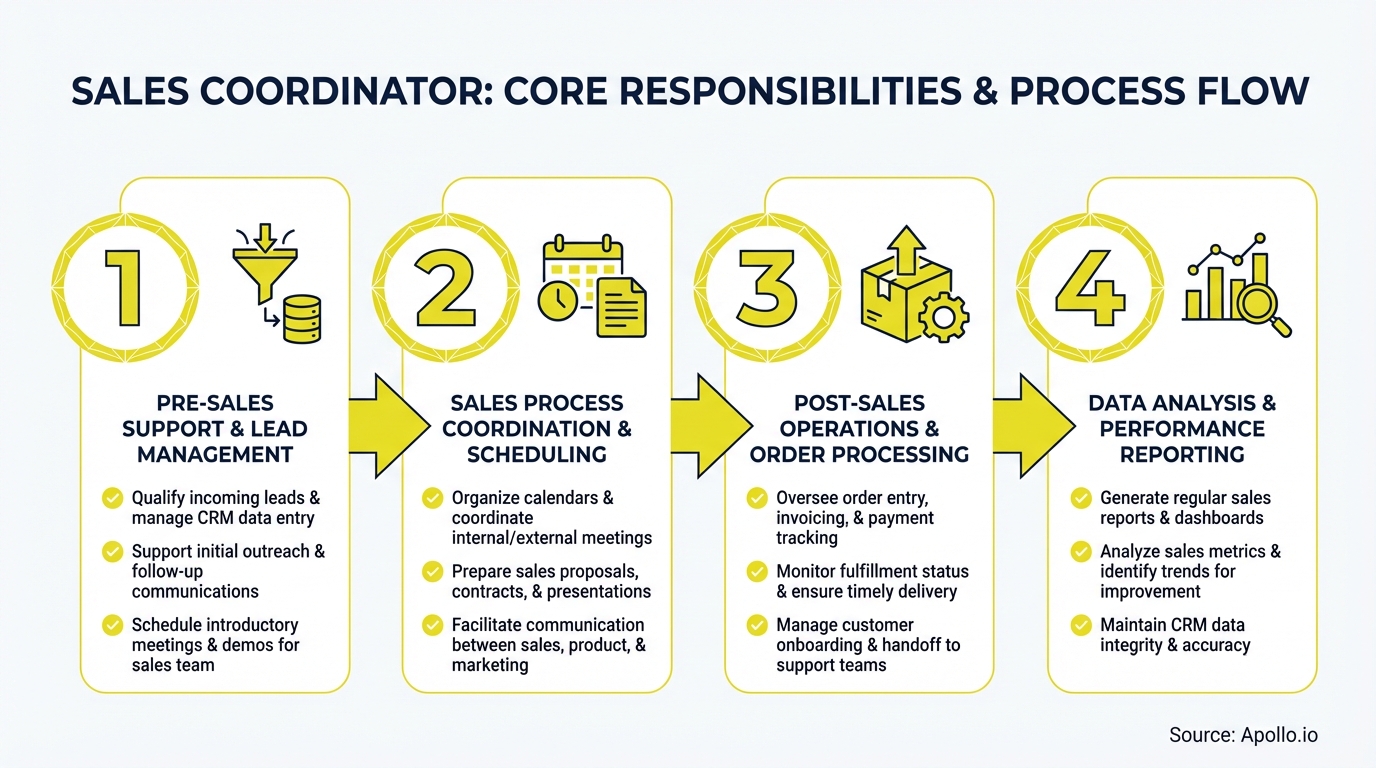
A sales coordinator is a sales operations professional who supports revenue teams by managing pipelines, coordinating customer interactions, and ensuring smooth execution of sales processes. They handle CRM administration, schedule meetings, prepare proposals, track performance metrics, and increasingly serve as the bridge between marketing content and sales execution.
According to the U.S. Bureau of Labor Statistics, sales-related roles are projected to grow 5% from 2024 to 2034, faster than average across all occupations. This growth reflects the increasing complexity of B2B sales and the need for specialized coordination roles.
In 2026, sales coordinators work across multiple platforms and systems. They manage data in CRMs, coordinate schedules, prepare sales materials, and track deal progress.
The best coordinators understand how to align content assets with buyer journey stages to accelerate pipeline velocity.
Why Does Content Marketing Matter for Sales Coordinators?
Content marketing directly impacts sales performance. Research from Gitnux shows that B2B companies that blog generate 67% more leads than those that do not. More importantly, 74% of B2B buyers conduct more than half of their research online before making an offline purchase.

Sales coordinators who integrate content strategy into their workflows enable Account Executives to engage better-informed prospects. When coordinators map case studies, product guides, and comparison resources to specific deal stages, they reduce objections and shorten sales cycles.
Struggling to align content with your sales process? Automate content delivery and multi-channel sequences with Apollo's engagement platform.
| Content Impact Area | Metric | Sales Coordinator Role |
|---|---|---|
| Lead Generation | 67% more leads with blogging | Curate and distribute educational content to prospects |
| Buyer Research | 74% research online pre-purchase | Ensure relevant assets are accessible at each stage |
| Executive Decision-Making | 84% use social media for decisions | Share thought leadership and case studies via social channels |
| Brand Awareness | 80% achieve awareness goals | Coordinate content campaigns with sales outreach timing |

How Do Sales Coordinators Map Content to the Buyer Journey?
Effective sales coordinators map specific content types to each buyer journey stage: awareness, consideration, and decision. This alignment ensures prospects receive the right information at the right time, reducing friction and accelerating deals.
Awareness Stage: Blog posts, industry reports, educational webinars, and social media content that address pain points without pushing products. Coordinators share these assets in initial outreach sequences.
Consideration Stage: Product comparison guides, case studies, demo videos, and solution briefs. Coordinators attach these to follow-up emails and prepare them for scheduled discovery calls.
Decision Stage: ROI calculators, implementation roadmaps, customer testimonials, and pricing proposals. Coordinators ensure these materials are ready before final presentations and contract negotiations.
What Content Formats Work Best for Sales Coordinators?
Video content has become critical. B2B video usage grew from 75% in 2021 to 84% in 2024, and this trend continues accelerating in 2026.
Sales coordinators should prioritize short product demos, customer success stories, and personalized video messages from Account Executives.
- One-pagers and battle cards for quick prospect education
- Interactive ROI calculators that quantify value
- Recorded product walkthroughs for asynchronous review
- Industry-specific case studies with quantified outcomes
- Competitive comparison matrices with sourced data
How Do Sales Coordinators Measure Content Marketing ROI?
Sales coordinators track content performance through pipeline metrics, not just engagement vanity metrics. The key is connecting content consumption to revenue outcomes.
Primary Metrics: Track which content assets appear in closed-won deals. Measure time-to-close for deals where specific content was shared versus deals without content support. Monitor conversion rates at each funnel stage based on content engagement.
Attribution Framework: Use multi-touch attribution to credit content that influenced deals. Tag content assets in your CRM when shared. Analyze which pieces correlate with higher win rates and shorter sales cycles.
| Metric Category | What to Measure | Why It Matters |
|---|---|---|
| Pipeline Velocity | Days to move between stages | Shows content's impact on deal acceleration |
| Content-Influenced Deals | Percentage of won deals with content engagement | Quantifies content's revenue contribution |
| Asset Performance | Win rate by content type shared | Identifies highest-value content to prioritize |
| Engagement Depth | Time spent with content, pages viewed | Indicates buyer intent and readiness |
Tired of scattered data across multiple tools? Unify your pipeline tracking and content analytics in Apollo's all-in-one platform.
Turn Forecast Guesswork Into Revenue Certainty
Pipeline forecasting a guessing game? Apollo delivers real-time deal visibility and intent signals that make your forecast actually reliable. Built-In increased win rates 10% with Apollo's buyer intelligence.
Start Free with Apollo →What Tools Do Sales Coordinators Need in 2026?
Modern sales coordinators need integrated platforms that eliminate tool sprawl. The best teams consolidate prospecting, engagement, content management, and analytics into unified systems.
Essential Capabilities: CRM integration, content asset libraries, email sequence automation, meeting scheduling, pipeline tracking, and performance dashboards. According to customer feedback, teams that consolidate tools report cutting costs in half while improving team productivity.
Sales coordinators at high-performing organizations use platforms that combine data enrichment, multi-channel outreach, AI-powered automation, and conversation intelligence. This consolidation eliminates context-switching and ensures data flows seamlessly across the revenue tech stack.
- Prospecting & Data: Access to verified contact databases with 224M+ business contacts and intelligent filtering
- Engagement Automation: Multi-channel sequences across email, phone, and social with A/B testing
- Content Management: Centralized asset libraries with usage tracking and performance analytics
- Meeting Coordination: Automated scheduling that syncs with team calendars and prospect availability
- Analytics Dashboards: Real-time visibility into pipeline health, content performance, and team activity
How Do Sales Coordinators Support SDRs and Account Executives?
Sales coordinators enable front-line sellers by handling operational tasks that would otherwise slow down revenue generation. They prepare materials, coordinate logistics, and ensure Account Executives enter meetings fully prepared with relevant context and assets.
For SDRs: Coordinators maintain clean prospect lists, prepare personalized outreach templates, schedule discovery calls, and track meeting conversion rates.
They ensure SDRs have access to social selling resources and recent company news for personalized outreach.
For Account Executives: Coordinators manage deal documentation, coordinate multi-stakeholder meetings, prepare custom proposals, and track contract negotiations. They surface relevant case studies and competitive intelligence based on prospect industry and use case.
Sales Leaders managing coordinator teams report significant efficiency gains when coordinators own content strategy. This allows AEs to focus on high-value conversations while coordinators ensure the right information reaches prospects at optimal times.
What Skills Should Sales Coordinators Develop in 2026?
The sales coordinator role requires a blend of operational excellence, strategic thinking, and technical proficiency. The most valuable coordinators combine process management with revenue impact.
Core Competencies: CRM administration, data analysis, project management, content curation, cross-functional collaboration, and communication skills. Coordinators must understand sales funnel mechanics and how content influences conversion at each stage.
Emerging Skills: AI tool proficiency, marketing automation platform knowledge, basic SQL for custom reporting, content marketing fundamentals, and social selling strategy. Coordinators who understand how to leverage AI for research, personalization, and workflow automation deliver outsized value.
| Skill Category | Specific Skills | Business Impact |
|---|---|---|
| Technical | CRM mastery, automation platforms, data analysis | Reduces manual work, improves data quality |
| Strategic | Content strategy, buyer journey mapping, ROI measurement | Aligns operations with revenue outcomes |
| Communication | Cross-functional collaboration, stakeholder management | Ensures alignment between marketing and sales |
| Process | Project management, workflow optimization, quality control | Increases team efficiency and deal velocity |
Start Scaling Your Sales Coordination With Apollo
Sales coordinators in 2026 play a strategic role in revenue generation. By integrating content marketing with sales operations, coordinators accelerate pipeline velocity, improve win rates, and enable Account Executives to focus on high-value activities.
The best coordinators consolidate their tech stack into unified platforms that combine prospecting, engagement, content management, and analytics. This approach eliminates data silos, reduces tool costs, and provides complete visibility into what drives revenue.
Apollo's all-in-one GTM platform gives sales coordinators everything they need: 224M+ verified contacts, multi-channel engagement automation, AI-powered workflows, meeting scheduling, deal management, and comprehensive analytics. Teams using Apollo report reducing tool complexity from three or more platforms into one unified workspace.
Ready to streamline your sales coordination workflows? Start free with Apollo and discover how modern sales teams cut their tech stack while scaling revenue.
Prove Apollo's ROI In Your First 30 Days
Budget approval stuck on unclear metrics? Apollo tracks every touch to revenue—quantify exactly how many hours saved and deals influenced. Built-In increased win rates 10% and ACV 10% with measurable signals.
Start Free with Apollo →Don't miss these
Sales
Inbound vs Outbound Marketing: Which Strategy Wins?
Sales
What Is a Sales Funnel? The Non-Linear Revenue Framework for 2026
Sales
What Is a Go-to-Market Strategy? The 2026 GTM Playbook
See Apollo in action
We'd love to show how Apollo can help you sell better.
By submitting this form, you will receive information, tips, and promotions from Apollo. To learn more, see our Privacy Statement.
4.7/5 based on 9,690 reviews
