
Sales Companies: Definition, Types, and How to Choose the Right One
Sales companies in 2026 face a radically different landscape than just two years ago. According to Gartner, 61% of B2B buyers now prefer a rep-free buying experience. This shift demands that modern B2B sales organizations rethink their entire approach to revenue generation, blending digital-first strategies with AI-powered automation and omnichannel consistency.

Stop Manual Research—Apollo Finds Contacts Fast
Tired of spending 4+ hours daily hunting for contact info? Apollo delivers 224M verified contacts with 96% email accuracy. Join 550K+ companies who eliminated manual prospecting.
Start Free with Apollo →Key Takeaways
- Sales companies must prioritize digital self-service channels, as 61% of B2B buyers prefer rep-free experiences
- E-commerce now accounts for 34% of B2B revenue, surpassing traditional in-person sales methods
- AI-guided selling will augment 75% of sales organizations by 2025, requiring strategic tech stack consolidation
- Omnichannel consistency is critical, with 69% of buyers reporting trust-eroding information gaps between channels
- Modern sales companies consolidate tools into unified platforms to cut costs and improve team efficiency
What Are Sales Companies in 2026?
Sales companies are businesses that sell products or services to other businesses (B2B) or consumers (B2C). In 2026, successful sales companies operate as integrated revenue engines combining digital commerce, AI automation, and human expertise.
They orchestrate omnichannel buyer journeys across websites, marketplaces, email, social, and sales rep touchpoints.
Research by McKinsey shows e-commerce has become the leading B2B sales channel, accounting for 34% of revenue in 2024. Modern sales companies invest heavily in digital infrastructure, data quality, and AI sales tools to meet buyers where they prefer to engage.
How Do Sales Companies Build Revenue Engines in 2026?
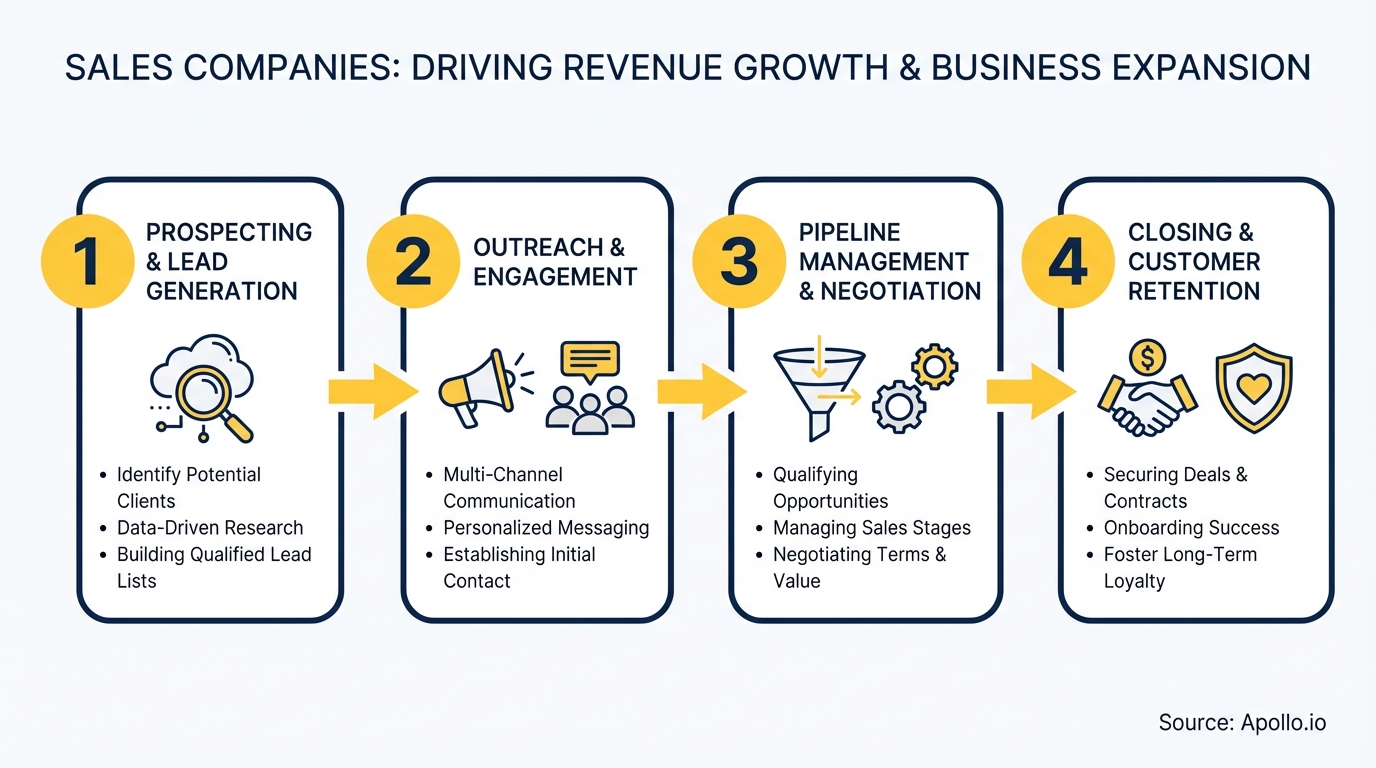
Sales companies build revenue engines by aligning marketing and sales teams around unified data, automating repetitive tasks, and creating consistent buyer experiences across all channels. The foundation includes verified contact databases, intelligent engagement workflows, and real-time pipeline visibility.
Key components include:
- Unified prospecting and enrichment: Access to 224M+ verified business contacts with 96% email accuracy
- Multi-channel engagement: Coordinated sequences across email, phone, LinkedIn, and ads
- AI-powered automation: Research agents, message generation, and call intelligence
- Pipeline management: Real-time deal tracking with forecasting and team analytics
- Tech stack consolidation: Single platform replacing 3-5 separate tools
Struggling to find qualified leads? Search Apollo's 224M+ contacts with 65+ filters to build targeted prospect lists.
Why Are Sales Companies Consolidating Their Tech Stacks?
Sales companies consolidate tech stacks to reduce costs, eliminate data silos, and improve team productivity. Maintaining separate tools for prospecting, enrichment, engagement, and analytics creates integration headaches, duplicated data entry, and significant licensing expenses.
A unified platform approach cuts complexity and accelerates rep ramp time.
Customer evidence demonstrates the impact:
- Predictable Revenue: "We reduced the complexity of three tools into one"
- Census: "We cut our costs in half"
- Cyera: "Having everything in one system was a game changer"
RevOps leaders report that consolidation improves data accuracy, simplifies reporting, and creates a single source of truth for pipeline metrics. SDRs and AEs benefit from having prospecting, outreach, and meeting scheduling in one workspace, eliminating context-switching between platforms.
Turn Forecast Guesswork Into Revenue Certainty
Pipeline forecasting a guessing game? Apollo delivers real-time deal visibility and intent signals that make revenue predictions accurate. Built-In increased win rates 10% with Apollo's scoring and guidance.
Start Free with Apollo →How Do SDRs and BDRs Book More Meetings at Scale?
SDRs and BDRs book more meetings by combining targeted prospecting, personalized multi-channel sequences, and AI-powered research. The winning formula includes building precise ICP lists, crafting contextual messaging based on prospect signals, and automating follow-up cadences while maintaining personalization at scale.
Modern SDRs using integrated platforms report 46% more meetings when leveraging AI research agents to gather prospect intelligence. They use social selling tools to warm up prospects on LinkedIn before sending emails, and coordinate touchpoints across channels to maximize response rates.

Best practices for 2026:
- Use 65+ filters to build hyper-targeted prospect lists based on technographics, funding signals, and intent data
- Personalize sequences with dynamic variables pulled from enriched contact profiles
- Leverage AI to generate contextual messaging that references recent company news or challenges
- Track engagement signals to prioritize hot prospects for immediate follow-up
- Automate meeting scheduling to eliminate back-and-forth email coordination
Spending hours on manual outreach? Automate your sequences with Apollo's multi-channel platform and book more meetings.
What Omnichannel Strategies Do Winning Sales Companies Use?
Winning sales companies create consistent buyer experiences across websites, email, social media, marketplaces, and sales conversations. They ensure messaging, data, and positioning align across every touchpoint to build trust and eliminate the confusion that drives 69% of buyers to report inconsistencies between channels.
Data from B2BEA indicates that 83% of companies consider omnichannel approaches critical for sales and marketing success. Sales Leaders implement governance frameworks ensuring website content, rep talking points, and digital collateral tell the same story with identical value propositions and proof points.
| Channel | Primary Use Case | Integration Requirement |
|---|---|---|
| Website | Self-service research and purchase | CRM sync for visitor tracking |
| Nurture sequences and engagement | Activity logging and response tracking | |
| Social selling and relationship building | Engagement signals and profile enrichment | |
| Phone | High-value conversations and closing | Call recording and AI note-taking |
| Marketplaces | Alternative buying paths | Inventory and pricing sync |
How Do Account Executives Close Deals Faster in 2026?
Account Executives close deals faster by leveraging pre-meeting intelligence, AI-powered conversation insights, and streamlined deal management workflows. They enter every conversation armed with comprehensive account research, recent funding announcements, technology stack details, and key stakeholder backgrounds.
AEs using AI call assistants report 35% increases in bookings by automatically capturing action items, generating follow-up emails, and surfacing deal risks based on conversation analysis. They shorten sales cycles by eliminating manual research time and focusing energy on high-value strategic selling activities.
Tactics that work:
- Use AI research agents to compile account intelligence before discovery calls
- Leverage conversation intelligence to identify objections and buying signals
- Track deal progression with automated pipeline updates and forecasting
- Coordinate with SDRs using shared account views and handoff workflows
- Personalize proposals using enriched firmographic and technographic data
What Role Does AI Play in Modern Sales Companies?
AI plays a transformative role in modern sales companies, augmenting rep productivity, personalizing buyer experiences, and surfacing predictive insights. By 2025, 75% of B2B sales organizations will augment traditional playbooks with AI-guided selling solutions, according to Gitnux research.
Sales teams use AI for:
- Research automation: AI agents gather prospect intelligence, saving 2-3 hours per rep daily
- Message generation: Contextual email and LinkedIn messages tailored to prospect pain points
- Call intelligence: Real-time transcription, automated summaries, and next-step recommendations
- Lead scoring: Predictive models identifying high-intent prospects for prioritization
- Pipeline forecasting: Deal health scoring based on engagement patterns and historical win rates
Founders and CEOs building outbound motions report that AI sales automation allows lean teams to compete with funded competitors by doing more with fewer resources.
How Can Sales Companies Get Started with Revenue Transformation?
Sales companies get started with revenue transformation by auditing their current tech stack, identifying tool overlap and data gaps, and consolidating onto unified platforms that combine prospecting, engagement, and analytics. The goal is creating a single workspace where reps execute their entire workflow without switching between systems.
Implementation roadmap:
- Audit current tools: Map every platform reps use for prospecting, outreach, meetings, and pipeline management
- Identify redundancies: Calculate combined licensing costs for overlapping functionality
- Evaluate consolidation options: Compare unified platforms against current multi-tool stacks
- Pilot with one team: Test consolidated workflows with SDRs or AEs before full rollout
- Measure impact: Track metrics like meetings booked, deal velocity, and rep ramp time
- Scale successful patterns: Expand proven workflows across the entire revenue organization
Sales Leaders implementing unified platforms report faster onboarding (reps productive in days vs. weeks), cleaner data (single source of truth), and better visibility (real-time pipeline dashboards). Marketing Leaders benefit from closed-loop attribution showing which campaigns drive pipeline and revenue.
Ready to Transform Your Sales Company for 2026?
Sales companies that win in 2026 embrace digital-first buyer preferences, consolidate fragmented tech stacks, and empower teams with AI-powered automation. They create omnichannel consistency, eliminate manual busywork, and focus human energy on high-value strategic selling.

Apollo provides the all-in-one platform sales companies need to compete: 224M+ verified business contacts, multi-channel engagement workflows, AI research and messaging, conversation intelligence, and unified pipeline management. Companies using Apollo report cutting costs in half while booking 46% more meetings and increasing close rates by 35%.
Whether you're an SDR looking to hit quota, an AE shortening sales cycles, a RevOps leader seeking clean data, or a Founder building scalable outbound motion, Apollo replaces 3-5 separate tools with one integrated workspace.
Try Apollo Free and see how 550K+ companies and 2M+ users are building modern revenue engines that scale.
Prove Apollo's Value In Your First 30 Days
Budget approval stuck on unclear metrics? Apollo tracks every touchpoint from first contact to closed deal—quantifying exactly how much pipeline you're generating. Built-In increased win rates 10% and ACV 10% with Apollo's scoring.
Start Free with Apollo →Don't miss these
Sales
Inbound vs Outbound Marketing: Which Strategy Wins?
Sales
What Is a Sales Funnel? The Non-Linear Revenue Framework for 2026
Sales
What Is a Go-to-Market Strategy? The 2026 GTM Playbook
See Apollo in action
We'd love to show how Apollo can help you sell better.
By submitting this form, you will receive information, tips, and promotions from Apollo. To learn more, see our Privacy Statement.
4.7/5 based on 9,690 reviews
