What Is a Sales Cadence? The 2026 Framework for Smarter, Signal-Led Outreach
A sales cadence is a structured sequence of outreach touches — across email, phone, and social channels — designed to convert prospects into conversations. But in 2026, the old "more steps = more pipeline" logic is broken. Buyers are more resistant, inboxes are more defended, and generic sequences actively damage your brand.
The teams winning today are building cadences that are signal-triggered, content-aligned, and deliverability-safe — not just longer. This guide gives you the updated framework to do exactly that.

Scale Smarter With Apollo's Pipeline Engine
Tired of your team burning hours on manual research instead of closing deals? Apollo delivers verified contacts and automated outreach so your reps spend time selling. Join 550K+ companies building predictable pipeline.
Start Free with Apollo →Key Takeaways
- A sales cadence is a repeatable, multi-channel sequence of touches mapped to buyer stages — not just a drip email list.
- According to Gartner, 73% of B2B buyers actively avoid suppliers who send irrelevant outreach — making personalization non-negotiable.
- Modern cadences require "stopping rules" — clear signals that trigger exit or escalation — not just a fixed number of steps.
- Content governance eliminates the messaging inconsistencies that erode buyer trust across touchpoints.
- AI-assisted cadences win on targeting and timing, not just copy volume.
What Is a Sales Cadence and How Does It Work?
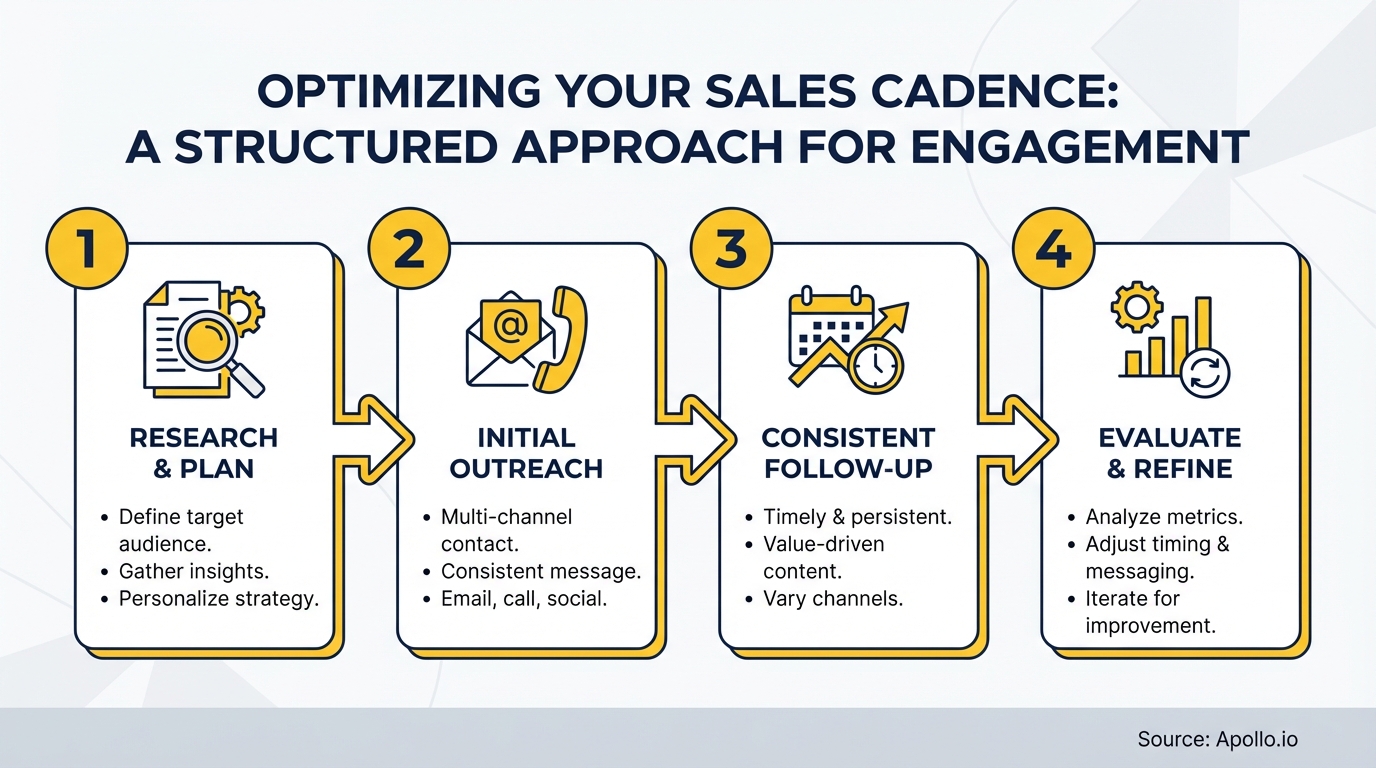
A sales cadence defines who you contact, when you contact them, how (channel), and what you say at each step. It creates consistency across reps and ensures no prospect falls through the cracks due to inconsistent follow-up.
According to Martal, 80% of B2B sales require five follow-up contacts after the initial meeting, yet 44% of salespeople give up after just one attempt. A structured cadence solves that persistence gap systematically.
The key shift in 2026: effective cadences are trigger-based, not time-based. Rather than sending touch #4 on day 10 automatically, high-performing teams use intent signals, email opens, or page visits to determine when to escalate or exit. Explore what makes a winning sales sequence to understand how sequencing logic has evolved.
The Cadence-to-Content Map: Aligning Every Touch to a Buyer Task
The biggest gap in most cadences is mismatched content — the wrong asset at the wrong stage. With Gartner reporting that 69% of B2B buyers encounter inconsistencies between what's on a company's website and what sellers say, content alignment is now a trust issue, not just a conversion issue.
Use this map to match each cadence step to the buyer's actual task:
| Cadence Step | Buyer Task | Asset Type | Gating | Channel |
|---|---|---|---|---|
| Touch 1 (Day 1) | Problem awareness | Short insight / stat email | Ungated | |
| Touch 2 (Day 3) | Research / validate need | One-page guide or blog post | Ungated | Email + social |
| Touch 3 (Day 6) | Compare solutions | Case study or ROI snapshot | Ungated (shareable) | Phone + email |
| Touch 4 (Day 10) | Stakeholder alignment | Decision brief / one-pager | Ungated (forwardable) | |
| Touch 5 (Day 14) | Risk reduction | Security / implementation FAQ | Ungated | Phone + email |
| Exit / Break-up | No signal detected | Permission-based opt-out email | N/A |
Shareability is critical. Modern buying involves multiple stakeholders, and your assets need to travel without rep involvement. Ungated, forwardable one-pagers and decision briefs let champions sell internally on your behalf. See sales cadence examples and best practices to see this in action.

How Many Touches Does an Effective Sales Cadence Need?
The answer is: fewer than you think, but more strategically timed. Research from Belkins shows the highest cold email reply rate (8.4%) comes from the very first email, with performance declining steadily with each follow-up. This supports a "less volume, more value" approach.
The practical implication: front-load your best message, then use signals to decide whether to continue. A 5-7 touch cadence with clear stopping rules outperforms a 12-step sequence with no exit logic.
Teams chasing volume without relevance are the ones getting flagged as spam.
"The moment we select someone in our database, they're instantly added to a sequence and we can take action right away. We're effective and efficient with our outreach."
Struggling to enroll the right prospects in the right sequences? Automate your multi-channel sequences with Apollo and trigger enrollment based on fit and intent signals.
What Are the Key Components of a Modern Sales Cadence?
A high-performing cadence in 2026 has six essential components:
- ICP-gated entry: Only enroll prospects that match your ideal customer profile. Broad list enrollment is the fastest path to low reply rates and damaged sender reputation.
- Channel diversity: Email, phone, and social outreach across the sequence — not just email blasts. Multi-channel cadences consistently outperform single-channel ones.
- Personalized first touch: Reference a specific trigger (funding round, job change, content engagement) in touch one. Generic openers get ignored.
- Signal-based progression: Use email opens, clicks, or website visits to determine when to escalate from email to phone.
- Stopping rules: Define exactly when a prospect exits the sequence — based on non-engagement, opt-out, or negative reply. Don't run sequences indefinitely.
- Deliverability hygiene: Authenticate your domains (SPF, DKIM, DMARC), warm new mailboxes, and vary subject lines. Repetitive templates now trigger spam filters at major providers.
Turn Funnel Guesswork Into Real Pipeline
Tired of watching marketing leads stall before they ever reach your reps? Apollo surfaces in-market buyers the moment they're ready, so your team stops chasing cold leads and starts closing. 90K paying customers can't be wrong.
Start Free with Apollo →Content Governance: Your Single Source of Truth for Cadence Messaging
The same Gartner research found that 69% of buyers encounter messaging inconsistencies between a company's website and its sellers. This is a cadence governance failure — and it costs deals.
A content governance system ensures every rep uses approved, current messaging that matches what's on your website and in your marketing materials. Here's a simple governance blueprint:
| Layer | Owner | Action | Cadence |
|---|---|---|---|
| Message library | Sales Enablement | Approve all sequence templates before launch | Per campaign |
| Content index | Marketing | Tag assets by stage, persona, and channel | Monthly review |
| Approval gate | RevOps | Lock live sequences from unauthorized edits | Ongoing |
| Performance review | Sales Leadership | Retire low-performing templates quarterly | Quarterly |
Governance doesn't slow teams down — it prevents the off-script messaging that confuses buyers and creates legal risk.
Pair this with sales analytics to identify which approved templates are actually converting.

How AI Is Changing Sales Cadence Execution
AI is now embedded in cadence execution at three levels: research, personalization, and next-best-action routing. According to AI-Bees, 37% of all sales organizations use AI in their sales processes, with more than half of high-performing organizations leveraging it.
But here's the key insight for 2026: AI makes copy cheaper and faster, but it doesn't make targeting smarter on its own. The teams seeing real lift are using AI to surface the right signals (intent data, technographic fit, engagement history) and then personalizing outreach based on those signals — not just generating more volume.
"With this kind of AI system, my BDRs can send 10x more personalized emails. Their productivity and growth has skyrocketed."
Want to find better-fit prospects before they enter your cadence? Search Apollo's 224M+ contacts with 65+ filters to build lists that convert from the first touch.
Apollo's AI-powered platform also helps you identify which AI sales tools are worth adding to your stack. See our breakdown of AI sales tools that actually close more deals.
Cadence KPIs: What to Measure and When to Pivot
Most teams track open rates and reply rates. High-performing teams track sequence health — a combination of engagement signals, deliverability metrics, and pipeline contribution.
| KPI | What It Measures | Healthy Benchmark | Action Trigger |
|---|---|---|---|
| Open rate | Subject line resonance + deliverability | >40% | Below 25%: rewrite subject lines, check deliverability |
| Reply rate | Message relevance + timing | 3–8% | Below 2%: rebuild personalization layer |
| Meeting booked rate | CTA effectiveness + ICP fit | 1–3% | Below 0.5%: audit ICP targeting |
| Bounce rate | Data quality | <3% | Above 5%: enrich contact data before sending |
| Sequence completion rate | Prospect engagement across all touches | Varies by length | High drop-off at touch 2: fix the follow-up message |
Note that B2B sales cycles have lengthened significantly. According to Sword and the Script, the median B2B sales cycle grew to 120 days in 2024. This means cadence KPIs must be evaluated over longer windows — and nurture sequences need to extend further than most teams plan for.
Conclusion: Build Cadences Buyers Actually Want to Receive
The best sales cadence in 2026 isn't the longest one — it's the most relevant one. That means signal-triggered enrollment, content that self-serves buyer questions, messaging governance that keeps reps and marketing aligned, and stopping rules that protect your sender reputation.
Teams that treat their cadence as a structured buyer journey — not just a rep activity tracker — are the ones booking more meetings with fewer touches.
Explore more sales cadence examples and best practices to see proven templates in action, or check out our guide to sales automation software to understand how to operationalize your cadence at scale.
Ready to build sequences that convert? Start Prospecting with Apollo — free.
