Sales Account Manager: Essential Skills and Strategies for 2026
Sales account managers in 2026 face a transformed landscape where AI tools, digital-first buyers, and cross-functional alignment determine who hits quota and who misses it. Research by Gartner shows sellers who effectively partner with AI tools are 3.7 times more likely to meet their sales quotas. This guide explores how modern sales account managers leverage AI, align with marketing, and navigate buyer preferences to build predictable revenue.

Skip The Hunt—Apollo Finds Contacts Instantly
Tired of spending 4+ hours daily hunting for contact info? Apollo delivers 224M verified contacts with 96% email accuracy. Join 550K+ companies who stopped researching and started selling.
Start Free with Apollo →Key Takeaways
- Sales account managers who integrate AI tools hit quota 3.7 times more often than those who don't
- 61% of B2B buyers now prefer self-service experiences, requiring account managers to enable digital buying journeys
- Organizations with aligned sales and marketing teams achieve 24% faster revenue growth through coordinated account strategies
- E-commerce channels now drive 34% of B2B revenue, making digital channel expertise essential for account managers
- Consolidating sales tools into one platform cuts costs in half while improving team efficiency and data accuracy
What Is a Sales Account Manager?
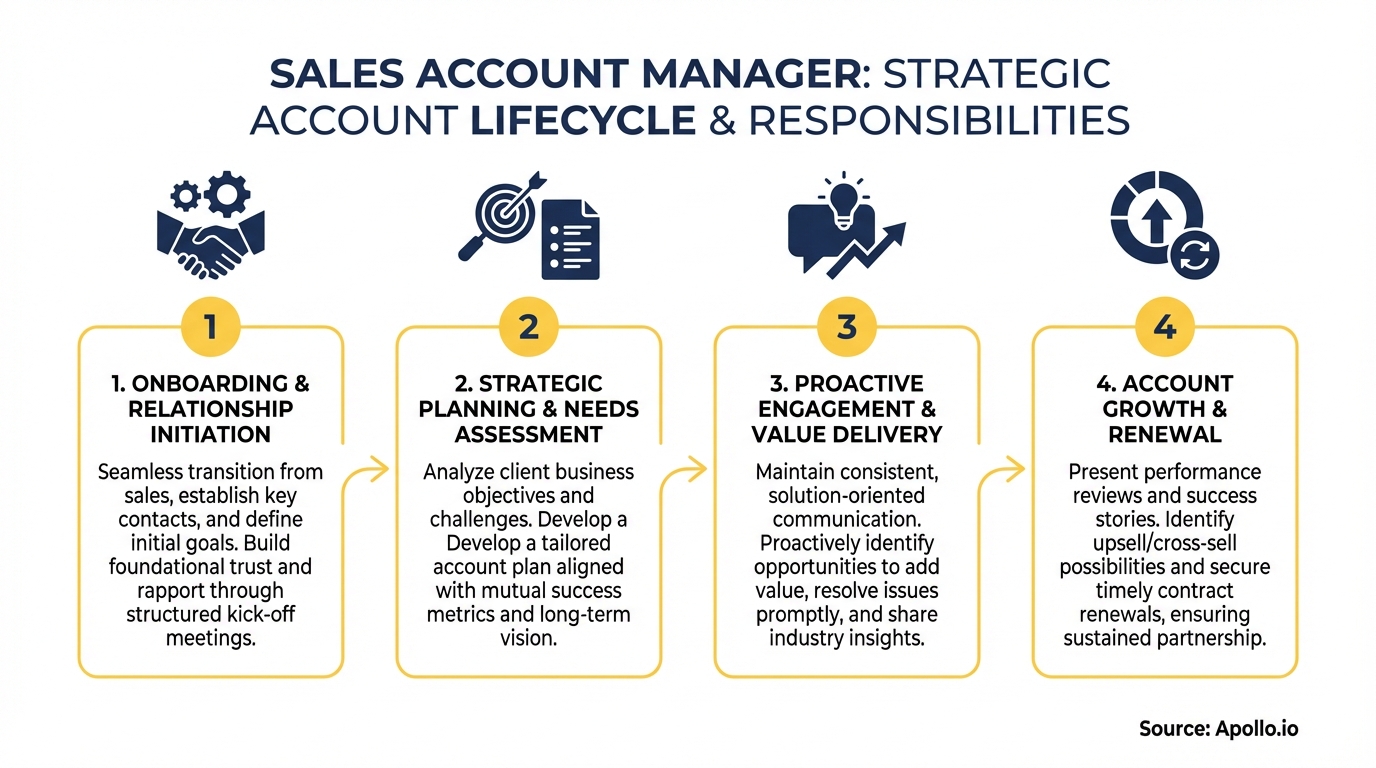
A sales account manager is a sales professional who owns the full relationship lifecycle with assigned business accounts. They prospect new opportunities, close initial deals, and expand revenue through cross-selling and upselling. Unlike SDRs who focus purely on lead generation or Account Executives who close net-new business, sales account managers balance acquisition with retention and growth.
In 2026, the role has evolved beyond relationship management. Modern sales account managers operate as revenue orchestrators who coordinate marketing campaigns, enable self-service buying, and leverage AI to personalize outreach at scale. They need proficiency in AI sales tools, digital channel optimization, and cross-functional collaboration.
Why Are Sales Account Managers Critical in 2026?
The B2B buying landscape has fundamentally shifted. According to Gartner, 61% of B2B buyers prefer a buying experience without direct interaction with sales representatives. This doesn't eliminate the need for sales account managers; it transforms their role into architects of buyer-enabled journeys.
Sales account managers bridge the gap between digital self-service and high-touch relationship building. They curate content, enable configurators, and intervene at critical decision points. Data from Gitnux indicates B2B organizations with aligned sales and marketing teams achieve 24% faster three-year revenue growth, often through strategic cross-selling led by account managers.
How Do Sales Account Managers Drive Revenue Growth?
Sales account managers drive revenue through four core mechanisms:
- Account expansion: Identifying cross-sell and upsell opportunities within existing accounts
- Renewal management: Preventing churn by demonstrating ROI and addressing objections proactively
- Executive alignment: Building relationships with C-level stakeholders as detailed in enterprise sales strategies
- Channel orchestration: Coordinating digital, partner, and direct sales motions to maximize account penetration
What Does a Sales Account Manager Do Daily?
The daily workflow of a sales account manager in 2026 blends strategic planning with AI-assisted execution. Here's what a typical day looks like:
| Time Block | Activity | Tools Used |
|---|---|---|
| 8:00-9:00 AM | Review AI-generated account insights and prioritize outreach | AI research agents, CRM dashboards |
| 9:00-11:00 AM | Conduct discovery calls and product demos | Video conferencing, screen sharing, AI call assistants |
| 11:00-12:00 PM | Coordinate with marketing on account-based campaigns | Slack, email, campaign management platforms |
| 1:00-3:00 PM | Build proposals, negotiate contracts, update deal stages | CPQ software, e-signature tools, CRM |
| 3:00-5:00 PM | Strategic account planning and pipeline reviews | Analytics dashboards, forecasting tools |
Struggling to manage complex account relationships across multiple tools? Track every deal stage and account interaction in one unified workspace with Apollo.
How Do Sales Account Managers Use AI to Hit Quota?
AI has become the defining factor separating quota-crushing sales account managers from those who struggle. The 3.7x quota attainment advantage comes from specific AI applications:
- Automated research: AI agents pull firmographics, technographics, and buying signals in seconds
- Personalized messaging: AI generates tailored outreach based on prospect data and past interactions
- Conversation intelligence: AI call assistants transcribe meetings, identify action items, and surface objections
- Predictive analytics: AI scores accounts by likelihood to expand, renew, or churn
- Workflow automation: AI triggers follow-ups, updates records, and routes leads based on predefined rules
RevOps leaders implementing AI sales automation report 46% more meetings booked and 35% increases in closed-won deals. Sales account managers using AI spend less time on manual research and more time building relationships.
What AI Tools Do Sales Account Managers Need?
The AI toolkit for sales account managers in 2026 includes:
- AI research agents: Automatically gather account intelligence and buying signals
- Generative AI for messaging: Create personalized email sequences and LinkedIn messages
- AI call assistants: Record, transcribe, and summarize customer conversations
- Predictive lead scoring: Identify which accounts to prioritize based on propensity models
- AI-powered CRM enrichment: Keep contact data clean and complete without manual updates
Turn Forecast Chaos Into Revenue Certainty
Pipeline forecasting a guessing game? Apollo's real-time deal intelligence gives you accurate visibility across every stage. Built-In increased win rates 10% with Apollo's scoring and signals.
Start Free with Apollo →How Do Sales Account Managers Align With Marketing?
Marketing and sales misalignment remains the top barrier to revenue growth. Research from Martech reveals 50% of B2B marketers miss their goals, with 44% citing sales alignment issues as the primary cause. Sales account managers bridge this gap through structured collaboration frameworks.

Effective alignment requires shared definitions of qualified accounts, coordinated outreach cadences, and closed-loop reporting. Sales account managers who participate in account-based marketing (ABM) planning sessions report higher conversion rates and shorter sales cycles.
They provide marketing with win/loss insights, competitive intelligence, and content feedback that improves campaign performance.
What Does Sales and Marketing Alignment Look Like?
Practical alignment between sales account managers and marketing includes:
- Shared account selection: Joint identification of target accounts based on ICP fit and propensity data
- Coordinated campaigns: Marketing nurtures accounts while sales account managers time direct outreach
- Content collaboration: Sales provides voice-of-customer insights; marketing creates assets that address objections
- Unified metrics: Both teams measure pipeline contribution, not just MQLs or closed deals in isolation
- Regular sync meetings: Weekly or biweekly reviews of account progress and campaign performance
How Do Sales Account Managers Enable Digital Buying?
With 61% of buyers preferring rep-free experiences, sales account managers must enable self-service without becoming obsolete. The solution is hybrid selling where account managers curate digital experiences and intervene strategically.
Modern sales account managers build resource libraries, configure product demos, and create interactive ROI calculators. They use social selling strategies to share insights on LinkedIn and engage buyers in digital communities. Data from McKinsey shows e-commerce channels now account for 34% of B2B revenue, making digital channel expertise essential.
What Digital Tools Do Sales Account Managers Use?
The digital toolkit for enabling buyer self-service includes:
- Product configurators: Interactive tools that let buyers customize solutions
- Self-service portals: Buyer dashboards with pricing, documentation, and case studies
- Video libraries: On-demand demos, tutorials, and customer testimonials
- ROI calculators: Tools that quantify business value based on buyer inputs
- Chatbots and AI assistants: Automated responses to common questions with escalation to humans
What Is the Difference Between a Sales Account Manager and Account Executive?
The lines between sales account managers and Account Executives blur, but key distinctions remain:
| Dimension | Sales Account Manager | Account Executive |
|---|---|---|
| Primary focus | Relationship lifecycle and account growth | New logo acquisition and deal closure |
| Account ownership | Long-term ownership (multi-year) | Transactional ownership (deal-based) |
| Revenue model | Expansion, cross-sell, renewal | Net-new contract value |
| Buyer relationship | Consultative partner over time | Solution advisor during purchase |
| Metrics | Net revenue retention, expansion rate | Win rate, average deal size |
Some organizations merge these roles into a unified sales model where one person handles the full customer journey. Others maintain specialization with Account Executives handing off to sales account managers post-sale.
The trend in 2026 favors consolidated ownership to improve buyer experience and reduce handoff friction.

How Can Sales Account Managers Cut Their Tech Stack?
Sales account managers juggle an average of 8-12 tools daily, leading to data silos, workflow friction, and inflated software costs. The solution is tool consolidation into unified platforms that handle prospecting, engagement, data enrichment, and analytics in one workspace.
Organizations that consolidate report dramatic improvements. As one RevOps leader at Census shared, "We cut our costs in half" by replacing separate tools for contact data, email sequencing, and call tracking with a single platform.
Predictable Revenue echoed this: "We reduced the complexity of three tools into one." Cyera added, "Having everything in one system was a game changer."
Tired of logging into 10+ tools every morning? Consolidate your entire sales tech stack with Apollo's all-in-one GTM platform.
What Should Sales Account Managers Look for in a Unified Platform?
When evaluating platforms for tool consolidation, sales account managers should prioritize:
- Integrated contact database: 224M+ verified business contacts with email, phone, and firmographic data
- Multi-channel engagement: Email, LinkedIn, phone, and video outreach in one workflow
- AI automation: Research agents, message generation, and conversation intelligence
- Deal management: Pipeline tracking, forecasting, and account planning tools
- Native integrations: Seamless sync with CRM, calendar, and communication tools
- Analytics and reporting: Real-time dashboards for activity, pipeline, and revenue metrics
Conclusion
Sales account managers in 2026 succeed by embracing AI, enabling digital buying journeys, and aligning with marketing to drive predictable revenue. The 3.7x quota advantage for AI-enabled sellers is real, but it requires the right tools and workflows.
Organizations that consolidate fragmented tech stacks into unified platforms report cost savings of 50% while improving efficiency and data quality.
The future belongs to sales account managers who orchestrate buyer experiences across digital and human touchpoints, leverage AI to personalize at scale, and coordinate with marketing to target high-value accounts. Those who cling to manual processes and siloed tools will struggle to hit quota in an increasingly competitive landscape.
Ready to transform your sales account management approach? Schedule a Demo to see how Apollo's all-in-one platform helps sales account managers hit quota 3.7 times more often.
Prove Apollo's ROI In Your First 30 Days
Budget approval stuck on unclear metrics? Apollo delivers measurable impact from day one—GTM Ops Agency got 4x more meetings, Built-In increased win rates 10%. Get the numbers leadership demands.
Start Free with Apollo →Don't miss these
Sales
Inbound vs Outbound Marketing: Which Strategy Wins?
Sales
What Is a Sales Funnel? The Non-Linear Revenue Framework for 2026
Sales
What Is a Go-to-Market Strategy? The 2026 GTM Playbook
See Apollo in action
We'd love to show how Apollo can help you sell better.
By submitting this form, you will receive information, tips, and promotions from Apollo. To learn more, see our Privacy Statement.
4.7/5 based on 9,690 reviews
