
What Is Product Led Sales? The 2026 Playbook for Hybrid GTM
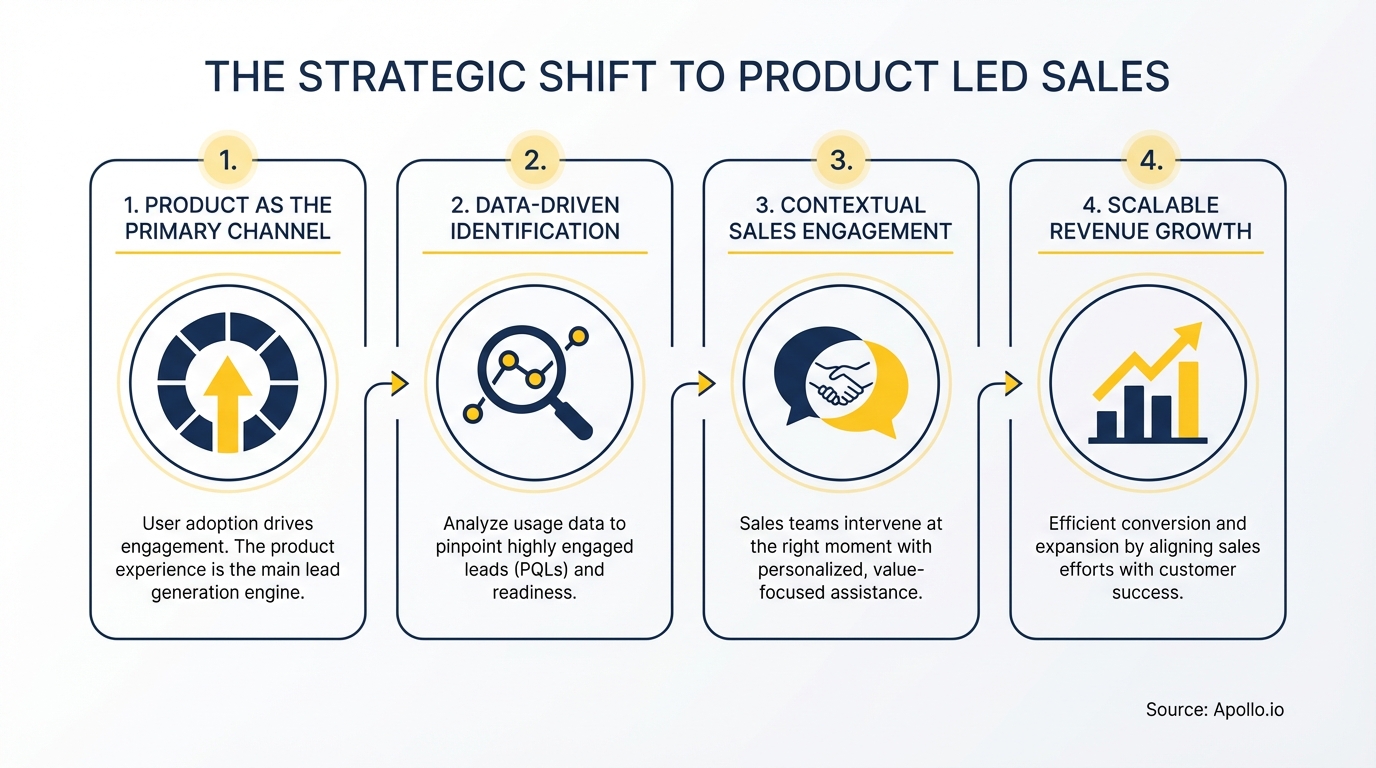
Product led sales (PLS) is a go-to-market strategy where product usage signals drive sales engagement. Instead of cold outreach to unknown prospects, reps intervene at high-intent moments — when a user has already experienced value inside the product.
Pure product-led growth (PLG) stalled in enterprise because free trials don't close six-figure deals on their own. PLS is the answer: let the product qualify, then let sales close. As Forrester noted in 2025, PLS is now moving from early-adopter strategy into mainstream B2B GTM playbooks.

Scale Smarter With Apollo's GTM Engine
Tired of manual research eating your selling time? Apollo surfaces verified contacts and automates outreach so your team scales without the chaos. Join 550K+ companies building predictable pipeline.
Start Free with Apollo →Key Takeaways
- Product led sales uses in-product behavior to trigger timely, relevant sales outreach — not cold prospecting lists.
- PLS reduces buyer friction: Gartner research shows 73% of B2B buyers actively avoid suppliers who send irrelevant outreach.
- Companies adopting PLS are twice as likely to achieve over 100% year-over-year revenue growth, according to Valley.
- Product Qualified Leads (PQLs) replace MQLs as the primary handoff signal between product and sales.
- AI-powered signal routing is becoming the core operational capability in 2026 PLS motions.
What Is Product Led Sales vs. Product Led Growth?
PLG and PLS are often confused. PLG is a growth strategy where the product drives acquisition, activation, and retention without sales involvement.
PLS adds a deliberate sales layer on top: product signals identify the right accounts to engage, and reps step in to convert or expand them.
| Dimension | Product Led Growth (PLG) | Product Led Sales (PLS) |
|---|---|---|
| Primary motion | Self-serve acquisition | Self-serve + sales-assist at high-intent moments |
| Lead signal | Sign-up volume | Product Qualified Leads (PQLs) |
| Sales involvement | Minimal or none | Targeted, triggered by usage thresholds |
| Best for | SMB / viral growth | Mid-market and enterprise expansion |
| Revenue ceiling | Limited by self-serve pricing | Scales to enterprise deal sizes |
PLS is not a replacement for sales-led growth — it is a smarter, signal-driven version of it. Teams that want to understand the full spectrum of founder led sales to enterprise motions benefit from seeing PLS as the hybrid layer between the two.
How Does Product Led Sales Work? The Core PLS Process
PLS follows a four-stage loop. Each stage generates data that feeds the next, creating a self-improving qualification engine.
- Acquire: Users discover and sign up for the product through self-serve channels (free trial, freemium, sandbox).
- Activate: Users reach a meaningful value milestone inside the product (first export, first integration, team invite).
- Signal: Product telemetry flags accounts that cross PQL thresholds — high usage frequency, feature adoption, seat expansion, or upgrade attempts.
- Engage: Sales receives a prioritized PQL queue and reaches out with context from actual product behavior — not a cold script.
The critical difference from traditional sales: the rep already knows what the prospect has done, what they value, and where they're hitting limits. That context makes every conversation more relevant. According to Gartner, 73% of B2B buyers actively avoid suppliers who send irrelevant outreach — PLS solves this by making every sales touch earned and contextual.

What Are Product Qualified Leads (PQLs)?
A Product Qualified Lead is a user or account that has demonstrated meaningful product engagement, making them a strong candidate for a sales conversation. PQLs replace the traditional MQL, which relies on form fills and content downloads rather than actual product behavior.
PQL Scoring Dimensions
| Signal Type | Example Triggers | Weight |
|---|---|---|
| Activation depth | Completed onboarding, used 3+ core features | High |
| Usage frequency | Daily active use for 7+ consecutive days | High |
| Expansion signals | Invited 3+ teammates, hit seat limit | Very High |
| Upgrade intent | Visited pricing page 2+ times, clicked upgrade CTA | Very High |
| Fit signals | Company size, industry, tech stack match ICP | Medium |
PQL scoring combines behavioral signals (what the user did) with firmographic fit (who the account is). The intersection of high intent and high fit is where reps should focus first. For teams building or refining their qualification approach, sales analytics infrastructure is essential to make PQL data actionable.
"The moment we select someone in our database, they're instantly added to a sequence and we can take action right away. We're effective and efficient with our outreach."
Turn Weak Funnels Into Winning Pipeline
Tired of marketing leads that never convert to real opportunities? Apollo surfaces high-intent prospects at the exact moment they're ready to buy. Top sales teams use Apollo to build pipeline that actually closes.
Start Free with Apollo →Why Product Led Sales Wins for Enterprise in 2026
The case for PLS has strengthened considerably. B2B buying behavior has shifted toward self-service at every deal size. Intentsify reports that in 2025, more than half of large B2B transactions of $1 million or greater are predicted to be processed through digital self-serve channels. Enterprise buyers want to evaluate before they talk to anyone.
Meanwhile, Forrester's State of Business Buying 2024 found that 86% of B2B purchases stall during the buying process. PLS directly addresses stalling by keeping buyers engaged inside the product while sales monitors intent signals and intervenes at the right moment — not too early, not too late.
Research from Bain shows software firms primarily using a product-led growth strategy increased their revenue approximately twice as fast as those with minimal or no PLG focus. PLS amplifies that growth by layering sales intelligence on top of product momentum.
Ready to act on your PQL signals faster? Explore Apollo's go-to-market tools to connect product intent signals with your outreach sequences.
How to Implement Product Led Sales: A Practical Playbook
Step 1: Define Your PQL Criteria
Work with product and RevOps to identify the 3-5 in-product behaviors that correlate with conversion. Don't guess — pull historical data from accounts that converted and find the common activation milestones they hit before buying.
Step 2: Build Your Signal Routing Infrastructure
Product telemetry needs to flow into your CRM in real time. This typically requires a product analytics tool, a data pipeline, and CRM enrichment to surface PQL scores alongside firmographic context. For teams evaluating their sales tech stack, consolidation matters: fewer tools in the pipeline means fewer data gaps.
Step 3: Create Segmented Playbooks by PQL Type
Not all PQLs are equal. A user who hit the seat limit needs a different conversation than a power user exploring an advanced feature.
Build separate playbooks for: expansion PQLs, upgrade-intent PQLs, and high-fit activation PQLs.
Step 4: Equip Reps with Product Context
Reps should see what the prospect has done in the product before they reach out. Surface this data in the CRM: features used, sessions logged, team size, last active date.
This replaces cold openers with contextual, relevant conversation starters.
Step 5: Measure and Iterate on PQL-to-Close Rate
Track PQL conversion rate, time-from-PQL-to-outreach, and PQL-sourced revenue as distinct pipeline metrics. Use this data to refine your PQL scoring model quarterly. Strong sales productivity in a PLS motion comes from continuously tightening the signal-to-action loop.

AI's Role in Product Led Sales in 2026
AI is transforming how teams operationalize PLS. The emerging capability is signal routing: AI automatically triages product accounts into the right motion (sales-assist, onboarding nudge, expansion play, or CS handoff) based on real-time behavioral and firmographic data.
Key AI applications in PLS:
- Auto-PQL scoring: AI models score accounts continuously against conversion patterns rather than relying on static rule sets.
- Next-best-action recommendations: Reps receive suggested outreach timing, channel, and messaging based on the specific signals an account triggered.
- Expansion detection: AI flags accounts showing expansion-ready signals (new use cases, team growth, feature ceiling) before CS or sales would otherwise notice.
- Messaging personalization: AI generates outreach copy that references specific product behaviors — making cold outreach feel like a warm, informed conversation.
"With this kind of AI system, my BDRs can send 10x more personalized emails. Their productivity and growth has skyrocketed."
Spending hours manually reviewing product usage data before outreach? Automate your PLS sequences with Apollo's sales engagement platform and reach high-intent accounts before competitors do.
Essential PLS Metrics to Track
| Metric | What It Measures | Why It Matters |
|---|---|---|
| PQL Volume | Accounts reaching PQL threshold per period | Pipeline health indicator |
| PQL-to-Opportunity Rate | % of PQLs that become sales opportunities | Validates PQL scoring accuracy |
| Time-to-Outreach | Hours from PQL trigger to first rep contact | Speed to lead in a PLS context |
| PQL Win Rate | % of PQL-sourced opportunities closed-won | Measures PLS motion quality |
| Expansion Revenue from PLS | Revenue from upsell/cross-sell triggered by product signals | Full revenue impact of PLS |
| Activation-to-PQL Rate | % of activated users who reach PQL threshold | Product-market fit signal |
For teams building out deal management capabilities, connecting PQL data directly to pipeline stages creates a unified view of how product engagement translates to revenue.
Conclusion: PLS Is the Default GTM Motion for 2026
Product led sales has moved from experimental to essential. Buyers want to evaluate on their own terms, deals stall when reps reach out too early with irrelevant messaging, and enterprise purchases are increasingly completed through digital channels.
PLS aligns your sales motion with how modern buyers actually buy.
The teams winning in 2026 are those that treat their product as their best qualification engine, build AI-powered signal routing into their RevOps infrastructure, and equip reps to have contextual conversations instead of cold ones. That combination reduces friction, accelerates pipeline, and scales without proportional headcount growth.
Get Leads Now and start turning product signals into pipeline with Apollo's unified go-to-market platform.
Prove Pipeline ROI With Apollo
ROI pressure killing budget approvals? Apollo gives sales teams measurable pipeline impact from day one. Leadium 3x'd annual revenue — see your returns before your next renewal conversation.
Start Free with Apollo →Don't miss these
Sales
Inbound vs Outbound Marketing: Which Strategy Wins?
Sales
What Is a Sales Funnel? The Non-Linear Revenue Framework for 2026
Sales
What Is a Go-to-Market Strategy? The 2026 GTM Playbook
See Apollo in action
We'd love to show how Apollo can help you sell better.
By submitting this form, you will receive information, tips, and promotions from Apollo. To learn more, see our Privacy Statement.
4.7/5 based on 9,690 reviews
