InsightsSalesWhat Is OTE Salary? The 2026 Guide to On-Target Earnings
What Is OTE Salary? The 2026 Guide to On-Target Earnings
February 26, 2026
Written by The Apollo Team
What Is OTE Salary? The 2026 Guide to On-Target Earnings
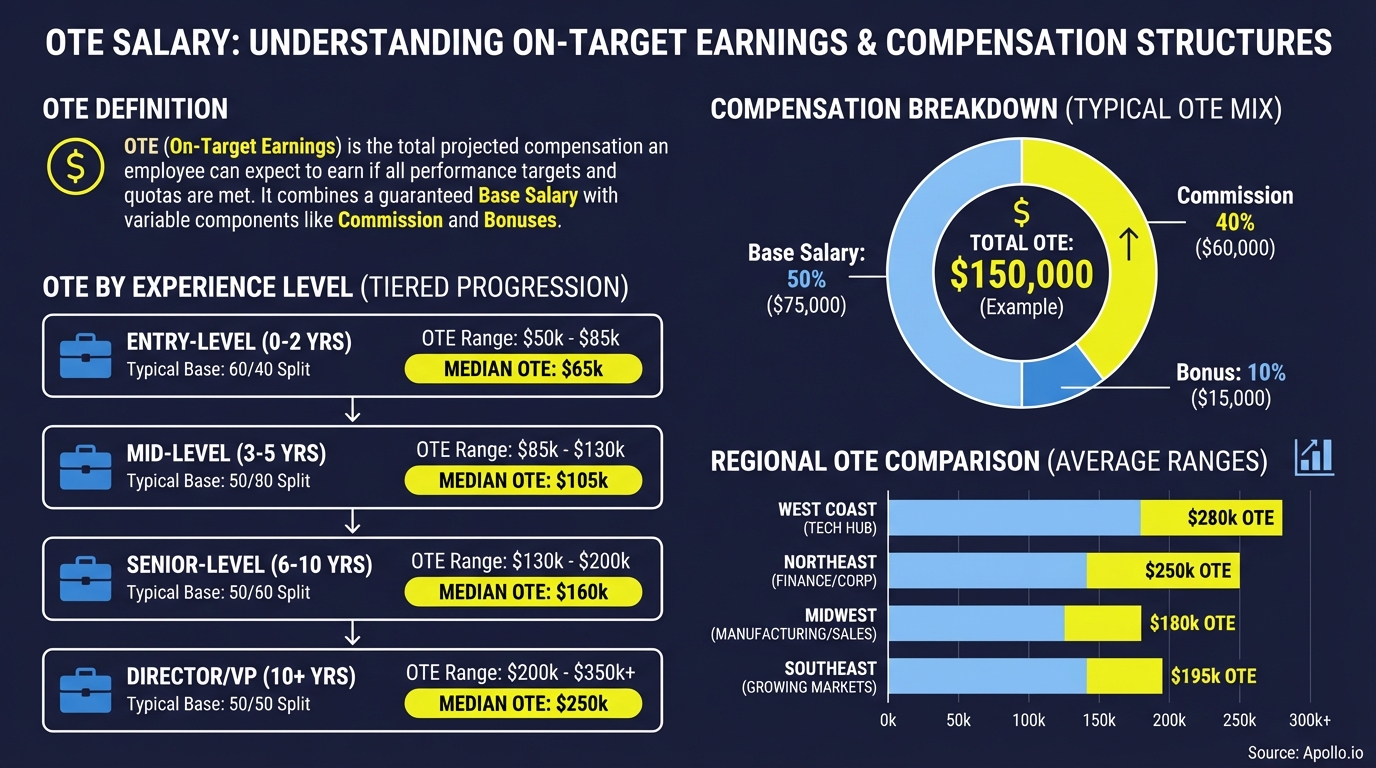
OTE salary (On-Target Earnings) is the total compensation a sales professional earns when they hit 100% of quota. It combines base salary plus variable pay like commissions and bonuses. According to CaptivateIQ, the average OTE across all sales roles was $174,000, with a median of $150,000, as of May 2025.
But here's the reality: only a fraction of reps actually reach their OTE. Understanding how OTE works—and what it means for your earning potential—is critical whether you're negotiating an offer, designing comp plans, or forecasting revenue.
OTE equals base salary plus full variable pay at 100% quota attainment
Research from Bridge Group shows median AE OTE in SaaS reached $190,000 in 2024, with a 53:47 base-to-variable split
Most reps don't hit 100% quota—realistic attainment rates shape actual take-home pay
Performance-based pay is accelerating: Everstage reports over 60% of SaaS companies now prioritize outcomes like renewals and upsells as key compensation drivers
OTE structures vary significantly by role, industry, region, and company stage
How Is OTE Calculated?
OTE combines two components: base salary (guaranteed pay) and variable compensation (commissions, bonuses, or incentives earned by hitting targets).
The split between base and variable depends on the role. Account Executives typically see a 50:50 or 60:40 split, while SDRs often have 70:30 or 80:20 splits favoring base pay. According to SaaStr, the average sales rep's OTE is generally around 20% (25% maximum) of the total revenue they close each year.
Example Calculation
An Account Executive role with $100K base and $100K variable (50:50 split) has $200K OTE. If they hit 100% of quota, they earn the full $200K.
At 80% quota attainment, they earn $100K base + $80K variable = $180K.
What Are Realistic OTE Benchmarks by Role in 2026?
OTE varies widely by sales role, seniority, and whether you're in a growth-stage startup or established enterprise. Here's what current data shows:
Role
Median OTE
Base:Variable Split
Top Performer OTE
SDR/BDR
$60K–$80K
70:30 or 80:20
$100K–$130K
Account Executive (AE)
$150K–$190K
50:50 or 53:47
$250K+
Senior AE / Enterprise AE
$200K–$250K
50:50
$350K+
Sales Engineer
$140K–$170K
80:20 or 90:10
$200K+
Customer Success Manager
$90K–$130K
80:20 or 85:15
$150K+
Sales Leader / VP Sales
$200K–$300K
60:40 or 50:50
$400K+
Top performers can significantly exceed these ranges. According to Salesso, top BDRs can earn over $130,000, while data from Harper James Capital shows top sales leaders can exceed $267,000.
"We've booked more meetings and have seen more production than ever before at Instabug. We booked 20 meetings in just the last week alone, which is way more than we used to be able to produce."
PIPELINE FORECASTING
Turn Forecast Guesswork Into Revenue Certainty
Pipeline forecasting feel like a gamble? Apollo delivers real-time deal visibility and intent signals so you can predict revenue with confidence. Built-In improved win rates 10% with Apollo's buyer intelligence.
OTE assumes 100% quota attainment, but industry data reveals a gap between target and reality. Quota attainment rates average 42.7% for Account Executives, meaning most reps earn significantly less than their stated OTE.
Common reasons for missed OTE include:
Unrealistic quotas: Quotas set without historical data or market validation
Ramp time: New reps may take 3-6 months to reach full productivity
Market conditions: Economic downturns, longer sales cycles, or budget freezes
Poor lead quality: Insufficient pipeline or low-fit prospects
Skill gaps: Inadequate training or enablement resources
When evaluating an OTE offer, ask these questions during negotiations:
1. What percentage of reps hit 100% quota last year?
If fewer than 50% hit quota, the OTE may be aspirational rather than realistic.
2. What's the base-to-variable split?
Higher base offers more income stability. A 70:30 split means you earn 70% of OTE even at zero quota attainment.
3. How is quota calculated and assigned?
Understand whether quotas are based on historical data, territory potential, or company growth targets.
4. What's the ramp period and compensation during ramp?
Many companies offer 50-100% of base during the first 3-6 months while you learn the product and build pipeline.
5. Are there accelerators or caps on commissions?
Accelerators reward overperformance (e.g., 1.5x commission rate above 100% quota). Caps limit upside, which can demotivate top performers.
6. What tools and resources support quota attainment?
Ask about CRM, sales engagement platforms, data quality, and enablement programs. For insights on modern sales tools, see our guide on enterprise sales solutions.
"Apollo allowed us to 3x our annual revenue without any decrease in efficiency."
Four diverse colleagues happily collaborate around a tablet at a modern office table.
Multi-Metric Compensation: Companies now reward behaviors beyond closed deals—pipeline generation, product adoption, customer expansion, and retention. This reflects the shift toward customer lifetime value over one-time transactions.
Outcome-Based Pay Structures: Instead of paying purely on bookings, teams earn commissions tied to renewals, upsells, net revenue retention (NRR), and account health scores. This aligns compensation with long-term business outcomes.
Transparency and Pay Equity: More companies publish OTE ranges in job postings to attract candidates and meet pay transparency laws. This reduces negotiation friction and improves candidate experience.
AI-Powered Compensation Management: Tools now automate commission calculations, provide real-time earnings visibility, and forecast payout scenarios. However, Xactly reports that 70% of companies still rely on spreadsheets for sales compensation plan design, creating accuracy and scalability challenges.
Shorter Ramp Periods with Better Enablement: Companies invest in onboarding programs, AI-powered coaching, and prospecting automation to accelerate time-to-productivity. For practical tips, explore our cold calling strategies and Apollo best practices.
How Do You Design Fair and Motivating OTE Plans?
For sales leaders and RevOps teams building compensation plans, follow these principles:
1. Benchmark Against Market Data
Use industry reports and peer data to set competitive OTE ranges. Underpaying leads to attrition; overpaying strains budgets without improving performance.
2. Align OTE with Revenue Goals
Your total sales comp budget should typically represent 8-12% of revenue. Individual OTE should reflect the revenue each rep is expected to generate.
3. Balance Risk and Reward
Higher variable pay motivates performance but increases income volatility. Adjust base-to-variable ratios based on role seniority, market predictability, and sales cycle length.
4. Test Plans Before Rollout
Model different scenarios (underperformance, target, overperformance) to ensure plans are financially sustainable and motivating across performance levels.
5. Communicate Clearly and Often
Provide reps with real-time visibility into earnings, quota progress, and commission calculations. Confusion erodes trust and motivation.
Four professionals discuss at a modern office table with laptops and notebooks.
Conclusion: OTE Is a Starting Point, Not a Guarantee
OTE salary provides a useful framework for understanding total compensation potential, but it's not a promise. Realistic earning expectations depend on quota attainment rates, ramp periods, market conditions, and the quality of leads and tools at your disposal.
Whether you're a candidate evaluating offers or a leader designing comp plans, focus on these fundamentals:
Validate OTE against actual attainment data
Understand the base-to-variable split and what it means for income stability
Ensure quotas are fair, achievable, and supported by quality pipeline
Invest in tools and enablement that accelerate productivity
Ready to accelerate your path to quota? Start Your Free Trial and discover how Apollo's all-in-one platform helps sales teams find better leads, automate outreach, and close deals faster.
ROI PROOF REQUIRED
Show Pipeline Impact In Your First 30 Days
Budget approval stuck on unclear metrics? Apollo tracks every dollar of pipeline generated from first touch. Built-In proved 10% higher win rates and 10% ACV lift. Get measurable ROI fast.