
What Does OTE Mean? On-Target Earnings Explained
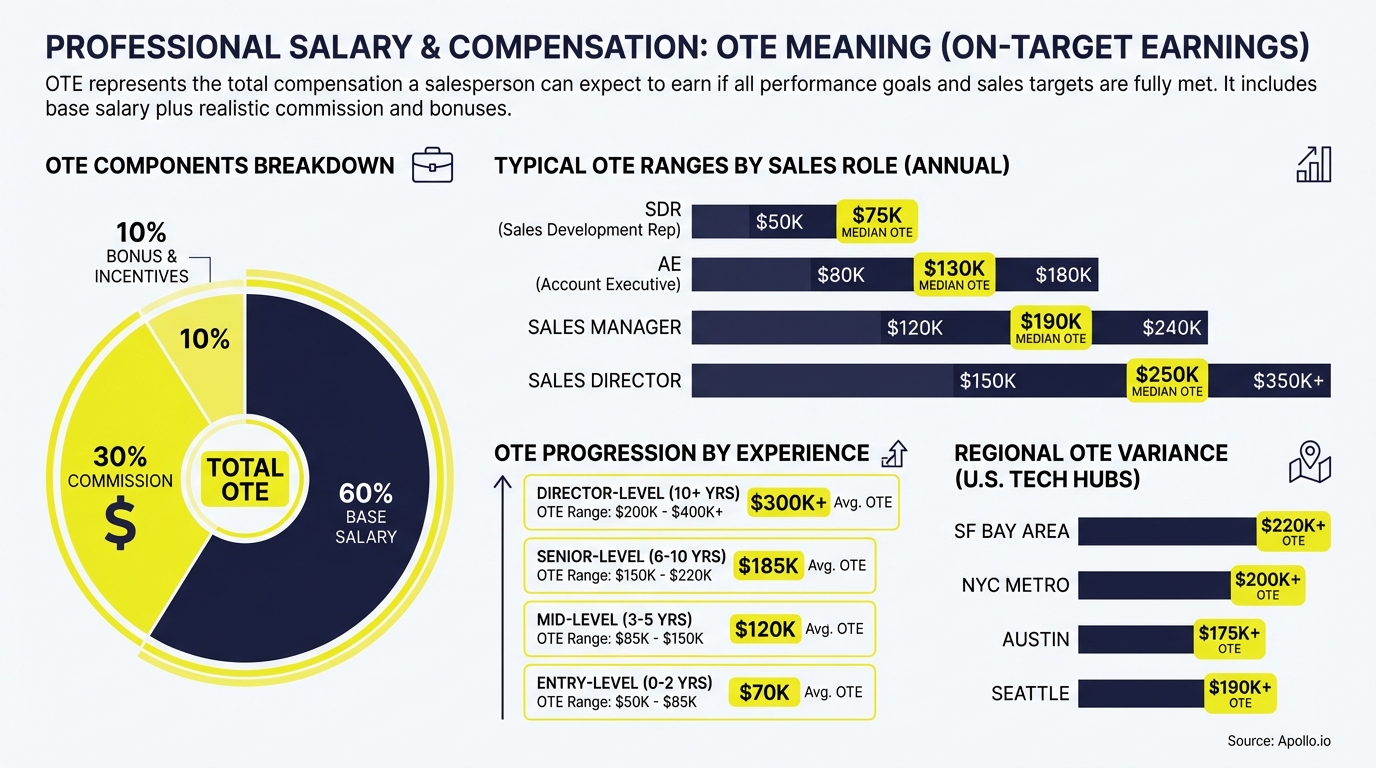
OTE stands for On-Target Earnings. It represents the total compensation a sales professional can expect when meeting 100% of their quota or performance targets. According to CaptivateIQ, this typically comprises a base salary and variable components such as commissions, bonuses, and sometimes equity.
Here's the reality check: OTE is a projection, not a guarantee. With pay transparency laws reshaping how companies advertise compensation and only a fraction of reps hitting quota, understanding what OTE actually means for your take-home pay matters more than ever.

Apollo Eliminates 4+ Hours Of Daily Research
Tired of spending 4+ hours daily hunting for contact info? Apollo delivers verified emails and mobile numbers instantly—no more data entry. Join 550K+ companies who turned research time into selling time.
Start Free with Apollo →Key Takeaways
- OTE combines base salary with variable pay (commissions, bonuses) assuming 100% quota attainment
- Common OTE splits are 50/50, 60/40, or 70/30 (base/variable) depending on role and seniority
- Pay transparency regulations now require realistic OTE ranges in job postings across multiple states
- OTE integrity depends on quota attainment rates, accelerators, caps, and ramp periods
- Evaluate OTE offers by asking about historical attainment rates and comp plan details
How OTE Works in Sales Compensation
OTE represents your total expected earnings when you hit your assigned quota. If a role advertises $120K OTE with a 60/40 split, you receive $72K base salary plus $48K in variable compensation at 100% quota attainment.
The variable portion typically includes:
- Commission: Direct percentage of closed revenue or deals
- Quota-based bonuses: Payments tied to hitting specific targets
- Accelerators: Higher commission rates above 100% quota
- SPIFs: Short-term incentives for specific products or behaviors
Salesforce notes that OTE structures vary significantly by role, with SDRs typically having higher base/variable ratios (70/30 or 80/20) compared to enterprise AEs (50/50 or 40/60).
"Apollo could be a third of the cost if you look at the full price of what we were spending on ZoomInfo, Outreach, Salesforce, and admins to make it all work."
OTE vs Reality: The Quota Attainment Gap
The biggest misconception about OTE? That most reps actually earn it. Industry data shows quota attainment remains a persistent challenge, making OTE projections optimistic for many sellers.
When evaluating an OTE offer, ask these questions:
- What percentage of reps hit 100% quota last year?
- What's the median attainment rate across the team?
- How long is the ramp period before full quota assignment?
- Are there caps on commission or accelerators above quota?
Companies with strong OTE integrity publish attainment benchmarks alongside compensation ranges. This transparency helps candidates make informed decisions rather than chasing inflated projections.
Turn Forecast Guesswork Into Revenue Certainty
Pipeline forecasting a guessing game? Apollo delivers real-time deal visibility and AI-powered insights that make your numbers predictable. Built-In increased win rates 10% with Apollo's scoring.
Start Free with Apollo →Common OTE Structures by Sales Role
| Role | Typical OTE Split | Base Focus | Variable Focus |
|---|---|---|---|
| SDR/BDR | 70/30 to 80/20 | Higher base for stability | Meeting/pipeline generation |
| Mid-Market AE | 60/40 to 50/50 | Balanced approach | Closed revenue targets |
| Enterprise AE | 50/50 to 40/60 | Lower base, higher upside | Large deal closures |
| Account Manager | 70/30 to 60/40 | Retention-focused | Expansion/renewal revenue |
Need better pipeline to hit your OTE targets? Search 224M+ verified contacts with Apollo's 65+ precision filters to build qualified lists faster.
Pay Transparency and OTE: 2026 Compliance Landscape
Massachusetts implemented pay range transparency requirements in October 2025, joining California, New York, Colorado, and other states requiring employers to disclose compensation ranges in job postings. For sales roles, this means OTE figures must reflect realistic earnings, not aspirational maximums.
These regulations are pushing companies toward clearer OTE communication:
- Explicit base/variable splits in job descriptions
- Realistic range bands (e.g., "$100K-$140K OTE" vs. "uncapped earnings")
- Disclosure of quota expectations and attainment assumptions
- Clarification of ramp periods and when full OTE becomes achievable
For candidates, this transparency provides better data for compensation negotiations. For employers, it requires tighter alignment between advertised OTE and actual team earnings.

Red Flags in OTE Offers
Watch for these warning signs when evaluating compensation plans:
- Vague "uncapped" language without specific OTE figures or quota details
- Extremely high variable ratios (e.g., 30/70 base/variable) in unproven markets
- No attainment data when you ask about team performance history
- Aggressive ramps (full quota in 30-60 days) without proper onboarding
- Commission caps that limit earnings below advertised OTE
- Clawback provisions that reclaim paid commissions on customer cancellations
Strong comp plans come with clear documentation, realistic targets, and historical proof that reps actually achieve the advertised OTE.
"Once we made the move over to Apollo, the average number of meetings booked increased by 75% and the number of call conversations [over one minute] doubled."
How to Calculate Your Expected Take-Home Pay
To estimate realistic earnings from an OTE offer:
- Start with base salary: This is guaranteed regardless of performance
- Apply realistic attainment: If 60% of reps hit quota, assume 60-80% of variable (not 100%)
- Factor in ramp: Reduce first-year expectations by 25-40% for ramp period
- Account for accelerators: Top performers may exceed OTE by 20-50%
- Consider timing: Commission payment schedules affect monthly cash flow
Example: $120K OTE (60/40 split) = $72K base + $48K variable
- Realistic Year 1 (70% attainment, 6-month ramp): $72K + ($48K × 0.70 × 0.5) = $88.8K
- Realistic Year 2 (85% attainment, full year): $72K + ($48K × 0.85) = $112.8K
- Top performer (120% attainment with accelerators): $72K + ($48K × 1.35) = $136.8K
For detailed benchmarks by role and industry, see our OTE Salary Guide.
OTE Negotiation Strategies
Leverage these tactics when discussing compensation:
Ask for comp plan documentation upfront. Review the actual plan document, not just verbal summaries. Look for quota calculations, payment schedules, and performance tiers.
Request attainment data. Companies with healthy sales cultures share this transparently. If they won't provide it, consider why.
Negotiate quota, not just OTE. A $150K OTE with $2M quota may be easier to achieve than $150K OTE with $3M quota.
Clarify accelerators and caps. Understand exactly how much you can earn above 100% and whether there are commission ceilings.
Get ramp terms in writing. Negotiate longer ramp periods (4-6 months) with reduced quota during onboarding.
Spending too much time on manual prospecting? Automate your outreach sequences with Apollo to focus on high-value activities that drive quota attainment.

The Future of OTE: Trends Reshaping Sales Compensation
Several forces are changing how companies structure and communicate OTE in 2026:
Pay compression vs. dispersion. Organizations are simultaneously addressing salary compression (narrowing gaps between tenured and new hires) while widening performance-based dispersion through accelerators. This creates a "winner-takes-more" dynamic where top performers earn significantly above OTE while average performers struggle to reach it.
Paying for certainty over volume. As sales cycles lengthen and predictability becomes prized, comp plans increasingly reward retention, expansion, and forecast accuracy rather than just new logo acquisition.
Specialization premiums. Technical sales roles, AI-focused positions, and specialized industry expertise now command higher OTE ranges as buying committees become more complex.
OTE integrity as a hiring differentiator. Companies that pair OTE figures with attainment rates in job postings are winning competitive talent battles by demonstrating transparency.
For B2B sales teams building compensation structures, these trends signal a shift toward more nuanced plans that balance base stability with meaningful performance upside.
Start Hitting Your OTE Targets
Understanding OTE is one thing. Actually achieving it requires the right tools, processes, and pipeline discipline.
Apollo consolidates your entire go-to-market tech stack into one workspace. Search 224M+ verified contacts, automate multi-channel sequences, enrich your CRM data, and track deals—all in a unified platform designed to help sales teams hit quota consistently.
Whether you're an SDR building pipeline, an AE closing enterprise deals, or a sales leader designing comp plans, Apollo provides the data and automation you need to turn OTE projections into reality.
Prove Apollo's Value In Your First Week
Budget approval stuck on unclear metrics? Apollo tracks every touchpoint from first contact to closed deal—quantify exactly how many hours saved and pipeline dollars generated. Built-In increased win rates 10% and ACV 10% with Apollo's scoring.
Start Free with Apollo →Don't miss these
Sales
Inbound vs Outbound Marketing: Which Strategy Wins?
Sales
What Is a Sales Funnel? The Non-Linear Revenue Framework for 2026
Sales
What Is a Go-to-Market Strategy? The 2026 GTM Playbook
See Apollo in action
We'd love to show how Apollo can help you sell better.
By submitting this form, you will receive information, tips, and promotions from Apollo. To learn more, see our Privacy Statement.
4.7/5 based on 9,690 reviews
