
What Is a Marketing Database? Architecture, Data Quality, and Activation in 2026
A marketing database is a centralized system that stores, organizes, and activates contact and account data to power segmentation, outreach, personalization, and revenue measurement. It is the operational foundation of every B2B go-to-market motion, from inbound and outbound marketing to lifecycle nurture and pipeline acceleration.
In 2026, the conversation has shifted from "do we have a database?" to "is our database actually usable?" According to research from Integrate.io, poor data quality costs organizations an average of $12.9 million annually. Raw volume no longer wins. Governance-ready, activation-fit records do.

Apollo Turns Research Into Pipeline Fast
Tired of burning hours verifying emails and chasing dead contact info? Apollo delivers 96% email accuracy across 224M contacts so your reps spend time selling, not searching. Join 550K+ companies building pipeline on autopilot.
Start Free with Apollo →Key Takeaways
- A marketing database stores contact and account records and powers segmentation, personalization, and attribution across channels.
- Data quality is the #1 activation blocker: 40% of B2B companies cite collecting quality data as a significant challenge.
- CDPs, CRMs, MAPs, and data warehouses each play distinct roles. Conflating them creates activation gaps.
- Privacy operations (suppression workflows, deletion propagation, consent tracking) are now a database design requirement, not an afterthought.
- Signal-based architecture is replacing static contact storage as the new organizing principle for modern marketing databases.
Marketing Database vs. CDP vs. CRM vs. Data Warehouse
These four systems are frequently confused. Each serves a distinct function in the data stack:
| System | Primary Purpose | Who Owns It | Activation Role |
|---|---|---|---|
| Marketing Database | Centralized contact/account storage for segmentation and outreach | Marketing / RevOps | Direct: feeds campaigns, sequences, and scoring |
| CRM | Relationship and pipeline tracking for sales | Sales / RevOps | Indirect: surfaces opportunity context |
| CDP | Unified customer profiles from first-party behavioral data | Marketing / Data | Identity resolution, audience building |
| Data Warehouse | Historical analytics and reporting across all systems | Data / Analytics | Indirect: powers measurement and attribution |
A marketing database is not a CDP and not a CRM. It is purpose-built for activation: turning records into targeted outreach, scored leads, and measurable pipeline. For a deeper look at how sales and marketing data interact, see the difference between sales and marketing.
Why Data Quality Is the Real Activation Blocker
Most teams believe their database is healthy. The data says otherwise.
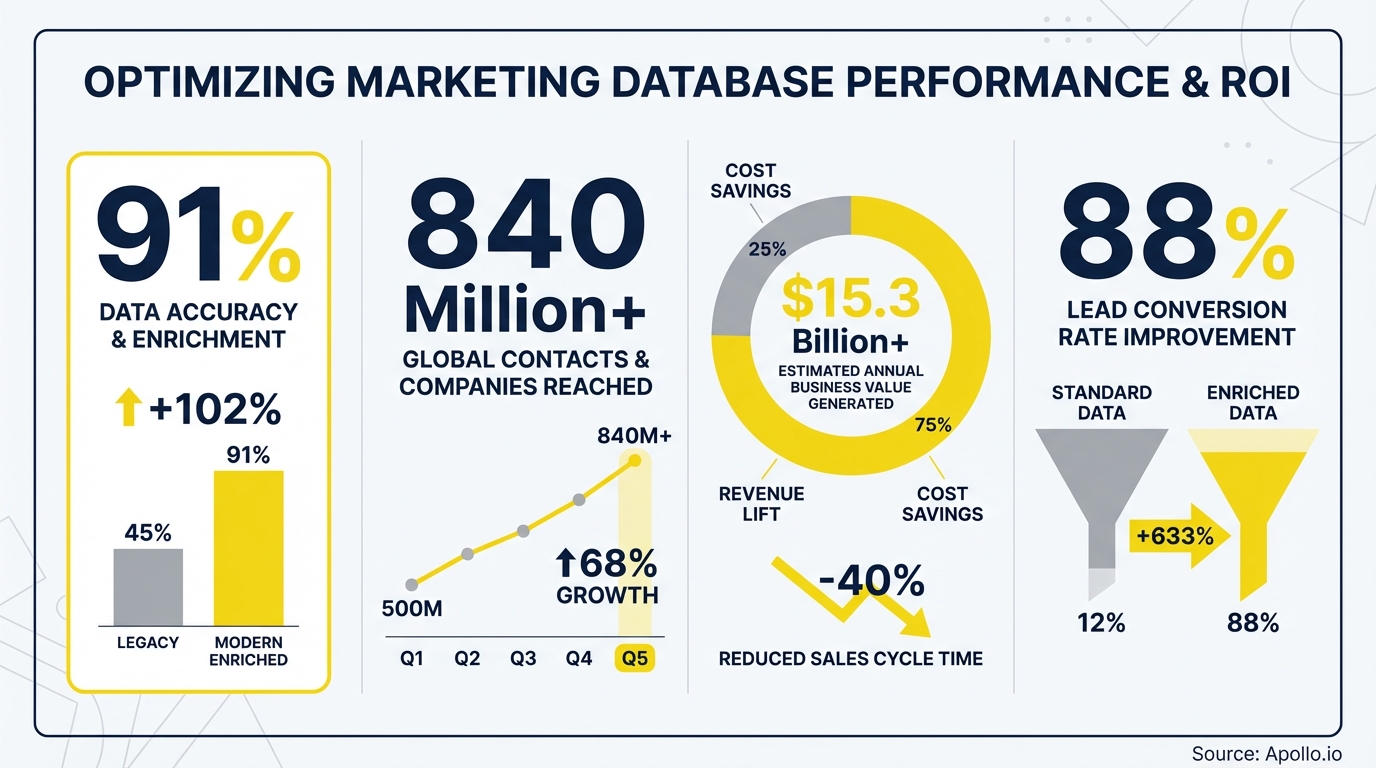
A 2025 survey of 200 CMOs found respondents estimate 45% of their data is poor quality, even while 85% say they trust it. That confidence gap is where campaigns fail silently.
The practical consequences are direct: duplicated records inflate audience size, stale contacts hurt deliverability, and missing firmographic fields break segmentation logic. Tired of dirty data dragging down your campaigns? Apollo's data enrichment keeps your records verified and continuously refreshed.
Data Quality Essentials Checklist
- Validation rules: Enforce format standards (email syntax, phone structure, domain format) at the point of entry.
- Deduplication: Run fuzzy-match deduplication on name, domain, and email fields on a defined schedule.
- Enrichment QA: After any enrichment run, audit fill rates by field and flag records with coverage below threshold.
- Freshness SLAs: Define maximum acceptable age per record type (e.g., contact title: 90 days; company headcount: 180 days).
- Data quality scorecard: Track fill rate, accuracy rate, and duplicate rate as operational KPIs reported monthly.
"Apollo enriches everything we have: contacts, leads, accounts... And we don't really have to touch it, it just works."

The Post-CDP Activation Problem (and How to Solve It)
CDP adoption is high but utilization is low. The next competitive edge is not buying another platform.
It is operationalizing what you already have through governance, identity resolution, and signal-based routing.
The shift in 2026 is from "big database" to "marketing-ready data": continuously refreshed, permissioned records with defined activation fit. Teams that treat data cleanup and standardization as a front-line growth initiative, not a back-office task, outperform those that do not.
Post-CDP Activation Roadmap
- Audit current utilization: Identify which CDP or MAP segments are actually triggering campaigns vs. sitting dormant.
- Define your identity resolution rules: Establish a primary key (email or account domain) and deterministic matching logic before any enrichment.
- Instrument signals: Add fields for intent topic, last web visit, content consumed, and ICP fit score. These replace static contact rows as the organizing principle.
- Build activation playbooks by segment: Map each audience segment to a specific sequence, scoring threshold, and routing rule.
- Establish a measurement governance framework: Define metric dictionaries, attribution approach, and audit trails before running campaigns.
According to Content Marketing Institute, 91% of B2B marketers collected first-party data in 2025, but half admitted their strategy was still in exploratory or developing stages. Adoption without operationalization creates the same activation gap as no adoption at all.
Turn Funnel Gaps Into Closed Deals
Forecasts feel like guesswork while quality leads stall at the top of your funnel. Apollo surfaces in-market buyers with precision targeting so every rep works the right pipeline right time. Join 90K paying customers forecasting with confidence.
Schedule a Demo →Privacy Operations: Now a Database Design Requirement
Privacy compliance is no longer a legal review that happens after the database is built. It must be designed into the architecture from the start.
California's DELETE Act requires data brokers to process consumer deletion requests via the DROP system at least every 45 days starting August 1, 2026, pushing B2B database operators toward auditable data lineage and suppression workflows.
Core Privacy Ops Requirements
- Consent fields: Store opt-in source, date, and channel for every contact record.
- Suppression lists: Maintain active suppression by email, domain, and account. Sync suppression changes to all connected systems within 24 hours.
- Retention schedules: Define maximum retention periods by record type and automate archival or deletion at expiry.
- Data lineage: Log the source, enrichment history, and modification timestamps for every record to support audit requests.
- Vendor governance: Require data providers to document their own lineage and deletion propagation capabilities before onboarding.
For B2B teams using permission-based email marketing, these controls are also directly tied to deliverability. Marketing databases increasingly need consent status, source tracking, and last-verified date fields to keep outbound scalable under current sender authentication requirements.
Signal-Based Architecture: The New Database Design Principle
Static contact rows are no longer sufficient. High-performing B2B teams in 2026 design their marketing database around signals: intent topic surges, content consumption, ICP fit changes, and buying-group behavior. These signals drive routing, scoring, and sequencing automatically.
Research shows marketers using intent data achieve up to 70% higher conversion rates, according to Wezeshamarketing. The operational implication: intent fields belong in the database schema, not just in a separate intent platform that nobody activates.
Key Signal Fields to Add to Your Schema
- Intent topic (current surge topic from third-party or first-party signals)
- Last engagement date and channel
- ICP fit score (refreshed on a defined schedule)
- Buying-group completeness (number of known contacts per target account)
- Stage in the B2B marketing funnel
Struggling to find and prioritize the right accounts from your database? Apollo's prospecting search uses 65+ filters to surface the exact contacts and companies that match your ICP.
"Apollo helps us turn data into action... we are living and breathing inside the tool."
Measurement Governance: Making Database-Driven Decisions Trustworthy
A marketing database is only as useful as the decisions it informs. Yet measurement credibility remains a systemic problem: 64% of B2B marketing leaders say their organization does not trust marketing measurement for decision-making (Forrester, 2024).
The fix is not better dashboards. It is governance.
Measurement Governance Framework
- Metric dictionary: Document every KPI with a precise definition, data source, calculation method, and owner. No undefined metrics in executive reporting.
- Attribution model: Choose and document a single attribution approach (first-touch, last-touch, or multi-touch) for pipeline reporting. Apply it consistently.
- Audit trails: Log all changes to scoring models, segment definitions, and attribution rules with timestamps and owner names.
- Review cadence: Conduct a quarterly data quality review tied to pipeline metrics to surface drift between database state and actual revenue outcomes.
Teams that align marketing database governance with revenue metrics are better positioned to connect B2B marketing metrics to revenue growth. See also our guide on marketing frameworks that drive revenue for how measurement fits into a broader GTM strategy.
How to Start Building a Better Marketing Database
Whether you are starting from scratch or fixing an existing database, the same principles apply: start with a clean identity resolution layer, enforce data quality at ingestion, instrument signals from day one, and build suppression and consent workflows before you scale outreach.
The global B2B data marketplace is growing rapidly, according to Landbase, which projects it will reach $3.2 billion by 2030. Investment in database quality and activation capability is not optional for teams that want to compete. For tactical execution, pair a strong database with the right B2B marketing tools and a lifecycle marketing strategy that maps database segments to every stage of the buyer journey.

Conclusion: Your Database Is Only as Good as Its Activation
A marketing database is not a storage system. It is a revenue asset.
The teams winning in 2026 are not those with the largest databases. They are the ones with the cleanest records, the clearest governance, and the tightest connection between data and action.
Apollo gives go-to-market teams a unified platform to search, enrich, and activate a database of 224M+ contacts, with built-in engagement tools so nothing gets lost between the database and the outreach. Ready to see it in action? Request a Demo and see how Apollo connects your marketing database to real pipeline.
Prove Pipeline ROI Before Next QBR
ROI pressure killing your tool budget? Apollo delivers measurable pipeline impact fast — so you walk into every budget review with numbers, not excuses. Leadium 3x'd revenue. Your turn.
Schedule a Demo →Don't miss these
Sales
Inbound vs Outbound Marketing: Which Strategy Wins?
Sales
What Is a Sales Funnel? The Non-Linear Revenue Framework for 2026
Sales
What Is a Go-to-Market Strategy? The 2026 GTM Playbook
See Apollo in action
We'd love to show how Apollo can help you sell better.
By submitting this form, you will receive information, tips, and promotions from Apollo. To learn more, see our Privacy Statement.
4.7/5 based on 9,690 reviews
