What Is Lifecycle Marketing? A B2B Strategy Guide for 2026
Lifecycle marketing is the practice of delivering targeted, stage-specific content and outreach to buyers and customers based on where they are in their relationship with your company. It spans from first awareness through purchase, retention, and expansion.
Done well, it turns one-time buyers into long-term revenue.
The stakes have never been higher. According to 6sense's 2025 B2B Buyer Experience Report, buyers are now contacting sellers earlier, with first contact shifting from 69% of the journey in 2024 to 61% in 2025. That means your lifecycle content must reach buyers before they ever speak to sales.

Apollo Turns Research Into Revenue
Tired of burning hours hunting down contact info that bounces anyway? Apollo delivers verified leads straight to your pipeline so your team sells instead of searches. Join 550K+ companies generating predictable pipeline.
Start Free with Apollo →Key Takeaways
- Lifecycle marketing covers every stage: awareness, consideration, purchase, retention, and expansion.
- B2B buyers complete most of their research before engaging sales, making early-stage content critical to shortlist formation.
- Personalization at every stage is no longer optional: 89% of marketing decision-makers consider it essential to business success.
- Most orgs are still in early maturity: lifecycle orchestration is a genuine competitive advantage right now.
- Retention is as important as acquisition. Increasing customer retention by just 5% can boost profits by 25% to 95%.
What Is Lifecycle Marketing and Why Does It Matter in 2026?
Lifecycle marketing is not a single campaign or channel. It is a coordinated system of content, outreach, and automation that speaks to buyers and customers differently depending on their stage.
The goal is to shorten time-to-purchase for new prospects and maximize revenue from existing customers through retention and expansion.
In 2026, lifecycle marketing has expanded beyond post-sale email nurtures. Revenue teams now treat it as a full-funnel revenue lever, with explicit budget and ownership across acquisition, conversion, and customer growth.
The term "revenue marketing" is increasingly used to describe this shift, reflecting how lifecycle programs are now evaluated on pipeline and revenue outcomes, not just engagement metrics.
For a deeper foundation, see lifecycle marketing strategies, stages, and best practices.
What Are the Core Lifecycle Marketing Stages?
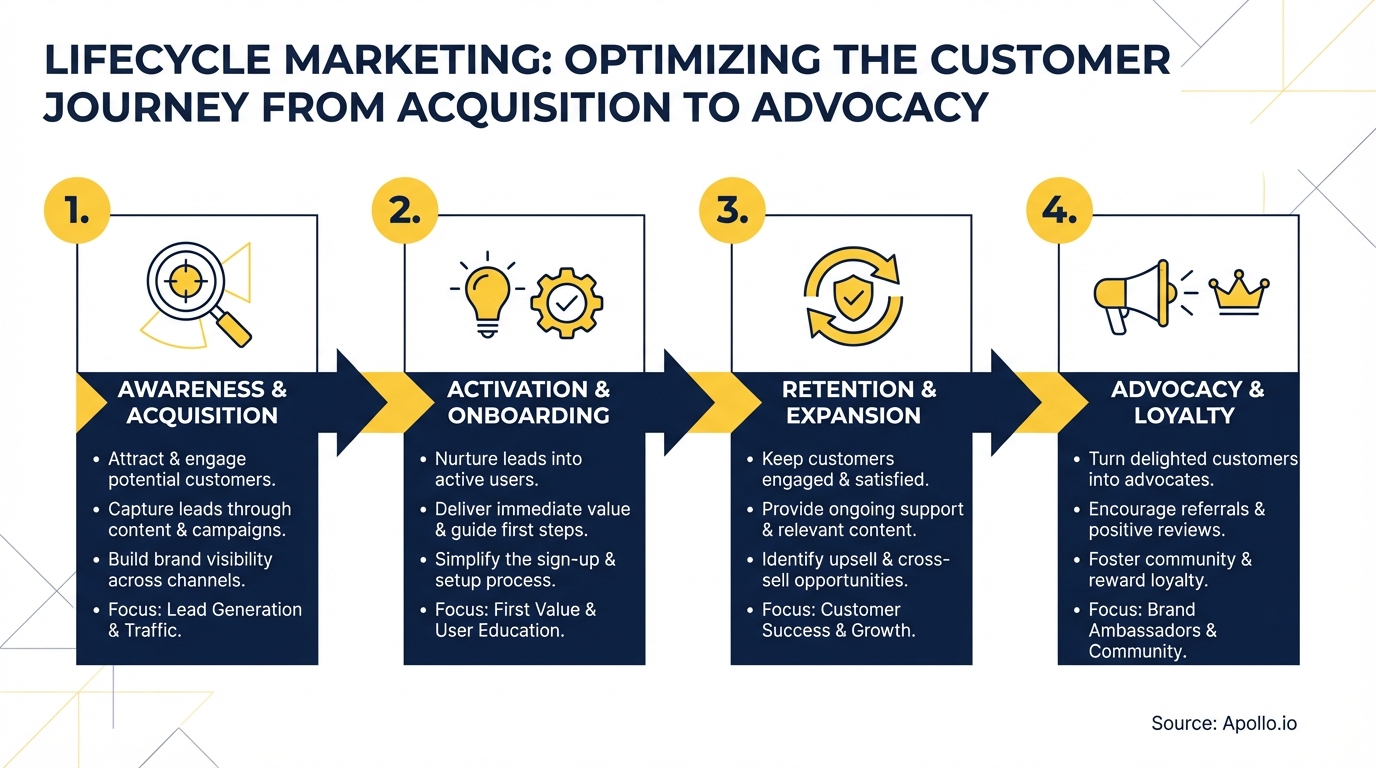
Lifecycle marketing is typically organized into five stages. Each stage requires different content, different channels, and different success metrics.
| Stage | Buyer Goal | Key Content Types | Primary Metric |
|---|---|---|---|
| Awareness | Discover the problem and potential solutions | Blog posts, thought leadership, SEO content | Organic reach, brand impressions |
| Consideration | Evaluate and shortlist vendors | Comparison guides, case studies, analyst reports | Content engagement, MQL volume |
| Purchase | Validate and finalize decision | ROI calculators, demos, peer reviews | Conversion rate, pipeline velocity |
| Retention | Realize value and renew | Onboarding sequences, usage tips, QBR decks | Churn rate, NPS, renewal rate |
| Expansion | Grow usage or add products | Upsell emails, in-app prompts, success milestones | NRR, upsell conversion rate |
Understanding how these stages connect to your B2B marketing funnel is essential for prioritizing where to invest first.
Turn Weak Leads Into Real Pipeline
Tired of watching marketing leads stall before they ever reach your pipeline? Apollo surfaces in-market buyers with intent signals so your team reaches the right prospects at exactly right moment. Over 550K companies run their pipeline on Apollo.
Start Free with Apollo →How Do You Win the Day-One Shortlist?
The most overlooked opportunity in B2B lifecycle marketing is the early-research phase, before any sales contact.
Research from SellersCommerce confirms that B2B buyers are 57% to 70% through their buying research before contacting sales.
By then, their shortlist is largely set.
Winning the Day-One shortlist requires proactive lifecycle content designed for buyers who are not yet raising their hands.
This includes:
- Role-based comparison content: Address the specific concerns of economic buyers, technical evaluators, and end users separately.
- Vendor evaluation kits: Provide requirements checklists and scoring templates buyers can use internally.
- Third-party validation: Analyst summaries, peer review links, and customer case studies that build credibility before a demo request.
- Buying-group content: Assets that help champions build internal consensus, not just information for the individual researcher.
This is where lifecycle marketing intersects directly with B2B digital marketing strategy.
The teams that build early-stage content systems gain a measurable shortlist advantage over teams still optimizing only for form fills.

What Should You Automate vs. Keep Human in Lifecycle Marketing?
Most lifecycle programs use partial automation: automated at some stages, human-assisted at others. Getting the balance right determines whether your program feels personalized or robotic.
Struggling to keep your outreach personalized at scale? Apollo's sales engagement tools let you automate sequences without sacrificing relevance, so every message fits the buyer's stage and role.
| Lifecycle Action | Automate | Keep Human |
|---|---|---|
| Initial nurture email sequence | Yes | Personalization layer for high-value accounts |
| Lead scoring and routing | Yes | Review and override for edge cases |
| Demo follow-up | Partial (day 1 email) | Custom follow-up based on conversation |
| Onboarding check-ins | Milestone triggers | CSM call at key usage drop signals |
| Renewal outreach | Early-warning alerts | Account executive-led renewal conversation |
| Upsell identification | Product usage signals | Human-led expansion conversation |
The rule of thumb: automate the trigger and the first touch, but keep humans in the loop for any conversation that requires judgment, negotiation, or relationship-building.
"These plays have completely removed the task of manually filtering and enrolling the contacts in sequences for the SDRs. It saves our reps over two hours of their workday to focus on higher-value activities."
How Does Personalization Drive Lifecycle Marketing Results?
Personalization is not a nice-to-have in lifecycle marketing. It is the mechanism that makes stage-specific content land.
Generic nurture emails get ignored. Messages that reflect a buyer's role, industry, and behavior get responses.
According to Contentful's personalization research, 89% of marketing decision-makers consider personalization essential for business success over the next three years. The pressure is on to move beyond first-name tokens and into genuine contextual relevance.
In practice, B2B personalization at scale requires clean, unified data. Product usage signals, CRM data, intent signals, and engagement history all need to feed into lifecycle triggers.
This is why the data foundation has become the primary bottleneck for lifecycle programs in 2026. Teams without reliable contact and account data cannot execute personalized lifecycle plays, regardless of how sophisticated their automation platform is.
Need clean, enriched contact data to power your lifecycle campaigns? Apollo's data enrichment keeps your records accurate and actionable, so your lifecycle triggers fire on real signals, not stale information.
"Apollo enriches everything we have: contacts, leads, accounts... And we don't really have to touch it, it just works."

What Makes Retention and Expansion a Lifecycle Priority?
Most lifecycle programs over-invest in acquisition and under-invest in the post-sale stages. This is a significant missed opportunity. According to ContentBacon, increasing customer retention by just 5% can boost profits by 25% to 95%.
Retention and expansion lifecycle content includes:
- Onboarding sequences: Milestone-based emails and in-app prompts that guide users to their first success moment.
- Health scoring alerts: Automated flags when usage drops below a threshold, triggering a human CSM outreach.
- Renewal campaigns: Content sent 90, 60, and 30 days before renewal that reinforces value and addresses risk.
- Expansion plays: Triggered by product usage signals indicating readiness for an upgrade or additional seat.
- Advocacy programs: Turning high-NPS customers into reference assets and case study contributors.
Retention lifecycle programs also serve a competitive defense function. Customers who receive regular, relevant communication from your team are harder for competitors to displace.
This is especially important in B2B, where switching costs are real but incumbent advantage erodes without active reinforcement.
For teams building out their full retention strategy, tracking the right B2B marketing metrics is essential to knowing which lifecycle stages need attention.
How Do You Measure Lifecycle Marketing Success?
Lifecycle marketing measurement should go beyond MQLs. Each stage needs its own metrics, and the program as a whole should connect to revenue outcomes.
| Stage | Primary KPI | Secondary KPI |
|---|---|---|
| Awareness | Organic traffic, branded search volume | Content engagement rate |
| Consideration | MQL volume, content downloads | Time to SQL |
| Purchase | Pipeline conversion rate | Average deal size, sales cycle length |
| Retention | Gross revenue retention (GRR) | NPS, product adoption rate |
| Expansion | Net revenue retention (NRR) | Upsell conversion rate |
Multi-touch attribution is the most accurate way to understand which lifecycle touches actually drove pipeline. Without it, teams over-credit last-touch channels and under-invest in early-stage content that influences shortlist formation. Integrating your marketing database with your CRM and engagement platform is the prerequisite for accurate attribution.
Conclusion: Build Your Lifecycle Marketing System Now
Lifecycle marketing in 2026 is a full-funnel revenue discipline. It starts before buyers contact you, runs through every conversion moment, and extends through renewal and expansion.
The teams that build systematic lifecycle programs today, while most competitors are still in early maturity, will hold a compounding advantage over time.
The priorities are clear: create content that wins the early shortlist, automate the right triggers with human oversight at critical moments, personalize based on real data, and invest as much in retention as in acquisition.
Apollo gives revenue teams the unified platform to execute lifecycle marketing end to end: verified contact data, AI-powered outreach, engagement automation, and enrichment that keeps your records current. Start free with Apollo and build a lifecycle engine that works across every stage of the buyer journey.
Prove Pipeline ROI With Apollo
Budget approval stuck on unclear metrics? Apollo gives sales teams measurable pipeline impact from day one. Leadium 3x'd their annual revenue — see your ROI before you ever commit.
Start Free with Apollo →Don't miss these
Sales
Inbound vs Outbound Marketing: Which Strategy Wins?
Sales
What Is a Sales Funnel? The Non-Linear Revenue Framework for 2026
Sales
What Is a Go-to-Market Strategy? The 2026 GTM Playbook
See Apollo in action
We'd love to show how Apollo can help you sell better.
By submitting this form, you will receive information, tips, and promotions from Apollo. To learn more, see our Privacy Statement.
4.7/5 based on 9,690 reviews
