
Lead Management Sales: How to Capture, Qualify, and Convert Prospects
Lead management sales is the systematic process of capturing, qualifying, and nurturing business contacts through your sales pipeline to close revenue. In 2026, effective lead management requires operational governance, AI-powered automation, and alignment between sales and marketing teams. Modern lead generation strategies depend on structured workflows that convert prospects into customers at scale.
According to Jifflenow, businesses with aligned sales and marketing teams are 67% more efficient at closing deals. Yet many organizations struggle with disconnected systems, unclear qualification criteria, and slow response times that cost them revenue.

Find Verified Contacts In Seconds With Apollo
Tired of spending 4+ hours daily hunting for contact info? Apollo delivers 224M+ verified contacts with 96% email accuracy. Join 550K+ companies who eliminated manual research.
Start Free with Apollo →Key Takeaways
- Speed-to-lead matters: conversion rates drop 8x after five minutes, making response SLAs critical for revenue
- Sales and marketing alignment drives 208% higher marketing revenue and faster deal cycles
- AI-powered lead management consolidates your tech stack and automates routing, enrichment, and next-best-action recommendations
- Operational governance with clear MQL/SQL definitions and auditable metrics prevents pipeline leakage
- RevOps leaders using unified platforms report measurable cost savings and team productivity gains
What Is Lead Management in Sales?
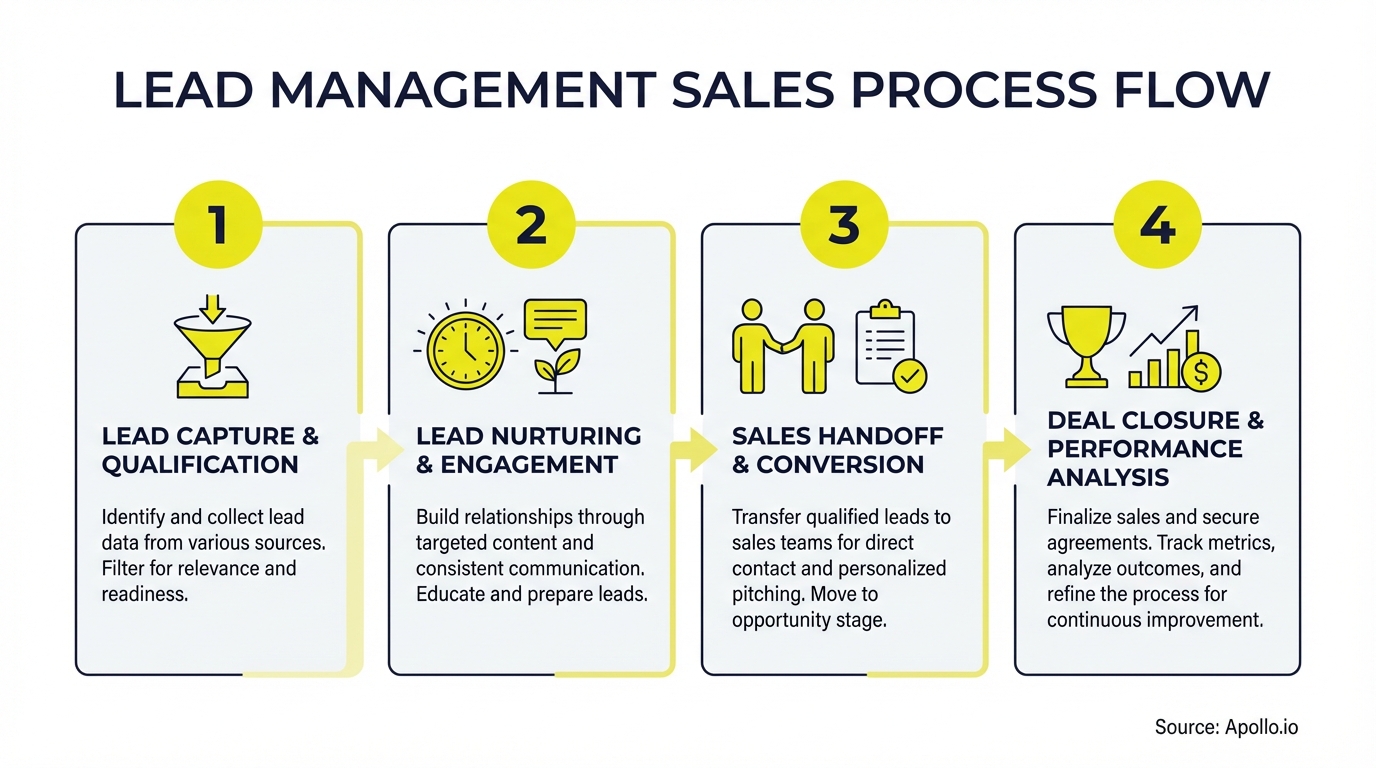
Lead management in sales is the end-to-end process of identifying potential customers, capturing their information, qualifying their fit, and guiding them through your pipeline until they convert. It connects prospecting activities with revenue outcomes through structured workflows.
The process includes five core stages:
- Capture: Collect contact details from inbound forms, outbound prospecting, events, and referrals
- Track: Log interactions, engagement signals, and behavioral data in your CRM
- Qualify: Score leads based on fit (demographics) and intent (behaviors) to prioritize high-value opportunities
- Distribute: Route qualified leads to the right sales rep based on territory, expertise, or capacity
- Nurture: Engage prospects with personalized content and outreach until they're ready to buy
For SDRs and BDRs, lead management determines which prospects to contact first and how to personalize outreach. For Account Executives, it provides context and intelligence to shorten sales cycles.
For Sales Leaders, it creates visibility into pipeline health and conversion metrics.
Why Do Sales and Marketing Teams Struggle with Lead Management?
The biggest challenge in lead management is organizational alignment. Research from Salesgenie shows that highly aligned companies grow 19% faster and are 15% more profitable, yet most teams operate with different definitions of what qualifies as a sales-ready lead.
Common friction points include:
- No shared qualification taxonomy: Marketing passes MQLs that sales rejects as unqualified, creating conflict and wasted effort
- Slow response times: Leads sit in queues for hours or days while conversion probability drops dramatically
- Fragmented tech stacks: Data lives in separate tools for enrichment, scoring, routing, and engagement, requiring manual handoffs
- Unclear ownership: Leads fall through cracks when territory rules, round-robin logic, or after-hours coverage aren't defined
- Poor data quality: Outdated contact information, duplicate records, and missing firmographic details slow down reps
According to Sopro, 91% of marketers now consider lead generation their top priority in 2025. Without operational governance and unified systems, that priority doesn't translate to closed revenue.
How Do SDRs and AEs Implement Speed-to-Lead SLAs?
Speed-to-lead is the time between when a prospect enters your system and when a sales rep makes first contact. InsideSales research analyzing 55M+ activities found conversion rates drop 8x after just five minutes, making response SLAs one of the highest-leverage improvements you can make.
Implementing speed-to-lead SLAs requires:
| Lead Segment | Response SLA | Coverage Model |
|---|---|---|
| Enterprise Inbound Demo Requests | 5 minutes | Dedicated AE, 24/7 on-call rotation |
| Mid-Market Form Fills | 15 minutes | Round-robin to SDR team, business hours |
| High-Intent Outbound Replies | 30 minutes | Original rep ownership, escalation after 1 hour |
| General Website Visitors | Same business day | Pooled lead queue, first-available assignment |
For SDRs managing high inbound volume, automated routing to the next available rep prevents bottlenecks. For AEs with named accounts, instant mobile notifications ensure they can respond even outside office hours.
RevOps leaders should build SLA dashboards that track compliance by rep, segment, and time of day to identify gaps.
Struggling to respond fast enough? Automate lead routing and instant alerts with Apollo's AI workflows.
Turn Forecast Guesswork Into Revenue Certainty
Missing quota because pipeline visibility is a black box? Apollo delivers real-time deal intelligence and automated lead scoring so you can forecast with confidence. Join 550K+ companies building predictable pipeline.
Start Free with Apollo →What Are MQL and SQL Qualification Standards?
Marketing Qualified Leads (MQLs) are prospects who meet baseline fit criteria and show engagement signals that indicate interest. Sales Qualified Leads (SQLs) are prospects who have been vetted by sales and confirmed as ready for a sales conversation.
The gap between these definitions causes massive pipeline leakage.
Effective qualification governance requires:
- Shared scoring model: Combine demographic fit (company size, industry, role) with behavioral intent (content downloads, email opens, demo requests) in one transparent rubric
- Clear pass/reject criteria: Document specific reasons a lead can be rejected (out of territory, wrong persona, no budget) and require sales to log rejection rationale
- Dispute resolution process: Create a monthly review where marketing and sales examine rejected MQLs to calibrate scoring thresholds
- Auditable handoff workflow: Track when marketing passes a lead, when sales accepts it, and outcome metrics (contacted, qualified, opportunity created)
For example, an enterprise SaaS company might define an SQL as: Director+ title at a company with 500+ employees in target industries, who requested a demo or engaged with pricing content in the past 7 days, and is not an existing customer. This removes subjectivity and creates accountability on both sides.
How Does AI Improve Lead Management Operations?
AI transforms lead management from manual workflows into intelligent automation. In 2026, 81% of sales teams use AI, and teams with AI report higher revenue growth than those without it.
The key is mapping AI capabilities to specific operational tasks.

AI-powered lead management includes:
| Task | AI Capability | Business Impact |
|---|---|---|
| Deduplication | Fuzzy matching across name, email, company variations | Prevents duplicate outreach, cleaner CRM data |
| Enrichment | Auto-append missing contact details, firmographics, technographics | Reps spend less time researching, more time selling |
| Lead Scoring | Predictive models trained on historical conversion data | Prioritize high-probability opportunities automatically |
| Routing | Intelligent assignment based on rep performance, capacity, expertise | Balanced workloads, faster speed-to-lead |
| Next-Best-Action | Recommend optimal channel, message, and timing per lead | Higher reply rates, shorter sales cycles |
Founders and CEOs implementing AI should start with data readiness: ensure your CRM has clean historical data on lead source, qualification status, and closed-won outcomes. Then pilot AI on one high-volume use case (like inbound routing) before expanding to scoring and recommendations.
Tired of juggling multiple tools for enrichment, scoring, and routing? Consolidate your tech stack with Apollo's all-in-one platform.
What Metrics Should RevOps Leaders Track?
Revenue Operations leaders need a unified dashboard that connects lead management inputs to revenue outcomes. Tracking activity metrics alone (leads captured, emails sent) misses the business impact.
Critical KPIs include:
- Speed-to-lead: Median and 90th percentile response time by segment and rep
- MQL-to-SQL conversion rate: Percentage of marketing-qualified leads accepted by sales
- SQL-to-opportunity rate: Percentage of sales-qualified leads that enter active pipeline
- Opportunity-to-close rate: Win rate by lead source and qualification stage
- Lead velocity: Month-over-month growth in qualified pipeline creation
- Cost per SQL: Total marketing + sales cost divided by SQLs generated
Best-in-class RevOps teams also track leading indicators like lead engagement score distribution, rep SLA compliance, and data completeness percentages. These predict future pipeline health before lagging metrics show problems.

A unified platform like Apollo's deal management system consolidates these metrics in one view. As one customer shared, "Having everything in one system was a game changer" (Cyera).
How Should Sales Leaders Build a Lead Management Playbook in 2026?
A lead management playbook documents your operating system: the SLAs, workflows, qualification criteria, and escalation paths that govern how leads move through your pipeline. In 2026, playbooks must account for AI-powered automation while maintaining human judgment for complex deals.
Your playbook should include:
- Segment-specific SLAs: Response time targets and routing rules by lead source, company size, and intent level
- Qualification checklists: Required fields, discovery questions, and pass/fail criteria for each pipeline stage
- Coverage models: Round-robin rules, territory assignments, after-hours protocols, and escalation triggers
- Nurture sequences: Multi-channel cadences for leads not yet sales-ready, with exit criteria to re-enter active pipeline
- AI adoption roadmap: Phased rollout plan for automated scoring, routing, and recommendations with success metrics
Sales Leaders should review playbook effectiveness quarterly, using proven nurturing strategies and conversion data to refine thresholds. Modern teams use platforms that consolidate prospecting and enrichment with engagement and pipeline tracking to reduce tool sprawl.
Start Improving Your Lead Management Today
Lead management sales is no longer just about capturing contact information. It's about building an operational system with clear SLAs, shared qualification standards, AI-powered automation, and measurable ROI. Organizations with aligned sales and marketing operations achieve 24% faster three-year revenue growth and 27% faster three-year profit growth, according to Salesgenie research.
For SDRs and BDRs, better lead management means spending time on high-probability conversations instead of manual research. For AEs, it means entering calls with complete context and intelligence.
For RevOps leaders, it means predictable pipeline creation and visibility into what's working.
Apollo consolidates your entire lead management workflow into one platform: 224M+ verified contacts, AI-powered enrichment and scoring, automated routing and sequences, and complete pipeline visibility. "We reduced the complexity of three tools into one," reports Collin Stewart from Predictable Revenue. "We cut our costs in half," adds Census.
Ready to transform your lead management process? Get Leads Now with Apollo's free trial.
Prove Apollo's ROI In Your First 30 Days
Budget approval stuck on unclear metrics? Apollo delivers measurable pipeline impact from day one—quantifiable time savings, faster deal velocity, and trackable revenue growth. Built-In increased win rates 10% and ACV 10%.
Start Free with Apollo →Don't miss these
Sales
Inbound vs Outbound Marketing: Which Strategy Wins?
Sales
What Is a Sales Funnel? The Non-Linear Revenue Framework for 2026
Sales
What Is a Go-to-Market Strategy? The 2026 GTM Playbook
See Apollo in action
We'd love to show how Apollo can help you sell better.
By submitting this form, you will receive information, tips, and promotions from Apollo. To learn more, see our Privacy Statement.
4.7/5 based on 9,690 reviews
