
What Are Lead Lists? And How to Build Ones That Actually Convert in 2026
Lead lists are structured databases of business contacts who match your ideal customer profile. In 2026, success depends on data quality, omnichannel activation, and measurement rigor—not just CSV size. According to Reach Marketing, 91% of marketers rank lead generation as their top priority, emphasizing its role in revenue growth.
This guide shows you how to build, govern, and activate lead lists that drive pipeline. You'll learn modern sourcing tactics, data quality frameworks, omnichannel playbooks, and measurement strategies that align with how B2B buyers actually engage today.

Apollo Finds Verified Contacts In Seconds
Tired of spending 4+ hours daily hunting for contact info? Apollo delivers 224M+ verified contacts with 96% email accuracy. Join 550K+ companies closing more deals.
Start Free with Apollo →Key Takeaways
- Lead lists are databases of ICP-matched contacts with verified emails, phone numbers, firmographics, and intent signals
- B2B buyers now prefer omnichannel engagement (email, phone, social, self-serve) rather than single-channel outreach
- Data quality costs companies at least $12.9M annually; governance frameworks and refresh cadences are non-negotiable
- Intent-scored, workflow-integrated lists outperform static CSVs for activation and attribution
- Modern lead lists require buying-group mapping, brand alignment, and measurement design from day one
What Are Lead Lists?
Lead lists are structured collections of business contact records enriched with firmographic, technographic, and behavioral attributes. Each record typically includes name, title, email, phone, company size, industry, tech stack, and sometimes intent signals like job changes or product research activity.
The distinction between a "contact database" and a "lead list" is actionability. A lead list is filtered, segmented, and prioritized against your ICP so sales teams can immediately activate outreach without manual research.
"Apollo enriches everything we have: contacts, leads, accounts... And we don't really have to touch it, it just works."
Modern lead lists aren't static CSVs. They're dynamic, continuously refreshed datasets integrated with your CRM, marketing automation platform, and sales engagement tools. Learn more about building lead lists that convert with the right filters and enrichment.
Why Lead List Quality Matters More Than Size
Research from Demand Gen Report shows that nearly three-quarters (75%) of B2B marketers estimate at least 10% of their lead data is inaccurate, outdated, or non-compliant. This directly impacts deliverability, conversion rates, and brand reputation.
Poor data quality manifests as bounce rates, spam complaints, wasted SDR capacity, routing errors, and compliance violations. The shift in 2026 is toward governance-first sourcing: knowing where records came from, how they're refreshed, and what audit trails exist.
| List Quality Factor | Impact on Performance | How to Measure |
|---|---|---|
| Email Accuracy | Deliverability, inbox placement, sender reputation | Bounce rate, validation score, catch-all rate |
| Phone Accuracy | Connect rate, conversation volume | Wrong number rate, voicemail rate, live answer rate |
| Firmographic Freshness | ICP match, relevance, personalization | Company size drift, industry misclassification rate |
| Intent Signal Recency | Timing, urgency, conversion likelihood | Signal age, engagement velocity, buying stage accuracy |
| Compliance Status | Legal risk, deliverability, opt-out handling | Suppression list coverage, consent documentation |
Struggling to maintain clean, up-to-date contact data? Apollo's enrichment keeps 224M+ contacts fresh with 96% email accuracy.
How to Source High-Quality Lead Lists in 2026
List sourcing has shifted from harvesting platforms to diversified, compliant methods. Here are the primary channels:
Sales Intelligence Platforms
Tools like Apollo provide verified contact databases with built-in enrichment, intent signals, and compliance frameworks. They aggregate data from public sources, partnerships, and first-party contributions, then validate and refresh records continuously.
This is the most scalable method for outbound teams.
First-Party Intent & Product-Led Signals
Website visitors, product trial users, content downloaders, and webinar attendees provide high-intent leads with implicit permission. These lists are smaller but convert better because engagement is self-selected.
Pair with reverse-IP lookup and form enrichment to build complete records.
Event & Community Sourcing
Conference attendees, community members, and partner referrals offer warm introductions and shared context. These lists require manual enrichment but yield higher reply rates and faster deal cycles due to relationship proximity.
Buying-Group Expansion
Once you're engaged with one stakeholder at a target account, map the full buying committee (economic buyer, technical evaluator, end users, procurement). Use org charts, job change alerts, and technographic signals to identify additional contacts within the same account.
This approach aligns with modern ABM and multi-stakeholder selling.
Need to build targeted lists fast? Search Apollo's 224M contacts with 65+ filters including intent, tech stack, and job changes.
Lead List Types and Use Cases
| List Type | Best For | Key Filters |
|---|---|---|
| Role-Based | Reaching specific personas (CTO, CMO, SDR Manager) | Job title, seniority, department |
| Industry-Vertical | Targeting SaaS, healthcare, finance, manufacturing | NAICS code, industry keywords, company description |
| Technographic | Replacement campaigns, integration plays, competitive displacement | Tech stack, vendor usage, implementation date |
| Intent-Triggered | Timing-based outreach during active research or evaluation | Job changes, funding events, product research signals |
| Account-Based (ABM) | Deep penetration into named target accounts | Company name, buying-group roles, account tier |
| Geography-Based | Regional expansion, local compliance, territory assignment | HQ location, office locations, regional presence |
According to BookYourData, 61% of B2B marketers state that generating high-quality leads is their biggest challenge. The solution is precise segmentation combined with continuous enrichment.
Turn Forecast Guesswork Into Revenue Certainty
Pipeline forecasting feel like a gamble? Apollo delivers real-time deal visibility and verified contact data so your forecasts actually match reality. Built-In improved win rates 10% with Apollo's intelligence.
Start Free with Apollo →Omnichannel Activation: Beyond Email Blasts
B2B buyers in 2026 expect flexibility. McKinsey's research shows the "rule of thirds" holds across buying stages: approximately one-third prefer in-person interactions, one-third remote interactions, and one-third digital self-serve.
Single-channel list activation (cold email only) misses two-thirds of buyer preferences.
Email Sequences
Still foundational, but deliverability requirements have hardened. Gmail/Yahoo authentication mandates (2024) and Microsoft DMARC enforcement (May 2025) mean verified, low-bounce lists are table stakes.
Use personalized sequences with 5-7 touchpoints over 10-14 days.
Phone & Dialer
Direct dial mobile numbers enable real-time conversations. Connect rates improve when calls are timed around email engagement (opened but no reply) and paired with personalized voicemail drops.
"My favorite, favorite part about Apollo is when someone asks me, 'What's your connection rate?' and I can consistently say, over the last seven months, it's at 36%."
Social Selling
Professional networks and social outreach complement email and phone. Use social engagement (comments, connection requests, InMails) as relationship-building touches rather than pitch channels.
This works especially well for executive buyers who ignore cold emails.
Digital Self-Serve & Content
McKinsey reports that 35% of B2B decision makers would spend $500,000+ through remote/self-serve channels. Create personalized landing pages, interactive ROI calculators, and on-demand demos targeted to list segments.
Track engagement to identify high-intent prospects for SDR follow-up.
Explore outbound prospecting strategies that integrate email, phone, and multi-touch engagement.
Data Quality Governance Framework
Governance prevents list decay and ensures compliance. Here's a practical framework:
Refresh Cadence
Establish SLAs for data freshness. Contact records should be re-verified every 60-90 days.
Firmographics (company size, revenue, employee count) should refresh quarterly. Intent signals and job changes require real-time or daily updates.
Validation & QA Process
Run email validation on all new records before activation. Use syntax checks, domain verification, and catch-all detection.
For phone numbers, validate format and carrier type. Implement spot-check QA on random samples to catch systemic issues.
Suppression & Compliance
Maintain global suppression lists for unsubscribes, bounces, spam complaints, and regulatory opt-outs. Sync suppression lists across all systems (CRM, marketing automation, sales engagement) to prevent re-contact violations.
Attribution & Measurement
Tag list sources, acquisition dates, and enrichment vendors in your CRM. Track list-to-opportunity conversion rates, cost-per-lead, and pipeline contribution by source.
Use holdout tests to measure incremental lift from new list segments or enrichment layers.
Learn how to implement data-driven prospecting strategies with measurement built in from the start.

Buying-Group Mapping and Multi-Stakeholder Lists
Modern B2B purchases involve 6-10 stakeholders on average. Single-contact lists miss the buying committee. Build buying-group maps that include:
- Economic Buyer: Budget authority, final decision maker
- Technical Evaluator: Assesses product fit, integration, and security
- End Users: Day-to-day product users who influence adoption
- Procurement/Legal: Contract negotiation, compliance review
- Executive Sponsor: Strategic alignment, internal champion
Use org charts, seniority filters, and department tags to identify these roles within each target account. Coordinate messaging so each stakeholder receives content relevant to their concerns (ROI for economic buyers, implementation for technical evaluators, ease-of-use for end users).
Intent Data Integration Across the Lifecycle
Intent signals (job changes, funding announcements, tech installations, content consumption) improve targeting and timing. But most teams only use intent for initial list building.
The opportunity is lifecycle integration:
- Prospecting: Prioritize accounts showing research-stage intent signals
- Engagement: Trigger follow-up sequences when contacts revisit your website or pricing page
- Qualification: Score leads higher when intent signals indicate active evaluation
- Negotiation: Alert sales when competitors are mentioned in intent data
- Renewal/Expansion: Monitor usage signals and job changes within existing accounts
Intent-scored lists consistently outperform static segmentation because timing matters as much as fit. Check out four ways to build better B2B lists using intent and enrichment layers.
Brand Alignment: Why Lists Need Trust-Building Content
Forrester research shows that 41% of B2B buyers begin their journey with a single preferred vendor already in mind. This means lead-list outreach competes against established brand preferences.
List activation must include brand-building assets:
- Case studies and customer proof points relevant to the prospect's industry
- Thought leadership content that establishes category expertise
- Trust signals (certifications, security documentation, third-party validation)
- Social proof (reviews, analyst recognition, customer testimonials)
Don't treat lists as purely transactional. Use them to distribute brand-reinforcing content that shapes buyer perception before the first sales conversation.
Measuring Lead List ROI and Attribution
Forrester reports that 64% of B2B marketing leaders don't trust their organization's marketing measurement for decision-making. To build measurement trust, implement these practices:
Source-Level Attribution
Tag every lead with acquisition source, list vendor, enrichment date, and initial campaign. Track these attributes through the entire funnel (MQL, SQL, opportunity, closed-won) to calculate cost-per-opportunity and ROI by source.
Holdout Testing
Run A/B tests with control groups. Example: activate 80% of a new list segment, hold back 20%, and measure incremental pipeline contribution. This isolates list impact from other growth drivers.
Engagement Velocity Metrics
Track time-to-first-reply, time-to-meeting-booked, and time-to-opportunity by list type. Faster velocity indicates better targeting and message-market fit.
Data Quality Dashboards
Monitor bounce rate, wrong-number rate, unsubscribe rate, and spam complaint rate by list source. Set thresholds (e.g., <2% email bounce rate) and pause low-quality sources.
Discover lead generation best practices that include measurement and attribution from the start.
Compliance and Privacy Governance
Data governance isn't just a legal checkbox. It protects deliverability, brand reputation, and customer trust. Key requirements:
- GDPR Compliance: Document lawful basis for processing (legitimate interest for B2B), honor opt-outs within 30 days, maintain data processing records
- CCPA/CPRA: Provide opt-out mechanisms for California contacts, disclose data sale/sharing practices
- CAN-SPAM: Include physical address and unsubscribe link in all emails, honor opt-outs within 10 business days
- TCPA (Phone): Avoid autodialed calls to mobile numbers without prior consent, maintain internal do-not-call lists
Vendor due diligence matters. Ask list providers: Where does data originate?
How is it refreshed? What audit trails exist?
What compliance certifications do they hold? Platforms increasingly face scrutiny over data sourcing practices, so transparent, compliant vendors are critical.

Apollo's Unified Approach to Lead Lists
Apollo consolidates list building, enrichment, engagement, and measurement in one workspace. Teams access 224M+ verified contacts with 65+ filters, then activate via multichannel sequences without switching tools.
This eliminates data silos, reduces tech stack costs, and accelerates time-to-pipeline.
Key capabilities include real-time enrichment, intent signals, job change alerts, buying-group mapping, email/phone/social sequences, engagement tracking, and native CRM sync. The platform handles data governance, validation, and refresh automatically.
Learn more about Apollo's sales intelligence and lead database for B2B prospecting.
Conclusion: Build Lead Lists That Drive Revenue
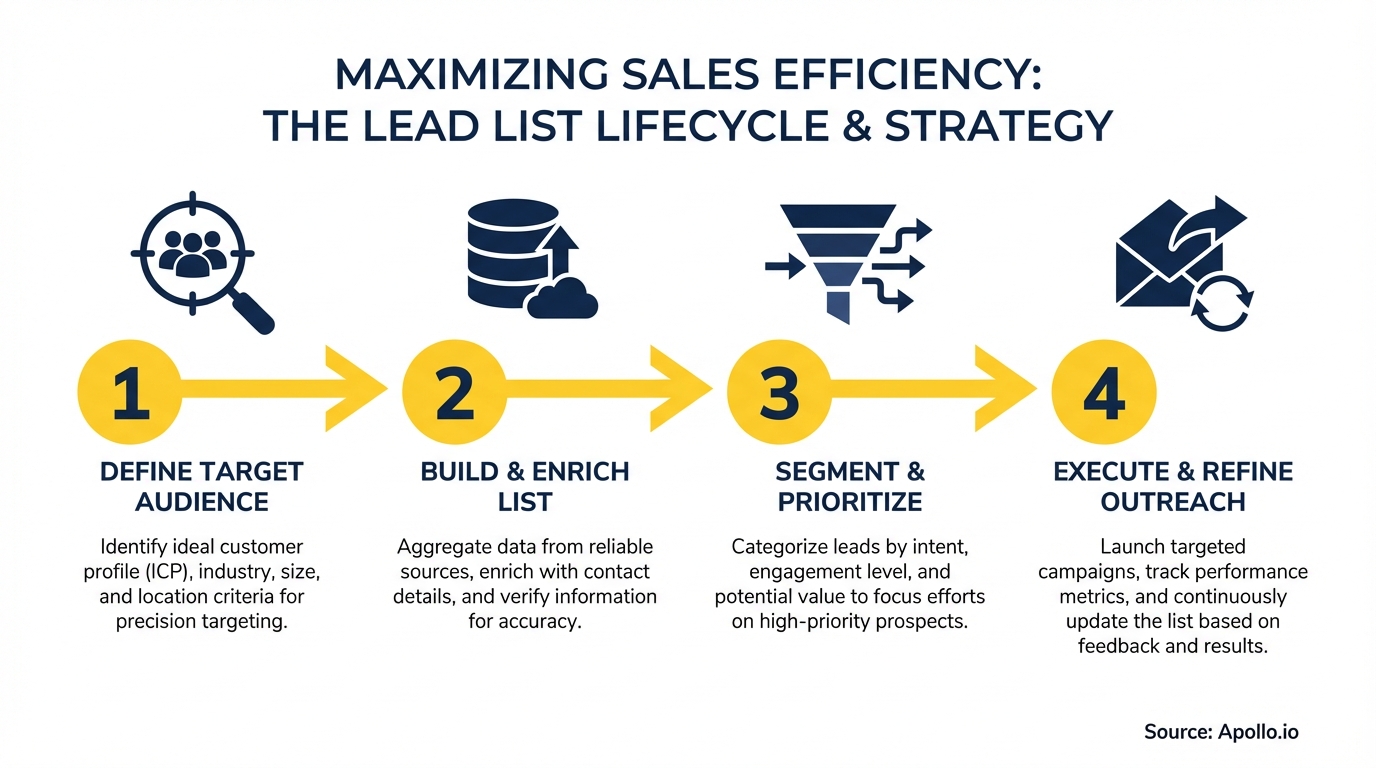
Lead lists remain essential for B2B growth, but success in 2026 requires modern practices: omnichannel activation, data quality governance, buying-group mapping, intent integration, brand alignment, and rigorous measurement. The shift is from static CSVs to dynamic, continuously enriched datasets that feed orchestrated campaigns across every channel buyers prefer.
Start with ICP clarity, source from compliant vendors, implement governance frameworks, activate across email/phone/social/self-serve, measure attribution rigorously, and iterate based on data. Teams that treat lead lists as strategic assets (not commodities) consistently outperform on pipeline generation and conversion rates.
Ready to build smarter lead lists? Request a Demo to see how Apollo's unified platform transforms prospecting, engagement, and revenue execution.
Prove ROI In Days, Not Quarters With Apollo
Budget approval stuck on unclear metrics? Apollo delivers measurable pipeline impact from day one—track every touchpoint to closed deal. Built-In increased win rates 10% and ACV 10% with Apollo's intelligence.
Start Free with Apollo →Don't miss these
Sales
Inbound vs Outbound Marketing: Which Strategy Wins?
Sales
What Is a Sales Funnel? The Non-Linear Revenue Framework for 2026
Sales
What Is a Go-to-Market Strategy? The 2026 GTM Playbook
See Apollo in action
We'd love to show how Apollo can help you sell better.
By submitting this form, you will receive information, tips, and promotions from Apollo. To learn more, see our Privacy Statement.
4.7/5 based on 9,690 reviews
