How to Build a Lead Generation Sales Funnel That Converts
Modern B2B buyers complete nearly 70% of their purchasing journey before engaging with sales, fundamentally reshaping how revenue teams approach lead generation. Your funnel must now capture attention, educate prospects, and build trust long before the first conversation. In 2026, successful funnels combine verified data, AI-powered automation, and multi-channel sequences to guide buyers from discovery to closed deals.

Apollo Finds Contacts While You Close Deals
Tired of spending 4+ hours daily hunting for contact info? Apollo delivers 224M verified contacts with 96% email accuracy. Join 550K+ companies who stopped researching and started selling.
Start Free with Apollo →Key Takeaways
- B2B buyers use 10+ touchpoints before converting, requiring coordinated omnichannel sequences
- Pre-contact content and buyer enablement assets now drive 70% of the purchase decision
- AI agents are automating qualification and outreach, changing how SDRs prioritize pipeline work
- Measurement governance separates winning teams from those stuck with unreliable attribution
- Video content and hybrid human interaction create higher engagement than text-only approaches
What Is a Lead Generation Sales Funnel?
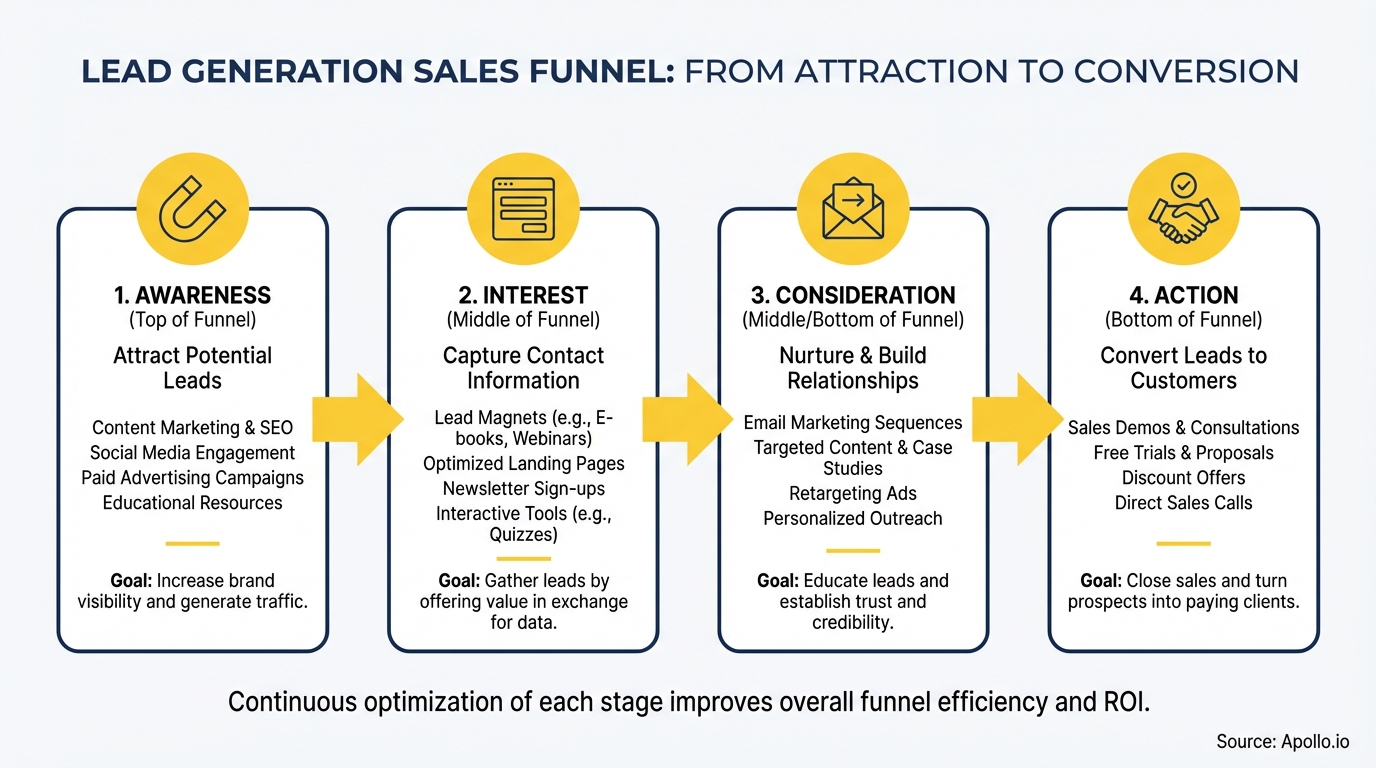
A lead generation sales funnel is a structured framework that moves prospects from initial awareness through evaluation and purchase decision. It maps every touchpoint where buyers interact with your brand, content, and sales team.
The funnel visualizes conversion rates at each stage, helping teams identify bottlenecks and optimize for revenue growth.
In 2026, effective funnels operate across multiple channels simultaneously. Research by McKinsey shows B2B buyers use an average of 10 interaction channels across the buying journey, with 42% using more than 11 touchpoints. Your funnel must coordinate website visits, email sequences, video prospecting, social outreach, and direct calls into one cohesive experience.
Traditional funnel stages (TOFU, MOFU, BOFU) remain relevant, but the buyer journey is no longer linear. Prospects jump between stages, re-engage after months of silence, and research competitors in parallel. Struggling to track these complex buyer journeys? Apollo's pipeline management consolidates prospect activity across channels so RevOps teams maintain visibility without juggling separate tools.
How Do SDRs Build Effective Lead Generation Funnels?
SDRs building effective funnels start with verified contact data and clear ideal customer profiles. They segment prospects by firmographics, intent signals, and engagement history to personalize outreach. Data-driven prospecting replaces spray-and-pray tactics with targeted sequences that address specific buyer pain points.

The pre-contact phase now demands as much attention as active outreach. According to 6sense's 2024 Buyer Experience Report, buyers are nearly 70% through their purchasing process before engaging sellers. SDRs must create educational content, comparison guides, and ROI calculators that prospects discover during anonymous research.
Multi-channel sequences are non-negotiable in 2026. Top-performing SDRs combine email, phone, social outreach, and direct mail into coordinated campaigns. They use AI to optimize send times, personalize messaging at scale, and prioritize accounts showing buying intent. Spending hours on manual outreach? Apollo's engagement platform automates multi-channel sequences while maintaining personalization, helping SDRs book more meetings without increasing headcount.
What Are the Stages of a B2B Lead Generation Funnel?
| Stage | Buyer Activity | Content Types | Conversion Goal |
|---|---|---|---|
| Awareness (TOFU) | Problem recognition, research, education | Blog posts, videos, webinars, social content | Website visit, content download |
| Consideration (MOFU) | Solution evaluation, vendor comparison | Case studies, product demos, comparison guides | Demo request, trial signup |
| Decision (BOFU) | Vendor selection, negotiation, approval | ROI calculators, security docs, references | Proposal acceptance, contract signature |
| Retention | Onboarding, expansion, renewal | Training materials, upsell offers, success stories | Renewal, expansion deal, referral |
Each stage requires different content formats and sales motions. Awareness content educates without selling.
Consideration assets demonstrate differentiation and build trust. Decision-stage resources remove final objections and enable internal champions to secure approval from stakeholders.
Data from Content Marketing Institute's 2025 report shows video is rated the most effective content type by 58% of B2B marketers. Account Executives managing complex deals use video to deliver personalized demos, address objections, and maintain momentum between formal meetings.
Turn Forecasting Guesswork Into Revenue Certainty
Missing in-market buyers while your pipeline sits in the dark? Apollo reveals which prospects are ready to buy right now with real-time intent signals. Built-In increased win rates 10% using Apollo's buyer intelligence.
Start Free with Apollo →Why Is Measurement Governance Critical for Funnel Success?
Measurement governance establishes consistent definitions, data quality standards, and attribution models across your revenue organization. Without it, marketing and sales operate with conflicting pipeline numbers, making optimization impossible. Forrester research reveals 64% of B2B marketing leaders don't trust their organization's marketing measurement for decision-making.
Strong governance starts with clear stage definitions. What qualifies as an MQL versus SQL?
When does a lead become an opportunity? RevOps leaders document these criteria, implement validation rules in CRM, and audit data quality monthly.
They establish attribution frameworks that credit touchpoints appropriately without over-weighting first or last touch.
Experimentation protocols separate high-performing teams from those stuck guessing. Define hypothesis, success metrics, sample size, and test duration before launching campaigns.
Track control groups, measure statistical significance, and document learnings in a central repository. Sales Leaders managing teams use these insights to coach reps on which tactics drive meetings and which waste time.
How Do AI Agents Change Lead Generation Funnels in 2026?
AI agents now handle qualification, research, and initial outreach tasks that previously consumed SDR capacity. Microsoft's Sales Agent (launched March 2025) autonomously researches leads, initiates contact, and schedules meetings.
This shifts SDR focus from volume activities to high-value conversations with qualified prospects who've already engaged with AI-driven touchpoints.
The hybrid model combines AI efficiency with human relationship-building. AI agents manage top-of-funnel touchpoints, score leads based on engagement signals, and route hot prospects to human reps.
SDRs take over when personalization and consultative selling create more value than automated sequences. Gartner predicts that by 2030, 75% of B2B buyers will prefer sales experiences prioritizing human interaction over AI.
Founders and CEOs building outbound motions benefit from AI's ability to test messaging at scale. Run parallel campaigns with different value propositions, pain points, and CTAs.
AI identifies winning patterns faster than manual testing, helping growing teams optimize before scaling headcount. The key is maintaining data quality so AI agents work from accurate contact information and firmographic intelligence.
What Buyer Enablement Assets Accelerate Funnel Velocity?
- ROI Calculators: Interactive tools showing cost savings and revenue impact with buyer-specific inputs
- Comparison Matrices: Side-by-side feature and pricing comparisons addressing common vendor evaluations
- Requirements Checklists: Downloadable guides helping buyers document needs and evaluate vendors systematically
- Security & Compliance Packs: Pre-built documentation answering InfoSec and legal questions before they're asked
- Implementation Timelines: Realistic project plans showing what happens after contract signature
These assets serve buyers during the 70% of the journey that happens before sales engagement. They establish authority, remove friction, and position your solution as the informed choice.
Account Executives managing enterprise deals use these resources to equip internal champions who must sell your solution to procurement, IT, and executive stakeholders.

The most effective enablement assets are discoverable through search and gated strategically. Make comparison guides and checklists available without forms to maximize reach.
Gate detailed ROI models and security documentation to capture contact information from high-intent prospects. Track which assets correlate with faster deal cycles and higher close rates.
How to Build a Lead Generation Funnel That Converts in 2026
Start by mapping your buyer's actual journey with real behavioral data. Interview recent customers about their research process, content consumption, and decision criteria. Identify gaps where prospects struggle to find information or fall out of your funnel. Use sales intelligence to understand which companies are researching your category before they raise their hand.
Build omnichannel sequences that coordinate touchpoints across email, phone, social, and events. Create content for each stage addressing specific questions buyers ask at that point in their journey.
Implement lead scoring that weighs engagement signals, firmographic fit, and intent data to prioritize follow-up. "We reduced the complexity of three tools into one," says Collin Stewart from Predictable Revenue about consolidating their sales tech stack.
Establish measurement standards and review funnel metrics weekly. Track stage conversion rates, velocity, and leading indicators of pipeline health.
Run regular experiments testing new channels, messaging, and content formats. Document what works and scale winning tactics across your team. "Having everything in one system was a game changer," notes the team at Cyera about unifying prospect data and activity tracking.
Start Building Your Lead Generation Funnel Today
The B2B buying journey has fundamentally changed. Buyers complete most research independently, use numerous touchpoints across channels, and form vendor preferences before engaging sales.
Your funnel must adapt with pre-contact content, buyer enablement assets, AI-powered automation, and measurement governance that drives optimization.
Teams at every stage can build effective funnels by starting with verified data, creating stage-appropriate content, and coordinating touchpoints into cohesive sequences. The key is maintaining visibility across channels while testing and refining based on actual buyer behavior. "We cut our costs in half," reports the Census team about consolidating their GTM platform.
Ready to build a funnel that converts? Request a Demo to see how Apollo consolidates prospecting, engagement, and pipeline management into one workspace trusted by 90K paying customers.
Prove Apollo's ROI In Your First 30 Days
Budget approval stuck on unclear metrics? Apollo tracks every touchpoint from first contact to closed deal. Built-In increased win rates 10% and ACV 10% with measurable pipeline impact.
Start Free with Apollo →Don't miss these
Sales
Inbound vs Outbound Marketing: Which Strategy Wins?
Sales
What Is a Sales Funnel? The Non-Linear Revenue Framework for 2026
Sales
What Is a Go-to-Market Strategy? The 2026 GTM Playbook
See Apollo in action
We'd love to show how Apollo can help you sell better.
By submitting this form, you will receive information, tips, and promotions from Apollo. To learn more, see our Privacy Statement.
4.7/5 based on 9,690 reviews
