
Inside Sales vs Outside Sales: Which Strategy Drives Better Results?
The debate between inside sales and outside sales is reshaping how B2B teams operate in 2026. With Gartner reporting that 80% of B2B sales interactions now occur in digital channels, sales leaders face a critical decision: invest in remote-first teams or maintain field presence. The answer lies in understanding how each model drives revenue, where inside sales teams can cover four times the prospects at half the cost compared to traditional field reps.

Apollo Cuts Research Time From Hours To Seconds
Tired of spending 4+ hours daily hunting for contact info? Apollo delivers 224M verified contacts with 96% email accuracy instantly. Join 550K+ companies who eliminated manual research.
Start Free with Apollo →Key Takeaways
- Inside sales reps reach 4x more prospects at 50% the cost of field sales teams
- Hybrid sales models now dominate, with 85% of companies adopting blended approaches by 2026
- AI-powered platforms help inside sales teams automate outreach while maintaining personalization
- Deal size and complexity determine whether inside, outside, or hybrid models work best
- Tool consolidation cuts costs significantly when moving from multiple platforms to unified systems
What Is Inside Sales vs Outside Sales?
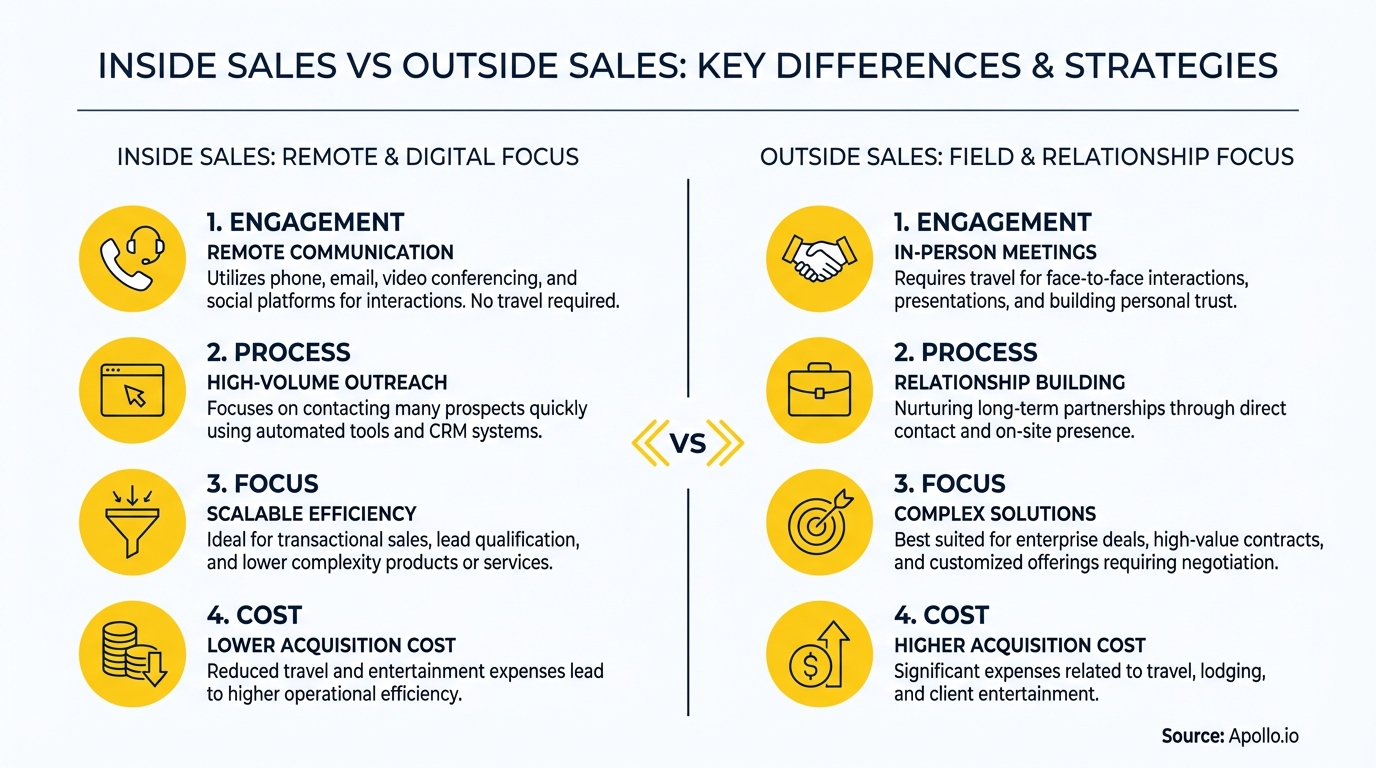
Inside sales is a remote selling model where reps engage prospects through phone, email, video, and digital channels without in-person meetings. Outside sales involves field representatives who travel to meet prospects face-to-face, building relationships through physical presence.
The distinction centers on location and methodology. Inside sales teams operate from offices or home setups, using AI sales tools and automation to scale outreach. Outside sales reps work in the field, managing territories and conducting site visits. Research by McKinsey shows inside sales representatives can cover four times the prospects at 50% of the cost compared to traditional field representatives.
How Do Inside Sales Teams Operate in 2026?
Inside sales teams use technology platforms to manage prospect relationships entirely through digital channels. They rely on CRM systems, sales engagement platforms, and data enrichment tools to identify, reach, and convert leads without leaving their workspace.

SDRs and BDRs typically handle prospecting and qualification, while Account Executives close deals via video calls and online demos. The process involves:
- Searching contact databases to build targeted prospect lists
- Running automated email and LinkedIn sequences
- Conducting discovery calls and product demonstrations remotely
- Managing pipeline through deal management software
- Analyzing conversation data to refine messaging
Struggling to find qualified leads across multiple tools? Search Apollo's 224M+ contacts with 65+ filters in one unified platform.

How Does Outside Sales Work Today?
Outside sales reps build relationships through in-person meetings, site visits, and face-to-face presentations. They manage geographic territories, attend industry events, and conduct on-site product demonstrations for high-value accounts.
This model works best for complex, high-ticket deals requiring executive access and technical evaluations. Outside sales reps spend 60-70% of their time traveling, meeting prospects at their locations, and building trust through physical presence. They handle enterprise accounts where deal cycles span months and multiple stakeholders require in-person attention.
Turn Forecast Guesswork Into Revenue Certainty
Missing deals because you can't see who's actually ready to buy? Apollo's intent signals and real-time tracking reveal in-market prospects before competitors reach them. Built-In increased win rates 10% with Apollo's scoring.
Start Free with Apollo →What Are the Key Differences Between Inside and Outside Sales?
The core differences span cost structure, reach, sales cycle length, and deal complexity. Inside sales prioritizes volume and efficiency, while outside sales focuses on relationship depth and deal size.
| Factor | Inside Sales | Outside Sales |
|---|---|---|
| Cost per Rep | $50K-$80K annual investment | $100K-$150K+ with travel expenses |
| Prospect Coverage | 100-150 prospects monthly | 25-40 prospects monthly |
| Average Deal Size | $5K-$50K | $50K-$500K+ |
| Sales Cycle | 30-90 days | 90-180+ days |
| Primary Channels | Phone, email, video, social | In-person meetings, events, site visits |
| Territory Coverage | National or global | Regional or local |
For Sales Leaders managing teams, the cost differential matters significantly. Inside sales reps generate higher activity volumes with lower overhead, making them ideal for mid-market segments.
Outside sales reps command higher salaries but close larger deals that justify the investment.
How Do SDRs Choose Between Inside and Outside Sales Approaches?
SDRs typically work within inside sales models because prospecting requires high-volume outreach that scales better through digital channels. The choice depends on target account complexity, deal size, and buyer preferences.
Most SDRs focus on inside sales tactics because they can reach more prospects daily through multi-channel sequences and automated workflows. They book meetings for AEs who may use outside sales approaches for high-value accounts. Data from Gartner shows 61% of B2B buyers prefer a rep-free buying experience, reinforcing the shift toward inside sales models that provide information without pressure.
When Should You Use Inside Sales?
- Deal sizes under $50K where travel costs exceed margins
- Mid-market segments with standardized buying processes
- Products requiring demos but not on-site evaluations
- Geographic territories too large for consistent field coverage
- Fast-moving sales cycles under 90 days
When Should You Use Outside Sales?
- Enterprise deals over $100K requiring executive sponsorship
- Complex solutions needing on-site technical assessments
- Industries where relationships drive purchasing decisions
- Products requiring physical demonstrations or installations
- Accounts with multiple decision-makers across locations
Why Are Hybrid Sales Models Becoming the Default in 2026?
Hybrid sales combines inside and outside approaches, with reps using digital channels for prospecting and qualification while meeting key stakeholders in person for critical deal stages. This model delivers the efficiency of inside sales with the relationship-building power of outside sales.
According to McKinsey, 85% of companies expect hybrid sales to be the most common role within three years. Companies implementing omnichannel strategies achieve EBIT growth of 13.5%, compared to 1.8% for less digitally enabled peers. RevOps leaders find hybrid models reduce costs while maintaining deal quality.
The shift reflects changing buyer preferences and economic pressure. Buyers want self-service research combined with expert consultation at decision points.
Sales teams need cost-effective prospecting with strategic in-person engagement for deal closure.
How Can Sales Teams Build Effective Hybrid Models?
Start by mapping your sales process to identify which stages benefit from digital efficiency versus in-person engagement. Assign inside sales tactics to prospecting, qualification, and initial demos.
Reserve outside sales approaches for finalist presentations, contract negotiations, and executive meetings.
Implement these steps:
- Define handoff points: Establish clear criteria for when deals transition from inside to field engagement
- Unify your tech stack: Use platforms that support both inside and outside sales activities in one workspace
- Train reps on both models: Equip teams with digital selling skills and relationship-building techniques
- Track model performance: Measure cost per acquisition, deal velocity, and win rates by approach
- Optimize territory design: Balance geographic coverage with account value and complexity
Spending hours managing deals across disconnected tools? Get complete pipeline visibility with Apollo's unified deal management platform.
What Role Does AI Play in Modern Inside Sales?
AI automates research, personalizes outreach at scale, and provides conversation intelligence that helps inside sales teams operate with outside sales-level effectiveness. AI tools handle data entry, meeting notes, and follow-up tasks that previously consumed 30-40% of rep time.
By 2028, Gartner predicts 10% of sales associates will use AI to manage multiple jobs simultaneously, indicating how dramatically AI enhances productivity. Inside sales teams use AI for:
- Prospect research and account intelligence
- Email and message personalization across sequences
- Call recording, transcription, and summary generation
- Next-best-action recommendations based on deal stage
- Automated CRM updates and task management
Founders building outbound teams report that AI-powered sales development reduces ramp time from 90 days to 30 days while maintaining quality standards.
Start Building Your Sales Model Today
Inside sales, outside sales, and hybrid approaches each serve specific market segments and deal types. The winning strategy in 2026 combines digital efficiency with strategic in-person engagement, powered by AI tools that automate repetitive work.
Most companies benefit from hybrid models that use inside sales for prospecting and qualification, reserving outside sales for high-value accounts and critical deal stages. The key is consolidating your sales tech stack into platforms that support both models without forcing reps to juggle multiple systems.
Ready to unify your inside and outside sales operations? Start a Trial with Apollo's all-in-one GTM platform and replace 3-5 separate tools with one workspace that handles prospecting, engagement, and pipeline management.
Prove Apollo's ROI In Your First 30 Days
Budget approval stuck on unclear metrics? Apollo tracks every touchpoint from first contact to closed deal. Built-In increased win rates 10% and ACV 10% with Apollo's scoring and signals.
Start Free with Apollo →Don't miss these
Sales
Inbound vs Outbound Marketing: Which Strategy Wins?
Sales
What Is a Sales Funnel? The Non-Linear Revenue Framework for 2026
Sales
What Is a Go-to-Market Strategy? The 2026 GTM Playbook
See Apollo in action
We'd love to show how Apollo can help you sell better.
By submitting this form, you will receive information, tips, and promotions from Apollo. To learn more, see our Privacy Statement.
4.7/5 based on 9,690 reviews
