
What Does ICP Mean in Sales? The 2026 Framework for a Living, Revenue-Driving Profile
ICP stands for Ideal Customer Profile. In sales, it defines the specific type of company most likely to buy your product, stay as a customer, and expand over time. Your ICP isn't just a targeting filter — it's the strategic foundation for every prospecting, messaging, and pipeline decision your team makes.
The problem? Most ICPs are static slide decks that gather dust. In 2026, the teams winning deals treat ICP as a living data model — one that accounts for acquisition and expansion, omnichannel behavior, and real-time intent signals. This guide shows you how to build one.

Build Pipeline Faster With Apollo
Tired of your reps burning hours on manual research instead of selling? Apollo surfaces verified contacts and ICP-fit accounts instantly. Join 550K+ companies turning smarter targeting into predictable pipeline.
Start Free with Apollo →Key Takeaways
- ICP (Ideal Customer Profile) in sales defines the company characteristics that predict high win rates, fast time-to-value, and long-term retention.
- A modern ICP covers both net-new acquisition and expansion fit — critical since most B2B revenue comes from existing customers.
- According to Revsure.ai, companies with well-defined ICPs achieve 68% higher account engagement and 33% higher conversion rates.
- ICP must now be executable across systems — as scoring fields, routing rules, and audience logic — not just narrative descriptions.
- Negative ICP (who to exclude) is as valuable as knowing who to target.
What Is an ICP in Sales, and How Is It Different from a Buyer Persona?
An Ideal Customer Profile describes the characteristics of a company that is a perfect fit for your product. A buyer persona describes an individual within that company. Both matter, but ICP comes first — it defines which accounts to pursue before you ever think about who to contact.
| Dimension | Ideal Customer Profile (ICP) | Buyer Persona |
|---|---|---|
| Unit of analysis | Company / Account | Individual contact |
| Key attributes | Industry, size, tech stack, revenue, growth stage | Role, goals, pain points, communication style |
| Primary use | Account selection, territory planning, ABM targeting | Messaging, outreach personalization, content |
| Owned by | RevOps / Sales Leadership | Marketing / Enablement |
Understanding B2B sales at a foundational level starts with this distinction. Target the wrong accounts and no persona strategy will save your conversion rates.
What Are the Core Components of a Modern ICP?
A complete ICP in 2026 goes well beyond firmographics. It layers in behavioral, technical, and expansion signals to give your team a full picture of fit.
| Component | Examples | Why It Matters |
|---|---|---|
| Firmographics | Industry, company size, revenue, geography | Baseline targeting filter |
| Technographics | CRM type, marketing automation, data stack | Integration fit and switching cost signals |
| Behavioral signals | Web visits, content downloads, demo requests | Indicates active buying intent |
| Business triggers | Funding rounds, hiring surges, leadership changes | Identifies accounts in motion |
| Expansion attributes | Product adoption depth, seat count growth, NPS score | Predicts upsell and renewal success |
| Negative ICP signals | Churn history, budget constraints, misaligned use case | Prevents wasted effort on poor-fit accounts |
As noted by Digital Clarity, many B2B tech companies fail to define a realistic ICP by casting too wide a net or basing their profile on outdated assumptions — ignoring market shifts and customer data entirely.

Why ICP Matters More Than Ever in 2026
ICP precision is now a direct revenue lever and a cost-control mechanism. Teams without a sharp ICP waste budget on poor-fit accounts, run longer sales cycles, and churn customers faster.
Research from Coredo.eu confirms that companies integrating ICP into their go-to-market strategy see a 30–50% increase in sales conversion. The operational case is equally strong: according to Martal, by 2026, 65% of B2B sales organizations will outpace competitors relying on intuition by using data-driven strategies — and ICP is the foundation of that data discipline.
There's also an expansion argument that most teams miss. ICP isn't only an acquisition tool.
It should define which customers are most likely to renew, expand, and advocate. Ignoring this leaves significant revenue on the table for every sales team focused purely on net-new pipeline.
"We know exactly what we want to say and who we want to say it to. It's just a matter of going into Apollo and making it happen."
Ready to turn your ICP into a real pipeline? Search Apollo's 224M+ contacts with 65+ ICP filters to find and prioritize your best-fit accounts instantly.
Turn Funnel Guesswork Into Closed Deals
Tired of watching marketing leads stall before they ever reach your pipeline? Apollo surfaces ICP-fit buyers with verified contact data so your team reaches the right accounts first. 550K+ companies trust Apollo to build pipeline that actually converts.
Start Free with Apollo →How to Build an ICP That Actually Works
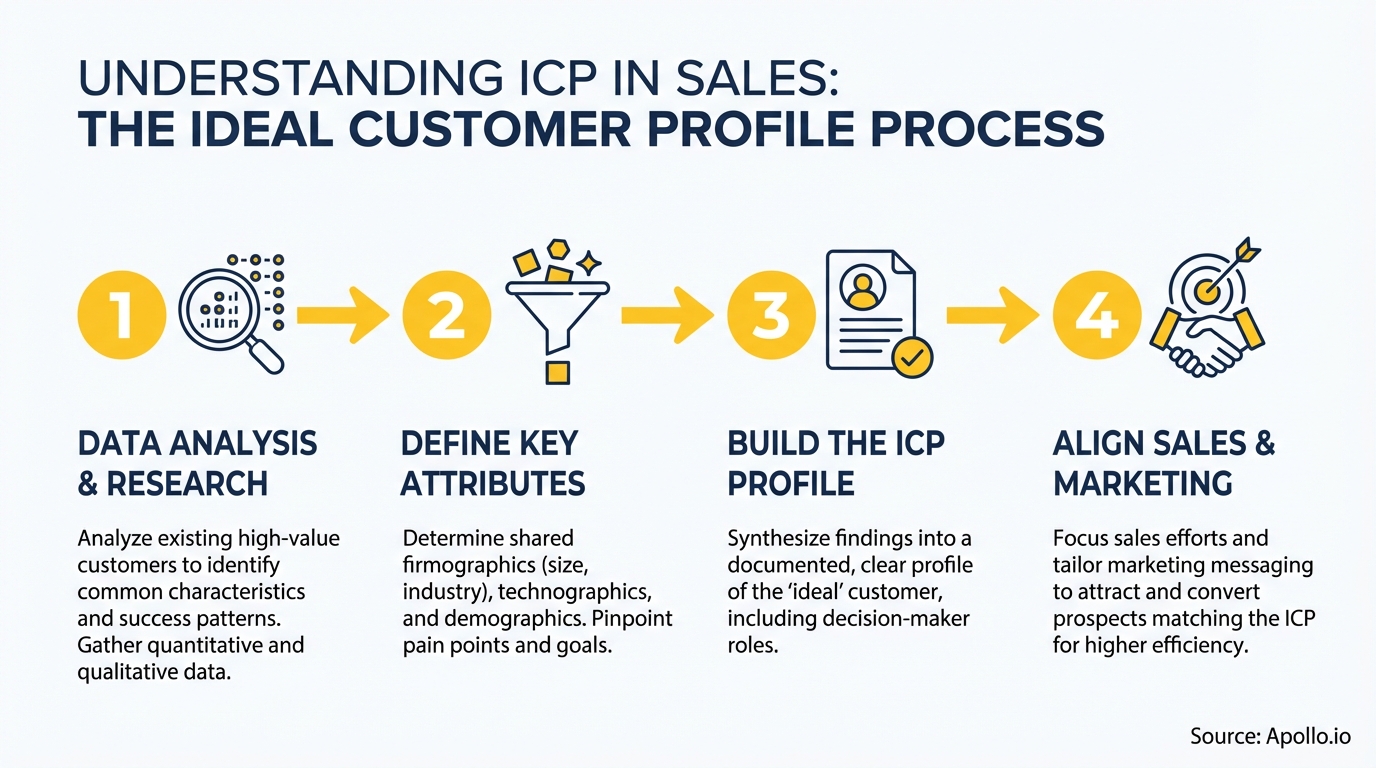
Building a strong ICP requires data from multiple sources, not just sales instinct. Follow this process:
- Analyze your best customers. Pull your top 20% by revenue, retention, and expansion. Identify what they have in common across industry, size, tech stack, and buying trigger.
- Run win/loss analysis. Compare won deals against churned accounts. The differences reveal your true ICP — not your aspirational one.
- Define negative ICP criteria. Identify deal characteristics that consistently predict churn, slow cycles, or low LTV. Use these as disqualification signals, not just deprioritization notes.
- Validate with pipeline data. Cross-reference ICP fit scores against actual win rates, deal velocity, and expansion rates. ICP should be provable, not assumed.
- Make it executable. Translate your ICP into CRM fields, lead scoring weights, and routing rules. An ICP that lives in a document has no operational value.
Tracking the right metrics throughout this process is critical. See which sales KPIs you should track in 2026 to measure whether your ICP is actually driving results.
ICP Drift: The Silent Revenue Killer
Even a well-built ICP degrades over time. As Cojoy RevGen explains, ICP drift — a gradual shift from urgency-driven customer segments toward broader, less pressured accounts — leads to longer sales cycles, lower win rates, and declining revenue efficiency in B2B SaaS.
Warning signs your ICP has drifted:
- Win rates declining without a clear competitive reason
- Average sales cycle length increasing quarter over quarter
- Churn concentrated in a specific cohort or segment
- Sales and marketing disagreeing on which accounts are "good"
- Expansion revenue flattening in accounts that looked strong at close
The fix is a quarterly ICP review cadence, owned by RevOps, with input from sales, marketing, and customer success. Treat it like a living data model, not an annual strategy exercise.
Expansion ICP: The Revenue Layer Most Teams Skip
Most ICP frameworks focus entirely on acquisition. That's a significant blind spot. Your expansion ICP defines which customers are most likely to buy more — more seats, more products, higher tiers.
Expansion ICP attributes to track:
- Product adoption depth: Are they using core features or just scratching the surface?
- Team growth signals: Hiring in departments that use your product is a strong upsell trigger.
- Engagement frequency: Login cadence, support ticket volume, and champion activity predict expansion readiness.
- Strategic alignment: Customers whose business goals align with your product roadmap are natural expansion targets.
"Apollo gets us the people we need to speak to. Without that, there's no business."
Your revenue operations function should own the expansion ICP, ensuring it feeds into customer success playbooks and account management workflows — not just marketing campaigns.
How to Operationalize ICP Across Your GTM Team
A great ICP only creates value when every team uses it consistently. Here's how each function applies it:
| Team | How They Use ICP |
|---|---|
| Sales Development | Account prioritization, outreach sequencing, qualification criteria |
| Account Executives | Discovery question framework, deal scoring, forecast confidence |
| Marketing | Audience targeting, content strategy, paid account selection |
| Customer Success | Onboarding prioritization, expansion signals, renewal risk scoring |
| RevOps | ICP scoring model, CRM routing rules, GTM alignment governance |
Cross-functional alignment on ICP is one of the most direct levers for improving sales productivity. When every team works from the same definition of a good account, handoffs get cleaner and pipeline quality improves.
Need to activate your ICP across multi-channel outreach? Automate your ICP-driven sequences with Apollo's sales engagement platform — email, phone, and social outreach in one unified workspace.
Conclusion: Your ICP Is a Revenue System, Not a Slide Deck
ICP meaning in sales has evolved. It's no longer a one-time exercise you do at company founding.
The teams consistently winning in 2026 treat their ICP as a dynamic, data-backed system — one that defines acquisition targets, guides expansion plays, and filters out poor-fit accounts before they drain resources.
Build it from your best customer data. Make it executable in your CRM. Review it quarterly. And extend it beyond acquisition to cover the expansion revenue that drives sustainable growth.
Apollo makes ICP-driven prospecting and outreach actionable at scale — from sales analytics that validate your targeting to enriched contact data across 224M+ professionals. Start free with Apollo and turn your ICP into a full pipeline engine today.
Prove Pipeline ROI Before Next QBR
Budget approval stuck on unclear metrics? Apollo delivers measurable pipeline impact fast — so your team justifies every dollar spent. Leadium 3x'd their revenue. See your ROI now.
Schedule a Demo →Don't miss these
Sales
Inbound vs Outbound Marketing: Which Strategy Wins?
Sales
What Is a Sales Funnel? The Non-Linear Revenue Framework for 2026
Sales
What Is a Go-to-Market Strategy? The 2026 GTM Playbook
See Apollo in action
We'd love to show how Apollo can help you sell better.
By submitting this form, you will receive information, tips, and promotions from Apollo. To learn more, see our Privacy Statement.
4.7/5 based on 9,690 reviews
