How to Prospect for Sales: Proven Strategies That Convert in 2026
Sales prospecting in 2026 isn't about volume anymore. With Gartner reporting that 61% of B2B buyers prefer an overall rep-free buying experience, outbound teams face a new challenge: breaking through to buyers who actively research independently. The prospecting playbook has shifted from spray-and-pray sequences to precision targeting with contextual value. This guide shows you how to prospect effectively when buyers control the research process and relevance determines whether your message gets read or ignored. Data-driven prospecting strategies are now table stakes for teams that want to book meetings consistently.

Apollo Finds Contacts While You Close Deals
Spending 4+ hours daily hunting for contact info. Apollo delivers 224M verified contacts with 96% email accuracy instantly. Join 550K+ companies who stopped manual research.
Start Free with Apollo →Key Takeaways
- Modern prospecting prioritizes relevance over volume—73% of buyers avoid irrelevant outreach
- SDRs and AEs must align messaging with on-site content to overcome the 69% consistency gap
- Automation reclaims selling time from research tasks, addressing the 76% non-selling time problem
- Multi-stakeholder outreach is critical as buying groups now average 13 decision-makers
- All-in-one platforms consolidate tech stacks and reduce tool switching that kills productivity
What Is Sales Prospecting in 2026?
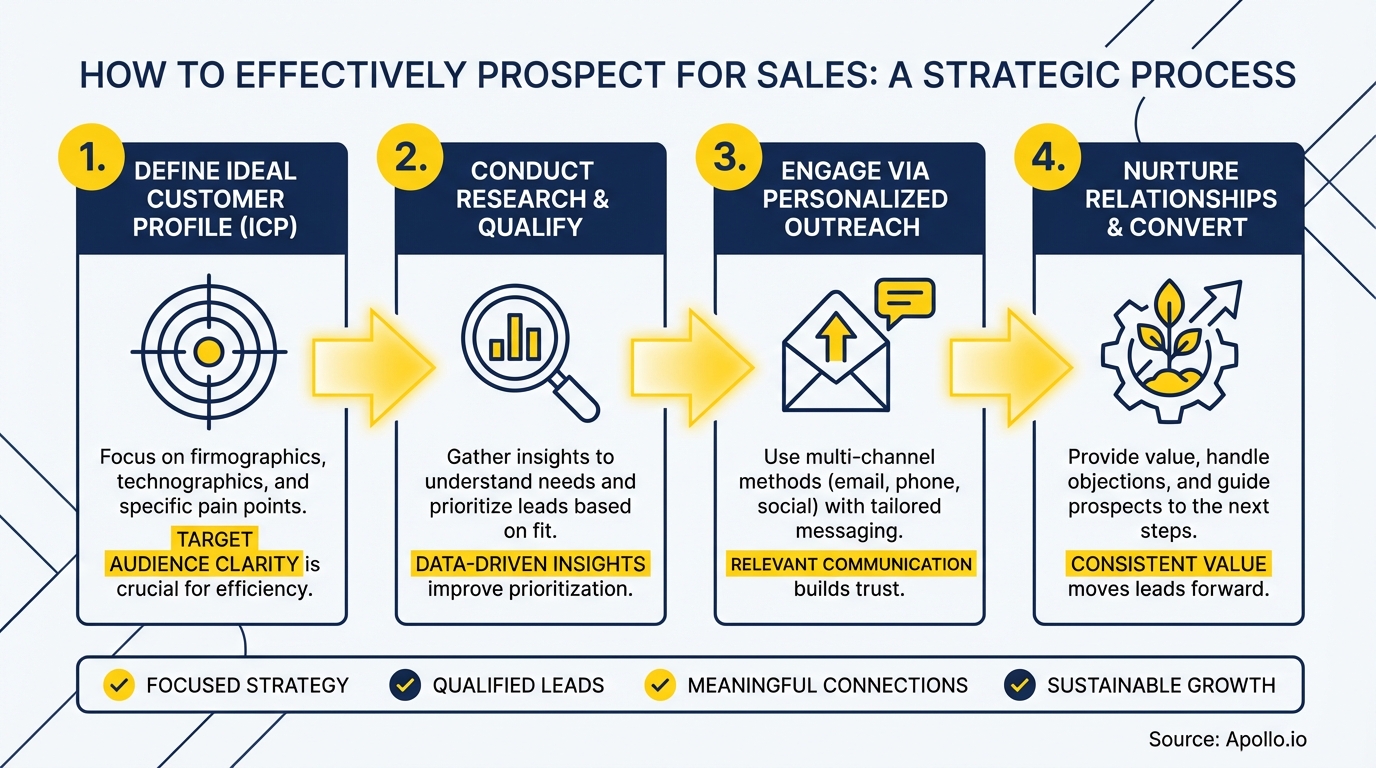
Sales prospecting is the process of identifying and engaging potential buyers who match your ideal customer profile before they enter your pipeline. In 2026, prospecting has evolved from list-based cold outreach to intelligence-driven engagement. According to BookYourData, by 2025, 80% of B2B sales interactions between suppliers and buyers are expected to occur through digital channels. This shift means prospecting now happens across email, phone, and social channels with messaging tailored to where buyers are in their research journey.
For SDRs and BDRs, prospecting starts with research: finding accounts that fit your ICP, identifying decision-makers and influencers, and uncovering signals like hiring trends or technology adoption. For Account Executives, prospecting involves multi-threading into existing accounts and targeting expansion opportunities.
The goal is consistent: start conversations with qualified buyers before competitors do.
Why Is Relevance-by-Design the New Prospecting Standard?
Relevance-by-design prospecting means aligning every outbound message with verifiable on-site assets and buyer context. This approach directly addresses two critical buyer pain points: 73% of B2B buyers actively avoid suppliers sending irrelevant outreach, and 69% report inconsistencies between website information and what sellers provide.
When your prospecting claims match your marketing content, buyers trust you enough to respond.
Sales Leaders implementing relevance-by-design frameworks see measurable improvements in response rates because they eliminate the credibility gap. Instead of generic value propositions, reps reference specific case studies, ROI calculators, or product documentation that buyers can verify independently. This transparency builds trust in a market where buyers prefer self-directed research. The Sales Acceleration Formula emphasizes this alignment between marketing assets and sales messaging as a core growth lever.
How Do SDRs Prospect Effectively With Multi-Stakeholder Buying Groups?
SDRs in 2026 face buying committees averaging 13 decision-makers across multiple departments. Effective prospecting requires mapping the entire buying group and coordinating outreach across stakeholders. Research from Marketing LTB shows B2B buying cycles increased by 22% in the last 3 years, largely due to this complexity.

Start by identifying economic buyers, technical evaluators, end users, and influencers within target accounts. Tailor messaging to each persona's priorities:
- Economic Buyers (CFO, VP): ROI, cost savings, risk mitigation
- Technical Evaluators (IT, RevOps): Integration capabilities, data security, implementation timeline
- End Users (Sales Reps, Managers): Ease of use, workflow efficiency, training requirements
- Champions (Sales Leaders): Team adoption, competitive advantages, measurable outcomes
Coordinate sequences so multiple stakeholders receive relevant messages within the same week. This multi-threaded approach prevents deals from stalling when a single champion goes dark. Email personalization strategies become critical when you're tailoring messages to four different personas in one account.
Struggling to find qualified leads across buying groups? Search Apollo's 224M contacts with 65+ filters to map entire buying committees.
What Prospecting Automation Reclaims Selling Time for Reps?
Sellers spend only 24% of their time actually selling—roughly 10 hours per week. The remaining 76% goes to research, data entry, and administrative work.
Automation reclaims this lost time by handling repetitive prospecting tasks while maintaining personalization quality.
Key automation capabilities for prospecting in 2026:
- Triggered Sequences: Automatically enroll prospects when they match specific criteria (job change, funding announcement, website visit)
- Research Automation: Pull company data, recent news, and contact information without manual lookups
- Multi-Channel Orchestration: Coordinate email, phone, and social touches in one workflow
- A/B Testing: Automatically test subject lines and messaging to optimize performance
- Task Automation: Create follow-up tasks and log activities without manual CRM updates
Account Executives using automation platforms report they can prospect into twice as many accounts without increasing headcount.
The key is governance: establish templates, approval workflows, and quality checks to ensure automation maintains message relevance. Sales automation best practices emphasize balancing efficiency with personalization quality.

Spending hours on manual outreach? Automate your sequences with Apollo's multi-channel platform.
Turn Forecast Guesswork Into Revenue Certainty
Marketing leads never converting to real opportunities. Apollo scores and tracks every prospect in real-time so you know exactly which deals will close. Built-In increased win rates 10% with Apollo's intelligence.
Start Free with Apollo →How Can Founders Build Prospecting Systems That Scale?
Founders and CEOs building outbound motions face a critical decision: build a tech stack from multiple vendors or consolidate on an all-in-one platform. According to Reach Marketing, personalized email campaigns result in a 29% higher open rate and a 41% higher click-through rate, making the right prospecting infrastructure essential for scaling revenue.
Successful prospecting systems include:
| Component | Function | Impact on Prospecting |
|---|---|---|
| Contact Database | Verified B2B contacts with enrichment | Eliminates manual research, ensures data accuracy |
| Engagement Platform | Multi-channel sequences (email, phone, social) | Increases touchpoints without manual effort |
| Sales Intelligence | Intent signals, job changes, funding events | Surfaces high-priority prospects automatically |
| Analytics Dashboard | Response rates, conversion metrics, rep performance | Identifies what's working and optimizes messaging |
Teams that consolidate on unified platforms report they can ramp new SDRs in half the time because there's one system to learn instead of five. As one customer noted: "We reduced the complexity of three tools into one"—Collin Stewart, Predictable Revenue. Building a sales tech stack that scales means choosing platforms that grow with your team without requiring constant tool switching.
What Role Does AI Play in Modern Prospecting Workflows?
AI in prospecting has evolved from basic email drafting to agentic systems that plan multi-step workflows. In 2026, AI assists with research (identifying ideal accounts), personalization (tailoring messages at scale), and optimization (testing what converts).
RevOps leaders use AI to maintain data quality, enforce governance rules, and surface coaching opportunities when reps send off-brand messages.
Practical AI applications for prospecting teams:
- Account Scoring: AI prioritizes which accounts to prospect based on fit and intent signals
- Message Generation: Draft personalized emails using prospect context and proven templates
- Call Intelligence: Analyze conversations to identify objections and winning talk tracks
- Workflow Suggestions: Recommend next-best actions based on prospect behavior
The key is governance: AI should accelerate human judgment, not replace it. Sales Leaders must establish quality checks, approval workflows, and training to ensure AI-generated content maintains brand voice and message relevance. AI writing tools for sales work best when they augment rep creativity rather than automate mindlessly.
How Do You Build a Sales Prospecting List That Actually Converts?
High-converting prospecting lists start with tight ICP definitions and accurate data. BDRs who prospect into accounts that don't match their ICP waste time on conversations that never close.
Start by analyzing your best customers: company size, industry, technologies used, growth stage, and geographic location. Then apply these filters to your contact database to build targeted lists.
List-building best practices for 2026:
- Start Narrow: Target 50-100 high-fit accounts rather than 1,000 marginal ones
- Multi-Thread Early: Include 3-5 contacts per account across different roles
- Layer Intent Signals: Prioritize accounts showing buying behavior (hiring, funding, tech adoption)
- Refresh Regularly: Update lists monthly to remove closed-lost accounts and add new prospects
- Segment by Persona: Group contacts by role to tailor messaging appropriately
Account Executives managing territory prospecting should coordinate with marketing on account-based campaigns. When marketing runs ads and sends content to target accounts, sales outreach becomes a continuation of an existing conversation rather than a cold interruption. Building prospecting lists that convert requires this alignment between demand generation and outbound prospecting.
Conclusion
Sales prospecting in 2026 rewards precision over volume. With buyers preferring self-directed research and actively avoiding irrelevant outreach, successful prospecting requires relevance-by-design frameworks that align outbound messaging with verifiable content.
SDRs, AEs, and Sales Leaders must adopt multi-stakeholder approaches, leverage automation to reclaim selling time, and consolidate tech stacks to eliminate tool-switching friction. Teams that master these fundamentals consistently book more meetings and build healthier pipelines.
Ready to transform your prospecting workflow? Schedule a Demo to see how Apollo consolidates prospecting, engagement, and intelligence in one platform—helping teams like yours cut costs and accelerate revenue growth.
Prove Apollo's ROI In Your First 30 Days
Budget approval stuck on unclear metrics? Apollo tracks every dollar of pipeline impact from day one. Built-In increased win rates 10% and ACV 10% with measurable signal-driven outreach.
Start Free with Apollo →Don't miss these
Sales
Inbound vs Outbound Marketing: Which Strategy Wins?
Sales
What Is a Sales Funnel? The Non-Linear Revenue Framework for 2026
Sales
What Is a Go-to-Market Strategy? The 2026 GTM Playbook
See Apollo in action
We'd love to show how Apollo can help you sell better.
By submitting this form, you will receive information, tips, and promotions from Apollo. To learn more, see our Privacy Statement.
4.7/5 based on 9,690 reviews
