
How to Calculate Sales Revenue: A Complete Guide for Business Leaders
Revenue calculations in 2026 extend far beyond simple formulas. With McKinsey research showing e-commerce now generates 34% of B2B revenue, sales leaders need multi-channel frameworks that capture every dollar across digital and traditional channels. Whether you're a RevOps leader consolidating data sources or a founder tracking ARR, this guide provides practical calculation methods that reflect modern B2B reality.

Apollo Eliminates 4+ Hours Of Daily Research
Tired of spending 4+ hours daily hunting for contact info? Apollo delivers 224M verified contacts with 96% email accuracy instantly. Join 550K+ companies who stopped wasting time on struggling.
Start Free with Apollo →Key Takeaways
- Sales revenue equals total income from customer purchases before deducting costs, requiring multi-channel attribution in 2026
- B2B companies now track e-commerce alongside traditional sales, with online channels driving 34% of revenue
- Modern revenue calculations demand integration of CRM, e-commerce, and ERP data for accurate attribution
- Industry benchmarks vary significantly: SaaS focuses on ARR/MRR while manufacturing tracks unit-based revenue
- Advanced considerations like revenue recognition, returns, and discounts impact final reportable figures
What Is Sales Revenue?
Sales revenue is the total income generated from selling goods or services before subtracting any costs or expenses. It represents the top line of your income statement and serves as the foundation for all profitability calculations.
In B2B contexts, revenue includes subscription fees, one-time purchases, professional services, and increasingly, e-commerce transactions.
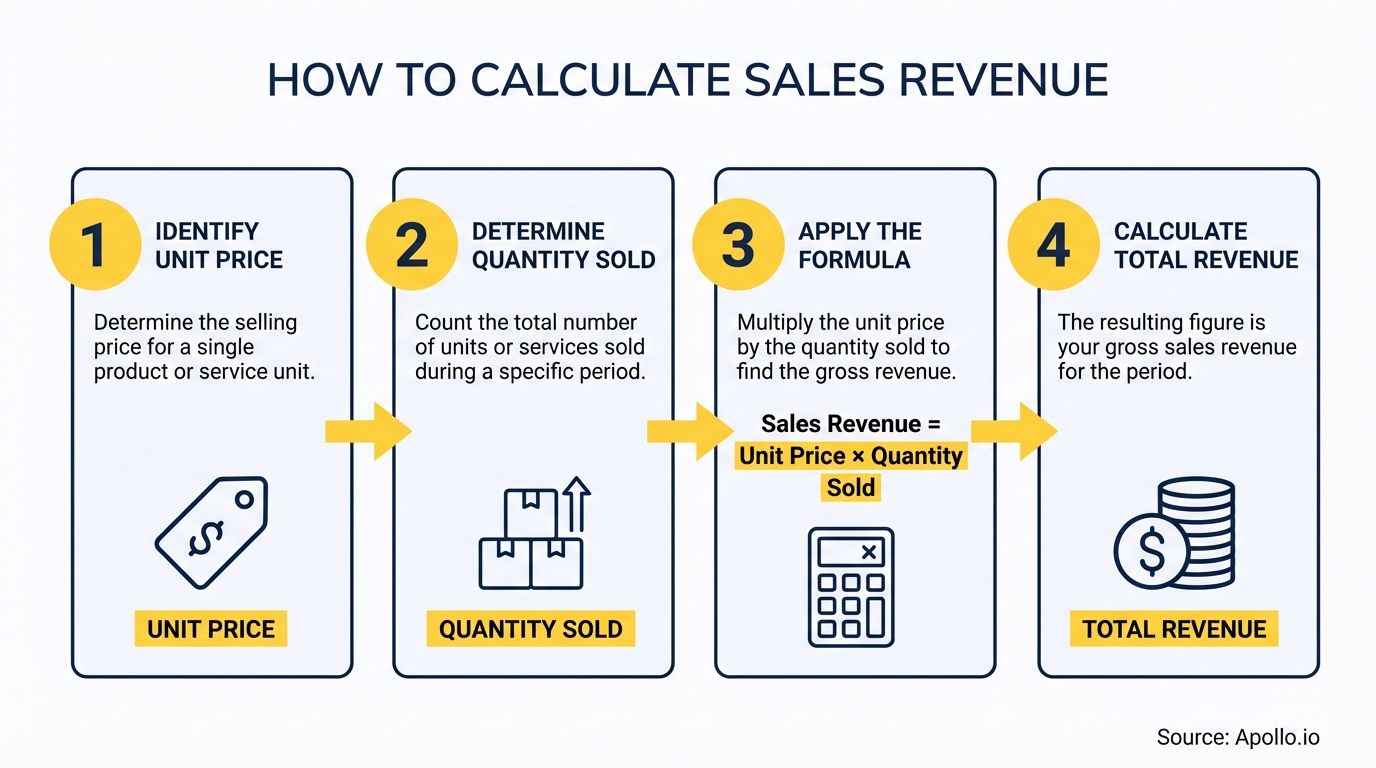
The basic formula remains: Sales Revenue = Number of Units Sold × Price Per Unit. However, modern B2B environments require tracking revenue across multiple channels, subscription models, and customer touchpoints.
For Account Executives managing complex deals, this means understanding how contract values, payment terms, and delivery schedules affect recognized revenue.
How Do You Calculate Revenue Across Multiple Channels?
Multi-channel revenue calculation requires attribution rules that assign value to each touchpoint. The formula expands to: Total Revenue = (Direct Sales Revenue) + (E-commerce Revenue) + (Partner Channel Revenue) + (Subscription Revenue).
Each channel needs separate tracking to identify performance drivers.
According to McKinsey's 2024 B2B Pulse, 71% of B2B companies now offer e-commerce, making channel integration critical. Attribution models include first-touch (credit to initial contact), last-touch (credit to closing channel), or weighted (distributing value across touchpoints). RevOps teams typically implement weighted models for accuracy.
| Attribution Model | Best For | Calculation Method |
|---|---|---|
| First-Touch | Lead generation focus | 100% credit to originating channel |
| Last-Touch | Closing efficiency | 100% credit to final conversion channel |
| Linear | Full journey visibility | Equal distribution across all touchpoints |
| Time-Decay | Sales cycle optimization | Higher weight to recent interactions |
Can't track revenue across scattered systems? Apollo's unified deal management gives you complete pipeline visibility in one workspace.
How Do Sales Leaders Integrate E-Commerce Data Into Revenue Calculations?
E-commerce integration starts with connecting your online platform to your CRM and ERP systems. Data normalization ensures consistent customer records, product codes, and transaction formats across systems.
The process requires mapping e-commerce orders to CRM opportunities and reconciling timing differences between order placement and revenue recognition.
Key integration steps include:

- Customer Matching: Link e-commerce accounts to CRM contacts using email, company domain, or unique identifiers
- Product Mapping: Align SKUs between e-commerce catalogs and ERP inventory systems
- Revenue Timing: Establish rules for when online orders convert to recognized revenue
- Return Handling: Build workflows for processing refunds and adjustments across systems
For Sales Leaders managing hybrid teams, consolidated tech stacks eliminate data silos. Companies like Predictable Revenue report, "We reduced the complexity of three tools into one," cutting integration overhead while improving accuracy.
Turn Forecasting Chaos Into Revenue Clarity
Pipeline forecasting a guessing game? Apollo reveals real-time deal stages and buying signals across your entire funnel. Built-In boosted win rates 10% with Apollo's scoring and visibility.
Start Free with Apollo →What Are Industry-Specific Revenue Benchmarks for 2026?
Revenue benchmarks vary dramatically by industry and business model. SaaS companies focus on Monthly Recurring Revenue (MRR) and Annual Recurring Revenue (ARR), while manufacturing tracks unit sales and average order values.
Understanding your sector's standards helps contextualize performance.
| Industry | Primary Metric | 2026 Benchmark |
|---|---|---|
| SaaS/Software | ARR Growth Rate | 20-30% YoY for growth stage |
| Manufacturing | Revenue per Employee | $250K-$500K annually |
| Wholesale/Distribution | Gross Margin | 25-35% on revenue |
| Professional Services | Utilization Rate | 75-85% billable hours |
Research from Statista projects B2B e-commerce will account for 56% of B2B revenue by 2025, making digital channel performance a critical benchmark across all sectors.

How Do You Account for Discounts, Returns, and Revenue Recognition?
Net revenue requires adjustments for discounts, returns, allowances, and recognition timing. The formula becomes: Net Sales Revenue = Gross Sales - Sales Returns - Sales Allowances - Sales Discounts.
These deductions reflect the actual cash you'll collect.
Revenue recognition follows accounting standards (ASC 606 in the US) that dictate when you can claim revenue. For subscription businesses, this means recognizing revenue ratably over the contract period.
A $12K annual contract becomes $1K monthly recognized revenue, not $12K upfront.
Common adjustments include:
- Early Payment Discounts: 2/10 Net 30 terms reduce revenue by 2% if customers pay within 10 days
- Volume Rebates: Tiered pricing that adjusts revenue based on total purchase volume
- Return Reserves: Estimated deductions for anticipated product returns (typically 2-5%)
- Deferred Revenue: Prepayments that can't be recognized until delivery occurs
Struggling with pipeline forecasting and revenue visibility? Apollo's go-to-market platform unifies your revenue data in one system.
What Tools Help Automate Revenue Calculations?
Modern revenue tracking requires integrated systems that pull data from multiple sources. CRMs like Salesforce or HubSpot track opportunity values, e-commerce platforms like Shopify capture online transactions, and ERP systems like NetSuite handle recognition rules and financial reporting.
Essential tool categories include:
- CRM Systems: Track deal values, close dates, and sales attribution
- Revenue Operations Platforms: Consolidate data across sales, marketing, and finance
- Business Intelligence Tools: Visualize revenue trends with dashboards and reports
- Spreadsheet Templates: Calculate revenue with pre-built formulas for different models
For founders and sales leaders tired of juggling multiple platforms, tool consolidation delivers significant cost savings. Census, an Apollo customer, reports, "We cut our costs in half" by replacing separate prospecting, engagement, and data tools with a unified platform.
How to Calculate Sales Revenue: Your Action Plan
Accurate revenue calculation in 2026 demands multi-channel tracking, proper attribution, and system integration. Start by defining your revenue model (transactional, subscription, or hybrid), then establish data flows between your CRM, e-commerce platform, and financial systems.
Implement attribution rules that match your sales process, and build regular reconciliation routines to catch discrepancies.
For SDRs and AEs focused on hitting quota, understanding how your deals convert to recognized revenue helps forecast accurately and prioritize high-value opportunities. For RevOps leaders, clean data integration across your tech stack eliminates manual reconciliation and provides real-time visibility into performance.
Ready to simplify your revenue tracking? Start prospecting with Apollo's unified GTM platform and see how 550K+ companies manage deals, track pipeline, and drive predictable revenue from one workspace.
Prove Apollo ROI In 30 Days, Not 6 Months
Budget approval stuck on unclear metrics? Apollo delivers measurable pipeline impact from day one—track time saved, meetings booked, and deals closed. Customer. io achieved 50% YoY growth with Apollo's proven ROI.
Start Free with Apollo →Don't miss these
Sales
Inbound vs Outbound Marketing: Which Strategy Wins?
Sales
What Is a Sales Funnel? The Non-Linear Revenue Framework for 2026
Sales
What Is a Go-to-Market Strategy? The 2026 GTM Playbook
See Apollo in action
We'd love to show how Apollo can help you sell better.
By submitting this form, you will receive information, tips, and promotions from Apollo. To learn more, see our Privacy Statement.
4.7/5 based on 9,690 reviews
