
How Much Does a Sales Engineer Make? 2026 Salary Guide
Sales engineers sit at the intersection of technical expertise and revenue generation, and the market compensates them accordingly. The U.S. Bureau of Labor Statistics reports a median annual wage of $121,520 for sales engineers as of May 2024, roughly 2.5x the median for all U.S. occupations. But that single number masks a wide range: the bottom 10% earn under $70,580, while the top 10% exceed $202,670.
If you're evaluating an offer, planning a career move, or benchmarking your current compensation, a single average won't cut it. This guide breaks down sales engineer pay by experience, industry, location, and compensation structure so you can make apples-to-apples comparisons.

Research Less, Pipeline More With Apollo
Tired of hours lost to manual lead research and dead-end contact data? Apollo surfaces verified, ready-to-contact prospects so your reps spend time selling. Join 550K+ companies building predictable pipeline.
Start Free with Apollo →Key Takeaways
- The BLS median for sales engineers is $121,520 (May 2024), but tech-sector OTE benchmarks commonly reach $200,000.
- Industry matters more than almost any other variable: software publishers pay a $35,000+ premium over manufacturing.
- Entry-level SEs start around $82,000; senior and principal-level roles with variable pay can reach $200,000+.
- Most SE compensation packages use a 70/30 or 80/20 base-to-variable split, making OTE the number to negotiate.
- Employment growth for sales engineers is projected at +5% through 2034, outpacing most sales roles.
Sales Engineer Salary Benchmarks: What the Data Actually Shows
Salary data for sales engineers varies depending on the source methodology. Government wage surveys capture W-2 base pay across all industries.
Market platforms capture self-reported total compensation, often skewed toward tech. Both are useful — but only when you understand what each is measuring.
| Data Source | Figure | What It Measures |
|---|---|---|
| BLS (May 2024) | $121,520 median | Base wage across all U.S. industries |
| Betts Recruiting (2024) | $120,000–$150,000 average | Placed candidates, tech-weighted |
| Built In (2026) | $129,820 base + $43,691 variable = $173,511 total | Self-reported total compensation |
| Comparably (July 2024) | $148,047 base + $33,640 avg bonus | Self-reported, tech and enterprise skewed |
| 6figr (Feb 2026) | $193,000 average; top 10% over $286,000 | Verified offer letters and payslips, tech-heavy |
The practical takeaway: BLS figures are conservative floor benchmarks. If you're in SaaS, cybersecurity, or cloud infrastructure, market-rate compensation will track closer to the Built In or Comparably figures for base, with OTE materially higher.
Sales Engineer Salary by Experience Level
Experience is the most reliable predictor of where you land within the range. According to Salary.com, the average annual salary for an entry-level sales engineer in the United States is $82,194 as of February 2026. From there, progression is steep for those who close enterprise deals or move into technical leadership.
| Experience Level | Typical Base Range | OTE Estimate (Tech) |
|---|---|---|
| Entry Level (0–2 years) | $75,000–$95,000 | $100,000–$130,000 |
| Mid-Level (3–5 years) | $100,000–$130,000 | $145,000–$175,000 |
| Senior (6–10 years) | $130,000–$160,000 | $180,000–$220,000 |
| Principal / Staff SE | $155,000–$185,000 | $210,000–$260,000+ |
The fastest path to the senior tier is pairing deal impact with product depth. SEs who can run complex proof-of-concept evaluations independently and influence enterprise deal cycles command the largest premiums. Understanding high-ticket sales dynamics is a core competency that separates mid-level SEs from senior earners.

Sales Engineer Salary by Industry
Industry choice is the single highest-leverage variable for maximizing sales engineer compensation. The BLS May 2024 data shows a $35,000+ gap between the top and bottom industries.
| Industry | BLS Median Annual Wage (May 2024) |
|---|---|
| Software Publishers | $137,650 |
| Wholesale Trade Agents and Brokers | $134,990 |
| Computer Systems Design and Related Services | $131,810 |
| Merchant Wholesalers, Durable Goods | $109,150 |
| Manufacturing | $101,940 |
SaaS and cybersecurity roles consistently appear at the top of market-rate surveys because the products are complex, deal sizes are large, and technical validation directly influences purchasing decisions. If you're considering a transition from manufacturing or industrial sales into software, the pay differential justifies the investment in technical upskilling.
"Having Apollo and having everything be in one system was a game changer — for BDRs specifically."
Turn Funnel Guesswork Into Pipeline Wins
Tired of marketing leads that never become real opportunities? Apollo surfaces high-intent prospects ready to convert, so your pipeline reflects deals — not wishful thinking. Join 550K+ companies forecasting with confidence.
Start Free with Apollo →Base vs. OTE: How to Read a Sales Engineer Compensation Package
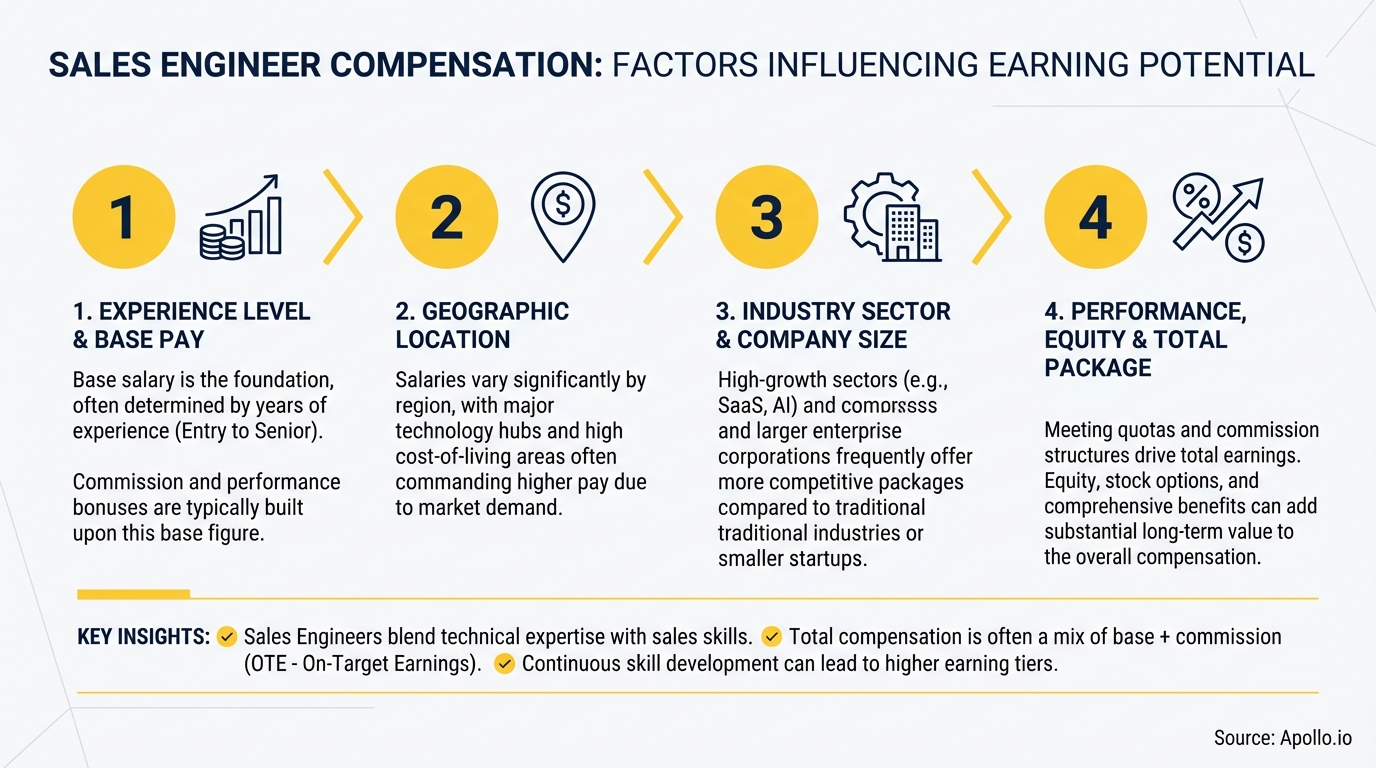
The biggest source of confusion when comparing offers is conflating base salary with total compensation. Sales engineer compensation is typically a mix of base salary and variable pay, including commission and bonuses.
Knowing the split structure determines how much of your pay is guaranteed versus performance-dependent.
According to We The Sales Engineers, common base-to-variable splits include 70/30, 60/40, and 80/20. The right split depends on your risk tolerance and deal cycle length.
| Split Model | Base % | Variable % | Best For |
|---|---|---|---|
| 80/20 | 80% | 20% | Long enterprise cycles, team-based selling |
| 70/30 | 70% | 30% | Mid-market SaaS, balanced risk |
| 60/40 | 60% | 40% | High-velocity deals, strong personal influence |
When evaluating offers: Always ask for the OTE, the quota, and the percentage of reps who hit quota at that company. A $200,000 OTE at 40% quota attainment is worth less in practice than a $175,000 OTE where 75% of SEs hit their number.
Sales engineers who want to sharpen their ability to influence and close large deals will also benefit from understanding how sales operations functions and how to use data to support compensation negotiations.
Sales Engineer Salary by Location
Geography still creates meaningful pay differentials, even in a remote-friendly market. BLS occupational wage data shows top-paying states include Delaware ($177,750 annual mean wage) and the District of Columbia ($175,210 annual mean wage) as of May 2023.
California, Washington, and New York also rank consistently among the highest-paying states for sales engineers.
Remote work has narrowed but not eliminated geographic premiums. Companies with distributed teams often apply location-based pay bands.
If you're negotiating a remote role headquartered in San Francisco, ask explicitly whether compensation is pegged to the HQ market or your location of residence.
Market Outlook: Why Sales Engineer Demand Is Growing
Many sales roles are contracting as automation handles routine prospecting and qualification. Sales engineers are bucking that trend.
The BLS projects +5% employment growth for sales engineers from 2024 to 2034, compared with -2% for sales and related occupations overall. The driver is straightforward: as products become more technically complex, buyers require expert-level validation before committing to large purchases.
This is especially true in AI infrastructure, cybersecurity, cloud platforms, and enterprise software. SEs who develop expertise in these domains are positioning themselves for sustained demand and above-market compensation. Understanding how sales analytics drives revenue is increasingly a differentiator for SEs operating in data-heavy sales environments.
Sales teams looking to maximize SE productivity also benefit from tools that reduce administrative overhead. Want to give your SEs more time on high-value deal work? Automate the repetitive parts of your sales workflow with Apollo so your technical talent focuses on what moves deals forward.

How to Negotiate Your Sales Engineer Compensation
Most SEs leave money on the table because they negotiate base salary in isolation. The variables with the highest upside are OTE structure, quota levels, accelerators for overperformance, and equity.
Here's a practical framework:
- Anchor to OTE, not base. Ask for the full OTE figure and model what hitting 80%, 100%, and 120% of quota pays out.
- Benchmark across sources. Use BLS for floor, Built In and Comparably for market rate, and 6figr for tech-sector verification.
- Quantify your deal impact. Document specific deals where your technical validation accelerated close or increased deal size.
- Negotiate accelerators. Push for above-quota accelerators that increase your commission rate once you hit 100% of target.
- Don't ignore equity. At growth-stage companies, RSUs or options can represent a substantial portion of total compensation.
Strong technical sales skills and demonstrated deal influence are your primary negotiation leverage points. Document your contributions before any compensation conversation.
"Now we know exactly what we want to say and who we want to say it to. It's just a matter of going into Apollo and making it happen."
If you're building or managing a sales engineering team and need to attract top talent, having the right tools in place matters as much as comp structure. Use Apollo to identify and reach the right SE candidates and accounts across a database of 224M+ verified contacts.
Frequently Asked Questions
What is a good salary for a sales engineer?
A competitive salary for a sales engineer in the U.S. ranges from $120,000 to $150,000 in base pay, with total compensation (including variable) commonly reaching $160,000 to $200,000+ in tech industries. The BLS median of $121,520 is a useful floor benchmark across all industries.
Do sales engineers make more than software engineers?
At the median, software engineers at major tech companies typically out-earn sales engineers in base salary. However, high-performing sales engineers with strong variable components and equity can match or exceed software engineer total compensation, particularly at growth-stage companies with aggressive OTE structures.
What is OTE for a sales engineer?
OTE (On-Target Earnings) is the total compensation a sales engineer earns when hitting 100% of their quota. It equals base salary plus fully earned variable pay.
For mid-to-senior SEs in tech, OTE commonly falls in the $175,000 to $220,000 range, with top performers earning significantly more through accelerators.
Which industries pay sales engineers the most?
Software publishing, computer systems design, and wholesale trade agents pay the highest median wages for sales engineers according to BLS May 2024 data. Manufacturing and industrial sectors pay meaningfully less, with medians around $101,940.
Build the Pipeline That Justifies Your Compensation
Sales engineers who consistently influence pipeline and accelerate deal velocity have the clearest path to top-tier earnings. Understanding how revenue operations drives growth gives SEs the strategic context to position their contributions more effectively during compensation reviews.
Whether you're an individual contributor benchmarking your worth or a sales leader building a high-performing SE team, the right go-to-market tools amplify what great technical talent can do. Schedule a demo with Apollo to see how 550K+ companies use the platform to build pipeline, engage buyers, and close more deals.
Apollo Proves ROI Before Day 30
ROI pressure killing your budget approval? Apollo delivers measurable pipeline impact fast — so you walk into every renewal conversation with proof, not promises. Leadium 3x'd their revenue. You're next.
Start Free with Apollo →Don't miss these
Sales
Inbound vs Outbound Marketing: Which Strategy Wins?
Sales
What Is a Sales Funnel? The Non-Linear Revenue Framework for 2026
Sales
What Is a Go-to-Market Strategy? The 2026 GTM Playbook
See Apollo in action
We'd love to show how Apollo can help you sell better.
By submitting this form, you will receive information, tips, and promotions from Apollo. To learn more, see our Privacy Statement.
4.7/5 based on 9,690 reviews
