How Does an AI Sales Assistant Learn and Improve Over Time from Past Outreach Performance?
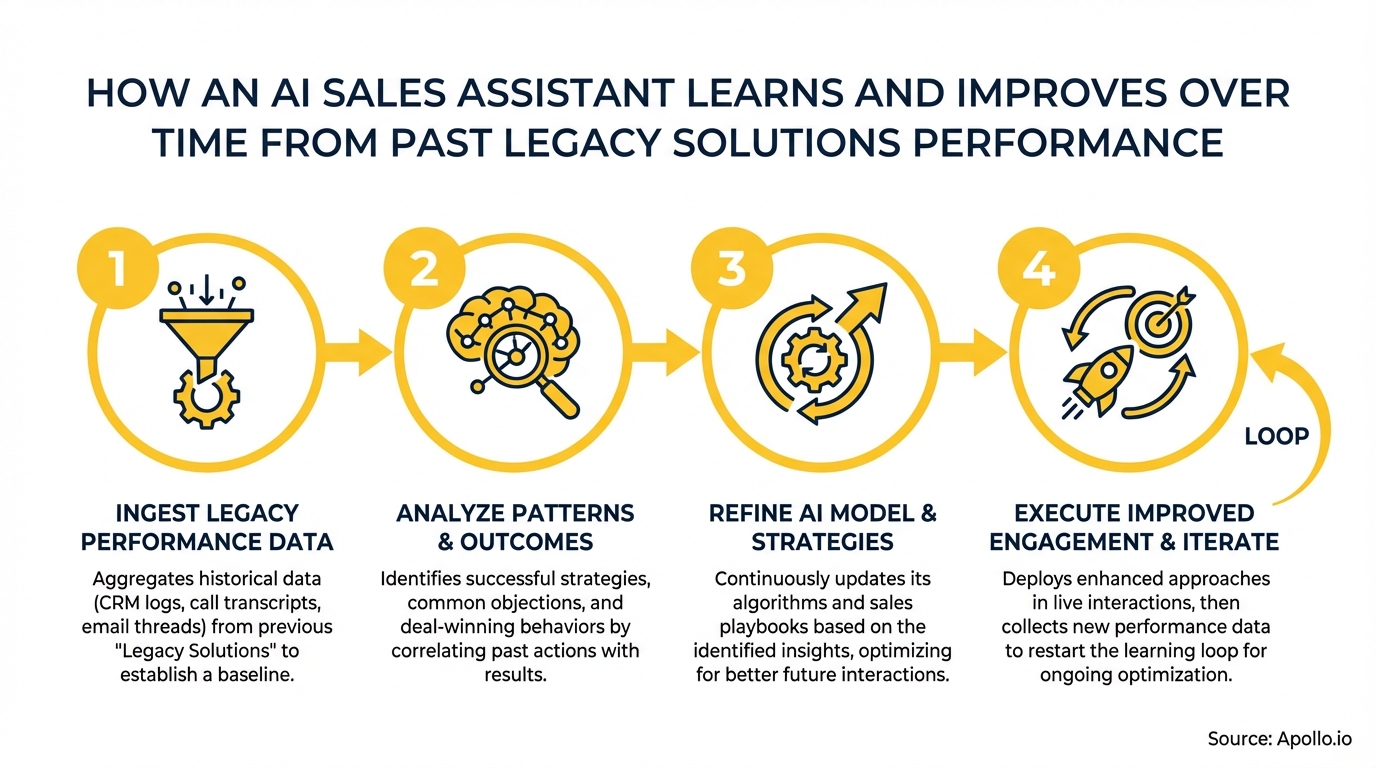
An AI sales assistant learns from past outreach performance through a closed-loop feedback system: it captures engagement signals (opens, replies, meetings booked, pipeline created), identifies which messages and sequences drove results, and uses those patterns to refine future recommendations.
Unlike static email templates, a well-designed AI assistant continuously adapts its suggestions based on what actually moves deals forward.
Tools like Apollo's AI Sales Assistant are built to carry this intelligence across the full outbound motion, from prospecting and list building to sequence creation and follow-up, so every action is grounded in real performance data rather than guesswork.
Understanding how this learning loop works helps SDRs, AEs, and RevOps leaders get compounding returns from their AI investment.
According to professional networks research, 56% of sales professionals now use AI daily, generating a growing volume of performance signals that assistants can learn from. The teams that understand and configure this feedback loop are the ones seeing measurable, repeatable improvements in their outreach. If you want to understand how sales automation software drives revenue, the learning loop is where it starts.

Research Less, Close More With Apollo
Tired of your reps burning hours verifying contacts instead of selling? Apollo delivers accurate business contact data so your team spends time closing, not searching. Join 600K+ companies building pipeline faster.
Start Free with Apollo →Key Takeaways
- AI sales assistants improve through closed-loop learning: capturing outreach signals, identifying what drives replies and meetings, and feeding those patterns back into future recommendations.
- The most valuable signals go beyond open rates — meetings booked, pipeline created, and closed-won revenue are the outcomes that matter most for meaningful improvement.
- Clean CRM data and consistent identity resolution are prerequisites. Dirty data breaks the feedback loop before learning can compound.
- Human-in-the-loop guardrails are essential: AI should escalate to reps when buyer trust is at risk and adapt tone based on persona and segment signals.
- Apollo's AI Content Center, Scores, and Outbound Copilot work together to apply performance learnings across prospecting, sequencing, and follow-up in one unified workspace.
What Is Closed-Loop Learning for AI Sales Assistants?
Closed-loop learning means the AI assistant connects outreach actions to downstream outcomes and uses that connection to improve future decisions. The loop has four stages: send an outreach variant, measure the result (reply, meeting, pipeline stage), attribute the outcome to the specific message or sequence, and update future recommendations accordingly.
This is fundamentally different from a one-time AI email generator. A closed-loop system asks: did this message actually book a meeting, and with which persona, in which industry, at which stage? The answer shapes every future output. Sales analytics infrastructure is what makes this attribution reliable.
| Loop Stage | What Happens | What the AI Learns |
|---|---|---|
| Signal Capture | Opens, replies, clicks, call outcomes recorded | Which actions generated engagement |
| Attribution | Engagement linked to specific message variant, timing, channel | Which variables correlated with positive outcomes |
| Pattern Recognition | Patterns identified by persona, industry, stage | Which segments respond to which approaches |
| Recommendation Update | Future sequences, scores, and messaging adjusted | Applied improvements to next outreach run |
What Signals Does an AI Sales Assistant Actually Learn From?
The most actionable learning signals fall into three tiers: engagement signals, pipeline signals, and conversation signals. Each tier gets progressively closer to revenue and therefore carries more weight in improving outreach quality.
- Engagement signals: email opens, reply rates, click-throughs, call connection rates, task completion
- Pipeline signals: meetings booked, opportunities created, stage progression, deal velocity
- Conversation signals: objections raised, topics mentioned, sentiment from call recordings, follow-up actions taken
Engagement metrics alone are misleading.
High open rates on a message that never books meetings tell the AI the wrong thing.
Systems that attribute outcomes all the way to closed-won revenue, not just clicks, produce the most reliable learning.
Apollo's Conversation Insights with AI captures objections and deal momentum from calls, feeding richer signals back into the loop.
Pairing this with intent data adds buying-signal context that makes those signals even more predictive.
Spending hours manually reviewing call recordings to find patterns? Let Apollo's AI call assistant surface the insights automatically so your team can act on them instead.
Turn Funnel Gaps Into Closed Deals
Pipeline forecasting a guessing game? Apollo surfaces high-intent prospects and keeps your funnel full of leads that actually convert. Nearly 100K paying customers stopped guessing and started closing.
Start Free with Apollo →How Do SDRs and AEs Benefit from AI That Learns Over Time?
SDRs benefit most from AI that improves sequence timing and message personalization based on what has historically booked meetings with their target personas.
Instead of starting each campaign from scratch, the AI applies accumulated performance data to surface higher-converting message variants and prioritize accounts most likely to respond.
For AEs managing active opportunities, AI that learns from conversation history is especially valuable. Pre-meeting research and preparation powered by AI surfaces past objections, company priorities, and deal context before every call.
Post-meeting follow-up becomes faster and more relevant because the AI draws on what was actually discussed, not a generic template.
Erik Fernando Nieto, BDR at JumpCloud, put it directly: "Apollo's AI Assistant filters and cleans prospect data for me, so I can find the right people faster and run better searches. It saves me about an hour per prospecting session." That time saving compounds when the AI is continuously refining which prospects to surface first based on what has worked before.
RevOps leaders benefit from a different angle: a unified system means performance data from prospecting, sequencing, and conversations feeds into one learning loop instead of fragmented point tools. As Tory Kindlick, Head of Revenue Ops at RapidSOS, noted: "Work that would've taken me hours was done before I even got off the train."
What Data Prerequisites Make AI Learning Reliable?
AI learning from outreach performance is only as reliable as the data feeding the loop. Three prerequisites matter most: CRM hygiene, identity resolution, and attribution consistency.
- CRM hygiene: Duplicate contacts, stale job titles, and missing company fields corrupt attribution. The AI cannot correctly learn which persona responded if the contact record is wrong.
- Identity resolution: Linking the same buyer across email, phone, and social channels ensures that engagement signals from multiple touchpoints are attributed to one account, not counted as separate interactions.
- Attribution consistency: Defining a consistent conversion event (reply, meeting booked, opportunity created) before running experiments prevents the AI from optimizing toward proxy metrics that don't correlate with revenue.
Understanding how data sync improves B2B sales and marketing ROI is foundational here. Without reliable data flowing between your engagement platform and CRM, the feedback loop produces noise instead of learning. Apollo's multi-channel sales engagement platform keeps engagement data, contact records, and sequence outcomes in one place, so attribution is reliable from the start.

How Does Apollo Apply Performance Learning Across the Outbound Motion?
Apollo applies learned performance patterns across three interconnected systems: the AI Content Center, Scores, and the Outbound Copilot. These are not separate tools but a unified layer of intelligence embedded in the workflow where reps already operate.
- AI Content Center:Configured with your value proposition, ICP pain points, and differentiators, the Content Center grounds every AI-generated message in business-specific context. As messaging performance data accumulates, outputs become progressively more aligned with what resonates for your specific audience.
- Apollo Scores:AI-generated lead scores rank prospects by ICP fit and activity signals, so reps prioritize accounts most likely to convert based on historical patterns from similar accounts.
- Outbound Copilot: The Outbound Copilot automates list building and sequence enrollment, applying ICP filters and performance learnings to decide who gets added to which sequence and when.
Research from Jeeva.ai found that teams using AI-driven personalization report 2x higher reply rates and a 30% increase in booked meetings.
The teams achieving those results are the ones using AI systems that continuously refine personalization based on what has actually worked, not static templates.
This is the architecture Apollo's AI Assistant is built around.
What Are the Human-in-the-Loop Guardrails That Prevent AI from Eroding Buyer Trust?
Human-in-the-loop guardrails are the rules and escalation paths that prevent an AI assistant from optimizing toward engagement metrics in ways that damage buyer relationships. As AI outreach becomes more prevalent, buyer sensitivity to automated communication increases.
The AI must learn not just what gets replies, but where automation reduces trust and a human rep should step in.
Practical guardrails include:
- Approval gates: The Outbound Copilot supports manual approval before adding new prospects to sequences, giving reps oversight over who receives automated outreach.
- Tone adaptation by segment: Senior buyers and enterprise contacts often require more measured, human-feeling communication. AI systems should apply segment-specific tone rules rather than optimizing globally.
- Escalation triggers: Negative sentiment in replies, explicit opt-outs, or accounts flagged as high-value should automatically route to human reps rather than continuing automated follow-up.
- Brand and compliance rules: Message generation should be governed by approved language guidelines, ensuring AI-optimized variants stay within legal, brand, and deliverability boundaries.
Apollo's approach keeps customer data protected under SOC2 and ISO 27001 standards, and does not allow customer data to train external AI models. This matters for governance: teams need confidence that the learning loop is improving their outreach, not exposing sensitive account data.
How Does Apollo's AI Assistant Consolidate the Learning Loop in One Platform?
Apollo's AI Sales Assistant consolidates the entire closed-loop learning workflow into one platform, eliminating the fragmented data problem that plagues teams stitching together separate prospecting, sequencing, and analytics tools. When research, outreach, engagement tracking, and conversation intelligence all live in the same system, the AI has complete attribution data to learn from, and reps have one workspace instead of four.
Ian Kistner, Head of Sales Development at Crusoe, described the practical impact: "We're using Apollo's AI Assistant to score and tier accounts, which makes it much easier to prioritize outbound in a quickly expanding market." That kind of prioritization gets sharper over time as the scoring models incorporate more performance history.
For revenue operations teams managing the stack, consolidation means fewer integration points to maintain, cleaner data lineage, and a single source of truth for outreach performance. As Sopro research reports, 78% of sales professionals say AI enables them to focus on higher-value tasks. That shift only happens sustainably when AI is embedded in the workflow, not layered on top of it.

Start Putting Closed-Loop AI to Work for Your Team
AI sales assistants that learn from past outreach performance do so through a disciplined architecture: capturing the right signals, attributing them to revenue outcomes, applying performance patterns by segment, and maintaining human oversight where buyer trust is at stake. The compounding advantage goes to teams that configure this loop intentionally, starting with clean data and a unified platform.
Apollo gives B2B GTM teams the prospecting data, engagement execution, conversation intelligence, and AI layer in one place, so the feedback loop runs on complete, reliable information from day one. Schedule a demo to see how Apollo's AI Assistant can start improving your outreach performance from the first campaign.
Prove Pipeline ROI With Apollo
ROI pressure killing your tool budget? Apollo delivers measurable pipeline impact from day one — so justifying the investment is effortless. Leadium 3x'd annual revenue. Your CFO will thank you.
Start Free with Apollo →Don't miss these
Sales
Inbound vs Outbound Marketing: Which Strategy Wins?
Sales
What Is a Sales Funnel? The Non-Linear Revenue Framework for 2026
Sales
What Is a Go-to-Market Strategy? The 2026 GTM Playbook
See Apollo in action
We'd love to show how Apollo can help you sell better.
By submitting this form, you will receive information, tips, and promotions from Apollo. To learn more, see our Privacy Statement.
4.7/5 based on 9,690 reviews
