How Mid-Market Companies Should Evaluate the Build vs. Buy Decision for GTM Automation
Mid-market GTM teams face a decision that carries real financial consequences: build custom automation, buy a platform, or do both. The answer shapes your tech stack costs, engineering bandwidth, and revenue velocity for years. According to GTM8020, the global marketing automation market was valued at $6.65 billion in 2024 and is projected to reach $15.58 billion by 2030, growing at a 15.3% CAGR. That growth reflects just how central sales automation has become for competitive GTM teams.
The stakes are especially high for mid-market companies: too many point solutions fragment your data and inflate costs, while a poorly scoped internal build consumes engineering cycles better spent on product. This guide gives RevOps leaders, sales ops managers, and founders a practical framework to make the right call.

Apollo Turns Hours of Research Into Minutes
Tired of your reps burning half their day verifying contact info instead of selling? Apollo delivers 230M+ accurate contacts so your team spends time closing, not chasing. Start building real pipeline today.
Start Free with Apollo →Key Takeaways
- The build-vs-buy decision is fundamentally a TCO and governance problem, not just a features comparison.
- License waste and tool sprawl are major hidden costs that tilt the economics toward consolidation.
- A hybrid "buy-then-extend" approach is now the dominant mid-market playbook for GTM automation.
- Governance guardrails matter as much as capability: shadow builds create audit and integration risk.
- RevOps leaders and SDRs both benefit most when automation runs on clean, unified data inside a single platform.
What Is the Build-vs-Buy Decision for GTM Automation?
The build-vs-buy decision for GTM automation is the process of evaluating whether to develop custom automation tooling internally, purchase an existing platform, or combine both approaches for workflows like lead routing, contact enrichment, outreach sequences, and pipeline handoffs.
It is not simply a software selection exercise. It involves total cost of ownership (TCO), integration complexity, data governance, and long-term maintenance burden.
Mid-market teams evaluating this choice typically weigh three paths:
- Buy: Purchase a purpose-built GTM platform with built-in automation, data, and engagement capabilities.
- Build: Develop custom workflows using low-code tools, internal engineering, or AI-assisted scripting.
- Hybrid (Buy-then-Extend): Buy a core platform for governance and standard workflows, then extend with custom logic where differentiation matters.
Why Do Mid-Market Companies Struggle with This Decision?
Mid-market companies struggle with the build-vs-buy decision because they face enterprise-level complexity without enterprise-level resources. Three compounding problems drive the difficulty.
License waste inflates the real cost of "buy." Most GTM stacks carry significant underutilization. When teams evaluate adding another platform, RevOps leaders must audit existing usage before approving new spend.
Shadow builds create governance risk. Research by Retool's 2026 Build vs Buy Shift survey found 60% of teams built something outside IT oversight in the past year. Speed was the top driver: 31% said they could build faster than IT, and 18% said IT's process was too slow. Without guardrails, these shadow automations create audit gaps and integration debt.
Talent scarcity makes "build" riskier than it looks. The real expense of building is not initial engineering.
It is maintaining connectors, handling API changes, and monitoring agent failures across workflows. Mid-market teams rarely have dedicated RevOps engineers available for ongoing upkeep.

How Should RevOps Leaders Evaluate the Decision Framework?
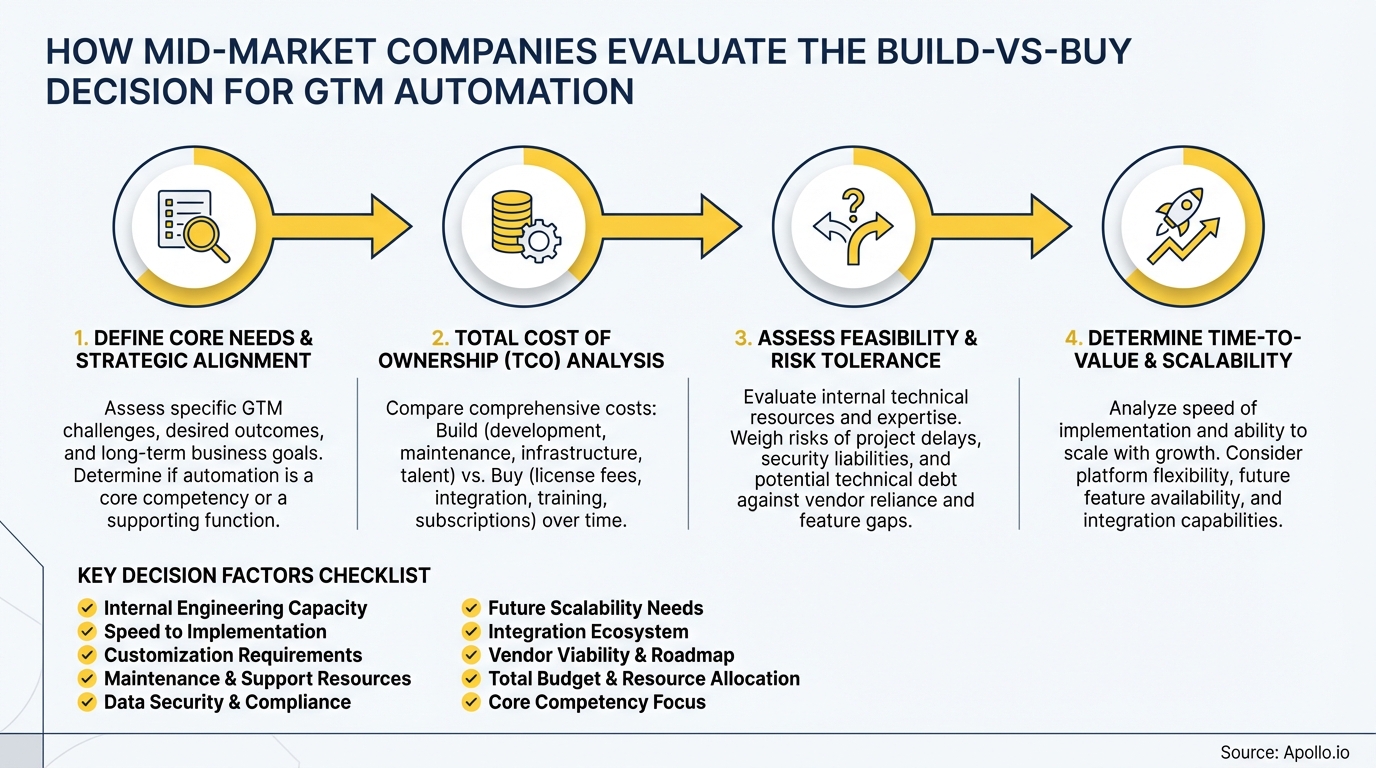
RevOps leaders should evaluate the build-vs-buy decision using a four-factor framework: TCO, integration complexity, governance readiness, and time-to-value.
| Factor | Build | Buy | Hybrid |
|---|---|---|---|
| TCO (Year 1) | Low license cost, high engineering cost | Predictable per-seat or consumption pricing | Platform cost + targeted build investment |
| Integration Complexity | High: custom connectors required | Low-Medium: native CRM and tool integrations | Medium: extend platform APIs |
| Governance | Weak unless deliberately designed | Strong: permissioning, logging, audit trails | Platform provides baseline controls |
| Time-to-Value | Slow: scoping, building, testing cycles | Fast: onboarding in days to weeks | Fast core deployment, staged extensions |
| Differentiation | High: fully custom logic | Low: shared feature set | Medium: custom logic on proven infrastructure |
For most mid-market GTM teams, the hybrid path wins on every practical dimension. Buy a platform that handles data quality, compliance controls, and standard workflows.
Build only where your ICP targeting or routing logic is genuinely proprietary.
Spending hours stitching together manual outreach across disconnected tools? Automate your GTM workflows with Apollo's AI sales automation platform and eliminate the integration overhead of building from scratch.
Turn Funnel Gaps Into Pipeline With Apollo
Pipeline forecasting a guessing game because quality leads never convert? Apollo surfaces in-market buyers with real-time signals so your reps reach the right prospects at right moment. Top revenue teams close more with less guesswork.
Schedule a Demo →What GTM Workflows Should You Build vs. Buy?
The right answer depends on workflow standardization: buy when the workflow is commodity, build when your competitive edge depends on it.
| GTM Workflow | Recommended Approach | Reason |
|---|---|---|
| Contact enrichment | Buy | Data freshness and coverage require ongoing vendor investment |
| Outreach sequences (email, phone, social) | Buy | Deliverability, compliance, and multi-channel coordination are platform problems |
| Standard lead routing | Buy | Native CRM routing rules handle most mid-market use cases |
| Custom ICP scoring models | Build (or extend) | Proprietary firmographic signals and weighting logic |
| Pipeline handoff automation | Hybrid | Buy the workflow engine, configure custom stage triggers |
| Renewal and upsell signals | Hybrid | Platform provides data; custom logic handles account-specific rules |
Research by Utmost Agency found that sales teams using automation report 27% higher close rates and up to 20% increases in pipeline conversion. Those gains require clean, reliable workflow execution, not just scripted logic.
Understanding how sales automation software drives revenue helps clarify which workflows generate the most measurable ROI when automated at the platform level.
How Do SDRs and RevOps Teams Evaluate Build-vs-Buy Differently?
SDRs evaluate build-vs-buy based on daily workflow friction, while RevOps leaders evaluate it on data governance and integration maintenance costs.
For SDRs and BDRs: The core question is speed to pipeline. Custom-built tools often lack the contact database, sequence automation, and CRM sync that SDRs need to hit activity targets. Buying a unified platform eliminates the context-switching between prospecting, outreach, and logging. Cazoomi reports that by the end of 2025, projections indicate around 80-90% of companies will be utilizing some form of marketing automation, which signals that SDRs without automation are operating at a structural disadvantage.
For RevOps leaders: The evaluation centers on data quality and governance. Agentic automation fails on messy CRM data and weak audit trails. A bought platform with permissioning, activity logging, and native CRM integrations with HubSpot and Salesforce reduces the governance overhead that kills custom builds at scale.
For founders and sales leaders at growing companies: The consolidation argument is decisive. "We cut our costs in half," reported Census after consolidating onto Apollo. "Having everything in one system was a game changer," noted Cyera. Tool consolidation reduces vendor management, eliminates data sync failures between point solutions, and lowers total stack cost.
What Governance Model Prevents Automation Sprawl?
A governance model for GTM automation prevents sprawl by establishing intake processes, ownership rules, and audit checkpoints before any workflow goes into production.
Key governance guardrails for mid-market teams:
- Intake gate: All new automation requests route through RevOps for TCO and integration review before build or buy approval.
- Ownership assignment: Every workflow has a named owner responsible for monitoring, updating, and deprecating it.
- Audit cadence: Quarterly reviews of all active automations to identify unused workflows and eliminate redundant tools.
- Shadow build policy: Document and register any automation built outside IT oversight within 30 days of deployment.
- Vendor pricing review: Evaluate whether seat, usage, or credit-based pricing models create uncontrolled spend as automation scales.
Governance is not just a cost control mechanism. It ensures that workflow automation remains auditable, which is critical as GTM teams adopt AI-powered agents that execute actions autonomously.
How Should Mid-Market Teams Get Started in 2026?
Mid-market teams should start by auditing their current stack for underutilization, then evaluate a unified GTM platform before scoping any custom builds.
A practical four-step starting sequence:
- Audit existing tools: Identify unused licenses and redundant capabilities across your current stack.
- Map core workflows: Document lead routing, enrichment, outreach, and handoff processes to identify what is commodity vs. proprietary.
- Model TCO for buy vs. build: Include engineering hours, integration maintenance, and vendor management overhead, not just license costs.
- Buy core, extend selectively: Deploy a unified platform for standard GTM workflows, then build only where your ICP logic requires custom differentiation.
Building a comprehensive sales tech stack that scales revenue starts with choosing a platform that consolidates prospecting, engagement, and pipeline management in one place, eliminating the integration debt that custom builds accumulate over time.
Need a unified starting point? Build and manage your pipeline with Apollo's all-in-one GTM platform, which consolidates prospecting, outreach, enrichment, and deal management without the overhead of stitching together multiple point solutions.

Make the Right GTM Automation Decision in 2026
The build-vs-buy decision for GTM automation is ultimately a TCO and governance decision. For most mid-market teams, the hybrid approach wins: buy a unified platform for core workflows, governance controls, and data quality, then extend with custom logic only where your competitive differentiation requires it.
The hidden cost of building is not the initial sprint. It is the ongoing integration upkeep, API maintenance, and engineering distraction that compounds as your GTM motion scales. A platform with native CRM sync, verified contact data, and built-in sales workflow automation eliminates that overhead from day one.
"We reduced the complexity of three tools into one," noted Predictable Revenue after consolidating onto Apollo. That simplification is the real ROI of getting the build-vs-buy decision right.
Get Leads Now and see how Apollo's unified GTM platform eliminates the build-vs-buy dilemma for mid-market teams.
Prove Pipeline ROI With Apollo
ROI pressure killing budget approvals before your tools get a chance? Apollo delivers measurable pipeline impact fast — teams like Leadium 3x'd annual revenue. Start your free trial and show results.
Start Your Free Trial →Don't miss these
Sales
Inbound vs Outbound Marketing: Which Strategy Wins?
Sales
What Is a Sales Funnel? The Non-Linear Revenue Framework for 2026
Sales
What Is a Go-to-Market Strategy? The 2026 GTM Playbook
See Apollo in action
We'd love to show how Apollo can help you sell better.
By submitting this form, you will receive information, tips, and promotions from Apollo. To learn more, see our Privacy Statement.
4.7/5 based on 9,690 reviews
