
How to Validate the Quality of a B2B Contact Database Before Purchasing Access in 2026
Buying access to a B2B contact database without validating its quality first is one of the most expensive mistakes a GTM team can make. According to CleanList.ai, poor data quality costs US businesses an estimated $3.1 trillion annually. Before you sign a contract, you need hard evidence, not marketing claims. This guide gives you a field-tested, verification-first framework to audit any B2B database before committing budget. If you're also thinking about how contact data enrichment drives ROI, this pre-purchase validation process is where that ROI story begins.

Research Less, Pipeline More With Apollo
Tired of burning hours verifying contact info instead of selling? Apollo delivers 230M+ accurate business contacts so your team spends time closing, not chasing. Start building real pipeline today.
Start Free with Apollo →Key Takeaways
- B2B contact data decays significantly every year, so freshness timestamps and re-verification cadences are non-negotiable before purchase.
- Email validity is not the same as deliverability — vendors must prove their data won't damage your domain reputation.
- A randomized sample pilot test is the single most reliable way to validate quality before committing to an annual contract.
- RevOps and legal teams should co-evaluate vendors in 2026, given tightening regulatory pressure on data brokers.
- A structured vendor scorecard turns subjective claims into comparable, auditable evidence.
Why Does B2B Database Quality Matter So Much in 2026?
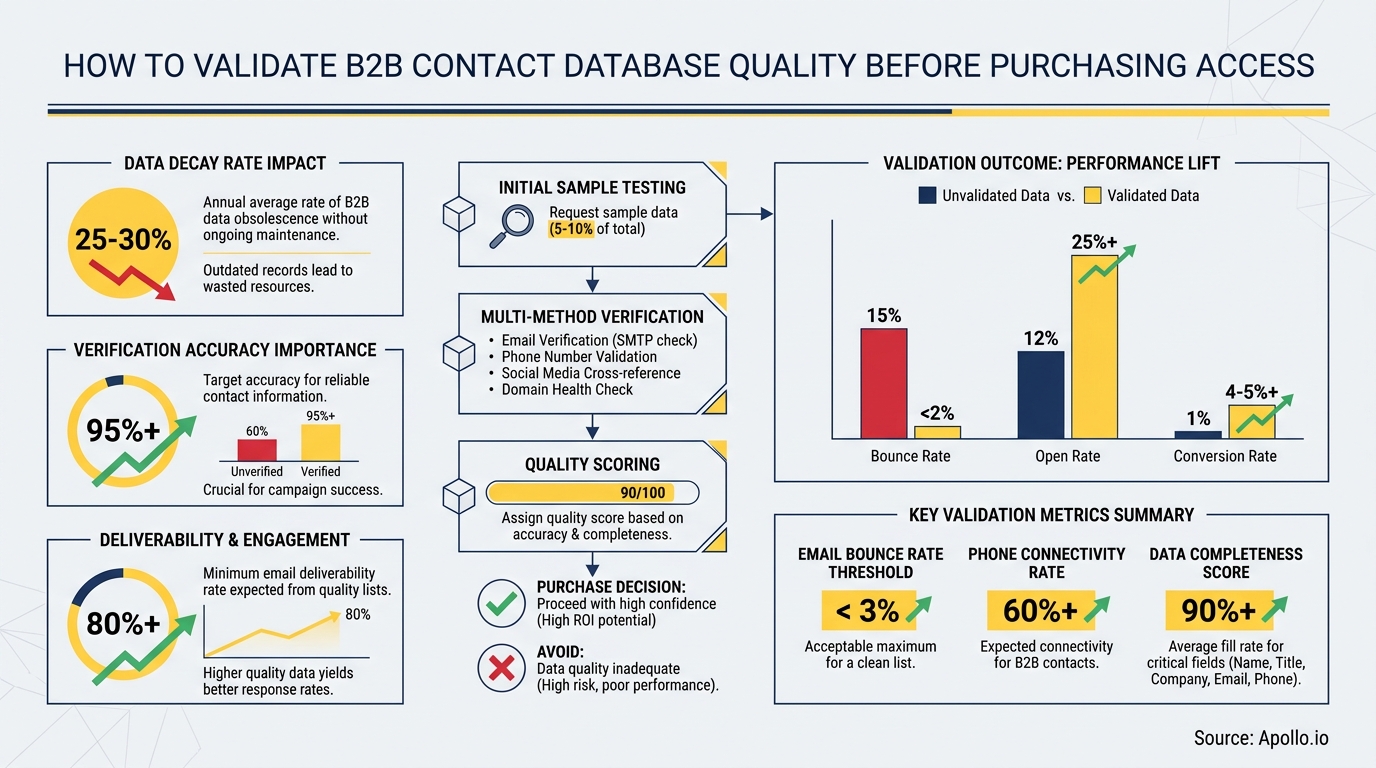
B2B contact data degrades faster than most buyers realize. Research from IndustrySelect shows B2B contact data decays at an average rate of 2.1% per month, translating to 22.5% annually. Some estimates run higher: a Medium analysis notes decay can reach 30–40% per year, meaning a database of 100,000 contacts could lose 25,000–35,000 valid records annually without intervention.
Job mobility is a structural driver. Workers change roles, companies, and emails constantly, making title and email fields the fastest-decaying data points in any B2B record. A 2023 Dun & Bradstreet study cited by Gitnux found 63% inaccuracy in B2B records. For SDRs, that translates directly to wasted dials, bounced emails, and missed quota.
What Is a Pre-Purchase Data Quality Audit?
A pre-purchase data quality audit is a structured validation process that tests a vendor's database before you pay for full access. It involves requesting a randomized sample, running it through independent verification tools, and scoring results against defined acceptance thresholds.
The goal is to replace vendor marketing claims with measurable evidence.
This is no longer optional. According to a 2025 Integrate and Demand Metric report cited by Demand Gen Report, approximately 75% of teams estimate that at least 10% of their lead data is inaccurate, outdated, or non-compliant. Sampling before purchase is the only way to quantify that risk for your specific ICP.
How Do You Build a Field-by-Field Validation Framework?
Validating a B2B database requires testing each data field independently, because each field decays at a different rate and carries different downstream risk. Use the table below as your field-level checklist.
| Field | What to Test | Acceptance Threshold | Re-verification Cadence |
|---|---|---|---|
| Business Email | Syntax, MX record, mailbox existence, catch-all flag, spam trap risk | 90%+ valid; <5% catch-all | Every 90 days |
| Direct Phone | Number format, line type (mobile vs. landline), active status | 85%+ connected | Every 6 months |
| Job Title | Current employer match, title standardization, seniority accuracy | 85%+ accurate to current role | Every 6 months |
| Company Data | Active company status, employee count, HQ address, industry code | 95%+ active companies | Quarterly |
| Last Verified Timestamp | Age of most recent verification per record | 90%+ verified within 6 months | Per contract SLA |
Ask vendors to provide a "last verified" timestamp at the field level, not just the record level. Email verified six months ago may still be current; a title verified 18 months ago is likely stale. For help building a B2B email list that converts, field-level freshness is the foundation.
Struggling to find qualified leads that don't bounce? Start free with Apollo's 230M+ verified business contacts and 97% email accuracy.

How Does Deliverability Risk Factor Into Database Validation?
Email deliverability risk goes beyond whether an address is syntactically valid. A technically valid email can still damage your domain reputation if it's a catch-all address, a role-based inbox, or associated with a high-bounce domain.
In 2026, this matters more than ever as email authentication enforcement has tightened significantly across the industry.
When evaluating a vendor's database for deliverability risk, check for these specific signals:
- Catch-all domain flags: Emails at catch-all domains accept any message but may never reach a real inbox.
- Role-based email indicators: Addresses like info@, sales@, or support@ inflate deliverable counts but rarely reach a decision-maker.
- Spam trap suppression: Ask vendors whether their suppression list is actively maintained and how frequently it's updated.
- Opt-out and unsubscribe handling: Confirm the vendor processes suppression requests on a defined SLA cycle.
- Domain reputation scoring: Some vendors provide risk scores per domain — request this as part of your sample data.
Learning how to verify email addresses for B2B sales before you start outreach is directly connected to protecting your sending domain's reputation long-term.
Turn Funnel Gaps Into Quota Wins
Pipeline forecasting a guessing game because leads stall before they ever reach sales? Apollo surfaces high-intent buyers at the right moment so every rep works pipeline that actually converts. Join 600K+ companies forecasting with confidence.
Start Free with Apollo →What Regulatory and Sourcing Questions Should RevOps Ask Vendors?
RevOps leaders evaluating data vendors in 2026 should treat regulatory due diligence as a procurement requirement, not an afterthought. California's DELETE Act (DROP platform) went live on January 1, 2026, requiring data brokers to process deletion requests on a 45-day cycle starting August 1, 2026.
Ask any vendor operating in the US whether they are registered with and compliant with this framework.
Beyond California, ask vendors the following due-diligence questions before signing:
- Data sourcing: Where does the data originate? What categories of sources are used (public records, opt-in forms, professional networks)?
- Data lineage: Can you trace a specific record back to its source category?
- Audit rights: Does the contract include the right to audit accuracy claims post-purchase?
- Dispute and rectification: What is the process for flagging and correcting inaccurate records?
- GDPR/EU posture: For international contacts, what lawful basis does the vendor rely on for processing?
- FCRA-like risk: If the CFPB's proposed data broker rule advances, does this vendor's data fall under new accuracy and safeguard requirements?
Privacy and legal teams are moving upstream into data-vendor selection. If your RevOps evaluation process doesn't include a legal review, add one before 2026 contracts are signed. For broader context on how data quality connects to pipeline outcomes, see how B2B sales organizations structure their data strategy.
How Do SDRs and RevOps Teams Run a Pre-Purchase Pilot Test?
A pilot test is the most reliable pre-purchase validation method for SDRs, RevOps leaders, and sales managers evaluating a new data vendor. Request a randomized sample of at least 200–500 records that match your ICP (industry, company size, title), then run the sample through an independent email verification tool before drawing conclusions.
Follow this five-step pilot blueprint:
- Define your ICP filter criteria before requesting the sample. Don't let the vendor cherry-pick records.
- Request a truly randomized export — not a "best records" showcase. Specify that you want a statistically representative slice.
- Run the email field through an independent verification tool and score valid, catch-all, risky, and invalid categories separately.
- Cross-reference 20–30 records manually against professional network profiles to spot-check title and company accuracy.
- Score against your acceptance thresholds (see the field-level table above) and use results as your contract negotiation anchor.
If the vendor refuses to provide a randomized sample or insists on controlling the selection, that refusal is itself a quality signal. Reputable vendors support pre-purchase audits because clean data sells itself. Platforms like Apollo's sales intelligence and lead database offer transparent access so teams can validate data quality before fully committing.
What Does a Vendor Scorecard Look Like in Practice?
A vendor scorecard converts subjective vendor claims into a structured, apples-to-apples comparison.
Use the template below to score any B2B data vendor before purchase.
| Evaluation Criterion | Weight | Score (1–5) | Evidence Required |
|---|---|---|---|
| Email validity rate (sample test) | 25% | Independent verification results | |
| Last-verified timestamp (field level) | 20% | Sample data export showing timestamps | |
| Re-verification cadence SLA | 15% | Contract or documentation | |
| Sourcing transparency | 15% | Written sourcing disclosure | |
| Regulatory compliance posture | 15% | DROP registration, GDPR lawful basis docs | |
| Suppression and opt-out SLA | 10% | Written SLA with processing cycle times |
Multiply each score by its weight and sum the results. Any vendor scoring below 3.5 weighted average warrants either renegotiation or disqualification. Share this scorecard across your RevOps, sales, and legal stakeholders before final sign-off. For teams also evaluating how data quality fits into a broader strategy, the best B2B marketing tools in 2026 all depend on clean underlying contact data to function.
Want verified data that passes your own scorecard? Search Apollo's 230M+ contacts with 65+ filters and validate quality before you build pipeline.

How Should You Apply This Framework Before Your Next Database Purchase?
Validating a B2B contact database before purchase is a structured process, not a gut-check. Start with a randomized sample pilot, score it field by field against defined thresholds, then layer in deliverability risk and regulatory due diligence before signing.
The combination of data decay rates and tightening email authentication standards in 2026 means the cost of skipping this process is measurable and growing.
Apollo is built for GTM teams that refuse to compromise on data quality. With 230M+ people, 30M+ companies, and 97% email accuracy, Apollo gives SDRs, AEs, and RevOps leaders a verified foundation for outbound that consolidates prospecting, enrichment, and engagement in one platform. "Having everything in one system was a game changer," said Cyera's team after switching to Apollo.
Ready to see what clean, verified B2B data looks like in practice? Request a Demo and put Apollo's data quality to the test before you commit.
Apollo Proves ROI Before Budget Talks
ROI pressure killing your next tool approval? Apollo delivers measurable pipeline impact fast — teams like Leadium 3x'd their annual revenue. See your ROI before the next budget conversation. Start free today.
Start Free with Apollo →Don't miss these
Sales
Inbound vs Outbound Marketing: Which Strategy Wins?
Sales
What Is a Sales Funnel? The Non-Linear Revenue Framework for 2026
Sales
What Is a Go-to-Market Strategy? The 2026 GTM Playbook
See Apollo in action
We'd love to show how Apollo can help you sell better.
By submitting this form, you will receive information, tips, and promotions from Apollo. To learn more, see our Privacy Statement.
4.7/5 based on 9,690 reviews
