How to Use Sales Intelligence Data to Personalize Outreach at Scale
Generic outreach is dead. Sales intelligence tools now give B2B teams the signal depth to personalize at volume — but only if you know how to operationalize the data. According to Seraleads, 85% of buyers now prefer personalized sales experiences. The gap between teams who deliver that and those who don't is a data and process problem, not a copywriting one.

Research Less, Pipeline More With Apollo
Tired of burning hours on manual lead research while your quota clock ticks? Apollo surfaces verified contacts and scales your outreach automatically. Join 600K+ companies building pipeline faster.
Start Free with Apollo →Key Takeaways
- Personalization at scale is a data operations challenge first, a messaging challenge second.
- Stacking 2-3 buyer signals per message outperforms single-variable personalization like first name and company alone.
- Buying stage determines which signals matter most — early-stage and renewal outreach require different data inputs.
- Over-personalization can backfire: governance guardrails protect buyer experience and sender reputation.
- Companies excelling at personalization report measurably higher revenue growth versus those that don't.
What Is Sales Intelligence Data and Why Does It Power Personalization?
Sales intelligence data is structured business information about companies and professionals — firmographics, technographics, intent signals, job changes, funding events, and engagement history — used to make outreach contextually relevant. It is not the same as a contact list.
A contact list tells you who exists; sales intelligence tells you who is ready to buy, why they might care, and what angle will resonate.
Research from Salesforge shows companies that excel in personalization report 40% higher revenue and up to an 8x ROI. The difference between those companies and the rest is signal quality and how systematically it feeds outreach workflows. Learn more about how intent data powers smarter B2B sales as the backbone of this approach.
What Signals Should You Stack for Personalized Outreach?
Effective personalization combines 2-3 overlapping signals rather than a single data point. The goal is to surface a specific, timely reason to reach out — not just to prove you know the prospect's name and employer.
| Signal Type | Example | Personalization Use |
|---|---|---|
| Firmographic | Company size, industry, revenue | Segment and qualify ICP fit |
| Technographic | CRM in use, marketing stack | Reference relevant integrations or gaps |
| Intent | Topic research activity, content consumption | Lead with the problem they're researching |
| Trigger / Event | New hire, funding round, product launch | Time outreach to a specific business moment |
| Engagement History | Email opens, website visits, event attendance | Advance the conversation from where they left off |
The strongest messages combine a trigger (funding event or new hire), role context (what this person cares about given their title), and a behavioral signal (intent topic or recent engagement). This stacked approach is the new baseline in 2026. Struggling to identify which signals your prospects are showing? Search Apollo's 230M+ contacts with 65+ filters to find in-market buyers before your competitors do.
How Do SDRs Personalize Outreach at Scale Without Burning Hours on Research?
SDRs personalize at scale by building signal-triggered sequences rather than manually researching each prospect.
The process has three components: enriched contact data, automated signal detection, and templated message frameworks with dynamic variables.
- Enrich first: Ensure every contact record has role, seniority, company size, industry, and at least one trigger signal before it enters a sequence. Use a structured data enrichment strategy to automate this continuously.
- Build signal-gated sequences: Create separate sequence branches per signal type. A prospect showing intent on "CRM migration" enters a different branch than one who just raised a Series B.
- Use dynamic variables beyond first name: Pull in company-specific pain points, relevant case studies, or trigger events as message variables — not just
{first_name}and{company}. - Govern volume per segment: Cap daily sends per sequence to prevent over-contact and protect deliverability.
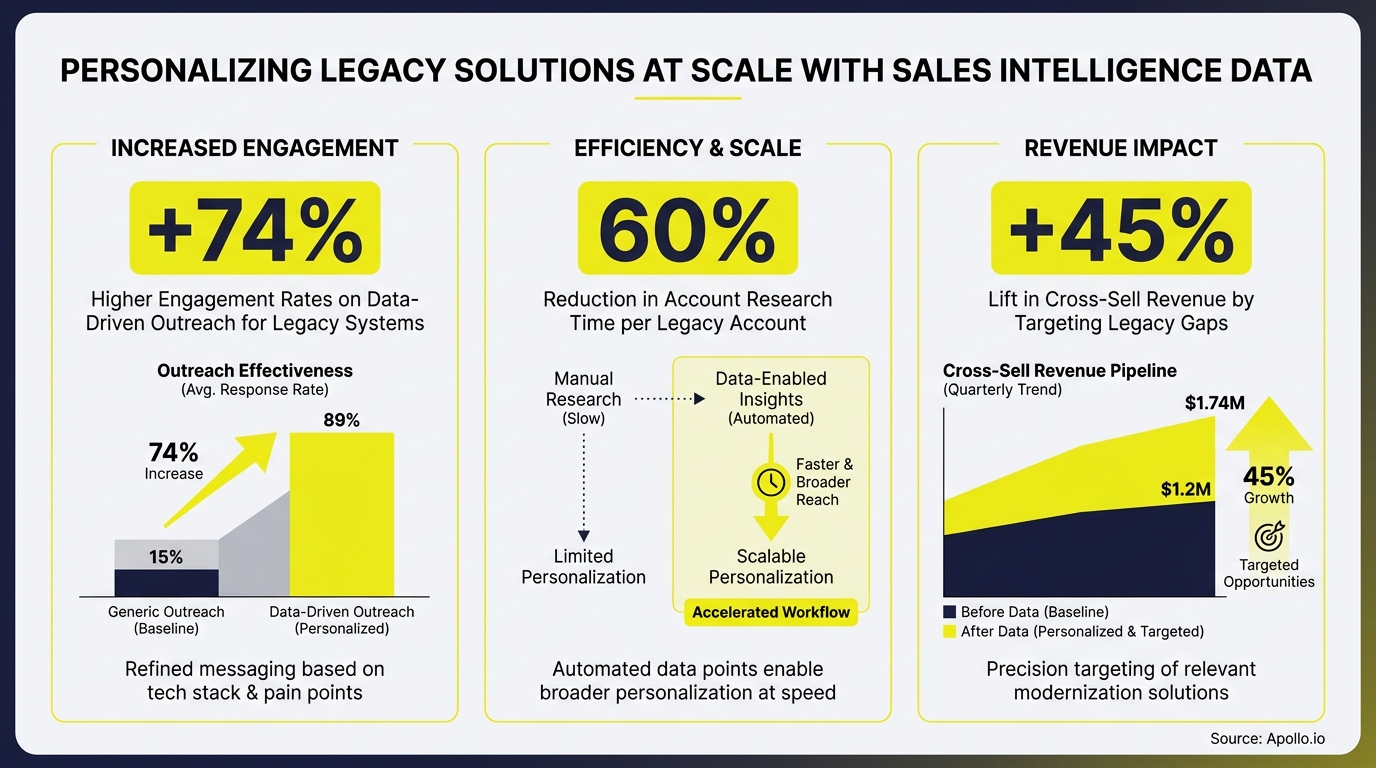
According to Salesmotion, signal-personalized emails achieve 18% response rates — 5.2x the average, per Instantly's Cold Email Benchmark 2026. The lift is real, but it requires the data infrastructure to support it. Learn how to do data enrichment the right way to keep your signal layer fresh.

How Does Buying Stage Change Which Data You Should Use?
Buying stage is the most underused personalization variable in B2B outreach. The signals and messages that work for a prospect in early research mode are different from those that work for a renewal or upsell conversation.
| Buying Stage | Priority Signals | Personalization Focus |
|---|---|---|
| Researching / Exploring | Intent topics, content downloads | Problem framing, educational value |
| Comparing / Evaluating | Competitor intent, demo requests | Differentiation, proof points |
| Buying / Deciding | Engagement spikes, pricing page visits | Risk reduction, ROI clarity |
| Renewing / Upgrading | Product usage, support tickets, expansion signals | Value realization, expansion use case |
For Account Executives managing active deals, this stage mapping also governs which assets to share and which CTAs to use. Sending a top-of-funnel awareness email to someone on the pricing page is a relevance failure — and relevance failures have real costs. A contact data enrichment layer that continuously updates stage signals keeps your outreach in sync with where the buyer actually is.
Turn Funnel Gaps Into Closed Deals
Tired of watching marketing leads stall before they ever reach your pipeline? Apollo surfaces high-intent prospects and arms your team with the signals to act first. 600K+ companies stopped guessing and started closing.
Start Free with Apollo →What Governance Rules Prevent Personalization From Backfiring?
Personalization governance means setting explicit rules for when to apply heavy personalization, when to use lighter touches, and when to suppress outreach entirely. Without these rules, automation produces over-contact, incoherent messaging across channels, or outreach that feels intrusive.
Key governance controls to implement:
- Signal freshness gates: Do not trigger personalized outreach from data older than 30-60 days. Job changes and company events go stale fast.
- Channel deduplication: Ensure prospects are not receiving conflicting messages across email, phone, and social outreach simultaneously from different teams.
- Suppression lists: Exclude contacts who have recently engaged, replied, or converted so automation does not contradict active conversations.
- Personalization depth by tier: Reserve deep, multi-signal personalization for high-value accounts. Use lighter firmographic personalization for high-volume, lower-ACV segments.
RevOps leaders building these governance frameworks benefit from a unified platform where enrichment, sequencing, and CRM sync happen in one place — not across four tools with manual handoffs. As Cyera noted, "Having everything in one system was a game changer." Spending hours managing disconnected tools? Run signal-triggered, multi-channel sequences from a single workspace with Apollo.
How Do You Measure Whether Personalized Outreach Is Actually Working?
Reply rate alone is an incomplete measure of personalization effectiveness. A full measurement framework tracks relevance, consistency, and downstream conversion — not just whether someone wrote back.
- Reply rate by signal type: Break out reply rates per signal used (intent vs. trigger vs. engagement) to identify which signals drive the most response.
- Meeting-to-sequence rate: Measures how often a sequence converts to a booked meeting — more meaningful than raw replies.
- Unsubscribe and spam rate: Rising unsubscribes on a personalized sequence signal over-personalization or frequency problems, not just deliverability.
- Stage progression rate: For AEs, track how often personalized follow-up accelerates deal stage movement versus stalling it.
- Pipeline influenced by enrichment source: RevOps should attribute pipeline to the enrichment signals that initiated the sequence to prove data ROI.
Data from MarketsandMarkets shows personalization drives a 10-15% revenue lift on average, with company-specific improvements ranging from 5-25%. Capturing that range requires knowing which personalization inputs are driving your results — and which are noise. Sales analytics connected to your outreach data closes this loop.

Start Personalizing at Scale with Apollo
Using sales intelligence data to personalize outreach at scale requires three things working together: verified, enriched contact data; signal-triggered sequence logic; and governance rules that keep personalization relevant without overwhelming buyers. Teams that nail the data layer consistently outperform those focused only on message copy.
Apollo consolidates the entire workflow — 230M+ verified contacts, 65+ search filters, intent signals, automated sequences, and CRM enrichment — in one platform. "We reduced the complexity of three tools into one," said Collin Stewart of Predictable Revenue. Instead of stitching together a fragmented sales tech stack, Apollo gives SDRs, AEs, and RevOps teams a single source of truth for finding, enriching, and reaching the right buyers at the right moment.
Start Your Free Trial and see how Apollo's AI-powered sales intelligence platform turns raw data into personalized pipeline.
Prove Pipeline ROI Before Next QBR
Budget approval stuck on unclear metrics? Apollo delivers measurable pipeline impact your leadership can't ignore. Teams like Built-In unlocked +10% win rates and +10% ACV — results that justify every dollar.
Schedule a Demo →Don't miss these
Sales
Inbound vs Outbound Marketing: Which Strategy Wins?
Sales
What Is a Sales Funnel? The Non-Linear Revenue Framework for 2026
Sales
What Is a Go-to-Market Strategy? The 2026 GTM Playbook
See Apollo in action
We'd love to show how Apollo can help you sell better.
By submitting this form, you will receive information, tips, and promotions from Apollo. To learn more, see our Privacy Statement.
4.7/5 based on 9,690 reviews
